"It won't go into overdrive" is one of the most common 6R80 complaints that comes through the door, and one of the most loosely described. Some customers mean the truck tops out in 5th and never takes 6th. Some mean it pulls 4,000 rpm on the highway because it never got past 3rd. Some mean it goes 1-2-3 and then flares or bangs trying to find 4th. Those are three different transmissions on the inside, and the first job is to figure out which one you have.
On the 6R80, the word "overdrive" has a specific meaning. The E clutch is the overdrive clutch, and it is applied in 4th, 5th and 6th. Everything below 4th runs without it. So the question that sorts this complaint is not "does it shift into overdrive," it is "which gears is it missing, and does the missing set share a clutch?"
The short version: Every 6R80 forward gear is two clutches, and E (4-5-6, Overdrive) is common to all three top gears. If 4th, 5th and 6th are all missing, work the E circuit: shift solenoid E, the solenoid multiplex valve, the E piston and the rear planet splines. If 4th works but 5th and 6th never come, every clutch has already proven itself somewhere lower in the range, so look first at why the PCM is not commanding the shift: speed signals, the lead frame, a failsafe state, or a limited range selection. If it is stuck in 3rd or 5th regardless of speed, you are probably looking at failsafe, not a burned clutch.


Where Overdrive Lives in a 6R80
The 6R80 is Ford's build of the ZF 6HP26, and it uses five holding elements. Alto's clutch kit bulletin for the 6R80 and ZF6HP26 names each one by the gears it serves, which is the most useful naming convention you can use at the bench:
| Element | Name | Applied in |
|---|---|---|
| A | 1-2-3-4, Forward | 1st, 2nd, 3rd, 4th |
| B | 3-5-R, Direct | 3rd, 5th, Reverse |
| C | 2-6, Intermediate | 2nd, 6th |
| D | Low/Reverse | 1st, Reverse |
| E | 4-5-6, Overdrive | 4th, 5th, 6th |
Read as pairs: 1st is A and D, 2nd is A and C, 3rd is A and B, 4th is A and E, 5th is B and E, 6th is C and E. The top three gears all ride on E. What changes from 4th to 6th is the partner clutch: A in 4th, B in 5th, C in 6th.
That table turns a vague complaint into a short suspect list:
- No 4th, 5th or 6th. The common element is E. Either E is not getting pressure or E cannot hold.
- 4th works, no 5th or 6th. E holds in 4th. B holds in 3rd. C holds in 2nd. Every element needed for 5th and 6th has already proven itself, so a pure clutch failure is less likely. Start with command and control, then look at E holding at higher speed.
- 5th works, no 6th. E holds, so look at C (2-6). If 2nd is also soft or flaring, C is your clutch.
- Locked in one gear regardless of speed. Think failsafe before you think clutches.
How the E Clutch Gets Its Oil
This is where the 6R80 differs from most of what people are used to working on. There is no dedicated variable solenoid just for E. Per ATRA's GEARS write-up on 6R80 control, SSD sends its regulated pressure to the solenoid multiplex valve, and in the upper gears that pressure goes to the clutch E regulator and latch valves to apply the overdrive clutch. SSD does double duty, handling D in the low range and E in the upper range, and the multiplex valve decides which clutch it is feeding.
What moves the multiplex valve is shift solenoid E, the unit's one on/off solenoid. That makes SSE the switch that tells the valve body "we are in the upper range now," and it explains why an SSE fault costs you 4th, 5th and 6th together instead of a single gear.
SSE also has a design change worth knowing before you order one. Transmission Digest reports that transmissions built before November 4, 2010 use a 10.5-ohm SSE, part 6L2Z-7G484-AA, with a tan snout, while units built after November 3, 2010 use an 18-ohm SSE, part AL3Z-7G484-B, with a gray snout. The later PCM driver is built for the higher resistance, and the two solenoids are not interchangeable. Check the build date on the case ID tag before installing a solenoid. The wrong SSE in a good valve body is an easy comeback to create.
ATRA also covers the programming side: the case carries a 13-digit solenoid body strategy and a 12-digit solenoid body identification, the solenoids come in five calibration bands (1 through 5, printed next to the matrix barcode), and a replacement solenoid body requires the strategy to be updated in the PCM. If a truck lost its top gears right after a valve body or solenoid job, compare the tag to what the scan tool reports before anything else.
Failsafe: Stuck in 3rd or Stuck in 5th
A lot of "won't shift into overdrive" trucks are sitting in failsafe, and the gear it is stuck in tells you what the PCM saw.
ATRA documents the 6R80's failure mode behavior. In 3rd gear failsafe, all solenoids are off. In the off state, SSB sends high pressure to the clutch B regulator and latch valves to apply the direct clutch, and the forward clutch (A) is applied hydraulically. That gives you A and B, which is 3rd. A truck in this state will pull fine from a stop, take no shifts, and run the highway at high rpm. The customer calls that "no overdrive," and they are right, but the cause is electrical or a lost command, not the E clutch.
If the failure happens while the unit is in 5th or 6th, it defaults to 5th. The PCM supplies low current to SSD, pressure goes through the multiplex valve to the clutch E regulator and latch valves, and once those latch valves move they stay put. That customer says "it takes off in a high gear and has no power," which is a different complaint that points to the same class of cause.
Ford has already documented one common way to get there. Technical Service Bulletin 13-6-8 covers 2011 to 2014 Mustang, 2011 to 2013 F-150 and 2012 to 2013 Expedition and Navigator built on or before 4/8/2013 that engage in 5th gear when starting, with a zero speedometer, dashed odometer and DTCs P0720 and P0722 that may or may not be stored. The repair is the molded leadframe, part AL3Z-7G276-A, and Ford notes that shift solenoid replacement is not required. The leadframe carries the speed sensors, and when the PCM loses output speed, it has no reliable way to schedule upshifts and it protects the unit.
Scan Tool First: Is It Being Commanded?
Before you touch anything, answer one question on a road test: did the PCM command the shift and the transmission fail to make it, or did the PCM never ask? Those lead to completely different repairs.
- Pull every code. P0720 and P0722 point at speed signals and the leadframe. P0771 is shift solenoid E performance. Gear ratio codes in 4th, 5th or 6th point at E holding. Fix any non-transmission codes first, because ATRA notes they directly affect transmission operation.
- Check the selector and range display. A 6R80 with SelectShift will hold a lower range if the driver has used the manual toggle. Make sure the truck is in plain D with no limited range showing in the cluster before you go deeper.
- Watch commanded gear against actual ratio. Log TSS, OSS, commanded gear and TFT together. Divide TSS by OSS yourself. If commanded gear goes to 5 and the ratio stays at 4th or flares, the command happened and the hardware failed. If commanded gear never goes past 3 or 4, the PCM is choosing not to shift and you need to find out why.
- Watch OSS for dropouts. A glitching OSS signal is exactly the input that sends the unit into protection, and it will not always leave a code on the first event.
- Check TFT against reality. The fluid temperature sensor lives on the same leadframe as the speed sensors, and the PCM uses it to schedule shifts. Compare the TFT reading to an infrared gun on the pan once the unit is warm. A reading that jumps around or disagrees with the gun is a leadframe or wiring problem until proven otherwise.
When It Is Commanded but Will Not Hold
If the scan tool shows 5th or 6th commanded and the ratio flares, slips or bounces back, the problem is hydraulic or mechanical, and the E circuit is where to start.
P0771 and the E circuit
ATRA's GEARS magazine published a useful pair of 6R80 cases under the title "Same Code, NOT the Same Problem." P0771 is shift solenoid E performance: the circuit is complete, but the result the PCM expected did not happen. Their process is worth copying. Verify the complaint, check solenoid amperage with a clamp meter on the solenoid wire, drop the pan and look for clutch material, air-check the E clutch circuit, and inspect the valve body for stuck valves. In one case the cause was the solenoid itself. In the other, the E clutch air-checked fine and the valve body was clean. The cause was stripped splines on the rear planet where the 4-5-6 hub engages. They found it by applying air to the A and E clutches at the same time while turning the output shaft by hand and feeling it grind. Add that test to every no-4-5-6 teardown. A good air check on E proves the piston seals. It does not prove the power path.
The cracked 4-5-6 piston
Transmission Digest ran an ATSG hotline case on a 2014 Expedition 5.4L with a 6R80 that slipped in 5th and set a 5th gear ratio code. On teardown, only the 4-5-6 (E) clutch plates had a slight burn. The drum was heated and crack-checked with nothing found, and the unit was rebuilt with a new valve body. It came back hunting 4-5-4-5 on the scan tool. After external causes were ruled out and a third teardown, the answer was a cracked 4-5-6 piston that had gotten worse since the first rebuild. ATSG noted that this failure usually shows up on the shift into 4th, not 5th. E can hold 4th and still fail in 5th.
E clutch clearance on the rebuild
If the E pack comes out, set it up correctly. Alto's 6R80/ZF6HP26 bulletin calls for 9 frictions and 9 steels in the E clutch, seated by air-applying at 40 psi several times, then measured with a feeler gauge between the bottom of the snap ring and the top of the pressure plate. Clearance should be .030 to .055 in (0.762 to 1.40 mm), and Ford offers five selective-thickness snap rings for the E clutch so you can set it with the ring instead of guessing at plate counts. Pre-soak frictions at least 20 minutes in the ATF they will run in. For a 6R80, that is MERCON LV.
Proving the Repair
One lap around the block does not prove a 6R80 repair, and ATRA explains why. Shift error codes need four consecutive failures to set, and continuous TCC codes need five. After the repair, run the drive cycle: in D, accelerate moderately from a stop to 50 mph and let it shift into 6th, hold steady speed and throttle for at least 15 seconds, tap the brake lights while holding speed for another 5 seconds, then brake to a stop and wait at least 20 seconds. Repeat five times, then run the self-test. The drive cycle itself requires 6th gear at 50 mph, so a truck that cannot reach 6th cannot complete it. Leave the adaptive tables to relearn before judging shift quality.
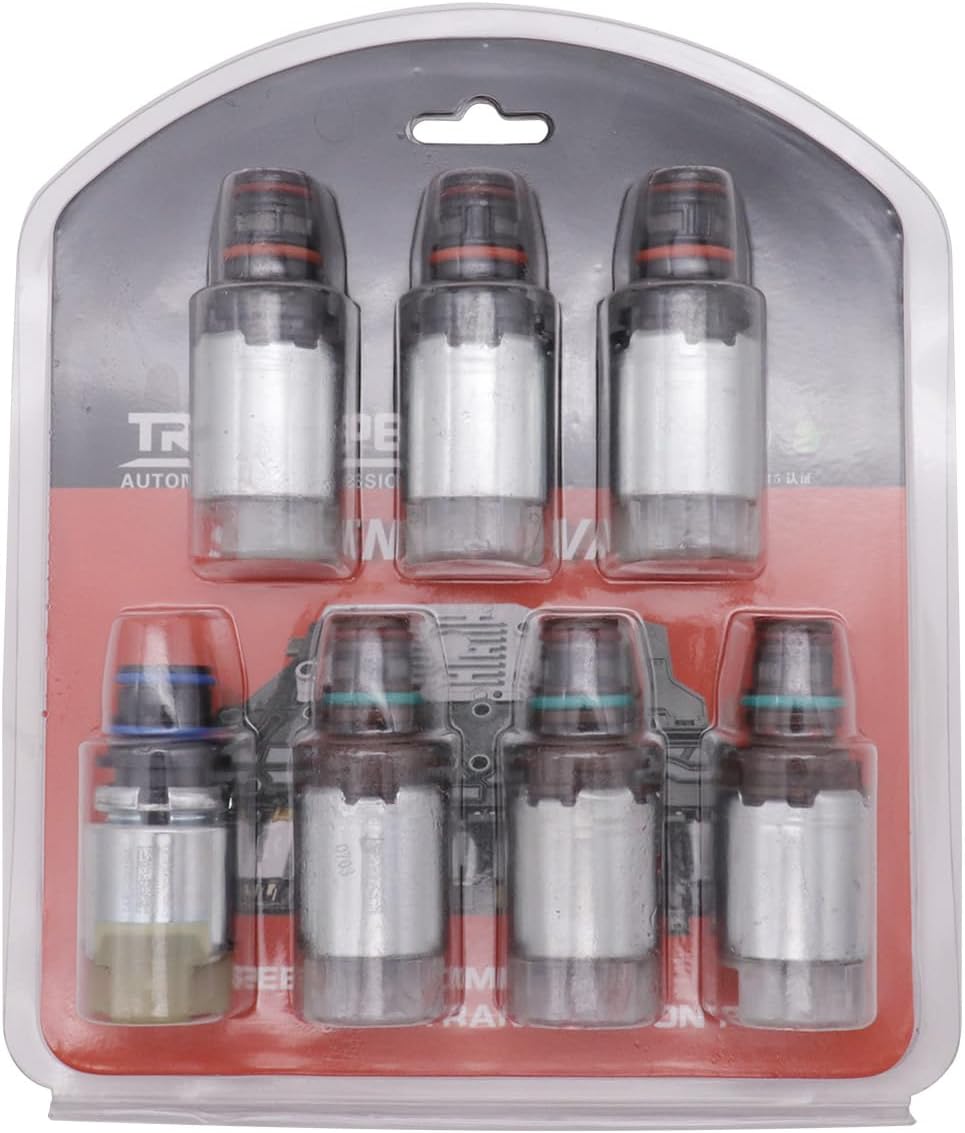
6R80 Transmission Solenoid Kit (OEM AL3P-7G276-AF)
If you have traced a no-4-5-6 complaint to shift solenoid E or a solenoid that has drifted out of its band, this is the complete solenoid set for the 6R80. Match the build date and program the strategy when it goes in.
See the 6R80 solenoid kit at CoreTransmissionParts →If the speed signals led you to the leadframe instead, CoreTransmissionParts also carries the 6R80 lead frame with temp and range sensor, and the full solenoid catalog covers other units.
Need parts for this job?
Lead frames, solenoid kits, valve bodies, master rebuild kits with E clutch frictions and MERCON LV, all matched to the 6R80 and shipped from the USA.
Shop 6R80 parts →FAQ
Why won't my 6R80 shift into 5th or 6th but 4th works?
Because every clutch used in 5th and 6th has already proven itself lower in the range, a pure clutch failure is less likely. 5th is B and E, 6th is C and E, and E already holds in 4th, B in 3rd and C in 2nd. Start by checking whether the PCM is commanding the shift at all: speed sensor signals, the leadframe, a failsafe state or a limited SelectShift range. If it is commanded and still slips, suspect E holding at higher speed, including a cracked 4-5-6 piston.
What clutch is overdrive on a 6R80?
The E clutch, named 4-5-6 Overdrive, applies in 4th, 5th and 6th. Its pressure comes from SSD through the solenoid multiplex valve to the clutch E regulator and latch valves, and the on/off shift solenoid E positions the multiplex valve. A fault in that path costs you all three top gears together.
Why is my 6R80 stuck in 3rd gear?
3rd is the 6R80's main failsafe gear. With all solenoids off, SSB applies the B clutch and the A clutch is applied hydraulically, which gives 3rd. The truck will pull from a stop but never upshift, so the cause is usually electrical or a lost command, not a burned clutch. Pull codes and check the speed signals and leadframe first.
Are 6R80 shift solenoid E parts interchangeable?
No. Units built before November 4, 2010 use a 10.5-ohm SSE (6L2Z-7G484-AA, tan snout) and units built after November 3, 2010 use an 18-ohm SSE (AL3Z-7G484-B, gray snout). The PCM driver is matched to the resistance, so check the build date on the case tag before ordering.
Sources
- ATRA / GEARS Magazine, "Controlling the 6R80," Lance Wiggins, July 2015. Backs the SSD to solenoid multiplex valve to clutch E regulator and latch valve path, 3rd gear failsafe with all solenoids off (SSB applying B, A applied hydraulically), the default to 5th when failsafe occurs in 5th or 6th, the 13-digit strategy and 12-digit ID and band numbers 1 through 5, strategy programming after solenoid body replacement, four consecutive failures for shift codes, and the 50 mph / 6th gear drive cycle repeated five times. atracom.blob.core.windows.net (PDF)
- ATRA / GEARS Magazine, "Same Code, NOT the Same Problem! A 6R80 With a Code P0771." Backs the P0771 definition (shift solenoid E performance), E clutch service in 4th, 5th and 6th, the amperage, pan, air-check and valve body checks, and the stripped rear planet splines at the 4-5-6 hub found by air-applying A and E while rotating the output shaft. gearsmagazine.com
- Transmission Digest, Wayne Colonna, "Ford 6R80 Shift Solenoid E Resistance Change Difference," April 30, 2024. Backs SSE as the 6R80's only on/off solenoid, the 10.5-ohm (before November 4, 2010, 6L2Z-7G484-AA, tan snout) and 18-ohm (after November 3, 2010, AL3Z-7G484-B, gray snout) versions, and the note that they are not interchangeable. transmissiondigest.com
- Transmission Digest, Wayne Colonna (ATSG Shift Pointers), "Transmission Slipping in Fifth Gear: An Elusive Cause of a Common Problem," December 12, 2022. Backs the 2014 Expedition 5.4L 6R80 5th gear slip and ratio code, the slightly burned 4-5-6 (E) plates, the 4-5-4-5 hunting comeback, and the cracked 4-5-6 piston found on the third teardown. transmissiondigest.com
- Ford Motor Company, Technical Service Bulletin 13-6-8, "6R80 Transmission High Gear Engagement From A Stop," 2013 (hosted by NHTSA). Backs the affected vehicles and 4/8/2013 build cutoff, 5th gear engagement when starting, zero speedometer and dashed odometer, DTCs P0720 and P0722, molded leadframe AL3Z-7G276-A, and the note that solenoid replacement is not required. static.nhtsa.gov (PDF)
- Alto Products, Bulletin BM304 (01/2020), 6R80 / ZF6HP26 Hi-Performance G3 Friction/Steel Module. Backs the clutch element names (A 1-2-3-4 Forward, B 3-5-R Direct, C 2-6 Intermediate, D Low/Reverse, E 4-5-6 Overdrive), the 9 frictions and 9 steels in the E clutch, the 40 psi air seating procedure, .030 to .055 in E clearance, the five Ford selective snap rings, and the 20-minute pre-soak. altousa.com (PDF)