A 6T40 or 6T45 that will not back up is one of the most common calls on these units. The Cruze, Malibu, Equinox, Terrain, Sonic, Regal or LaCrosse drives forward fine, maybe with a flare into 3rd, but when the selector goes into R the engine just revs, or it creeps backward like the parking brake is on, or it clunks and does nothing. Often there is a check engine light with P0776 stored in the TCM.
GM has documented this failure in more than one bulletin, and the fix is well understood. The trap is that the code looks like a solenoid problem, so a lot of these cars get a TEHCM they did not need. This is how reverse works in a 6T40, what actually takes it out, and the order I diagnose it in, with the GM bulletins and technical references cited inline and listed at the bottom.

How the 6T40 Makes Reverse
Reverse in the 6T30/40/45/50 family takes two clutches. Per the clutch apply chart in Sonnax's Gen 2 6T40 quick guide, reverse applies the 3-5-Reverse (3-5-R) clutch and the Low and Reverse clutch, with the shift solenoid on. Park and Neutral also have the Low and Reverse clutch applied, which is why the engagement into R from P or N is really just the 3-5-R clutch coming on.
Each of those clutches has its own pressure control solenoid inside the TEHCM (the combined control solenoid valve and TCM assembly bolted to the valve body). GEARS Magazine's "Understanding GM 6T40 Solenoids" lists PCS2 as the 3-5-R clutch solenoid and PCS3 as the solenoid feeding the Low/Reverse and 4-5-6 clutch regulator valve. The on/off shift solenoid controls the clutch select valve, which is what lets one PCS3 circuit serve two different clutches depending on range and gear.
| Range | Shift solenoid | 3-5-R clutch | Low and Reverse clutch |
|---|---|---|---|
| Park | On | Off | Applied |
| Reverse | On | Applied | Applied |
| Neutral | On | Off | Applied |
| Drive 1st | Off | Off | Off (low one-way clutch holding) |
The table explains the symptom pattern. The 3-5-R clutch is also the clutch for 3rd and 5th gear, so if it cannot hold, you lose reverse and you get slips or flares into 3rd and 5th. When a customer says "no reverse, and it flares on the highway," the 3-5-R clutch is the first suspect. If reverse is gone but 3rd and 5th are perfect, the problem is more likely on the Low and Reverse side, in line pressure, or in the controls.
The input speed sensor also reads the 3-5-R clutch housing, per GEARS' 6T40/45 diagnosis article. The TCM compares input speed to what it should be in the commanded gear, and when the 3-5-R clutch slips the ratio is wrong and it sets P0776, a pressure control solenoid 2 performance code. The code names the solenoid, but the solenoid is usually not what failed.
Cause 1: Broken 3-5-R Apply (Waved) Plate
This is the headline failure. GM Preliminary Information PI0780A (June 2015), "Slip or No Reverse or 3rd Gear, No Forward, DTC P0776," covers the 2008-2011 Malibu, 2010-2011 Equinox and Terrain, 2011 Cruze, Regal and Captiva Sport, 2010-2011 LaCrosse, 2009-2010 G6 and others with 6T30/40/45/50 units built on or before Julian date 11-015 (January 15, 2011). The listed complaints are slip or flare in reverse, no reverse, slip or flare in 3rd, no 3rd, and P0776 active or in history.
GM's cause: a broken 3-5-R apply (waved) plate. The waved plate is the cushion between the piston and the clutch pack. When it cracks, pieces of spring steel go through the transmission, the clutch pack loses its clamp, and the housing splines can get chewed up.
The repair in PI0780A is more than a plate:
- Install a new 3-5-R piston and 3-5-R apply (waved) plate. GM recommends doing this any time the transmission is apart for any reason on these builds.
- Replace any 3-5-R piston that has notches in it. GM removed those notches during the 2011 model year.
- Separate the case halves, disassemble the unit and clean the debris out of the entire transmission.
- Replace the pump fluid filter and the control solenoid filter plate. GM warns that skipping the teardown and filter replacement could lead to repeat transmission damage and repairs.
That last point is where comebacks come from. A broken wave plate puts metal into every circuit, and the solenoid filter plate is the only thing protecting the TEHCM. Changing the plate and piston without cleaning the case and replacing both filters is how a car gets a second no-reverse three months later, now with a damaged solenoid too.
This is not unique to the small unit. GM's special coverage 14404B on the bigger 6T70/6T75 (2007-2009 Acadia, Enclave, Outlook, Traverse, Malibu, Aura, G6 and others) describes a cracked or fractured wave plate resulting in a loss of 3rd, 5th and reverse gears, with the dealer repair being replacement of the 3rd/5th/reverse clutch plate. Same design idea, same failure.
The aftermarket fix
Sonnax notes that the 3-5-R waved plate failure continued in some units even after GM's updated parts, and that it can damage the drum splines. Its 144555K Drum Saver kit for the 6T40/45/50 (all generations) pairs an improved waved plate with custom steels, and Sonnax lists the symptoms it addresses as P0776, flare shifts, harsh reverse engagement, loss of reverse, harsh 2-3 and 4-5 shifts, and missing 3rd or 5th. If the housing splines are already notched, that kit is the way to save the drum instead of replacing it.
Cause 2: Cut or Damaged 3-5-R Piston Seal
Not every 3-5-R failure is a broken plate. GM Preliminary Information PI0670A (February 2012), "Diagnostic Tips for DTC P0776, Slips in or No Reverse, Third, Fifth," covers 2012 Cruze, Sonic, Malibu, Equinox, Terrain, Verano, Regal, LaCrosse and Captiva Sport. For Gen 1 controls, GM's inspection order before replacing the TEHCM is:
- Inspect the valve body.
- Inspect the pump.
- Inspect the 3-5-R housing.
- Inspect the 3-5-R clutch piston for cut or damaged sealing lips.
- Only if none of those show the cause, replace the TEHCM. GM says not to replace it before visually inspecting the 3-5-R clutch and piston.
PI0670A adds two points every tech should know. First, the TEHCM performance test in the scan tool does not work on Gen 1 controls (2012 Cruze and Sonic with the 1.8L, Orlando, Captiva Sport 3.0L), but it is functional and required on Gen 2 controls. Second, GM says not to rely on an air check of the 3-5-R clutch through the case feed ports, because it has frequently led to incorrect diagnosis of the piston. The only reliable way to judge the 3-5-R piston is to take the transmission apart and look at it.
That second point surprises people who grew up air-checking RWD units. On a 6T40 a piston can hold air on the case check and still leak under real apply pressure, or the air can find another path and make a good piston look bad.
Cause 3: Low Line Pressure or a Damaged Pump
If there is no reverse and forward is also weak or missing, stop thinking about one clutch. GM Preliminary Information PI0324F covers 2011-2014 6T30, 6T40, 6T45 and 6T50 applications with complaints running from harsh shifts to no forward or reverse, with P0776, P0796, P2714 or P2723 possible, often on low-mileage vehicles. The cause is no or low line pressure from a damaged fluid pump, and GM's instruction is to do the line pressure check before replacing the TEHCM or valve body.
Reverse tends to show low pressure first, because a clutch that barely holds in a light-load forward gear gets asked to carry engine torque through a steep reverse ratio. Low fluid does the same thing. Check the level hot at the check plug with DEXRON-VI before anything else; GEARS' diagnosis article puts that check at 85-95°C (185-205°F).
Cause 4: Controls and the Low and Reverse Side
When reverse is gone but 3rd and 5th are fine, the 3-5-R clutch is probably healthy and the fault is on the other half of the reverse circuit: the Low and Reverse clutch or whatever feeds it. That circuit depends on PCS3 making pressure, the shift solenoid being on, and the clutch select valve moving so oil is routed correctly. Keep in mind that the Low and Reverse clutch is also applied in Park and Neutral and in engine-braking 1st, so a Low and Reverse problem usually shows up as more than just reverse, such as no engine braking in manual 1st.
- Solenoid resistance. GEARS gives 3-5 ohms for every pressure control solenoid and 16-20 ohms for the on/off shift solenoid, and Sonnax lists the same values at 70°F.
- Never 12 volts direct. GEARS warns against applying battery voltage straight to the pressure control solenoids. Test with regulated air and a proper driver, or cycle them through the TCM with a capable scan tool.
- Debris. A stuck clutch select valve or regulator valve in a unit that has already shed a wave plate is common. That is why PI0780A insists on a cleaned case and a new control solenoid filter plate.
- Selector and range input. Confirm the scan tool shows R when the lever is in R. A stretched or misadjusted shift cable can leave the manual valve between detents, which gives a soft or missing engagement with no hard fault in the clutches.
Diagnostic Order That Saves a TEHCM
- Read codes from the TCM and note P0776 (3-5-R), P0796, P2714, P2723 and any pressure or communication codes.
- Check fluid level hot at the plug with DEXRON-VI and look at the fluid. Metal in the pan plus P0776 on a pre-2011 build points hard at the wave plate.
- Road test and watch the gear ratio. Slip or flare into 3rd and 5th plus no reverse means 3-5-R clutch. Reverse only points at the Low and Reverse side, the controls or the selector.
- Put a gauge on the case and run the line pressure test before condemning the TEHCM or valve body (PI0324F).
- On Gen 2 controls, run the TEHCM performance test. On Gen 1 it will not work, so follow PI0670A's inspection order.
- Do not trust a case air check of the 3-5-R piston. Tear down and look.
- On teardown, replace the 3-5-R piston and waved plate (and any notched piston), inspect the drum splines, clean the entire case, and replace the pump filter and control solenoid filter plate.
- After the repair, purge air and relearn adapts.
After the Repair: Purge and Relearn
A freshly assembled reverse circuit is full of air. GEARS' 6T40/45 diagnosis article includes cycling the selector from park to reverse three times to purge air from the reverse clutches as part of the adaptive learn preparation. Then run the Service Fast Learn with the fluid in range. A car that comes back from a 3-5-R repair with a harsh or delayed reverse usually needs the purge and the learn done properly, not more parts.
If the pan is off, the filter and pan gasket are part of the job, and the fill is DEXRON-VI only, with the level set hot at the check plug.
6T40 bonded piston set at Core Transmission Parts
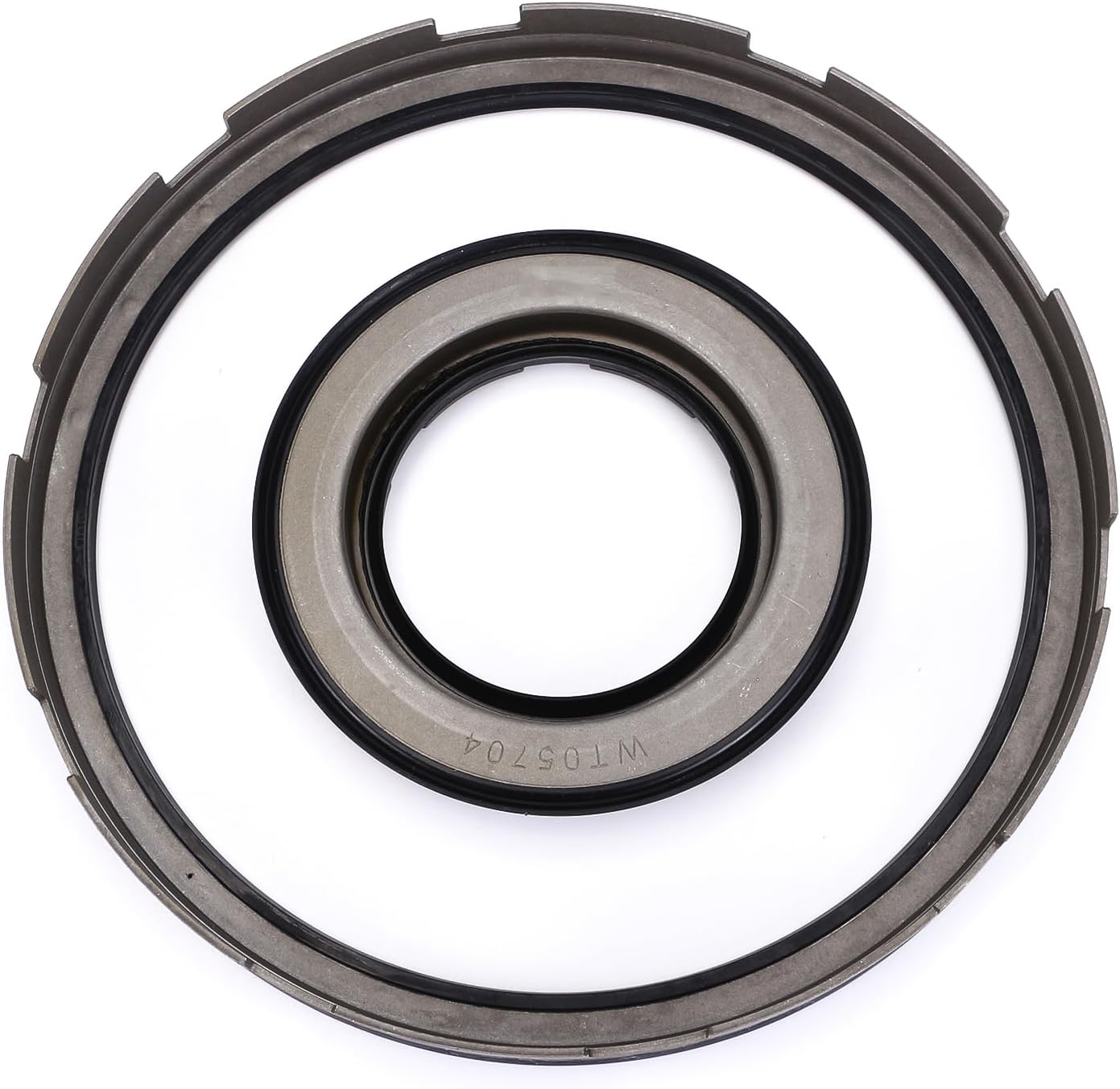
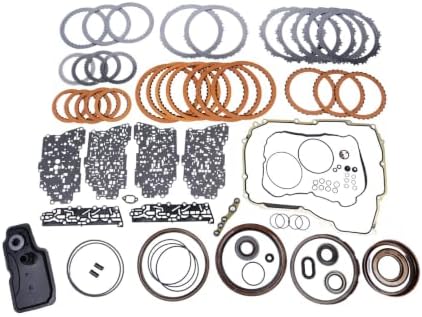
The 3-5-R piston is the part GM tells you to replace along with the waved plate. Core Transmission Parts carries a bonded piston set for 2012-up 6T40 units, plus complete master rebuild kits for a full teardown.
View the 6T40 bonded piston set →Or get the full 6T40 master rebuild kit at Core Transmission Parts
6T40 and 6T45 bonded piston sets, rebuild kits with frictions and steels, filters and solenoid kits — shipped fast from the USA.
Shop 6T40 parts →Related guides
- GM 6T40 / 6T45 Wave Plate Failure: Why P0776 Is Not Just a Solenoid
- 6T40 Slipping: Causes and Fix
- 6T40 Limp Mode Causes and Fix
- 6T40 Common Problems and Fixes
- 6T40 Shift Solenoid Symptoms and Replacement
FAQ
Why does my 6T40 have no reverse?
The most common cause is a failed 3-5-R clutch, either from a broken 3-5-R apply (waved) plate as described in GM bulletin PI0780A or from cut sealing lips on the 3-5-R piston per PI0670A. Low line pressure from a damaged pump, low fluid, stuck valves from debris and a misadjusted shift cable can also cause it.
What does P0776 mean on a 6T40?
P0776 is a pressure control solenoid 2 performance code. PCS2 controls the 3-5-R clutch, and the TCM sets the code when input speed shows that clutch did not hold when commanded. GM bulletins point to the 3-5-R waved plate and piston as frequent causes, so the code alone does not prove the solenoid or TEHCM is bad.
If I lose reverse, will I also lose 3rd and 5th gear?
Often, yes. The 3-5-R clutch is applied in 3rd, 5th and reverse, so when it fails you typically get no reverse plus slips or flares into 3rd and 5th. If reverse is gone but 3rd and 5th are normal, look at the Low and Reverse side, line pressure, the controls and the shift cable instead.
Can a 6T40 no reverse be fixed without rebuilding the transmission?
Only when the cause is outside the clutch pack, such as low fluid, a shift cable problem or a control fault confirmed by testing. A broken waved plate or damaged 3-5-R piston requires teardown, and GM says to split the case, clean out the debris and replace the pump filter and control solenoid filter plate so the failure does not repeat.
Can I air check the 3-5-R clutch on a 6T40?
GM says not to rely on it. Bulletin PI0670A states that air checking the 3-5-R clutch through the case feed ports has frequently led to incorrect diagnosis, and that the only reliable way to judge the 3-5-R piston is to disassemble the transmission and inspect it.
Sources
- General Motors — Preliminary Information PI0780A, "Slip or No Reverse or 3rd Gear, No Forward, DTC P0776," June 2015 (via NHTSA). Backs the applications and the Julian date 11-015 build cutoff, the listed complaints, the broken 3-5-R apply (waved) plate cause, replacing the 3-5-R piston and waved plate, the notched-piston change in 2011, and the case-split cleaning plus pump filter and control solenoid filter plate replacement. static.nhtsa.gov (PDF)
- General Motors — Preliminary Information PI0670A, "Diagnostic Tips for DTC P0776, Slips in or No Reverse, Third, Fifth," February 2012 (via NHTSA). Backs the Gen 1 inspection order, the cut or damaged 3-5-R piston sealing lips, the do-not-replace-the-TEHCM-first instruction, the Gen 1 versus Gen 2 TEHCM performance test note, and the warning against case air checks of the 3-5-R clutch. static.nhtsa.gov (PDF)
- General Motors — Preliminary Information PI0324F, December 2013 (via NHTSA). Backs low or no line pressure from a damaged pump causing complaints up to no forward or reverse on 2011-2014 6T30/40/45/50 units, the related DTCs, and the line pressure check before replacing the TEHCM or valve body. static.nhtsa.gov (PDF)
- General Motors — Special Coverage 14404B, "Transmission Clutch Wave Plate," August 2016 (via NHTSA). Backs the 6T70/6T75 cracked or fractured wave plate causing loss of 3rd, 5th and reverse, and the 3rd/5th/reverse clutch plate replacement. static.nhtsa.gov (PDF)
- Sonnax — 6T40-GEN2-ZIP quick guide. Backs the solenoid and clutch apply chart (3-5-R and Low and Reverse clutches applied in reverse, shift solenoid on in P, R and N) and the 3-5 ohm and 16-20 ohm resistance values at 70°F. sonnax.com (PDF)
- Sonnax — "Protect Against 6T40 & 6T70 3-5-R Failures & Salvage Damaged Drums with Sonnax Drum Saver Kits." Backs the continued waved plate failures, drum spline damage, the symptom list and kit 144555K for 6T40/45/50. sonnax.com
Also referenced: ATRA / GEARS, "Understanding GM 6T40 Solenoids," for the PCS2 and PCS3 clutch assignments, the shift solenoid and clutch select valve, resistance specs and the never-apply-12-volts warning, gearsmagazine.com; and ATRA / GEARS, "6T40/45 Diagnosis and Fixes," for the hot level check range, the input speed sensor reading the 3-5-R housing, and cycling park to reverse three times to purge air, gearsmagazine.com.