P0716 is one of the codes that gets a 6T40 condemned for the wrong reason. The customer says it banged into gear, the light came on, and the scanner says "Input Speed Sensor Performance." Somebody orders a sensor, and half the time that is the right call. The other half, the sensor goes in and the code is back in a week, because what actually failed was the harness, the connection at the TEHCM, or the steel target on the 3-5-R clutch housing the sensor reads.
This is how I work P0716 on the GM 6T40 and 6T45 (Cruze, Sonic, Malibu, Equinox, Terrain, Regal, LaCrosse, Verano, Encore, Trax and the rest of the transverse six-speeds). It starts with what GM's monitor actually looks for, because once you know that, the code tells you a lot more than "replace sensor." GM's OBD tables, GM bulletins, GEARS and GM TechLink are listed at the bottom.

What GM's monitor actually checks
GM's 2011 OBD monitor documentation has a section written just for the 6T40, and P0716 is spelled out there [1]. In shop terms:
| Item | 6T40 value (GM 2011 OBD tables) |
|---|---|
| Descriptor | Input Speed Sensor Performance |
| Fail condition | Transmission input speed drops 1350 RPM or more |
| Time | 0.8 second fail time |
| MIL | One trip |
| Vehicle speed | 10 km/h (about 6 mph) or more |
| Engine speed | 400 to 7500 RPM, held for 5 seconds |
| Ignition voltage | 9 to 31.99 V |
| Other | Throttle position and engine torque signals from the ECM must be valid |
Three things in that table shape the diagnosis.
It is a dropout test, not a range test. The TCM is not comparing input speed to engine speed or to a calculated value. It is watching for the signal to fall by 1350 RPM in under a second while the car is rolling. A turbine shaft connected to a running engine through a converter does not lose that much speed that fast, so the TCM decides the signal is lying. That points you at anything that can interrupt a signal for a fraction of a second: a cracked wire flexing, a terminal that opens up when hot, a sensor tip that loses the target for a few teeth.
It is one trip. One event and the lamp is on. Compare that to the 4T45 section of the same GM document, where P0716 needs a 1000 RPM drop held for 3.25 seconds and two trips [1]. The 6T40 calibration is far quicker to flag a glitch, which is why you see intermittent P0716 history codes on 6T40s with no drivability complaint at all.
It shuts down other monitors. GM lists P0716 among the codes that disable the clutch and solenoid performance tests, including the P0776 (PC solenoid B stuck off) monitor [1]. Without good input speed the TCM cannot calculate ratio or slip, so it stops judging the clutches. Fix the speed sensor code first, then see what else comes back.
How P0716 differs from P0717
P0717 is the "no signal" code. On the 6T40 it sets when input speed reads under 50 RPM for 4.5 seconds while the engine is making 50 Nm or more and the car is doing 16 km/h or more, also one trip [1]. There is a second P0717 case that matters: if output speed code P0722 has already failed and input speed is under 1000 RPM, the TCM sets P0717 too, and GM's note on that case is that the controller uses a single power supply for the speed sensors [1].
So if a 6T40 comes in with P0717 and P0722 together, do not buy two sensors. Two sensors rarely die at the same time. A shared supply problem, a harness fault or a TEHCM fault takes out both signals at once. P0716 alone, with no other speed codes, is much more likely to be the input circuit or its target.
What the input speed sensor reads
Per GEARS, the 6T40 input speed sensor sits on the rear cover, its harness runs inside the case to the TEHCM (the combined TCM and solenoid body on the valve body), and it reads the 3-5-R clutch assembly as it turns [2]. The TCM uses that signal to calculate gear ratio and clutch slip. It is a 2-wire sensor that produces a digital signal, and the TEHCM supplies its operating voltage [2]. The output speed sensor, for comparison, sits under the valve body and reads the park gear [2].
That location is the whole story on the hard ones. The sensor is not reading the input shaft. It is reading a target on a rotating clutch housing. If that housing, its target or its retaining hardware moves, wobbles or gets damaged, a perfectly good sensor produces a bad signal.
GM has a bulletin that shows exactly this on the bigger sister unit. Bulletin 16-NA-013 covers 2016 6T70/6T75-family vehicles (Enclave, LaCrosse, Regal, XTS, SRX, Equinox, Impala, Traverse, Acadia, Terrain) with no reverse, sometimes no 3rd, an erratic input speed signal and P0716 and/or P0717 [3]. The cause was the input shaft speed sensor reluctor ring retainer ring coming out of its groove. The repair replaced the retainer ring, the reluctor wheel, the 3-5-Reverse clutch piston and the 3-5-Reverse and 4-5-6 clutch housing assembly [3]. That bulletin is not written for the 6T40, but the layout is the same idea: the ISS reads the 3-5-R side of the unit. When a 6T40 has P0716 together with a reverse, 3rd or 5th complaint, I treat it as a possible 3-5-R problem first and a sensor second.
Symptoms that come with P0716
- Check engine light with P0716 current or history, often with no other complaint, because the one-trip monitor catches very short dropouts.
- Harsh or banging shifts. Without a trusted input speed the TCM cannot run closed-loop shift control, so it falls back to firm, protective pressure.
- Adaptive learning stops. Shift quality does not improve with driving after the code sets.
- Converter clutch control goes away, since TCC slip is engine speed minus input speed.
- No reverse, no 3rd or flared 3rd and 5th when the real problem is the 3-5-R clutch or its target, as in GM's 16-NA-013 pattern [3].
How I diagnose it, in order
- Pull all codes and freeze frame. P0716 alone, P0716 with P0717, or P0717 with P0722 each point somewhere different (see above). Note the fluid temperature, gear and vehicle speed in the freeze frame. A code that only sets hot points at a wire or terminal that opens with heat.
- Check for bulletins and software. GM bulletin 17-NA-147 is a good example of how GM handles these codes on its later FWD six- and nine-speed applications (2017-2018 Cruze Gen II, Malibu, Equinox, Terrain and others): run the SI diagnostic first, and only if it finds nothing, replace the input speed sensor (24279771), the output speed sensor, or on early builds the internal harness kit (24292335) plus output sensor [4]. Check the RPO on your vehicle against the bulletin before you use those part numbers.
- Check the fluid hot. The 6T40 has no dipstick. GEARS says to check it with the engine running, fluid at 85 to 95 C, in Park, at the plug near the axle seal [2]. Current GM data lists DEXRON VI and a 4.0 to 6.0 L (4.2 to 6.3 qt) service fill for the 6T40 [5]. Low fluid causes clutch slip that makes everything downstream look wrong.
- Graph the data on a road test. Watch Transmission Input Speed, Transmission Output Speed, Engine Speed, TCC Slip Speed, Commanded Gear and TFT together. With the converter locked at a steady cruise, input speed should sit right on engine speed and TCC slip should be near zero. A P0716 event shows as input speed falling straight down while engine speed and output speed stay put. GEARS is blunt that scan data is the only way to examine ISS function on this unit, since it is wired internally to the TEHCM [2].
- Separate signal from slip. If input speed drops while engine speed flares up, that is real slip (the clutch let go and the turbine and engine separated), not a dead sensor. If input speed drops while engine speed holds steady and output speed holds steady, the signal is lying.
- Test the sensor properly. These are active 2-wire sensors that signal by switching current, not voltage. In the GEARS advanced speed sensor article the example switched between about 7 mA and 14 mA, and the voltage change at the sensor was only about 20 mV, so a plain voltmeter or back-probe tells you almost nothing [6]. Put a 10-ohm resistor in series and scope the drop across it; the article's clean example trace was a 6T40 input speed sensor [6]. Do not use old variable-reluctance tests like resistance or AC voltage on these sensors [6].
- Inspect what it reads. When the sensor comes out, look at the tip for metal fuzz. A tip coated in fine ferrous debris means something is wearing. On teardown, check the 3-5-R housing target and its retaining hardware for movement, cracks and wobble before you put a new sensor on an old problem.
The fix, by cause
| What you found | Fix |
|---|---|
| Signal drops out, engine and output steady, sensor fails the current test | Replace the input speed sensor, clear codes, relearn |
| Signal drops out hot or when the harness is moved, sensor tests good | Repair or replace the internal harness and check the TEHCM connection |
| P0717 with P0722 | Check the shared speed sensor supply, harness and TEHCM before any sensor |
| P0716 plus no reverse, 3rd or 5th, or fuzz on the sensor tip | Teardown: inspect and replace the 3-5-R housing, target and retaining hardware, and the 3-5-R piston and clutches as needed |
After any repair, clear codes and run the adaptive learn. GEARS gives the path (Module Diagnosis, Transmission Control Module, Configurations/Reset Functions, Transmission Adaptive Values Learn) and the conditions: drive wheels blocked, parking and service brakes on, zero throttle, TFT 70 to 100 C, and Park to Reverse three times to purge air from the reverse clutches, then power the TCM down and restart [2].
How to keep it from coming back
Use DEXRON VI and set the level hot at the check plug, every time [2][5]. Overfilling by half a quart is enough to push fluid out the vent on this unit, per GEARS [2], and underfilling slips the clutches. When the sensor or harness is replaced, route and clip the harness exactly as it came out so nothing rubs a rotating part. And if the sensor tip came out fuzzy, find where the metal came from before you button it up.
FAQ
What does P0716 mean on a 6T40?
It means the TCM saw the input speed signal fall off faster than the transmission can physically slow down. GM's 6T40 monitor sets P0716 when input speed drops 1350 RPM or more within 0.8 seconds with the vehicle moving at 10 km/h or more. It is a one-trip code, so the light comes on the first time it happens.
Is P0716 always a bad input speed sensor?
No. The sensor is the most common fix, but the same code comes from a chafed internal harness, a poor connection at the TEHCM, or a damaged or loose reluctor on the 3-5-R clutch housing that the sensor reads. GM's own bulletin says to run the SI diagnostic first and only replace the sensor if nothing else is found.
What is the difference between P0716 and P0717 on a 6T40?
P0716 is a performance code: the signal is there but drops out. P0717 means input speed stayed under 50 RPM for 4.5 seconds while the engine was making at least 50 Nm and the car was moving 16 km/h or more. If P0717 sets together with output speed code P0722, suspect the shared speed sensor supply in the TEHCM or the harness before buying two sensors.
Can I drive with a P0716 code?
Gently and for a short distance. With no trusted input speed the TCM cannot calculate ratio or slip, so shifts get firm and adaptive learning stops. The bigger risk is that P0716 can be the first sign of a 3-5-R clutch or reluctor problem, which gets worse with every mile.
Do I need a relearn after replacing a 6T40 input speed sensor?
Clear codes and run the Transmission Adaptive Values Learn with a capable scan tool. GEARS lists the conditions: wheels blocked, both brakes applied, zero throttle and fluid between 70 and 100 C, cycling Park to Reverse three times to purge the reverse clutches. Then road test and watch input speed.
Shop the 6T40 input speed sensor → All 6T40 parts →
Need parts for this job?
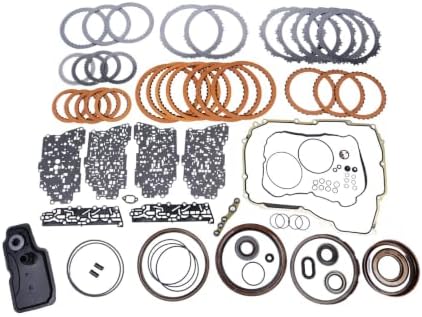
6T40 rebuild kits, overhaul kits, valve bodies and solenoids, with secure checkout.
Shop 6T40 parts →Sources
- General Motors — 2011 OBD monitor tables, "11OBDG08 TRANS Diagnostics," 6T40 Unique Section (and 4T45 Unique Section). Backs the P0716 1350 RPM / 0.8 s / one-trip criteria and enables, the 4T45 1000 RPM / 3.25 s / two-trip comparison, the P0717 50 RPM / 4.5 s case and the P0722 single-power-supply case, and P0716 in the P0776 disable list. gsi.ext.gm.com PDF
- GEARS Magazine (ATRA) — "6T40/45 Diagnosis & Fixes." Backs the ISS location on the rear cover reading the 3-5-R clutch, the 2-wire digital sensors powered by the TEHCM, the OSS reading the park gear, scan data as the only way to check ISS function, the 85-95 C hot level check, the overfill warning, and the adaptive learn path and conditions. gearsmagazine.com
- GM Bulletin 16-NA-013 (NHTSA copy) — No Reverse, No Third, DTC P0716, P0717. Backs the reluctor ring retainer ring cause and the retainer, reluctor wheel, 3-5-R piston and 3-5-R/4-5-6 housing repair on 2016 6T70/6T75-family vehicles. static.nhtsa.gov PDF
- GM Bulletin 17-NA-147 (NHTSA copy) — MIL with DTCs P0716, P0717, P0721, P0722, P0723, P176B-D. Backs the "diagnose in SI first, then replace" correction, the 02MAR2017 build split and part numbers 24279771, 24289782 and 24292335. static.nhtsa.gov PDF
- GM TechLink — 2026 Transmission Fluid Capacities chart. Backs DEXRON VI and the 4.0-6.0 L (4.2-6.3 qt) service capacity for the 6T40 (RPO MNH). gm-techlink.com PDF
- GEARS Magazine (ATRA) — "Advanced Speed Sensors, Part 2." Backs the 7 mA / 14 mA current switching, the roughly 20 mV voltage change, the 10-ohm series resistor scope method on a 6T40 input speed sensor, and the warning against VR-style tests. gearsmagazine.com