A slipping Impala is one of the most common 6T70 jobs we see, and it is also one of the easiest to get wrong, because "Impala" covers two different generations of the transmission and two different families of slip. A 2014-2019 car that flares on the 2-3 is usually telling you something about its valve body. A 2012-2013 car that slips in 3rd, 5th and reverse is usually telling you something about one clutch pack. A car that slips everywhere is telling you about pressure. This guide sorts the Impala slip by build and by gear, gives you the scan tool checks and pressure numbers from GM service information, and lays out the fix for each pattern. Numbers in brackets point to the Sources list at the bottom.
Which 6T70 is in the Impala on your lift?
Only the 3.6L V6 Impala has a 6T70. The 2012 Impala manual lists the 3.6L V6 (engine VIN code 3) [6], and those 2012-2013 W-body cars carry the first-generation unit (RPO MH2 or MH4) [3]. The 2014-and-later Impala was offered with the 2.4L, the 2.5L and the 3.6L V6 (VIN code 3) [6], and GM bulletin 18-NA-358 lists the 6T70 Impala from 2014 through 2019 under RPO M7W [1]. Sonnax's RPO chart puts M7W in the second generation and states that M7U, M7W, M7V, M7X and MHM units use Gen 2 hardware and software that is not designed to interchange with Gen 1 [3].
That split matters more on a slip job than on any other. Gen 2 got a new valve body and spacer plate, a TEHCM with variable feed solenoids and no pressure switches, and new friction, steel and wave plate stacks in several clutches. The Gen 2 1-2-3-4 clutch went from seven plates to nine thinner ones, with a notched piston for identification [3]. A Gen 1 clutch kit in a Gen 2 case is a guaranteed slip. Read the RPO label before ordering anything.
How the 6T70 holds each gear
You cannot diagnose a slip on this unit without the apply chart in your head. It is a clutch-to-clutch six-speed with five clutches and one low one-way clutch. Per Sonnax's apply chart [3]:
| Range | Clutches applied |
|---|---|
| 1st | 1-2-3-4 + low one-way clutch (low/reverse added for engine braking) |
| 2nd | 1-2-3-4 + 2-6 |
| 3rd | 1-2-3-4 + 3-5-R |
| 4th | 1-2-3-4 + 4-5-6 |
| 5th | 3-5-R + 4-5-6 |
| 6th | 2-6 + 4-5-6 |
| Reverse | 3-5-R + low/reverse |
Use it like a map. A slip in 1st through 4th that goes away in 5th and 6th points at the 1-2-3-4 clutch. A slip in 3rd, 5th and reverse points at 3-5-R. A slip in 2nd and 6th points at the 2-6 clutch, which lives in the case cover. A slip in 4th, 5th and 6th points at 4-5-6. A slip in every gear points at line pressure, the pump or the converter, not a clutch pack.
Each of those clutches is fed by its own regulator valve driven by its own pressure control solenoid: PCS2 runs the 3-5-R regulator, PCS3 the low/reverse and 4-5-6 regulator, PCS4 the 2-6 regulator and PCS5 the 1-2-3-4 regulator, with PCS1 on line pressure [3]. That is why a single sticking valve can make one shift flare while the rest feel normal.
Start with the scan tool and a road test
GM's road test procedure for the 6T70/6T75 assumes the engine runs right, the tires are at pressure and the fluid level is correct before you judge anything [4]. On a slip complaint, watch these PIDs: engine speed, Transmission ISS, Transmission OSS, commanded gear, gear ratio, Line PC Sol. Pressure Cmd., the PC Sol. 2-5 pressure commands, TCC PC Sol. duty cycle, TCC Slip Speed and transmission fluid temperature [4]. A true clutch slip shows as ISS climbing away from OSS times the gear ratio while commanded gear stays put.
- Upshifts: at a steady 15 to 20 percent throttle, each upshift should produce a noticeable shift feel or engine speed change within 1 to 2 seconds of the commanded gear change [4]. A long, soft change with rising rpm is a flare.
- Step-in downshifts: from light throttle in 3rd, 4th, 5th and 6th, a quick step-in should complete the downshift within 2 seconds [4].
- Garage shifts: engagements should be complete in under 2 seconds with fluid above 20 C. GM suggests watching Transmission ISS reach 0 rpm to time the delay [4].
- Converter: this unit runs an electronically controlled capacity clutch that holds roughly 20 RPM of slip in 2nd through 6th. When the TCC is commanded on with steady throttle and no shift in progress, slip should stay under 100 RPM. More than that for over 6 seconds sends you to converter diagnosis [4].
That last point catches a lot of Impalas. A highway "slip" with rpm wandering 150 to 300 above where it should be, in a steady gear, with ISS and OSS agreeing on the ratio, is converter clutch slip. No amount of clutch pack work will fix it.
GM's list also includes TFP Switch 1, 3, 4 and 5. Only Gen 1 TEHCMs have those switches; Gen 2 uses clutch pulse learn instead [3]. On a 2012-2013 car, Sonnax rates them a very high failure item that typically sets P0752, P0872, P0877 or P0989 [3].
Check the fluid the GM way
Low fluid on a 6T70 shows up first as a slip on hard turns and a delayed engagement when hot. GM's level procedure: level ground, engine running, cycle the selector through each range pausing about 3 seconds, idle at least a minute, then read the dipstick only with fluid at 180-200 F (82-93 C), driving in 2nd to warm it if needed [5]. ATRA's seminar gives the same 180-200 F window [2]. Fluid should be red or dark brown. Very dark or black fluid with a burnt smell means inspect for metal and debris; big parts or metal means flush the cooler and lines and overhaul [5].
Use DEXRON-VI only [5]. Both Impala manuals say a leak is the only reason the level should drop and that there is a special procedure for checking and changing the fluid [6]. The 2012 Impala manual lists the automatic transmission capacity at 5.0 L (5.3 qt) [6], which is a service refill, not a dry fill.
Slips everywhere: check line pressure
If the car slips in every range, put a gauge on it before you pull anything. GM's line pressure check uses a DT 21867-A gauge at the line pressure test hole, with the scan tool commanding the Line PC solenoid up and down in roughly 200 kPa (29 psi) steps, only in Park or Neutral below 1,500 RPM. Run it at least three times, compare against the solenoid valve pressure chart, and torque the plug to 12 Nm (106 lb in) when you are done [5]. ATRA's 6T70 seminar adds a practical shortcut: check line pressure at idle, and if it is low, inspect the pump outlet seal for damage [2].
GM's "Fluid Pressure High or Low" list is the checklist for a unit that fails that test [5]:
- Pump: loose pump bolts, leaking or damaged pump outlet seals and filter seal, a mis-installed or damaged filter, a sticking line pressure blow-off valve.
- Drive gear support: damaged converter seal or fluid passage tube gasket and tube.
- Upper valve body: leaking gasket, worn or sticking pressure regulator valve or spring.
- TEHCM: leaking filter plate seals, a variable bleed solenoid stuck high or low.
- Case: a missing lube oil circuit orifice or baffle.
The pump on this transmission is a remote, off-axis, chain-driven vane pump [3], so a slip in all gears can also come from a stretched or broken drive link or sprocket. That is a case-cover-off job, not a pan-drop job.
2014-2019 Impala: flare, slip and shudder from the valve body (18-NA-358)
This is the slip pattern we see most on the newer car. GM bulletin 18-NA-358 lists the 2014-2019 Impala (RPO M7W) for a severe launch shudder in 1st, a shudder in 4th, or a shudder on the 2-3 upshift or 3-2 downshift, often with a flare, a slide or bump, a slip or a harsh shift [1]. GM's cause: debris in the upper and/or lower valve bodies, or valves scratched or scored so they do not move properly [1].
Look at the chart above: on a 2-3, the 2-6 clutch releases while 3-5-R comes on. A 3-5-R regulator hanging in a scored bore makes the oncoming clutch lag, and the engine flares.
Diagnose it in GM's order [1]:
- Rule out an engine misfire or driveability problem.
- Rule out TCC shudder by watching TCC slip while the converter clutch is engaged during the event.
- Try to reproduce the launch shudder with a first-gear power brake, for 5 seconds or less so you do not hurt the 1-2-3-4 clutch.
If it reproduces, GM replaces the upper and lower valve body assemblies together: upper 24281084, lower 24257450, kit 24264343, plus DEXRON VI [1]. GM also states that TEHCM replacement has not been an effective repair for this condition; performance test and clean or replace the TEHCM as needed instead [1]. The note that saves the most comebacks: inspect the input and output speed sensors for debris. Debris on the sensors means an internal component is failing. No debris but scratched valves and bores means check the final drive bearing [1]. Bolting new valve bodies onto a unit that is shedding bearing metal just scores the new ones.
2012-2013 Impala: slip in 3rd, 5th and reverse
On the Gen 1 W-body car, a slip or flare in 3rd and 5th, often with a missing or slipping reverse, points straight at the 3-5-R clutch, because it is the only clutch those three ranges share. ATRA describes the classic version: a broken 3-5-R wave plate lets the apply piston over-stroke, the piston leaks and the clutch loses apply. Expect P0776, with any of P0777, P2723, P0717, P0716, P2715 or P2714 setting alongside it [2].
ATRA says that failure mainly hit units built before the 2010 model year [2], and Sonnax dates the updated wave plates to the 2012 model year [3], so a 2012-2013 Impala is less exposed than an early Malibu or Acadia. But a high-mileage fleet car can still burn the 3-5-R pack. ATRA's quick test is worth doing first: unplug the transmission and see whether reverse engages. If reverse is fine unplugged, the problem is electrical or hydraulic control, not the shell [2].
If it comes apart, do what ATRA recommends and install the updated wave plates in every clutch: 1-2-3-4 24259063, 2-6 24259816, 3-5-R 24254103 and low/reverse 24259817 [2][3]. Inspect the reaction carrier for debris damage. And remember that the reaction carrier, input ring gear and ring gear snap ring are serviced as separate parts even though catalogs show one assembly. Leave the ring gear off and you get a no-drive and a P2723 after the rebuild [2].
Slip in 2nd and 6th, or a 3-4 bind
A slip in 2nd and 6th only is the 2-6 clutch. GM's checklist: worn or damaged 2-6 plates, a damaged backing plate or sheared splines, stripped input ring gear splines or a broken ring gear retainer, and in the case cover a damaged 2-6 piston, delaminating seals, a broken return spring or retainer, or a worn piston bore [5]. ATRA notes the 2-6 snap ring and case snap ring groove were updated [2].
The opposite complaint, a bind on the 3-4 or 4-3 shift with a possible P0797, is a leak between the 3-5-R and 4-5-6 circuits from a worn ring groove on the case cover hub sleeve. ATRA's check: pull the hub, measure ring-to-groove clearance with a feeler gauge, and replace the case cover if it is over 0.007 in. [2]. A tie-up on the 3-4 can feel like a slip followed by a bang, so do not skip it.
After the repair: program and relearn
The TCM is inside the transaxle, so any time you replace the unit you have to program the TCM [2]. After any repair, run Service Fast Learn Adapts with the scan tool so the TCM learns each clutch's fill characteristics, then shut the engine off, let the TCM power down and restart to complete it [2]. CP Learn keeps refining clutch fill in steady 3rd, 5th and 6th gear [2]. A rebuilt unit that leaves with old adapts will flare on its first few shifts and get blamed for the rebuild.
For prevention, the 2014 Impala manual tells the driver to stop and idle when the TRANSMISSION HOT IDLE ENGINE message appears, since driving with high fluid temperature can damage the transmission [6]. ATRA lists 100,000-mile normal and 50,000-mile severe fluid-only service, with the filter not serviceable except after internal repair [2]. A rental or fleet Impala is severe service by any definition.
Quick reference
| Impala slip pattern | Likely cause | First check |
|---|---|---|
| All gears, worse hot | Low fluid, low line pressure, pump or pump drive | Hot level at 180-200 F; line pressure gauge [5] |
| Rpm wanders at cruise, ratio correct | Converter clutch slip | TCC slip over 100 RPM for 6 s [4] |
| Launch shudder, 2-3 / 3-2 flare (2014-2019) | Valve body debris or scored valves | 18-NA-358 checks; inspect sensors for debris [1] |
| 3rd, 5th and reverse (2012-2013) | 3-5-R clutch or wave plate | P0776 family; unplug-for-reverse test [2] |
| 1st through 4th only | 1-2-3-4 clutch | Apply chart [3]; Gen 2 uses 9 plates |
| 2nd and 6th only | 2-6 clutch in case cover | GM 2-6 checklist [5] |
| 3-4 bind, P0797 | Worn case cover hub ring groove | Max 0.007 in. ring clearance [2] |
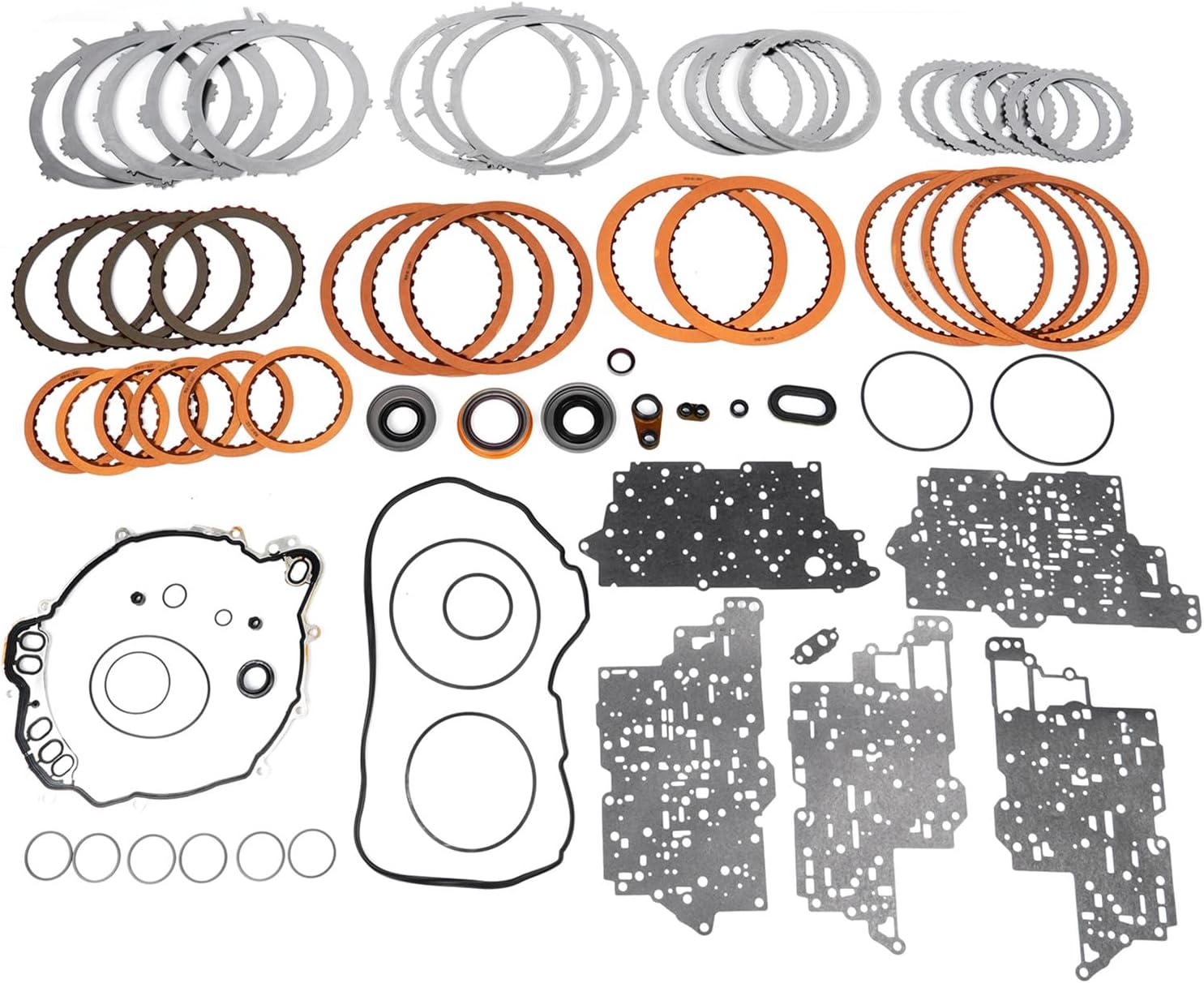
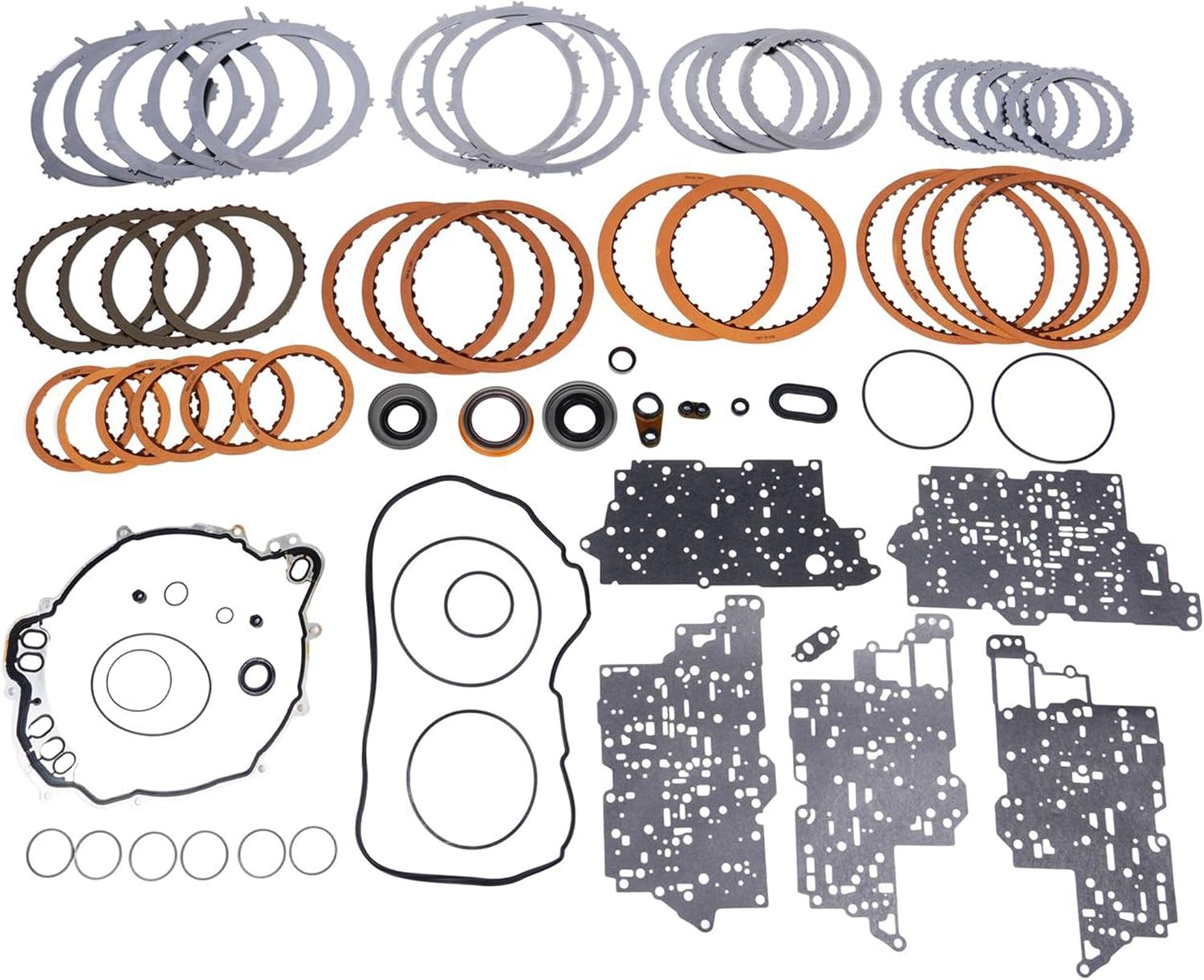
Shop the part for this fix: 6T70 friction clutch kit 2013-Up
When a 2014-2019 Impala has burned a clutch pack, this CoreTransmissionParts friction kit covers the Gen 2 stack. For a 2012-2013 Gen 1 car, use the 2007-2014 friction kit instead.
View the 6T70 friction clutch kit at CoreTransmissionPartsNeed a different generation or the full overhaul? Browse all 6T70 parts at CoreTransmissionParts.
Need parts for this job?
Our 6T70 parts page has Gen 1 and Gen 2 rebuild kits, valve bodies, pumps and clutch drums for the V6 Impala, all on our own checkout. For fluid specs across every unit, see the transmission fluid spec chart.
FAQ
Why is my Chevy Impala transmission slipping?
On a V6 Impala with the 6T70, slipping usually comes from one of four places: low fluid or low line pressure (slips in every gear), a slipping torque converter clutch at cruise, valve body debris on the 2014-2019 car (GM bulletin 18-NA-358), or a worn or failed clutch pack. Which gears slip tells you which clutch to look at, using the 6T70 apply chart.
Is there a GM bulletin for a 2014-2019 Impala transmission slipping?
Yes. GM bulletin 18-NA-358 covers 2014-2019 Impalas with the 6T70 (RPO M7W) that shudder on launch, in 4th or on the 2-3 or 3-2 shift and may also flare, slip or shift harsh. GM traces it to debris or scored valves and replaces the upper and lower valve bodies together, and says replacing the TEHCM has not fixed it.
Why does my Impala slip in 3rd, 5th and reverse?
Those three ranges share only the 3-5-R clutch, so that is where to look. ATRA describes a broken 3-5-R wave plate that lets the piston over-stroke and leak, usually with DTC P0776. It mainly hit units built before 2010, but a high-mileage 2012-2013 Impala can still burn that clutch pack.
How do I know if it is the torque converter or the transmission slipping?
Watch TCC slip speed on a scan tool at steady cruise. GM says slip should stay under 100 RPM once the converter clutch is commanded on, and more than that for over 6 seconds points to the converter. If engine speed flares during or after a shift and input speed no longer matches output speed times the gear ratio, it is a clutch slip inside the transmission.
What fluid does a slipping 6T70 Impala need?
DEXRON-VI only. GM's 2012 Impala manual lists the service capacity at 5.0 L (5.3 qt), and the level must be checked hot, with fluid at 180-200 F, per the GM procedure. Low fluid causes slips and delayed engagements, so check the level correctly before condemning anything.
Related guides
Sources
- General Motors, Service Bulletin 18-NA-358, "Shudder, 2-3 Upshift or 3-2 Downshift Concern," December 2021. Backs the 2014-2019 Impala RPO M7W listing, the launch, 4th-gear and 2-3/3-2 shudder with flare, slide, slip and harsh shift, the valve body debris cause, the misfire and TCC slip checks, the 5-second power brake test, the TEHCM note, the speed sensor debris and final drive bearing check, and parts 24281084, 24257450 and 24264343. static.nhtsa.gov (PDF)
- ATRA, "6T70 Product Issues and Updates" seminar. Backs the 180-200 F level check, the 100k/50k service intervals, TCM programming and Service Fast Learn Adapts, CP Learn gears, the idle line pressure and pump outlet seal check, the broken 3-5-R wave plate and P0776 family codes, the pre-2010 note, the unplug-for-reverse test, the four updated wave plates, the separately serviced input ring gear and P2723, the 2-6 snap ring update, and the 0.007 in. case cover hub ring clearance for 3-4 bind and P0797. atracom (PDF)
- Sonnax, "GM Gen 1 6T70/75/80, Ford 6F50/55 Concerns and Repair Techniques" webinar. Backs the RPO chart (MH2/MH4 Gen 1, M7W/M7U Gen 2, no interchange), the clutch apply chart, the solenoid-to-regulator table, the chain-driven vane pump, the Gen 1 pressure switches and their DTCs, the 2012 model year wave plate update, and the Gen 2 change list including the nine-plate 1-2-3-4 clutch and notched piston. Sonnax (PDF)
- GM service information for the 6T70/6T75, Road Test (2011 Saab 9-4X workshop manual). Backs the PID list, the 1-2 second upshift and 2 second step-in downshift timing, the under-2-second garage shift at 20 C, the ECCC 20 RPM slip and the 100 RPM / 6 second TCC slip limit. saabwisonline.com
- GM service information for the 6T70/6T75 (2011 Saab 9-4X workshop manual): Transmission Fluid Level and Condition Check, Line Pressure Check, Fluid Pressure High or Low, and No Second and Sixth Gear. Backs the DEXRON VI warning, the 180-200 F hot check and fluid condition rules, the DT 21867-A gauge procedure with 200 kPa steps below 1,500 RPM and 12 Nm plug torque, the high/low pressure cause list, and the 2-6 clutch checklist. Fluid Level Check / Line Pressure Check / Fluid Pressure High or Low / No 2nd and 6th
- Chevrolet, 2012 and 2014 Impala Owner Manuals. Back the 3.6L V6 (VIN code 3) engine, the 2014 2.4L/2.5L/3.6L lineup, DEXRON-VI, the 5.0 L (5.3 qt) capacity, the leak-only fluid loss and special check procedure notes, and the TRANSMISSION HOT IDLE ENGINE message. 2012 manual (PDF) / 2014 manual (PDF)