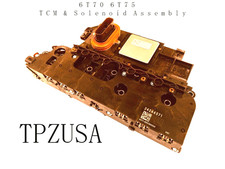
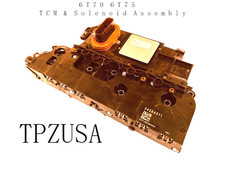
A generic code reader calls P0973 "Shift Solenoid A Control Circuit Low." On a GM 6T70 or 6T75 the factory descriptor is Shift Solenoid Valve 1 Control Circuit Low Voltage, and its partner P0974 is Shift Solenoid Valve 1 Control Circuit High Voltage. Shift solenoid 1 (SS1) is one of the two on/off solenoids built into the TEHCM, the combined solenoid body and transmission control module that GM's service information calls the Q8 control solenoid valve assembly.
Two facts drive the whole job. First, there is no external harness between the TCM and SS1. The solenoid and the module that drives it are one bolted assembly sitting on the valve body, so "circuit" here means a few millimeters of internal leads and the module's own driver. Second, P0973 is a Type A code with an immediate limp: Reverse and 5th only. The customer does not show up with a light on. They show up because the car pulls away in 5th.
The facts below come from GM's 6T70/6T75 service information for the 2011 application (a Gen. 1 unit), plus Sonnax and ATRA technical training. Gen. 2 units (2013-up 6T70) changed the TEHCM, so pull the service information for the exact vehicle when you can.

What shift solenoid 1 does
The 6T70 TEHCM carries eight solenoids. Per Sonnax's 6T70/6F50 training and ATRA's 6T70 introduction, two are on/off shift solenoids (SS1 and SS2) and six are variable pressure control solenoids (PCS1 through PCS5, plus the TCC solenoid). Sonnax's solenoid function table assigns SS1 to clutch select valve 2 and SS2 to clutch select valve 3. The clutch select valves do the routing. The PC solenoids do the pressure.
GM's circuit description for SS1 says:
- SS1 is a normally closed (NC) on/off solenoid and part of the control solenoid valve assembly, which has no serviceable components.
- When SS1 is energized, its fluid pressure goes to clutch select valve 2 and strokes it against spring pressure into the applied position.
- The TCM controls it through a low side driver. Current is supplied through a high side driver (HSD) that shuts off on excessive current and resets when the fault clears.
GM's shift solenoid state chart shows when SS1 is actually on, and it is not when most people expect:
| Range / gear | SS1 | SS2 | Ratio |
|---|---|---|---|
| Park | ON | ON | - |
| Reverse | ON | OFF | 2.88 |
| Neutral | ON | ON | - |
| 1st, engine braking | ON | ON | 4.484 |
| 1st | OFF | ON | 4.484 |
| 2nd | OFF | ON | 2.872 |
| 3rd | OFF | ON | 1.842 |
| 4th | OFF | ON | 1.414 |
| 5th | OFF | ON | 1.000 |
| 6th | OFF | ON | 0.742 |
So SS1 is energized in Park, Reverse, Neutral and engine-braking 1st, and off in every normal forward gear. GM lists the effective final drive as 2.77 or 3.16 depending on application. Keep this chart in front of you during diagnosis. It explains why the two codes produce different fail-safes, and it tells you which ranges to cycle through when you verify a repair.
P0973 vs P0974: set criteria and what the TCM does
Both codes run when engine speed has been 400 RPM or higher for 5 seconds and ignition voltage is 8.6 volts or more.
| DTC | Sets when | Type | TCM action per GM |
|---|---|---|---|
| P0973 | Short to ground on the SS1 control circuit for 2 seconds | A | Reverse and 5th only, TCC inhibited, maximum line pressure, adapts frozen, HSD turned off, no Tap Up/Down, no manual forward shifts |
| P0974 | Open, or short to power, on the SS1 control circuit for 2 seconds | B | 1st gear inhibited |
Note who detects P0973: GM's text says the control solenoid valve assembly itself sees the short to ground. A grounded control circuit on a low-side-driven solenoid can energize SS1 when the TCM did not ask for it, which strokes clutch select valve 2 in a forward gear where the chart says it should be at rest. My read is that this is why GM treats it as Type A and shuts the high side driver off. Dropping power to all the solenoids puts the unit in its hydraulic default, and that default is Reverse or 5th.
P0974 is the opposite case. With an open circuit SS1 can never be energized, so the TCM cannot get the states that need SS1 on, and GM's answer is to inhibit 1st. As a Type B code it needs two consecutive failed trips before the lamp comes on, so a P0974 car can drive around for a while with only a soft complaint, such as a 2nd-gear start.
For comparison, GM's SS2 codes run the other way around: P0976 (SS2 low) is Type B with frozen adapts and max line pressure, while P0977 (SS2 high) is the Type A Reverse-and-5th limp. If a scan shows SS2 codes as well as SS1 codes, look at what the two share, which is the module and its supply, not two separate solenoids.
What the customer reports
- P0973: pulls away in a high gear and stays there. Forward is 5th only, reverse still works, no converter lockup, harsh engagements from maximum line pressure, and the manual shift buttons do nothing.
- P0974: no 1st gear. The vehicle starts in 2nd and feels lazy off the line. It often drives otherwise normally until the lamp comes on.
- Either code after a hot drive. That points toward a module heat problem, not a solenoid. More on that below.
Diagnosis, in GM's order
1. Battery, charging and the X1 connector first
The test only runs above 8.6 volts, and the HSD trips on excessive current, so I check battery state and charging voltage before anything else. Then look at the X1 20-way transmission connector at the case for bent pins, fluid wicking or a broken lock. That connector is the only part of the SS1 circuit you can reach without removing the module. Record freeze frame data before you clear anything. If the code set hot, at low voltage or right after a cold start, write it down.
2. Run GM's circuit/system verification
GM's verification for SS1 is specific. Drive the vehicle in 2nd gear long enough to raise TCM temperature at least 3 C (5 F), then sit in Park for 5 seconds. Next, Reverse for 5 seconds, then idle in Park for 5 seconds. Then check that all three scan tool test status parameters read OK:
- Shift Solenoid Valve 1 Control Circuit High Voltage Test Status
- Shift Solenoid Valve 1 Control Circuit Open Test Status
- Shift Solenoid Valve 1 Control Circuit Low Voltage Test Status
That sequence makes sense against the state chart. Second gear commands SS1 off, Park and Reverse command it on, so both driver states get exercised. GM then says to drive under the run conditions or the freeze frame conditions. If it passes, stop. GM states that going on to circuit and component tests after a pass can lead to unnecessary part replacement, and points you to intermittent and poor-connection testing. That is the line between a properly diagnosed module and a guessed one.
3. Pull the module and bench it on the harness
If verification fails, GM's circuit test is short. With the ignition off, remove the Q8 assembly. Perform the TEHCM inspection: check the connectors and pins for damage, bent pins, debris, a broken retaining tab or contamination. Make sure no metallic debris sits inside the connectors near the terminals. Check the solenoid leads for contamination or metallic debris, and confirm all four filter plate retaining tabs are uncracked and holding tension.
Set the module on a clean surface next to the transmission and connect it to the vehicle's X1 harness through the DT-47825-20 adapter harness. Ignition on, recheck the three test status parameters. If any reads Fault or Malfunction with the module out of the case and on a known harness, GM's call is to replace the Q8 control solenoid valve assembly. Out of the case, there is nothing left in the circuit that is not part of the module.
4. Optional: prove the solenoid on air
When I want to know whether SS1 is also mechanically stuck, for example after a contamination failure, GM's solenoid performance test uses the DT-47825-100 test block. Bolt it to the valve body face of the assembly at 5 Nm (44 lb in) center-out, supply 90-100 psi of shop air, and put the gauge on port H for shift solenoid 1. Its key-on, engine-off normal state is full pressure flow to the gauge, which matches the state chart (SS1 is commanded on in Park). Command it off and on several times and bleed the gauge between tests. GM warns not to energize any solenoid for more than two minutes, and to expect some flicker at key-on because the TCM dithers the solenoids to keep them clean.
Heat, mounting and the wrong module
Two TEHCM details from the Sonnax and ATRA training are worth knowing before you condemn a solenoid. The 6T70 TCM uses a spring-loaded bracket that pushes it against a heat sink on the valve body, and both say that leaving the bracket out causes TCM thermal shutdown. The module also has two internal temperature sensors on the circuit board to protect itself. If you get circuit codes after someone else has had the side cover off, check that the bracket is there before you buy anything.
The second trap is generation. Sonnax notes that several TEHCM part numbers exist, and that a module designed for Gen. 2 6T70, 6T75 and 6T80 units will not work properly in a Gen. 1 build, even when the part number seemed to match. Sonnax also lists clutch select valve 2 among the Gen. 2 valve body changes, so the hydraulics SS1 controls are different too. Identify the unit by RPO from the Service Parts Identification label and order by VIN.
The fix
Connector or pin fault at X1. Repair the terminals, clear codes, and rerun GM's verification sequence until all three test status parameters read OK.
Fault stays with the module on the bench harness. Replace the Q8 control solenoid valve assembly. SS1 is not serviced separately. GM's repair notes send you to the control module references for replacement, setup and programming, and say to perform the TEHCM inspection before replacing the TCM.
Debris on the solenoid leads or filter plate. A new module will not survive in contaminated oil. Find where the metal came from first, whether that is a clutch, a pump or a bushing, and clean or overhaul the unit before installing the replacement.
Every repair: reset the adapts. GM requires "Resetting of the transmission's adaption" after control solenoid valve assembly replacement, valve body work, any internal repair and any shift quality repair. GM warns that skipping it can cause poor shift quality and more codes. Part of the procedure is ignition off with all systems powered down, which GM says can take up to 2 minutes. After the reset, road test through the drive cycles so the TCM relearns shift pressures, then perform the Diagnostic Repair Verification.
When the TEHCM is coming out anyway
If the inspection finds metallic debris on the solenoid leads or filter plate, the module is not the whole job. The Gen. 1 6T70 master rebuild kit at Core Transmission Parts covers the gaskets and seals for the overhaul. Confirm Gen. 1 or Gen. 2 by RPO before you order.
View the 6T70 Gen. 1 master rebuild kit →FAQ
Can I drive with P0973 on a 6T70?
Only gently and not far. GM classifies P0973 as a Type A code, and the TCM limits the transmission to Reverse and 5th, inhibits converter lockup and commands maximum line pressure. Pulling away in 5th loads the clutches and builds heat, so get it diagnosed rather than commuting on it.
Is P0973 a bad solenoid or a wiring problem?
On a 6T70 the shift solenoid and the TCM are one assembly, the TEHCM, so there is no external wiring between them. Check battery voltage and the X1 20-way connector first. If GM's bench test with the module on the DT-47825-20 harness still shows a fault, the module is the problem.
Can shift solenoid 1 be replaced by itself?
No. GM's service information says the control solenoid valve assembly has no serviceable components, so the repair is the complete TEHCM. Match Gen. 1 or Gen. 2 by RPO and VIN, then program it and reset the transmission adapts.
What is the difference between P0973 and P0974?
P0973 is a short to ground on the SS1 control circuit for 2 seconds. It is Type A, with a Reverse and 5th limp. P0974 is an open or short to power for 2 seconds. It is Type B, and the TCM inhibits 1st gear, so the vehicle starts in 2nd.
Shop the 6T70 Gen. 1 master rebuild kit →
Need parts for this job?
TEHCM assemblies, solenoid kits, valve bodies, pumps, rebuild kits and DEXRON-VI for the 6T70 and 6T75.
Shop 6T70 parts →Sources
- General Motors service information, 6T70/6T75: "DTC P0973 or P0974" (2011 application, published on SAAB WIS Online). Backs the GM descriptors, the SS1 circuit description (NC on/off, clutch select valve 2, low side driver, high side driver, no serviceable components), the 400 RPM / 8.6 V run conditions, the 2-second set criteria, the Type A/B actions, the 2nd-gear/Park/Reverse verification and three test status parameters, the DT-47825-20 bench test and the repair notes. saabwisonline.com
- General Motors service information, 6T70/6T75: "DTC P0976 or P0977." Backs the SS2 comparison: SS2 feeds clutch select valve 3, P0976 is Type B with frozen adapts and maximum line pressure, P0977 is the Type A Reverse-and-5th limp. saabwisonline.com
- General Motors service information, 6T70/6T75: "Shift Solenoid Valve State and Gear Ratio," "Solenoid Performance Test," "TEHCM Inspection" and "Resetting of the transmission's adaption." Backs the solenoid state and ratio chart, the DT-47825-100 air test (5 Nm, 90-100 psi, SS1 on port H, full flow at KOEO, two-minute limit, dither), the connector, lead and filter plate tab inspection, and the adapt reset requirement. solenoid states · solenoid air test · TEHCM inspection · adapt reset
- Sonnax: GM 6T70/Ford 6F50 webinar (PDF). Backs the eight-solenoid TEHCM layout, SS1 to clutch select valve 2 and SS2 to clutch select valve 3, the spring-loaded heat sink bracket and thermal shutdown warning, the internal temperature sensors, the Gen. 2 TEHCM and clutch select 2 valve changes, and the note that TEHCMs carry several part numbers. sonnax webinar PDF
- Sonnax: "Identifying GM 6T70 Series TEHCM Generations Using VIN/RPO Codes." Backs the warning that a Gen. 2 TEHCM will not work properly in a Gen. 1 build even when the part number appears to match. sonnax.com
- ATRA: GM 6T70 Introduction webinar (PDF). Backs the two on/off shift solenoids (SS1, SS2), the six variable bleed solenoids, the Bosch-built TEHCM and the heat sink bracket and thermal shutdown warning. atracom PDF