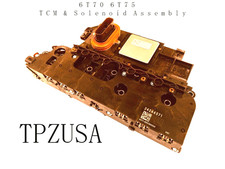
A generic scan tool will call P0961 "Pressure Control Solenoid A Control Circuit Range/Performance." On a GM 6T70 or 6T75 the factory descriptor is more specific: Line Pressure Control Solenoid Valve Performance. The solenoid in question is pressure control solenoid 1, the one that sets line pressure for the whole transmission, and it lives inside the TEHCM (GM calls it the Q8 control solenoid valve assembly).
The thing most people get wrong about this code is what it actually measures. P0961 is not a hydraulic test. Nothing in the 6T70 measures line pressure directly. Per GM service information, P0961 sets when the line PC solenoid current the TCM measures does not equal the current it commanded for 5.0 seconds. GM describes it as an internal electrical malfunction of the solenoid. That one fact steers the whole diagnosis, and it is why a worn pressure regulator valve can wreck shift quality all day without ever setting P0961.
The facts below come from GM's 6T70/6T75 service information for the 2011 application (a Gen. 1 unit), plus Sonnax and ATRA technical material. Codes, set criteria and tests on a Gen. 2 unit (2013-up 6T70) can differ in detail, so pull the SI for the exact vehicle when you can.

How line pressure control works in a 6T70
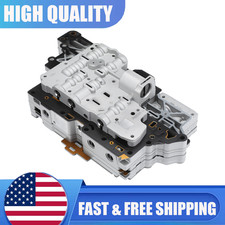
Per both ATRA's 6T70 introduction and Sonnax's 6T70/6F50 training, the TEHCM carries two on/off shift solenoids and six variable solenoids: PCS1 through PCS5 and the TCC solenoid. PCS1 controls the line pressure valves. PCS2 through PCS5 each run one clutch regulator valve (3-5-R, L/R and 4-5-6, 2-6 and 1-2-3-4).
GM's circuit description spells out the line PC solenoid behavior:
- It is a normally high solenoid. Its output pressure goes to the pressure regulator valve and the isolator valve. More solenoid pressure means more line pressure.
- The TCM controls it through a low side driver by varying current. Less current closes the exhaust port and raises pressure. More current opens the exhaust and drops pressure.
- Power comes from the TCM through a high side driver (HSD), which shuts off if it sees excessive current and resets once the fault is gone.
Normally high is the design choice that matters. If the solenoid loses control entirely, line pressure goes to maximum, not to zero. You get harsh shifts instead of burned clutches. Sonnax notes that Gen. 1 units use variable bleed solenoids and Gen. 2 units changed to variable feed solenoids along with an updated pressure regulator valve and isolator valve spring, which is one reason Gen. 1 and Gen. 2 parts do not cross over.
P0961 vs P0962 vs P0963
GM groups the three line PC codes on one diagnostic page. They run when engine speed has been at least 400 RPM for 5.0 seconds and ignition voltage is 8.6 volts or more.
| DTC | GM descriptor | Sets when | Type and TCM action |
|---|---|---|---|
| P0961 | Line PC Solenoid Valve Performance | Measured current does not equal commanded current for 5.0 s | Type B. Freezes adapts, commands maximum line pressure |
| P0962 | Line PC Solenoid Control Circuit Low Voltage | Short to ground on the control circuit for 2 s | Type A. Reverse and 5th only, no TCC, max line, HSD off, no tap or manual shifts, torque management on |
| P0963 | Line PC Solenoid Control Circuit High Voltage | Open or short to voltage on the control circuit for 5 s | Type B. Freezes adapts, commands maximum line pressure |
Type B means the code needs two consecutive failed trips before it lights the lamp. So by the time a customer brings it in for P0961, the module has seen the current mismatch on at least two drives.
The P0962 fail-safe is worth understanding because it tells you how the unit is built. GM's solenoid state chart shows 5th gear uses the 3-5-R and 4-5-6 clutches, both fed by normally high solenoids (PCS2 and PCS3). Kill the high side driver and every solenoid goes to its default, so the unit lands in Reverse or 5th. That is the "stuck in a high gear" complaint. A P0961 by itself does not do that. It just pins line pressure high and stops learning.
What the customer feels
- Harsh engagements and firm shifts everywhere. That is the maximum line pressure command doing its job.
- Shift quality that does not improve. Adapts are frozen, so whatever the unit learned before the fault is what it keeps.
- Check engine lamp after a couple of drives. Type B logic.
- If it escalates to P0962, a hard limp: Reverse and 5th only, no converter lockup.
If the complaint is slipping, flare or soft shifts with P0961 stored, be suspicious. Max line pressure should not cause slip. Look for a second problem, usually fluid level or a worn valve body.
Diagnosis: work it in this order
1. Check fluid and the other codes
GM's line pressure check starts with fluid level, a code scan and the manual linkage. Fix any supply voltage, TCM or speed sensor codes before you chase a solenoid performance code. Because the test only runs above 8.6 volts and depends on clean current feedback, I check battery and charging voltage and the X1 20-way connector before anything comes apart.
2. Run GM's verification
Engine running in Park, move the shifter through each range and back to Park. GM says to then confirm these scan tool test status parameters read OK: Line Pressure Control Solenoid Valve Performance Test Status, Control Circuit High Voltage Test Status and Control Circuit Low Voltage Test Status. Then drive it under the run conditions or recreate the freeze frame. If it passes, GM is blunt: stop, do not go on to circuit and component tests, and treat it as an intermittent. That is how TEHCMs get replaced for no reason.
3. Put a gauge on it
This is what separates an electrical fault from a hydraulic one. GM's line pressure check uses a gauge on the line pressure tap and the scan tool's Line PC Solenoid output control. The scan tool can only command it in Park or Neutral below 1,500 RPM, and it steps pressure in roughly 200 kPa (29 psi) increments. GM says to repeat the sweep at least 3 times for consistent readings. Compare against GM's solenoid valve pressure chart:
| Requested (kPa) | Actual, metric | Actual, psi |
|---|---|---|
| 0 | 345-900 kPa | 50-130 psi |
| 200 | 690-900 kPa | 100-130 psi |
| 400 | 1100-1310 kPa | 160-190 psi |
| 600 | 1520-1725 kPa | 220-250 psi |
| 800 | 1860-2070 kPa | 270-300 psi |
| 1000 | 1860-2070 kPa | 270-300 psi |
Reinstall the test plug at 12 Nm (106 lb in) when you are done.
How to read it: if pressure follows the commands and P0961 keeps returning, the hydraulics are fine and the fault is electrical, in the solenoid or its driver. If pressure does not follow the chart and no electrical code is present, it is hydraulic. If it sits at the top of the chart no matter what you command, the solenoid is not regulating. That fits a P0961 or a stuck solenoid. If it is low across the board, look at supply, not the solenoid.
4. Bench the TEHCM
GM's circuit test: ignition off, remove the Q8 assembly and inspect it. Check the connector pins for damage, bends, debris or a broken retaining tab. Make sure no metallic debris sits near the terminals, the solenoid leads are clean, and all four filter plate retaining tabs are intact and holding tension. Then connect it to the vehicle harness through the DT-47825-20 adapter harness, ignition on, and recheck the three test status parameters. If any reads Fault or Malfunction with the module out of the case and on the harness, GM says to replace the Q8 assembly.
To prove the solenoid is mechanically stuck rather than electrically bad, GM's solenoid performance test uses the DT-47825-100 air test block. Drain the module, bolt the block to the valve body face at 5 Nm (44 lb in) center-out, and feed it 90-100 psi of shop air. PC solenoid 1 is port A, and its key-on engine-off normal state is regulated flow to the gauge. Command it on and off and watch the gauge. Do not energize a solenoid for more than two minutes. Expect some flicker at key-on, because the TCM dithers solenoids to keep them clean.
When it is the valve body, not the solenoid
GM's "Fluid Pressure High or Low" chart is the list I go to when the gauge disagrees with the command and the electrical tests pass:
- Pump: loose pump bolts, leaking pump outlet seals or oil filter seal, a damaged or misinstalled filter, a sticking line pressure blow-off valve.
- Drive gear support: a leaking converter seal, fluid passage tube or tube gasket.
- Upper valve body: gasket leaks, or a worn, sticking or damaged pressure regulator valve or spring.
- Lower valve body: gasket leaks.
- TEHCM: leaking filter plate seals, or a solenoid stuck high or low.
- Case: a missing lube circuit orifice or baffle.
ATRA's 6T70 product issues material gives the quick version: check line pressure at idle, and if it is low, inspect the pump outlet seal for damage.
On the valve body side, Sonnax's Gen. 1 6T70/6T75 vacuum test guide lists two valves for line pressure complaints. A worn pressure regulator valve causes erratic line pressure, low converter and lube flow, burned clutches, TCC apply and release problems, overheating and poor shift quality. The fix is oversized kit 124740-12K with tool F-124740-TL12. A worn isolator valve gives low line pressure, line pressure instability and no line rise. Sonnax offers 124740-16 (spring only) or the 124740-03K isolator valve kit. Remember GM's description: PCS1 output feeds both of those valves. A tired bore in either one makes PCS1 look bad on the gauge while the solenoid tests perfectly on air.
The fix, by root cause
Electrical fault confirmed in the TEHCM. Replace the Q8 control solenoid valve assembly. GM says it has no serviceable components. Match it by generation, not just by the number on the old module. Sonnax warns that a Gen. 2 module will not work properly in a Gen. 1 build and that part-number lookups can lead you to the wrong one. Get the RPO from the Service Parts Identification label and match RPO, year and model. GM's repair notes point to the control module references for setup and programming of the replacement, and to inspecting the TEHCM before replacing the TCM.
Harness or connector fault. Repair the pins or the X1 connector, clear codes and verify with the three test status parameters.
Hydraulic line pressure problem. Work GM's list: pump seals, filter, blow-off valve, pressure regulator and isolator bores. Vacuum test, then ream and oversize what fails.
Every repair: reset adapts. GM's repair instructions call for "Resetting of the transmission's adaption" after all transmission repairs, then the Diagnostic Repair Verification. With adapts frozen by the code and a new module learning from zero, skipping the reset gets you a harsh unit and a comeback.
Parts for a P0961 repair
If the gauge test sends you into the pump seals, valve body gaskets and filter plate seals GM lists, the Gen. 1 6T70 master rebuild kit at Core Transmission Parts carries the gaskets and seals for the job. Confirm Gen. 1 or Gen. 2 by RPO before you order.
View the 6T70 Gen. 1 master rebuild kit →FAQ
Is it safe to drive with P0961 on a 6T70?
It will usually drive, but it shifts hard. GM classifies P0961 as a Type B code, and when it sets the TCM commands maximum line pressure and freezes adaptive learning. If it escalates to P0962, the TCM limits the unit to Reverse and 5th with no converter lockup, so get it diagnosed rather than driving on it.
Does P0961 mean my line pressure is wrong?
Not directly. Per GM, P0961 sets when the line pressure control solenoid current the TCM measures does not match the current it commanded for 5.0 seconds. It is an electrical performance test of the solenoid. Actual line pressure has to be checked with a gauge on the line pressure tap.
Will a new TEHCM fix P0961?
If the fault follows the module, yes. GM's test is to remove the Q8 control solenoid valve assembly, inspect it, and run it on the vehicle harness through the DT-47825-20 adapter. If the test status still reads Fault or Malfunction, replace the assembly. Match Gen. 1 or Gen. 2 by RPO, and plan on programming and an adapt reset.
What is the difference between P0961, P0962 and P0963?
P0961 is a current mismatch, the solenoid performance code. P0962 is a short to ground on the control circuit for 2 seconds and is a Type A code with a Reverse and 5th limp. P0963 is an open or short to voltage for 5 seconds. P0961 and P0963 both command maximum line pressure and freeze adapts.
Shop the 6T70 Gen. 1 master rebuild kit →
Need parts for this job?
TEHCM assemblies, solenoid kits, valve bodies, pumps, rebuild kits and DEXRON-VI for the 6T70 and 6T75.
Shop 6T70 parts →Sources
- General Motors service information, 6T70/6T75 — "DTC P0961-P0963" (2011 application, published on SAAB WIS Online). Backs the GM descriptors, the circuit description (normally high line PC solenoid feeding the pressure regulator and isolator valves, low side driver current control, high side driver protection), the run conditions, the 5.0 s current mismatch set criteria for P0961, the P0962/P0963 criteria, the Type A/B actions including maximum line pressure and the Reverse/5th limp, the scan tool test status verification, the DT-47825-20 bench test and the repair notes. saabwisonline.com
- General Motors service information, 6T70/6T75 — "Line Pressure Check," "Solenoid Valve Pressure," "Shift Solenoid Valve State and Gear Ratio," "Fluid Pressure High or Low," "Solenoid Performance Test" and "TEHCM Inspection." Backs the gauge procedure (Park/Neutral below 1,500 RPM, 200 kPa steps, 3 sweeps, plug at 12 Nm), the requested vs actual pressure chart, the 5th gear clutch and solenoid states, the pump/valve body/case cause list, the DT-47825-100 air test (5 Nm, 90-100 psi, PC solenoid 1 on port A, two-minute limit, dither) and the connector and filter plate inspection. line pressure check · pressure chart · solenoid states · pressure high or low · solenoid air test · TEHCM inspection
- Sonnax — GM 6T70/Ford 6F50 webinar (PDF). Backs the solenoid-to-valve table (PCS1 = line pressure valves), the Gen. 1 VBS vs Gen. 2 VFS solenoid change, the updated Gen. 2 pressure regulator and isolator valve spring, and the pressure regulator wear symptom list. sonnax webinar PDF
- Sonnax — GM Gen. 1 6T70/6T75 Vacuum Test Guide. Backs the pressure regulator valve symptoms and 124740-12K/F-124740-TL12, and the isolator valve symptoms (low line, instability, no line rise) with 124740-16 and 124740-03K. sonnax.com
- Sonnax — "Identifying GM 6T70 Series TEHCM Generations Using VIN/RPO Codes." Backs the warning that a Gen. 2 TEHCM will not work properly in a Gen. 1 build, the part-number lookup trap and using the Service Parts Identification label RPO. sonnax.com
- ATRA — GM 6T70 Introduction and 6T70 Product Issues webinars (PDF). Backs "Pressure Control Solenoid 1 controls line pressure" and the idle line pressure check with pump outlet seal inspection. introduction · product issues