A 6T75 that drops into one gear and stays there, SES light on, is not one failure — it is at least three different ones that all end at the same place: the TCM decides it cannot trust what the transmission is telling it, so it stops shifting and protects the hardware instead. The unit is used behind the 3.6 in the Acadia, Enclave, Traverse, Outlook, G6, Aura, Torrent, Equinox and Malibu, and GM has documented each of these failure modes separately over the life of the platform. Guessing at parts here is how a $40 filter job turns into a $900 valve body you didn't need. This is the order to work it in.
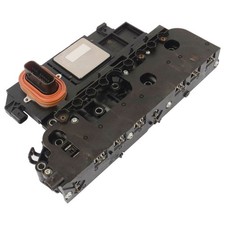


What Failsafe Actually Does on This Unit
"Stuck in gear" on a 6T75 almost always means the TCM has set a Type A diagnostic trouble code and gone into failsafe, not that a clutch mechanically welded itself in place. When the input speed sensor (ISS) or output speed sensor (OSS) signal fails the TCM's run-time checks, the module reacts the same way regardless of which exact fault tripped it: it freezes the adaptive shift tables, turns off the high-side driver so the torque converter clutch cannot apply, commands maximum line pressure so nothing is allowed to slip, disables neutral idle, and locks out Tap Up/Down and manual gear selection. On a confirmed ISS or OSS fault specifically, GM's own fault logic for this unit limits the transmission to Reverse and 5th gear only — which is exactly why the complaint reads as "it won't shift, it just sits in one gear" from the driver's seat. That is a protective mode, not a broken part, and it is reversible once the triggering fault is fixed and the codes are cleared.
The harder part is that three unrelated hardware failures on this platform can all end up tripping that same protective logic, and they do not share a fix.
Cause 1: Broken 3-5-Reverse Wave Plate (the Most Common One)
GM's own bulletin on this, 09-07-30-012F, covers 2007-2009 Enclave, Equinox, Malibu, Traverse, Acadia, G6, Aura, Outlook and VUE, all with the 6T70/75. The complaint is an SES light with no reverse and/or a slip or flare in 3rd and 5th gear. Any of these codes can set independently of each other once the plate breaks: P0776 (Clutch Pressure Control Solenoid 2 Stuck Off), P0777, P2723, P0717, P0716, P2715, and P2714. Notice P0716 and P0717 are on that list — the same codes that drive the unit into the Reverse-and-5th failsafe described above. A broken wave plate can absolutely be the root cause behind what looks like a pure speed-sensor failsafe.
The mechanism: a broken 35R clutch wave plate lets the clutch apply piston over-stroke, which leaks apply pressure and causes loss of apply in the 3-5-reverse clutch. GM's bulletin notes this normally does not show up before roughly 20,000 miles, and that debris generated by the broken plate can affect the speed sensors and other clutches — which is the link between a mechanical plate failure and a sensor-looking code.
The fix is not a parts-cannon swap. Per the bulletin, the repair requires pulling the transmission, removing the case cover, inspecting the 35R/456 clutch housing for the broken wave plate, and checking the case for damage from the broken pieces. The new plate is GM part 24254103. Critically, the bulletin requires inspecting the filter plate assembly (16) for metallic debris on the screens before deciding how far the repair goes: no debris on the screens means the pump filter did its job and the pump, torque converter and valve body can stay in; debris on the screens means the pump and torque converter need further inspection, including the cooler and cooler lines. Skipping that debris check and reusing a contaminated pump filter is explicitly called out as leading to repeat failure.
Cause 2: Ring-Land Wear in the End Cover (Early-Build Units)
This one is older and narrower: Transmission Digest documented it in a 2008 tech article covering 2007 model-year GMC Acadia, Buick Enclave, Pontiac G6, and Saturn Aura and Outlook units built before June 15, 2007. The code is P0797 (Pressure Control Solenoid C Stuck Off), and the complaint is a bind-up on the 3-4 and 4-3 shifts that gets worse as the transmission warms up — not a full stuck-in-gear failsafe in every case, but it is commonly misdiagnosed as one because the symptom and the solenoid-sounding code point techs at the wrong part.
The actual wear is in four Teflon sealing rings on the hub in the center of the transmission's end cover, which seal the fluid circuits for the 3-5-reverse and 4-5-6 clutches. A poor surface finish on early-production hubs let the ring-groove area wear prematurely, opening a cross-leak between those two clutch-apply circuits. Spec for the ring-land-to-ring clearance is no more than 0.008 inch (0.2 mm), checked with a feeler gauge. If you are seeing bind-up on 3-4/4-3 with a P0797 and you're inside a pre-June-2007 unit, measure that clearance before you order a solenoid.
Cause 3: TEHCM Pressure Switch Delamination
The third path to failsafe is electrical/hydraulic rather than a broken plate. The Gen. 1 6T70/6T75 TEHCM carries four internal fluid pressure switches that feed the TCM gear-selection and clutch-timing data. Over time and mileage, the laminated film on these switches can breach or delaminate, which stops the switch from reading correctly. One bad switch causes shift irregularities — slipping, flares, harsh application, bind-ups, erratic TCC apply. Once more than one switch fails, the TCM has lost enough confirmed data to trigger full failsafe mode.
Sonnax, which makes the standard rebuild kit for this, sells kit 124740-70K (40 sets of laminate discs and seals, enough for 10 TEHCM units) with installation tool 124740-TL70. The important limitation: this kit repairs laminate disc and seal failures only. If a switch has failed electrically rather than mechanically, the kit will not fix it, so test the switches for proper electrical operation before you install it — otherwise you've spent the parts cost and labor on a TEHCM that was never going to pass. These switches are not available separately through OE channels, which is why the rebuild-kit route exists in the first place.
Cause 4: A Shift Solenoid Circuit Code in the TEHCM
Speed sensor codes are not the only Type A codes that pin a 6T75 in Reverse and 5th. Per GM's service information, P0973 (Shift Solenoid Valve 1 Control Circuit Low Voltage, a short to ground for 2 seconds) and P0977 (Shift Solenoid Valve 2 Control Circuit High Voltage, an open or short to power for 2 seconds) are both Type A. On either one the TCM limits the unit to Reverse and 5th, inhibits the TCC, commands maximum line pressure, freezes adapts, turns the high side driver off and blocks tap and manual shifts.[6] Their partners are milder: P0974 inhibits 1st gear only, and P0976 freezes adapts and raises line pressure.[6]
Both shift solenoids are on/off, normally closed and built into the TEHCM, and GM says the assembly has no serviceable components. GM's state chart has SS1 on in Park, Reverse, Neutral and engine-braking 1st, and SS2 on everywhere except Reverse.[7] Check battery voltage and the X1 20-way connector first. Then run GM's verification and, if it fails, bench the module on the DT-47825-20 adapter harness. If the fault stays with the module out of the case, the fix is a TEHCM matched by RPO, programmed, with an adapt reset. Our 6T70 P0973 guide walks through the full test.
How to Actually Diagnose It, in Order
- Pull every module, current and history. Don't stop at the TCM. Note which of P0776/P0777/P2723/P0716/P0717/P2715/P2714 (wave plate), P0797 (ring land), or a specific pressure-switch circuit code (TEHCM) you have. The combination tells you which of the three failures you're chasing before you open anything.
- Check fluid level and condition correctly before anything else. The 6T75 is specified for DEXRON VI only — GM's own service procedure warns that the wrong fluid can cause internal damage. Level has to be checked with the transmission fluid temperature between 180°F and 200°F (82°C-93°C), engine idling, shift lever cycled through every range and back to Park first. Checking cold gives you a false reading in either direction on this unit.
- If codes point at the ISS/OSS circuit (P0716/P0717), check the wiring and connector before condemning the sensor. The TCM supplies the input speed sensor at 8.3-9.3V; ignition voltage needs to be 8.6V or higher for the diagnostic to even run. A 2007 Acadia case documented in Transmission Digest turned out to be an open output-speed sensor, not a TCM or valve body fault — confirm the circuit before you replace anything.
- If the codes point at the wave plate circuit, don't skip the filter-screen inspection. That debris check in GM's bulletin is what decides whether you're doing a plate-and-filter repair or a full pump/converter/valve-body job. Guess wrong here and you'll be back in it in a few thousand miles.
- If you suspect the TEHCM, bench-test the pressure switches electrically before ordering the Sonnax kit. Laminate failure and electrical failure look the same from the driver's seat and need different parts.
6T70/6T75 Filter and Pan Gasket Kit, GM 24223670
Required any time the case is opened for a wave-plate repair — GM's bulletin calls for replacing the control solenoid filter plate, and a contaminated filter left in place is how this repair comes back.
See it in the shop →Keeping It From Coming Back
- Don't keep driving on a confirmed failsafe code. Line pressure is pinned high and, if the cause is a broken wave plate, metal is circulating through the pump filter and solenoid screens every mile it runs.
- Always run the debris check when you're in the case. Skipping the filter-screen inspection on a wave-plate repair is the single most common reason these come back.
- Confirm the switches electrically before buying the TEHCM kit. It only fixes one of the two ways these switches fail.
- Keep the fluid on-spec and check it at the right temperature. DEXRON VI only, checked hot, is cheap insurance against pushing a borderline switch or plate into failure early.
FAQ
What does "failsafe mode" mean on a 6T75 transmission?
It's the TCM protecting the hardware when it loses a signal it trusts, most often input or output speed. It turns off the TCC, commands maximum line pressure, freezes adaptive shift learning, and restricts which gears it will use. On a confirmed ISS/OSS fault, GM's logic limits this unit to Reverse and 5th gear only, so the car feels stuck at one highway ratio with no shifts.
What codes point to a 6T75 stuck in gear or in failsafe?
A broken wave plate sets P0776 and can independently set P0777, P2723, P0717, P0716, P2715, or P2714. Ring-land wear sets P0797. TEHCM pressure switch delamination sets a pressure-switch circuit code specific to the failed switch and triggers failsafe once more than one switch fails. Pull current and history codes from every module before deciding which failure you have.
Can I keep driving a 6T75 in failsafe mode?
Only far enough to get it to a shop. Line pressure is pinned at maximum, which accelerates wear on whatever is already damaged, and if the cause is a broken wave plate, debris is circulating through the filter and solenoid screens with every mile. A repairable fault can turn into a full rebuild the longer it keeps running this way.
What fluid does the 6T75 take, and can the wrong fluid cause failsafe?
DEXRON VI only — GM's own procedure warns the wrong fluid can cause internal damage. Wrong fluid won't by itself set the pressure-switch or wave-plate codes, but low or degraded fluid changes line pressure and can push a borderline switch or plate into failure sooner. It's the fastest thing to check first.
Will a TEHCM pressure switch kit fix 6T75 failsafe mode?
Only if the failure is the laminate discs and seals breaching, which the Sonnax 124740-70K kit addresses. It won't fix a switch that failed electrically, so bench-test the switches first. It also won't fix a broken wave plate or worn ring lands — those are separate mechanical failures elsewhere in the unit.
Related 6T70/6T75 guides
Solenoid kits, filters, pan gaskets and valve bodies for the 6T70/6T75 — shipped fast from the USA.
Shop 6T75 parts →Sources
- General Motors — Technical Service Bulletin 09-07-30-012F, "No Reverse, 3rd or 5th, Check Engine Light Illuminated, DTC P0776 (Replace 3-5 Reverse Clutch Plate (Waved))," October 2012 (2007-2009 Acadia, Enclave, Equinox, Malibu, Traverse, G6, Aura, Outlook, VUE, all 6T70/75). Backs the full code list that can set independently (P0776, P0777, P2723, P0717, P0716, P2715, P2714), the broken 35R clutch wave plate mechanism and its approximately 20,000-mile onset, the debris warning linking the broken plate to speed sensor and other clutch issues, new wave plate part number 24254103, and the required filter plate (16) debris inspection that determines whether the pump, torque converter and valve body need further work. nhtsa.gov (PDF)
- Sonnax — "How to Rebuild TEHCM Pressure Switches in GM 6L45/50/80/90, Gen. 1 6T70/75 Transmissions." Backs the TEHCM's four internal pressure switches and their role feeding TCM gear-selection and clutch-timing data, the laminate film breach/delamination failure mode, the resulting slip/flare/bind-up/erratic-TCC symptoms and the failsafe trigger once more than one switch fails, rebuild kit 124740-70K (40 sets of discs and seals) and installation tool 124740-TL70, and the limitation that the kit repairs laminate and seal failures only, not electrical failures. sonnax.com
- Transmission Digest — Pete Luban, "Ring-a-Ding-Ding," Shift Pointers, February 1, 2008 (GM 6T75; Acadia, Enclave, G6, Aura, Outlook). Backs the P0797 "Pressure Control Solenoid C Stuck Off" code and the bind-up on 3-4/4-3 shifts that worsens with heat, the ring-land wear mechanism in the end cover's four Teflon sealing rings for the 3-5-reverse and 4-5-6 clutch circuits, the pre-June-15-2007 production cutoff, the 0.008 inch (0.2 mm) maximum ring-land clearance spec, and the 2007 Acadia case of an open output-speed sensor misread as a different fault. transmissiondigest.com
- GM Service Information via Saab WIS — "Transmission Fluid Level and Condition Check," 6T70/6T75 Automatic Transmission (Saab 9-4X, shares the GM 6T70/75 transaxle unchanged). Backs the DEXRON VI-only fluid specification and the warning that the wrong fluid can cause internal transmission damage, and the required check procedure at 180°F-200°F (82°C-93°C) fluid temperature with the shift lever cycled through every range first. saabwisonline.com
- GM Service Information via Saab WIS — "DTC P0716 or P0717," 6T70/6T75 Automatic Transmission. Backs the input speed sensor's 8.3-9.3V TCM supply and the 8.6V minimum ignition voltage for the diagnostic to run, the P0716 and P0717 fail conditions, and the Type A failsafe response: adaptive functions frozen, TCC disabled, maximum line pressure commanded, neutral idle disabled, Tap Up/Down and manual gear selection inhibited, and the transmission limited to Reverse and 5th gear operation. saabwisonline.com
- General Motors service information, 6T70/6T75: "DTC P0973 or P0974" and "DTC P0976 or P0977" (2011 application, published on SAAB WIS Online). Backs the shift solenoid 1 and 2 descriptors and set criteria (2 seconds), the Type A Reverse-and-5th limp for P0973 and P0977, P0974 inhibiting 1st, P0976 freezing adapts with maximum line pressure, the normally closed on/off solenoids with no serviceable components, and the DT-47825-20 bench test. P0973/P0974 · P0976/P0977
- General Motors service information, 6T70/6T75: "Shift Solenoid Valve State and Gear Ratio." Backs the SS1 and SS2 on/off states by range and gear. saabwisonline.com