The typical C-Class shift complaint goes like this: the car pulls off fine cold, then partway through the drive it gets stuck in one gear, the check engine light comes on, and after a restart it will only take off in 2nd. Or it never sets a light, it just bangs into 2nd, flares on the 2-3, or slides into 3rd at part throttle. On the W202 and W203 C230, C240, C280 and C320, nearly all of these come back to the 722.6 control system: the TCM, the electrical conductor plate on top of the valve body, the 13-pin connector, the solenoids, or the valve body bores. This guide is the order I check them in, with the specs to back each step. (Late V6 W203 cars may carry the later 722.9 instead, so read the tag on the left side of the case before you order anything.)
How the 722.6 Makes a Shift
You cannot diagnose a 722.6 shift problem without knowing how few parts actually do the shifting. Per the ATSG 722.6 manual, there are three on/off shift solenoids (1-2/4-5, 2-3 and 3-4), two pulse-width-modulated pressure solenoids (modulating pressure and shift pressure) and a PWM torque converter clutch solenoid. The shift solenoids do something unusual: they are switched on only to make their shift, then switched back off. In every steady gear all three are off. The 1-2/4-5 solenoid does double duty, which is why a fault in that one circuit can affect both the 1-2 and the 4-5.
The TCM reads input speed from two Hall-effect sensors, N2 and N3, and gets road speed, engine load and throttle from the ECM and ABS module over CAN. ATSG notes most CAN messages go out every 20 milliseconds and that the TCM is fully adaptive, calculating the required pressure from load and engine speed. So a shift problem has four possible sources: a bad input signal, a bad output (solenoid or wiring), a hydraulic problem in the valve body, or worn clutches and brakes.
Limp Mode: Why It Sticks in 2nd
The most common C-Class complaint is "stuck in a gear." That is the failsafe working, not a mechanical failure. Because the shift solenoids are off in every gear, an electrical fault simply stops the shifting. ATSG puts it plainly: the transmission stays in the gear it was in when the fault was seen, until the car is stopped, the engine is turned off, 10 seconds pass and it is restarted. After that 2nd gear is hydraulically available (3rd on some models), and reverse always works. A C-Class that pulls away in 2nd after a restart and will not upshift is in limp mode.
Two details from the ATSG DTC chart change how you handle the car. First, a limp-in code can recover on a key cycle, but if the same code is detected for three key cycles the system stops recovering and the code has to be cleared with a scan tool. Second, after you fix the cause, all codes must be cleared before limp mode turns off. A lot of "the new part did not fix it" comebacks are simply a code nobody cleared.
A separate behavior is loss of drive. If the TCM sees an improper ratio, input sensor overspeed or engine overspeed, it can drop the transmission into neutral to protect it. A C-Class that goes to neutral on the road is telling you about a ratio or speed sensor problem, not a stuck solenoid.
Read the Codes First
Mercedes stores its own two-digit and internal codes as well as the generic OBD-II codes, so use a scan tool that reads the TCM directly, not just a generic reader on the engine module. These are the shift-related codes from the ATSG Mercedes DTC table and what they point at:
| OBD code | ATSG description |
|---|---|
| P0753 | 1-2/4-5 shift solenoid circuit |
| P0758 | 2-3 shift solenoid circuit |
| P0763 | 3-4 shift solenoid circuit |
| P0748 | Modulating (MPC) or shift (SPC) pressure solenoid circuit |
| P0743 | TCC (PWM) solenoid circuit |
| P0702 | Solenoid supply voltage out of range |
| P0715 | N2 or N3 sensor, sensor supply voltage, or N2/N3 comparison implausible |
| P0705 | Transmission range recognition (selector) coding invalid or implausible |
Febi's conductor plate service bulletin makes the key point: every sensing and control device lives on the conductor plate, and any failure of those devices produces a fault code. A single solenoid code is often a single solenoid. Several unrelated solenoid and speed sensor codes at once, or a P0715 plus a solenoid code, almost always means the conductor plate, the 13-pin connector or the harness, not five bad parts.
Electrical Checks at the 13-Pin Connector
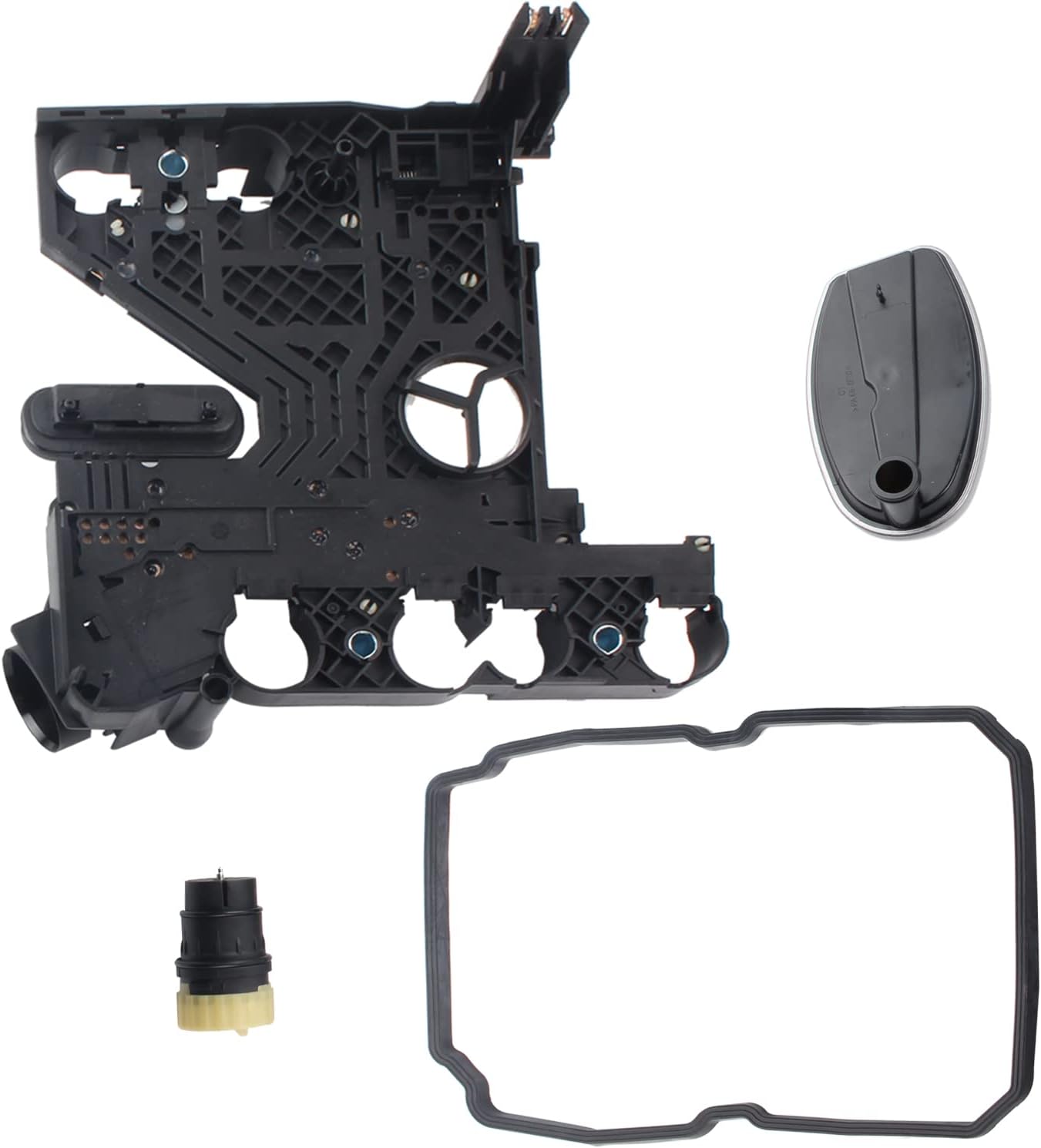
The 722.6 has no internal wiring harness. A plastic conductor plate on top of the valve body carries the six solenoids, the N2 and N3 sensors, the fluid temperature sensor and the Park/Neutral contact, and connects to the car through a 13-pin connector in a guide sleeve on the left side of the case. That gives you one place to test almost everything.
Unplug the harness by turning the tan collar counterclockwise until it clicks and pops out, then measure each solenoid against the common supply pin (pin 6) using the ATSG pin chart. ATSG's resistance specs:
- 1-2/4-5, 2-3 and 3-4 shift solenoids: 2.5 to 6.5 ohms each.
- Modulating pressure and shift pressure solenoids: 2.5 to 6.5 ohms each.
- TCC PWM solenoid: 2.0 to 4.0 ohms.
An open reading or a dead short confirms the circuit fault. If every solenoid reads in range at the case but the codes keep coming back, measure again from the TCM connector. Good at the case and bad at the TCM means the harness; good at both means look at supply voltage (P0702) and the TCM.
The fluid temperature sensor is a trap. ATSG explains that it is wired in series with the Park/Neutral reed contact, so the TCM only sees transmission temperature in Reverse or a forward gear; in Park or Neutral it substitutes engine temperature. Check it in R or D. ATSG's chart puts it at about 750 ohms at 20 C and about 957 ohms at 80 C, rising with temperature. A sensor reading wildly out of that curve will skew shift timing and pressure because the TCM adapts shift pressure to fluid temperature.
The Leaking Guide Sleeve and the Conductor Plate
Look at the connector before you condemn anything. Febi calls the guide sleeve seals a common source of oil leaks, and its bulletin goes further: when those O-rings fail, ATF can get into the harness plug, and metal particles suspended in the fluid can cause short circuits. ATSG notes the sleeve O-rings have been changed several times by the factory for leakage. If the connector has oil in it, replace the sleeve and its O-rings, clean the connector, and check whether oil has wicked up the harness toward the TCM. Fix the leak or the new parts will fail the same way.
When the plate itself fails, Febi lists the result as faulty signals, a warning light and limp-home mode. The N2 and N3 sensors are built into the plate, so a speed sensor code is fixed by a plate, not a separate sensor. The job is done from underneath:
- Drain the fluid warm and measure it, then let the unit cool before taking it apart.
- Unplug the 13-pin connector, remove the 7 mm screw in the center of the sleeve and pry the sleeve out.
- Drop the pan, pull the filter, remove the valve body bolts and lower the valve body, watching the selector plunger.
- Move the solenoids to the new plate in exactly the same positions. Febi notes the shift solenoids have no O-rings and the two pressure modulating solenoids have two each; check the port screens for debris while they are out.
- Torque the solenoid retaining bolts to 8 Nm and the valve body bolts to 8 Nm (ATSG: 71 in-lb). Install the sleeve with new lubricated O-rings and tighten its 7 mm screw to 2.5 Nm.
- Lock the harness plug by turning the collar clockwise to resistance, then about 30 degrees further until it clicks.
Fluid Level and Fluid Type
Shift complaints that only show up after the car is warm, or on hard turns and stops, are often fluid. Daimler's WIS procedure AR27.00-P-0100AC requires checking with the car on its wheels and the fluid above 80 C, confirmed on a scan tool with the selector in R or D, and warns that both under-fill and over-fill cause malfunctions. Most C-Class cars have no dipstick, so it takes a dipstick tool and a scan tool to get it right.
The fluid has to meet MB 236.14. Mercedes-Benz USA Star Bulletin S-B-00.40/89d (hosted by NHTSA) limits the 722.6 to 236.14 fluid, part number A001 989 68 03 10, and says 236.14 must never be mixed with 236.15 or 236.16. A C-Class topped off with a generic ATF or the blue 722.9 fluid can develop harsh or erratic shifts with good hard parts. If what drains out is dark and smells burnt, the clutches are already damaged and a fluid change will not bring the shift quality back.
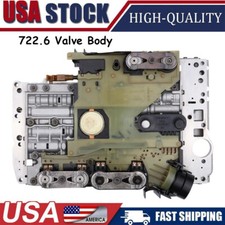
When the Problem Is the Valve Body
If the codes are clear, the electrical checks pass and the level is right, but the car still flares, bumps or bangs on a particular shift, the valve body is next. Sonnax's article by Mio Cundl describes the classic 722.6 complaint: engine flare on the 2-3 and 4-5 upshifts or a neutral flare on the 5-4 and 3-2 downshifts. The cause is wear in the outer bore of the working pressure regulator valve, which lets modulating solenoid signal oil leak past the valve so working pressure does not rise with load. Cundl writes that in 1998 many high-mileage cars repaired under Mercedes warranty had the same 2-3 flare putting the car into limp mode. The 1-2/4-5, 2-3 and 3-4 overlap sleeves sit in the same signal circuit, wear on the inside and leak on the outside, and drag working pressure down further.
Sonnax's 722.6/NAG1 vacuum test guide maps the symptom to the bore:
- 1-2 flare, bump or harsh shift: 1-2/4-5 overlap control valve and sleeve.
- 2-3 flare, bump or harsh shift: 2-3 overlap control valve and sleeve.
- 3-4 flare, bump or harsh shift: 3-4 overlap control valve and sleeve.
- No 2-3, 4-3 neutral, soft shifts under acceleration, delayed engagement: pressure regulator valve.
- Shift concerns in all forward gears, shift flares with codes: shift pressure regulating valve and the regulating valve pressure control valve.
- Harsh lockup: TCC damper valve (late units only).
Vacuum test those locations on the bench. One or two worn bores can be repaired with oversize valves and sleeves; a casting worn at several locations is usually cheaper to replace with a tested valve body. One more hard-parts note: ATSG points out that some 722.6 units got a dished cushion plate in the K2 clutch, likely added for harsh upshift and downshift complaints. If you are in the unit anyway, install it the way the manual shows.
The Diagnostic Order, Start to Finish
- Confirm the case tag reads 722.6, then pull TCM codes with a Mercedes-capable scan tool.
- Inspect the 13-pin connector and guide sleeve for oil. Fix any leak first.
- Measure solenoid resistances at the case, then at the TCM if needed. Check the temperature sensor in R or D.
- Several unrelated codes or a P0715: replace the conductor plate. A single solenoid code with an out-of-range reading: replace that solenoid.
- Set the fluid level hot with 236.14 fluid, clear all codes and road test.
- Flare or harsh shift with no codes: vacuum test or replace the valve body. Burnt fluid or slipping in gear: overhaul.
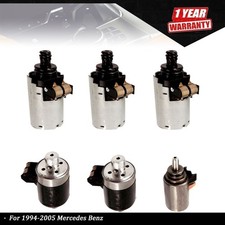
722.6 Shift Solenoid Kit, 1994-2005
If the ohm check finds an open or out-of-range shift solenoid, CoreTransmissionParts carries a 722.6 shift solenoid kit for the C-Class years, so you can replace the set while the valve body is down.
View the solenoid kit →Shop the 722.6 solenoid kit →
Frequently Asked Questions
Why is my Mercedes C-Class stuck in 2nd gear?
That is almost always the 722.6 limp mode. When the TCM sees an electrical fault it holds the current gear, and after the engine is shut off for 10 seconds and restarted the transmission only has 2nd gear (3rd on some models) and reverse. Read the TCM codes to find the fault, fix it, and clear all codes, or the limp mode stays on.
What is the resistance of a 722.6 shift solenoid?
ATSG lists the 1-2/4-5, 2-3 and 3-4 shift solenoids and the two pressure control solenoids at 2.5 to 6.5 ohms, and the TCC solenoid at 2.0 to 4.0 ohms. Measure each one against the common supply pin at the 13-pin case connector, then at the TCM if the case readings are good.
Can an oil leak at the transmission plug cause shift problems?
Yes. The 13-pin connector sits in a guide sleeve sealed by O-rings, and when they fail ATF can get into the harness plug. Febi notes metal particles in that fluid can cause short circuits, which shows up as solenoid or speed sensor codes and limp mode.
Why does my 722.6 flare on the 2-3 shift?
With no codes and the fluid level correct, a 2-3 flare usually points at the valve body. Sonnax ties it to wear in the working pressure regulator valve bore and the 2-3 overlap control valve and sleeve, which let signal oil leak so working pressure does not rise with load.
Sources
- ATSG (Automatic Transmission Service Group), "Mercedes, Jaguar, Daimler/Chrysler 722.6 5 Speed" technical manual (2009). Backs the solenoid application chart (shift solenoids on only during the shift), the limp mode and 10-second restart behavior, the three-key-cycle rule, loss of drive, the DTC table (P0753, P0758, P0763, P0748, P0743, P0702, P0715, P0705), the 2.5-6.5 ohm and 2.0-4.0 ohm solenoid specs, the TFT/Park-Neutral series circuit and resistance chart, the 8 Nm (71 in-lb) valve body torque, the sleeve O-ring changes, and the K2 dished cushion plate. w124performance.com (PDF)
- Febi Bilstein technical bulletin, "Mercedes Benz Conductor Plate" (July 2013). Backs the conductor plate component list, failure leading to warning light and limp-home, fault codes from plate devices, no pressure taps, the guide sleeve seal leaks and oil entering the harness plug, the removal steps, the 8 Nm and 2.5 Nm torques and the 30-degree collar lock. techtips.ie (PDF)
- Sonnax Technical Resource 129, "Mercedes 722.6, Daimler W5, Porsche W5, Jaguar 722.6" (Mio Cundl). Backs the 2-3/4-5 upshift flare and 5-4/3-2 neutral flare complaint, working pressure regulator bore wear, the 1998 warranty cars with 2-3 flare and limp mode, and overlap sleeve wear. sonnax.com
- Sonnax, "Mercedes 722.6/Chrysler NAG1 Vacuum Test Guide." Backs the symptom-to-valve list for the overlap control valves, pressure regulator valve, shift pressure regulating valve and TCC damper valve. sonnax.com
- Daimler AG WIS AR27.00-P-0100AC, "Check oil level in automatic transmission and correct if necessary," Transmission 722.6. Backs the on-wheels, above-80 C level check with temperature confirmed in R or D, and the under/over-fill warning. mbclub.ru (PDF)
- Mercedes-Benz USA Star Bulletin S-B-00.40/89d, "Operating Fluid Specification Changes for Automatic Transmission" (NHTSA-hosted). Backs the 236.14-only requirement for the 722.6, part number A001 989 68 03 10, and the never-mix rule. static.nhtsa.gov (PDF)
Shop conductor plates, solenoid kits and valve bodies for the C-Class 722.6, on our own secure checkout.
Shop 722.6 parts →