A W163 ML with a "shift problem" usually comes in with one of four complaints: it will not upshift, it starts in 2nd, it bangs into a gear, or the revs flare between gears. On the 722.6 those four complaints trace back to a short list of parts: the conductor plate and its 13-pin plug, the shift lever's range switch, a broken spring in the valve body, or worn bores and overlap sleeves. Clutch packs come later, if at all.
Every first-generation ML, the 1998-2005 ML320, ML350, ML430, ML500 and ML55 AMG, uses the electronically controlled 722.6 five-speed. This is how we sort out shift complaints on these trucks, using the ATSG, Sonnax and factory numbers so you are not guessing at the parts counter.
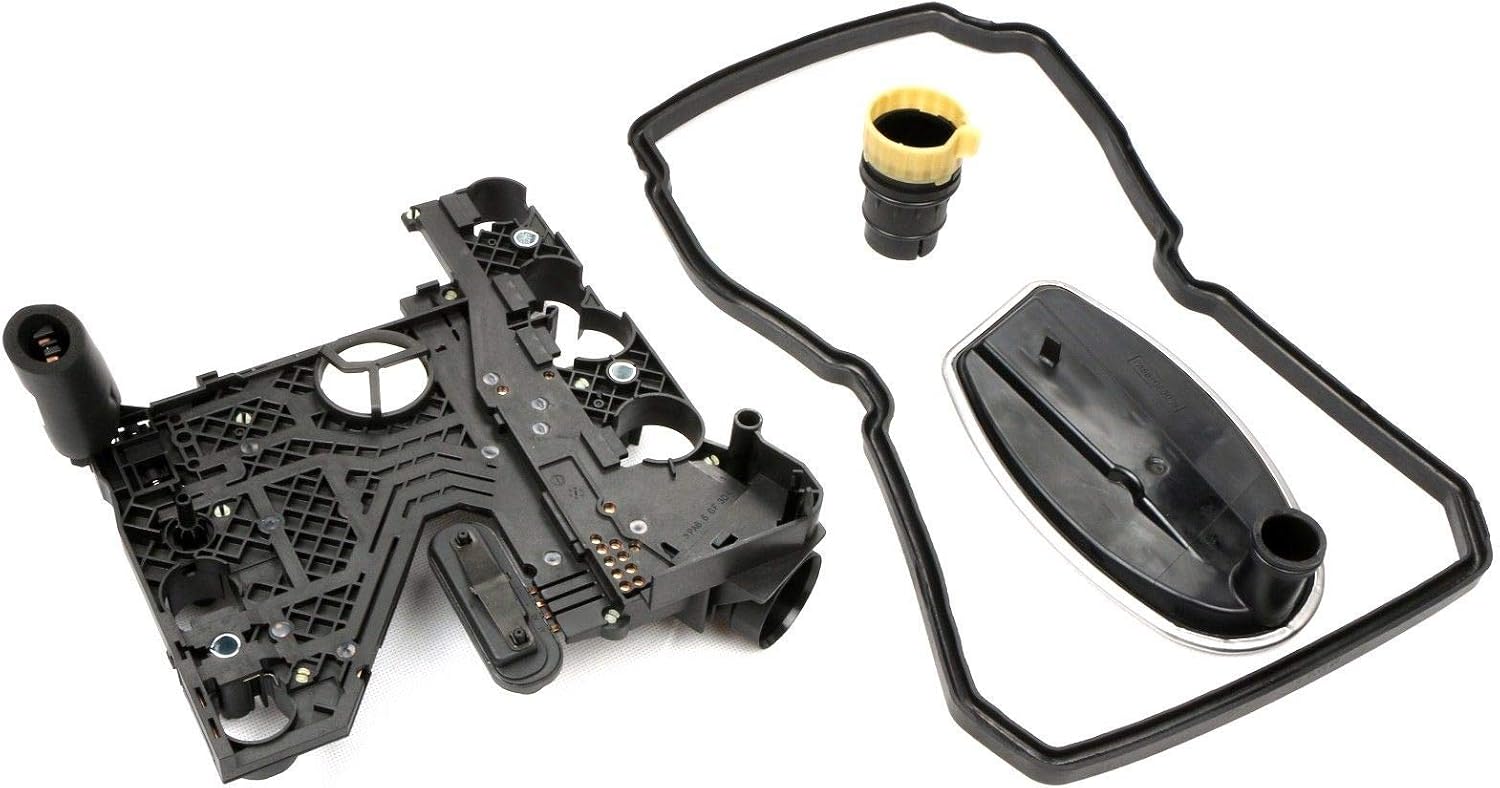
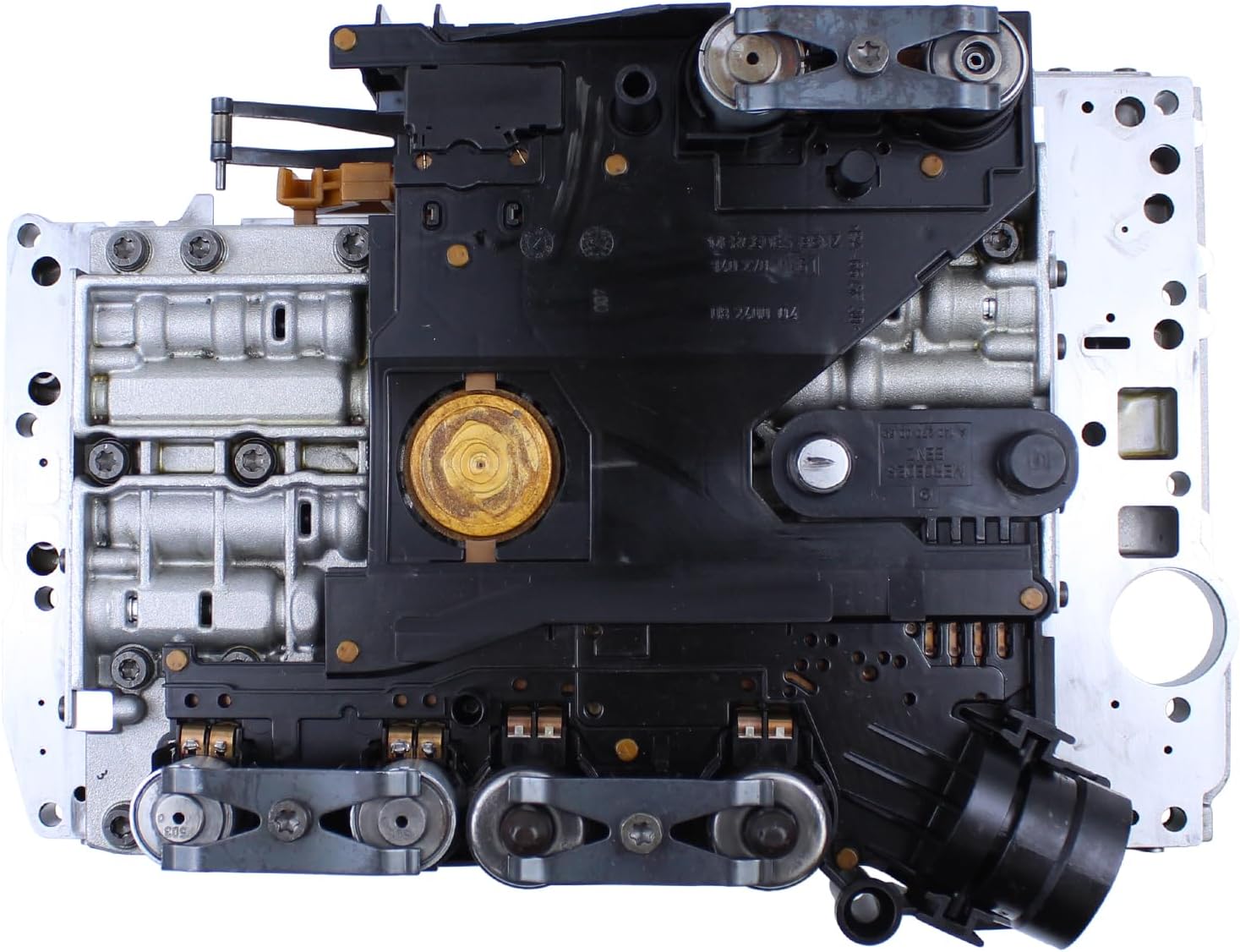
How the 722.6 Makes a Shift
You need the control layout in your head before the codes make sense. All the electrical parts live on one assembly bolted to the top of the valve body: the conductor plate. ATSG's manual lists six solenoids on it:
- Three on/off shift solenoids: 1-2/4-5, 2-3 and 3-4. Each is normally closed and sealed with two O-rings. The TCM switches one on to start a shift, then switches it off again once the shift is done, and they stay off while the truck is in gear.
- Modulating pressure control (MPC): a PWM solenoid that sets working (line) pressure. Low exhaust gives high line pressure, and it moves with the throttle.
- Shift pressure control (SPC): a PWM solenoid that sets clutch pressure during the shift and the clamping force that keeps a clutch from slipping afterward.
- TCC solenoid: a PWM solenoid that ramps the multi-disc converter clutch on and off, in 2nd through 5th.
The plate also carries the N2 and N3 Hall-effect input speed sensors and the fluid temperature sensor, wired in series with the Park/Neutral reed contact. The febi bilstein conductor plate bulletin makes the point every tech needs to hear: the transmission has no pressure taps and no pressure transducers, so any "pressure" your scan tool shows is calculated from the PWM commands, not measured. The TCM finds a bad shift by comparing speeds. If you understand that, you can see why a sensor fault can look like a mechanical failure.
ATSG also explains the failsafe. Because the shift solenoids are off while the truck is in gear, an electrical fault leaves the transmission in whatever gear it had. After the truck stops, the engine is off for 10 seconds and it restarts, it comes up in 2nd (3rd on some models) with reverse.
Step 1: Make Sure It Is Not Normal Behavior
Some ML "shift problems" are the truck doing what it was designed to do. The 2001 M-Class operator's manual covers three of them:
- Cold delayed upshift. In D, 4 or 3 the 1-2 and 2-3 upshifts are held late so the catalytic converter heats up faster. The manual says this works below 31 mph (50 km/h) at part throttle with the engine under 95 F (35 C), and warns the owner that the late shift and extra engine noise "might be perceived as a malfunction." A customer who only drives cold, short trips will describe this as "it won't shift."
- Downshift lockout. If the driver selects a lower range and the downshift would over-rev the engine, the manual says the transmission will not downshift. That is not a fault.
- Adaptive shift points. The manual states the shift process "is continuously adapted" to driving style and conditions. A truck that has been driven gently and is then driven hard will shift differently for a while.
Then check the S/W switch. ATSG notes that Winter mode gives a 2nd-gear start in D and a 1.93:1 reverse instead of 3.16:1. A truck left in W pulls away in 2nd every time, which owners tend to call "stuck in second."
Step 2: Read the Codes Before You Touch Anything
A truck that is truly stuck in 2nd after a key cycle has stored a code. Pull codes with a scan tool that can read the Mercedes TCM, not just generic OBD. ATSG's code table covers the shift circuits:
| OBD code | Circuit (per ATSG) | Limp mode |
|---|---|---|
| P0753 | 1-2/4-5 shift solenoid circuit | Yes |
| P0758 | 2-3 shift solenoid circuit | Yes |
| P0763 | 3-4 shift solenoid circuit | Yes |
| P0743 | TCC (PWM) solenoid circuit | - |
| P0748 | MPC solenoid circuit, and also SPC solenoid circuit | Yes |
| P0702 | Solenoid supply voltage out of range | - |
| P0715 | N2/N3 sensor supply, N2, N3 or N2-to-N3 comparison | - |
Two things in that table catch people out. First, P0748 is shared by MPC and SPC, so the generic code does not tell you which pressure solenoid failed. You need the Mercedes-specific code number (ATSG lists 102 for MPC and 103 for SPC). Second, ATSG notes that once repairs are made, every stored code must be cleared or the limp-mode lockout stays active. If the same code sets on three key cycles in a row, the TCM will not recover on its own.
Step 3: Test the Conductor Plate From the 13-Pin Plug
febi's bulletin puts most 722.6 shift and engagement complaints that come with a check-engine light and limp mode down to failed contacts on the conductor plate. You can test the whole plate without dropping the pan. ATSG's case connector chart gives the pinout:
| Pin | Function |
|---|---|
| 1 | N3 input speed sensor signal |
| 2 | MPC solenoid ground control |
| 3 | N2 input speed sensor signal |
| 4 | Fluid temp sensor and P/N contact signal |
| 6 | Battery supply for all solenoids |
| 7 | Sensor supply voltage |
| 8 / 9 / 13 | 2-3 / 3-4 / 1-2/4-5 shift solenoid ground |
| 10 | SPC solenoid ground control |
| 11 | TCC solenoid ground control |
| 12 | Sensor ground |
With the plug off, measure from pin 6 to each ground pin. ATSG's specs are 2.5-6.5 ohms for the three shift solenoids, MPC (6 and 2) and SPC (6 and 10), and 2.0-4.0 ohms for the TCC solenoid (6 and 11). A reading that is open, or one that drifts while you flex the plug, means the plate or the adapter sleeve has failed. febi gives a 4-8 V supply on the speed sensor feed, and 800-1200 ohms for the temperature circuit at 20 C, with the selector in D or R. In P or N the reed contact is open and the circuit reads open. That is normal, and it is why ATSG says the TCM uses engine temperature in Park and Neutral.
Look at the plug itself before you condemn the plate. ATSG describes the case connector as an adapter sleeve sealed by two O-rings and held with a captured brass screw. When those O-rings harden, ATF leaks past them and wicks up the harness. If the connector is wet, replace the adapter sleeve and its seals along with the plate (febi lists the guide sleeve with new seals as part of the job). Also check the harness back toward the TCM for oil, because a harness full of ATF will keep causing faults after a new plate goes in.
Step 4: Do Not Forget the Shift Lever
An ML that will not upshift, or that is slow to engage, with no solenoid codes, may have a bad range switch. ATSG explains that the transmission range recognition switch (TRRS) is built into the shift lever assembly in the center console, and it "is a commonly failed device that produces complaints such as delayed engagements or no up-shifts." Water from an open sunroof or a spilled drink is all it takes to damage it. A stuck manual-low indicator in the gear display, whatever the lever position, is a strong clue. ATSG notes the switch is hard-wired to the TCM on 1996-1999 models and reports over the CAN bus on 2000-up models, so the later trucks need a scan tool that can read the lever data. The switch is not sold separately. The whole shift lever assembly gets replaced.
Step 5: Set the Fluid Level Hot
The level has to be right before any shift-quality judgment means anything. There is no dipstick. Daimler's WIS procedure AR27.00-P-0100AC uses the service dipstick (tool 140 589 15 21 00) through the locked filler tube, with the truck level, and says a precise reading is only possible above 80 C. WIS lists dry-fill capacities for the model 163 units of 7.6-8.0 liters (722.673) and 8.8-9.2 liters (722.674), and warns that both under- and over-filling cause malfunctions. Use MB 236.14 fluid only. Read fluid temperature on the scan tool in D or R, for the reed-switch reason above.
Step 6: The Valve Body Causes
If the electrical checks pass and the level is right, the shift problem is in the hydraulics. Three failures account for most of them.
Broken regulating pressure control valve spring
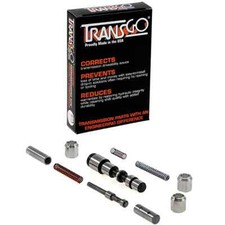
Sonnax's part page for the 68942-01 spring says delayed engagement into Drive or Reverse, flared 2-3, 3-4 and 4-5 upshifts and flared kickdowns are most often caused by a broken regulating pressure control valve spring. It usually breaks in the middle, and the two halves screw into each other, which shortens the spring and changes line pressure. ATSG makes the same call on the first-design control valve pressure regulator spring and gives the Mercedes replacement part number as 140 993 58 01. The Sonnax spring fits '99-and-earlier units with two valves in the control pressure regulator bore, which covers the early ML320 and ML430.
Working pressure regulator bore wear
Sonnax Technical Resource 129, by Mio Cundl of D.B. Automobile in Berlin, explains the flare under load. The outer bore of the working pressure regulator valve wears, and pMod solenoid signal oil leaks past the boost end of the valve. Working pressure then stops rising with engine load, and the transmission flares on 2-3 and 4-5 upshifts or drops into neutral on 5-4 and 3-2 downshifts. He writes that in 1998 many high-mileage cars repaired under Mercedes warranty had the same 2-3 flare, bad enough to set limp mode, and that the cause was valve body material that was not hard enough. The repair is a hardened bushing and a new valve, after a vacuum test confirms the leak.
Worn overlap sleeves
The 1-2/4-5, 2-3 and 3-4 overlap sleeves are in the same pMod circuit. Sonnax says they commonly wear on the inside and leak on the outside, and any of them leaking cuts pressure at the working pressure valve. ATSG's tip is to look for shiny patches inside the sleeves and keep each sleeve with its own valve, because the inside diameters differ. Sonnax sells all three as kit 68942-05K. Run the Sonnax 722.6/NAG1 vacuum test on the sleeves and the regulator bore before you replace the whole valve body.
Step 7: Harsh Shifts and Clutch Wear
A bang into gear with good fluid and clean codes is a different problem from a flare. Because the 722.6 shifts clutch to clutch, the TCM is timing one clutch releasing against another applying, and it adapts that timing over time. If a pack has been slipping, the TCM keeps raising pressure to compensate, and the shifts get firmer and firmer until the friction is gone. That is why a harsh-shift complaint on a high-mileage towing ML often turns into a rebuild. One detail from ATSG's K2 section: a dished cushion plate was added to the K2 clutch on some models, which ATSG believes was "probably added because of harsh upshift or downshift concerns." When you rebuild, put back the cushion plate that was in the unit and set every clutch clearance to spec.
Do not swap random solenoids to cure a harsh shift. ATSG notes the MPC and SPC solenoids are interchangeable with each other, and the three shift solenoids with each other, but they work as a matched system with the valve body. Fix the bores and springs first, then reset the adaptations and road test.
W163 ML Symptom Chart
| Symptom | Check first |
|---|---|
| Late 1-2 / 2-3 when cold, fine when warm | Normal warm-up program (below 31 mph, engine under 95 F) |
| Starts in 2nd, normal otherwise | S/W switch in W |
| Stuck in 2nd after restart, CEL on | Codes, 13-pin plug, conductor plate |
| No upshift, no solenoid codes | Shift lever TRRS, fluid level |
| Delayed engagement plus 2-3/3-4/4-5 flare | Regulating pressure control valve spring |
| Flare only under load, 5-4/3-2 neutral flare | Working pressure bore and overlap sleeves (vacuum test) |
| Harsh shifts that get worse over months | Clutch wear, then a rebuild |
722.6 Shift Solenoid Kit 1994-2005
When the ohms test at the 13-pin plug fails a solenoid circuit: CoreTransmissionParts carries a 722.6 shift solenoid kit for the 1994-2005 range, which takes in every W163 ML model year.
View the 722.6 solenoid kit →Shop 722.6 shift parts →
Frequently Asked Questions
Why is my Mercedes ML stuck in second gear?
Usually the TCM has put the transmission in limp mode after an electrical fault, such as a failed conductor plate or a leaking 13-pin connector. After a restart a 722.6 in limp mode gives only 2nd and reverse. Check first that the S/W switch is not in W, because Winter mode also starts the truck in 2nd.
What causes a delayed engagement and flared shifts on a 722.6?
Sonnax names a broken regulating pressure control valve spring as the most common cause of delayed engagement into Drive or Reverse with flared 2-3, 3-4 and 4-5 shifts. The spring breaks in the middle, its halves screw together, and line pressure changes. On '99-and-earlier units with two valves in the regulator bore, Sonnax sells a stronger replacement, part 68942-01.
How do I test the 722.6 shift solenoids without removing the pan?
Unplug the 13-pin connector at the case and measure from pin 6, the solenoid supply, to each solenoid ground pin. ATSG gives 2.5-6.5 ohms for the three shift solenoids and the MPC and SPC solenoids, and 2.0-4.0 ohms for the TCC solenoid. An open circuit, or a reading that changes when you move the plug, points to the conductor plate or the adapter sleeve.
Is a late upshift on a cold ML a transmission problem?
Not always. The M-Class operator's manual says the 1-2 and 2-3 upshifts are delayed below 31 mph at part throttle while the engine is under 95 F, so the catalytic converter heats up faster. If the shifts are normal once the truck is warm, nothing is wrong.
Sources
- ATSG (Automatic Transmission Service Group), Mercedes 722.6 Technical Service Information manual (2009). Backs the solenoid descriptions and application chart, the failsafe and limp-mode behavior, the DTC table (P0753, P0758, P0763, P0743, shared P0748, P0702, P0715) and the three-key-cycle rule, the 13-pin case connector pinout and adapter sleeve, the solenoid resistance specs, the TRRS failure note, the S/W reverse ratios, spring part number 140 993 58 01, the overlap sleeve kit 68942-05K and the K2 cushion plate note. w124performance.com (PDF)
- Sonnax Technical Resource 129, Mio Cundl, "Mercedes 722.6, Daimler W5, Porsche W5, Jaguar 722.6" (2009). Backs the working pressure regulator bore wear and pMod leak, the 2-3/4-5 and 5-4/3-2 flare symptoms, the 1998 warranty limp-mode history, and overlap sleeve wear in the pMod circuit. sonnax.com
- Sonnax, 722.6 Regulating Pressure Control Valve Spring, part 68942-01. Backs the delayed engagement and 2-3/3-4/4-5 and kickdown flare symptoms, the broken spring as the most common cause, how the spring breaks, and the '99-earlier two-valve fitment. sonnax.com
- Mercedes-Benz, M-Class Operator's Manual, ML 320 / ML 430 / ML 55 AMG (USA Edition B 2001). Backs the cold delayed-upshift program (below 31 mph, engine under 95 F), the downshift over-rev lockout and the adaptive shift statement. archive.org (PDF)
- Daimler AG WIS AR27.00-P-0100AC, "Check oil level in automatic transmission and correct if necessary," Transmission 722.6. Backs the dipstick tool 140 589 15 21 00, the above-80 C check, the model 163 capacities for 722.673 and 722.674, and the under/over-fill warning. mbclub.ru (PDF)
- febi bilstein / Blue Print Technical Bulletin, "Mercedes Benz Conductor Plate" (2013). Backs conductor plate contact failure as a cause of shift faults and limp mode, the no-pressure-sensor point, the 4-8 V sensor supply, the 800-1200 ohm temperature circuit in D or R, and the guide sleeve with new seals in the repair. techtips.ie (PDF)
The vacuum test in Step 6 is Sonnax's "Mercedes 722.6/Chrysler NAG1 Vacuum Test Guide" (sonnax.com).
Shop conductor plates, solenoid kits, shift kits and valve bodies for the W163 ML 722.6, on our own secure checkout.
Shop 722.6 parts →