No reverse is one of the complaints that makes a customer assume the worst, and on a Mercedes 722.6 it can genuinely be a $20 connector or a $400 in-case repair — the symptom alone doesn't tell you which. The good news is that this unit only has a handful of places a reverse-only complaint can actually come from, and they fail at very different rates. Work through them in order and you will usually land on the real cause before you've spent an hour on the car.
This post is built from Sonnax's documented wear conditions for the 722.6/NAG1 valve body, a febi/Bilstein technical teardown of the conductor plate, Transmission Digest's factory-sourced breakdown of the shift strategy, and Mercedes-Benz's own fluid service bulletin. Sources are listed at the end.

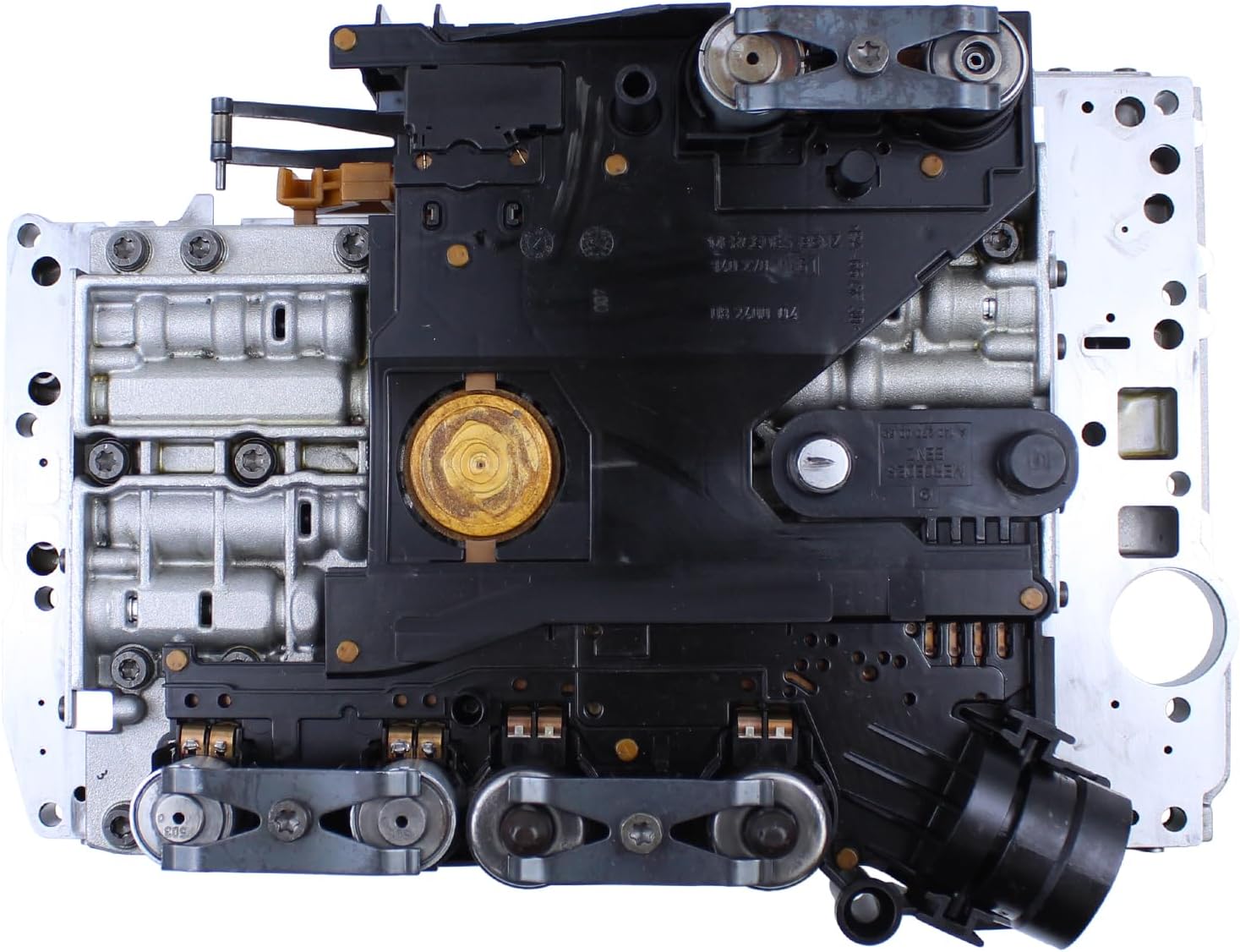

Three Places a No-Reverse Complaint Can Start
Unlike a shift-feel complaint that can come from a dozen places inside the valve body, a true no-reverse (or reverse-only-when-cold, or reverse-with-a-long-delay) complaint on the 722.6 narrows down fast, because Reverse uses its own dedicated hardware that Drive never touches. The three places to check, in the order they actually fail on real cars, are the conductor plate and its connector (electrical), the manual valve and pressure regulator bore inside the valve body (hydraulic), and the B3 reverse brake clutch pack itself (mechanical). Everything else — low fluid, the wrong fluid, a sticking selector cable — is cheap to rule out first and belongs at the top of any test drive.
Cause 1: Conductor Plate, Connector and the Reed Switch (Check This First)
The conductor plate is the internal wiring and connector board bolted to the top of the valve body, and on the 722.6 it carries more than just the solenoid and speed-sensor wiring. A febi/Bilstein technical teardown of the part lists a reed switch on the plate that is closed by a magnet on the selector-shaft plunger and is wired in series with the fluid temperature sensor specifically to signal Park and Neutral to the TCM and the starter-inhibit circuit. If that reed switch or its wiring is faulty — or if ATF has wicked into the 13-pin external connector through worn guide-bush O-rings, which febi's documentation identifies as the same failure path that lets metal-contaminated fluid short the harness — the TCM can receive bad range data and simply refuse to command Reverse, even though the hydraulic side of the transmission is perfectly healthy.
This is the cheapest possible cause to rule out and should be checked before anything else. Pull the 13-pin connector and look for fluid weeping out of it, corrosion on the pins, or a discolored, oil-soaked harness running back toward the conductor plate. Cycle the selector through every position while watching range data on a scan tool; a range signal that doesn't match the lever position, or drops out intermittently, points straight at the plate or connector rather than anything mechanical.
Cause 2: Manual Valve Bore Wear (Sonnax-Documented, Often No Code)
If the electrical side checks out, the next place to look is the manual valve and pressure regulator bore, and this is the cause that gets missed most often because it frequently sets no fault code at all. Sonnax's own vacuum test documentation for the 722.6/NAG1 lists the manual valve bore by name, with the exact symptom set of low line pressure, no 2-3 shift, 4-3 neutral, delayed Drive/Reverse, soft shifts under acceleration, and slip codes — all traced to a worn or damaged valve body casting at that bore. The pressure regulator valve, which shares the same wear-prone bore area, is separately documented by Sonnax as a cause of delayed engagement and loss of torque converter lockup when it wears.
Sonnax's part-specific documentation for this unit adds a second, related failure: a broken regulating pressure control valve spring. The spring usually snaps near its middle, and as the two halves screw into each other the spring's effective length changes, which throws off line pressure control. Sonnax lists delayed engagement into Drive or Reverse among the direct symptoms of this exact failure, alongside flared 2-3, 3-4 and 4-5 upshifts. Both of these are purely mechanical wear conditions inside the valve body casting, which is exactly why they can produce a real, repeatable no-reverse complaint with a completely clean code scan.
The fix for worn manual valve or pressure regulator bores is Sonnax's oversized valve and sleeve kit (part 68942-07K, or the sleeve-only version 68942-06), which restores the bore without replacing the whole casting, reamed in with Sonnax's dedicated tooling. A broken regulating pressure control valve spring is replaced directly. In practice, most independent shops doing volume 722.6 work find it faster and more reliable to swap in a remanufactured or new valve body with solenoids outright rather than ream and sleeve a worn casting bore by bore, especially if the unit already has other age-related wear.
Cause 3: Worn B3 Reverse Clutch Pack
If the connector checks out and a line-pressure or vacuum test clears the valve body, the remaining cause is the B3 brake itself — the clutch/brake assembly that actually produces Reverse. The 722.6 does not use a reverse band like older Mercedes transmissions; from the 722.3 onward it uses a dedicated multi-disc clutch for the job, and Sonnax's own vacuum-test checkball reference for this unit lists a distinct "B3 Clutch Exhaust" circuit in the lower valve body, confirming it as its own separate hydraulic path from the forward clutches (K1, K2, K3) and brakes (B1, B2). Because B3 only does work in Reverse, wear here produces a complaint that is isolated to Reverse and shows up as a very specific, repeatable pattern: engagement that takes longer and longer to happen over weeks or months, gets noticeably worse once the transmission is fully warmed up, and eventually requires blipping the throttle a few times to build enough pressure before Reverse finally catches. That progression — slow at first, worse hot, eventually absent — is the classic signature of a friction clutch pack losing material, not an electrical fault, which tend to be sudden and consistent rather than gradual.
A worn B3 pack is an in-the-case repair. There is no external adjustment or valve body swap that fixes worn friction material; the transmission has to come out and open up to replace the clutch pack, which is also the point at which most shops inspect and replace every other friction element while they're in there rather than chase this one pack again in another 40,000 miles.
How to Work the Diagnosis in Order
- Check the fluid first. Confirm the level is correct per the factory hot-check procedure and that it's actually MB 236.14 (ATF 134) — low or wrong fluid is the cheapest possible explanation and costs nothing to rule out before anything else.
- Scan for codes and watch live range data. A range-sensor mismatch or dropout while cycling the selector points at the conductor plate, connector or reed switch before you touch the valve body.
- Inspect the 13-pin connector and harness for fluid intrusion, corrosion, or a discolored harness run — the single most common root cause on this unit, and the fastest to fix.
- Pull a line-pressure or vacuum-test reading on the manual valve and pressure regulator bore if the connector and codes are clean. This catches the Sonnax-documented bore wear and spring failure even with no code set.
- Note the engagement pattern. A delay that has been slowly getting worse over time, especially hot, points at the B3 clutch pack itself rather than anything upstream of it.
The Fix and What It Costs
If the conductor plate or 13-pin connector is the root cause, it's a bolt-in repair once the pan and valve body are dropped — no internal teardown required, and by far the cheapest and most common fix for this complaint. Expect roughly $85-$125 in parts for a conductor plate, filter and gasket kit plus shop labor to drop the pan and valve body. If a line-pressure test confirms worn manual valve or pressure regulator bores, or a broken regulating pressure control valve spring, that's also a valve-body-level repair — either a Sonnax bore repair kit in a shop set up to ream and sleeve it, or a direct-fit replacement valve body with solenoids, which most independent shops find faster and more predictable. If the B3 clutch pack itself has worn friction material, that's a full in-case repair, and most shops price it as part of a master rebuild rather than opening the case just to touch one clutch pack.
After any valve body or in-case repair, don't skip the adaptation relearn. Transmission Digest's coverage of Mercedes-Benz transmission adaptations notes that these control systems are fully adaptive and will illuminate a warning if the system sees adaptive values outside the expected range after a repair, so a test drive or scan-tool relearn procedure matters as much as the parts themselves.
722.6 Master Transmission Rebuild Kit
Full friction, steel, seal and gasket kit for a 722.6/NAG1 in-case repair — the right call once a worn B3 clutch pack is confirmed.
View the 722.6 master rebuild kit →Shop 722.6 parts →
Frequently Asked Questions
Why won't my Mercedes 722.6 go into reverse?
The three most common causes, in order of how often they actually show up, are a conductor plate or 13-pin connector fault that drops a sensor or reed-switch signal and makes the TCM think the selector isn't where it actually is, wear in the manual valve/pressure regulator bore that Sonnax documents as a direct cause of delayed Drive and Reverse engagement, and a worn B3 reverse brake clutch pack that has lost friction material. Start with the cheapest check (the connector) and work toward the most expensive (an in-case repair).
What does it mean if reverse takes longer and longer to engage?
A reverse engagement delay that grows over weeks or months, especially after the transmission is fully warmed up, is the classic wear pattern for a friction clutch pack that is losing its hold: the B3 reverse brake. As the frictions wear, it takes longer for the piston to take up clearance and build enough apply pressure to stop slipping before the vehicle actually moves. Eventually, especially hot, it may not engage at all until the driver blips the throttle to raise line pressure.
Is a no-reverse complaint the conductor plate or something inside the valve body?
It can be either, which is why the diagnosis has to be worked in order rather than guessed. A conductor plate or connector fault is electrical and usually accompanies a stored speed-sensor or range-switch code, and it affects Drive as well as Reverse in many cases. Worn manual valve or pressure regulator bores are mechanical and Sonnax's own documentation lists this exact wear condition as a cause of delayed Drive and Reverse with no code required. A worn B3 clutch pack is also mechanical but isolated to Reverse specifically, since it is not part of any forward gear's clutch group.
What is the B3 clutch on a 722.6?
B3 is the brake assembly that holds a planetary member stationary to produce Reverse on the 722.6/NAG1. Sonnax's own vacuum test documentation for this unit lists a dedicated B3 Clutch Exhaust checkball location in the lower valve body, confirming it as a distinct hydraulic circuit from the forward clutches (K1, K2, K3) and brakes (B1, B2). It only does work in Reverse, which is why a worn B3 pack produces a Reverse-only complaint.
What fluid does the 722.6 use?
Mercedes-Benz star bulletin S-B-00.40/89d specifies operating fluid sheet 236.14 (ATF 134), red in color, part number A001 989 68 03 10, for every 722.6. The bulletin is explicit that this is the only approved oil for the unit and that it must not be mixed with the blue 236.15 or gold 236.16 fluids used on later 722.9 and 725.0 transmissions.
Sources
- Sonnax — "Mercedes 722.6/Chrysler NAG1 Vacuum Test Guide" (Critical Wear Areas & Vacuum Test Locations). Backs the manual valve bore's documented symptom set (low line pressure, no 2-3, 4-3 neutral, delayed Drive/Reverse, soft shifts under acceleration, slip codes), the shared pressure regulator valve bore's symptoms (no lockup, delayed engagement), the oversized valve/sleeve repair parts (68942-07K, 68942-06), and the lower-valve-body checkball table confirming a dedicated B3 Clutch Exhaust circuit separate from the K1/K2/K3 and B1/B2 forward hardware. sonnax.com
- Sonnax — "Regulating Pressure Control Valve Spring," part 2313, 722.6/NAG1 application. Backs the broken-spring failure mode, the mechanism by which the two halves screw together and change the spring's effective length, and the documented symptom list of delayed engagement into Drive or Reverse plus flared 2-3, 3-4 and 4-5 upshifts. sonnax.com
- febi (Bilstein Group) — "Mercedes Benz Conductor Plate" technical document (FTEC005). Backs the conductor plate's reed switch wired in series with the fluid temperature sensor to signal Park/Neutral, the guide-bush O-ring failure path that lets ATF and metal contaminants reach the 13-pin harness connector, and the roughly 5-liter refill quantity on a conductor plate service. partsfinder.bilsteingroup.com (PDF)
- Transmission Digest — Wayne Colonna, "The 722.6 Shift Strategy" (February 1, 2005). Backs the shift-group architecture, the shift-solenoid logic, and the broader hydraulic control strategy used to establish how Reverse's dedicated hardware differs from the forward shift groups. transmissiondigest.com
- Transmission Digest — "Mercedes-Benz Transmission Adaptations" (February 26, 2026). Backs the fully adaptive nature of Mercedes-Benz transmission control systems, the warning-lamp behavior when adaptive values fall outside the expected range, and the need for a post-repair relearn procedure. transmissiondigest.com
- Mercedes-Benz USA / Mercedes-Benz Canada — Star Bulletin S-B-00.40/89d, "Operating Fluid Specification Changes for Automatic Transmission" (November 6, 2013). Backs the 722.6 fluid specification: ATF 134, BeVo sheet 236.14, red color, part number A001 989 68 03 10, and the incompatibility note against the blue 236.15 and gold 236.16 fluids used on later units. static.nhtsa.gov (PDF)
Shop 722.x conductor plates, valve bodies and rebuild kits, shipped fast from the USA.
Shop 722.x parts →