A 9HP48 noise complaint usually arrives with only a vague description: "it whines," "it clunks when I step on it," or "something grinds underneath." On a 948TE Cherokee, Renegade, Compass or Chrysler 200, those three complaints can come from at least five places: the chain-driven pump, the transfer gear and differential bearings, the two dog clutches, driveline lash that software is supposed to manage, and, on Active Drive AWD units, the power transfer unit bolted to the side of the case. Two of these get fixed with a laptop. One is a factory warranty extension. The rest mean pulling the transmission.
Below, the noise is sorted by when it happens. Chrysler builds its own version as the 948TE, so confirm the unit before ordering parts (Transmission Digest, Part 1).
The short version: A whine that follows engine rpm in Park points at the pump, its chain, or fluid starvation. A whine or growl that follows road speed points at the transfer gear or differential bearings (both are tapered roller bearings). A clunk on tip-in from a coast in 5th or 6th at 30-45 mph on a 2019 3.2L Cherokee is covered by TCM flash 21-045-20. A grinding noise with P1720 or P215C on a 2014-2017 Cherokee with Active Drive II is the PTU input spline, covered by warranty extension 21-014-23. Check the fluid level the right way before any of it.
First, Classify the Noise
On the road test, note whether the noise follows engine rpm, road speed, or a specific shift or throttle change, and whether it is there in Park.
| When you hear it | Likely source | First check |
|---|---|---|
| Whine in Park/Neutral, climbs with engine rpm | Pump, pump chain, starvation | Fluid level at temperature |
| Whine or growl that tracks road speed, any gear | Transfer gear or differential bearings, PTU on AWD | Coast in Neutral at speed; AWD vs FWD |
| Clunk on throttle after coasting, 5th/6th, 30-45 mph | Driveline lash, TCM calibration | Software level vs 21-045-20 |
| Bump on a 2-1 coastdown with light or no brake | TCM calibration | Software level vs 21-045-20 |
| Clunk or bang on a 4-5 or 5-4 shift | F dog clutch release/engagement | Ratio and dog clutch DTCs |
| Grinding underneath, P1720 or P215C, may not move | PTU input spline (Active Drive II) | Build date vs 21-014-23 |
Whine That Follows Engine RPM: The Pump
Transmission Digest describes the 9HP48 pump as a chain-driven, remote-axis, dual-chamber vane pump similar to the 8HP pump, inside the bell housing, with its drive gear using four flats that mesh with the converter hub (Transmission Digest, Part 1). It turns whenever the engine runs, in any range.
That gives you a clean test. In Park, raise engine speed slowly to about 2,500 rpm and back down. A whine that rises and falls with the tach, with the vehicle stationary, lives in the pump circuit or the converter. The usual causes, in order of how often they turn out to be the answer:
- Low fluid and aeration. The 948TE has no bottom pan and the filter is internal, so a slow leak goes unnoticed. When the pump starts pulling air, you get a buzzing whine that often comes and goes on turns and stops. Transmission Digest also notes an external hydraulic line at the back of the case that can blow out with age (Part 1). Check there when the level is low and the source is not obvious.
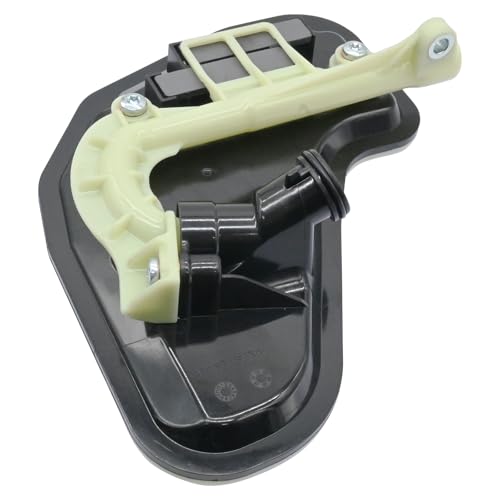
- A leaking filter neck or tube O-ring. The Filtran filter's outlet neck fits into the pump housing, and a bypass tube from the valve body to the filter outlet uses O-rings (Transmission Digest, Part 1). A hard or cut O-ring on the suction side lets the pump draw air even with a correct level.
- Chain and drive wear. Transmission Digest compares the pump chain to the 6T70's and says to check it for wear. A stretched chain gets louder as it wears and eventually rides badly on the sprocket teeth.
If the level and fluid are good and the whine still climbs with rpm, the pump and chain are inside the bell housing and the transmission has to come out. See the 9HP48 pump failure guide.
Whine or Growl That Follows Road Speed: Transfer Gear and Differential
If the noise is silent in Park, silent while revving in Neutral, but appears and climbs with road speed regardless of gear, it is downstream of the gearset. On the 9HP48, both the transfer gear and the differential are supported by tapered roller bearings, and the transfer gear/pinion gear has the park gear made onto it (Transmission Digest, Part 2). The differential carrier is shared between 2WD and 4WD applications.
Road test: at a steady 45 to 50 mph, shift to Neutral and coast. A noise that keeps the same pitch in Neutral is a bearing or final drive noise, not a pump or clutch. One that changes between drive and coast suggests gear contact or bearing preload, often from a previous rebuild set up wrong.
On the bench, Gears Magazine notes the case has reliefs so a 2-jaw puller can grab the transfer gear bearing inner race; misplace the puller and you can damage the cage (Gears Magazine, "ZF 9HP48: A Mechanical Marvel"). That becomes a self-inflicted whine.
Do not forget the PTU on AWD units
On a Cherokee with Jeep Active Drive, a speed-linked growl or grind may be the PTU splined to the transmission output, not the transmission.
Grinding Underneath with P1720 or P215C: The PTU Spline
FCA bulletin 21-017-21 (May 2021, revised as Rev. A) covers 2014-2017 KL Cherokees built from April 14, 2014 through October 10, 2016 with a 948TE/9HP48 and Jeep Active Drive II (sales code DK4). The customer may report a grinding noise from under the vehicle while driving or a vehicle that will not move, with a MIL and one or both of these codes:
- P1720-00 Output Speed Sensor - Wheel Speed Rationality
- P215C-00 Output Shaft Speed - Wheel Speed Correlation
The later version, 21-014-23 Rev. A (August 2023), states the cause directly: spline wear between the differential input splines and the transmission output shaft. The repair is a PTU assembly replacement with an updated part, which comes filled and with the actuator installed (FCA 21-017-21). The labor allowance listed is 2.7 hours, or 4.0 hours on the 2.4L engine.
Those are output-speed rationality codes and the symptom can be "will not move," which looks like a dead transmission. It is not: the output is turning, the spline to the wheels is gone. Check build date and sales code before quoting a transmission.
A separate issue affects 2017-2019 Cherokees with the two-speed PTU. NHTSA recall 25V-011 (FCA campaign 01C) describes an improperly seated input shaft snap ring that can allow the input shaft to move inward, wearing the range shift sleeve and damaging splines or the range fork. Owners may notice a Service 4WD message, noise, vibration or a change in drive quality, and the failure can cause loss of motive power or loss of Park while stationary. Run the VIN for open recalls before diagnosing anything on these model years.
Clunk on Tip-In or a Coastdown Bump: Check the Software
The most common 9HP48 "clunk" is not broken hardware. FCA bulletin 21-045-20 (September 11, 2020, superseding 21-055-18) applies to 2019 KL Cherokees with the 3.2L V6 (EHK) and the 948TE (DFH, or DFJ with locker rear axle DSH). Its listed symptoms include:
- An audible clunk after applying throttle from a coasting condition, predominantly in 5th and 6th gear at 30-45 mph.
- Poor shift quality or a "bump" during 2-1 coastdowns with light brake or no brake applied.
- Vehicle not defaulting to automatic drive, disabled paddle shifters, or "shift not allowed" in 9th.
The repair is a TCM reflash to the latest software, with the PCM updated as well. The bulletin calls for a battery charger holding 13.2 to 13.5 volts during the flash, which takes about 6 minutes. Gears Magazine notes that early FCA 9HP48 units had many shift quality complaints that were resolved through TCM programming, and that FCA has issued TCM update bulletins for every model and year (Gears Magazine, "ZF 9HP48: A Mechanical Marvel"). On any 948TE with a clunk complaint, confirm the TCM and PCM are on current software first.
If the clunk survives the flash, check engine and transmission mounts and the half-shaft joints; software cannot fix a torn mount.
Clunk on a Specific Shift: The Dog Clutches
The 9HP48 uses two dog clutches, which are positive-locking toothed connections rather than friction packs. They engage with almost no drag, which is why ZF used them, but they have to be synchronized by the TCM because teeth cannot slip like friction plates. Per Transmission Digest (Part 2):
- The F dog clutch anchors the common #1/#2 sun gear to the output gear support. It is engaged in Park, Neutral, Reverse and 1st through 4th. Its sleeve has two sealing rings for apply and release.
- The A dog clutch locks the #3 sun/#4 ring gear to the input shaft and is applied in 1st through 7th. Oil pressure in the center of the input shaft moves the valve that applies and releases it.
So the F dog releases on the 4-5 upshift and must re-engage on the 5-4 downshift. The A dog releases on 7-8 and re-engages on 8-7. A loud clunk or bang right at one of those shifts, especially with ratio or stuck-in-gear codes, points at the dog clutch, its apply circuit, or its spline wear. Transmission Digest says to closely inspect both dog clutches for spline wear on teardown. Gears Magazine adds that, on air check, the F dog leaks heavily until its piston shuttles, then seals, and would not shuttle below about 60 psi on their test units (Gears Magazine). Know that before calling an air check a failure.
Check the Fluid Level Correctly
Every noise on this list gets worse with the wrong fluid level, and the 948TE level check is not intuitive. Gears Magazine lays out the procedure: engine running, transmission in Park, fluid temperature read on a scan tool, and the level read in millimeters on Mopar tool 10323A (or a homemade dipstick) through the fill check plug near the differential. The reading is compared against a temperature chart. For example, at 140 degrees F the acceptable range is 16 to 23 mm. On 3.2L and 3.6L vehicles the plug is reached from under the hood with the engine cover removed; on the 2.4L, through the left front wheel well (Gears Magazine, "948TE Checking Fluid Levels").
Use Mopar ZF 8 & 9 Speed ATF, part 68157995AB, which is pale green, and do not put leak dye in this transmission (Gears Magazine). If the fluid in the sample is not pale green, someone has topped it off with something else, and that is worth knowing before you diagnose shift feel.
A Diagnostic Order That Saves Teardowns
- Run the VIN for recall 25V-011 and bulletins 21-045-20 and 21-014-23.
- Pull codes from the TCM and the AWD/PTU module.
- Check fluid level at temperature with the right tool; look at color and debris.
- Road test and classify the noise: rpm, road speed, or event.
- Flash TCM and PCM if not current, then run the learn.
- Check mounts and half-shafts if a tip-in clunk survives the flash.
- Only then pull the unit for pump, bearing, or dog clutch work.
Pulling the Unit for a Bearing or Dog Clutch Noise?
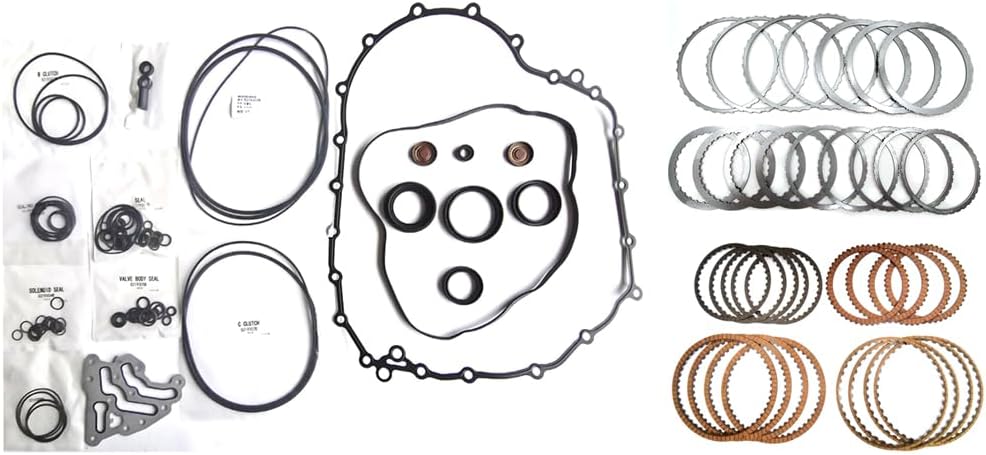
If the noise is inside the case, the bell housing is coming off anyway. Reseal and refresh it all at once with a 9HP48 rebuild kit.
Shop rebuild kits →FAQ
Why does my 948TE whine when I rev it in Park?
A whine that rises with engine rpm while parked comes from the pump circuit. The 9HP48 pump is chain driven off the converter hub, so it turns whenever the engine runs. Low fluid, a leaking filter neck O-ring, or a worn pump chain are the usual causes, so check the level at the specified temperature before anything else.
What causes a clunk when accelerating after coasting in a Jeep Cherokee 9-speed?
On 2019 Cherokees with the 3.2L and 948TE, FCA bulletin 21-045-20 lists a clunk on throttle after coasting, mostly in 5th and 6th gear at 30-45 mph. The fix is a TCM reflash with the PCM brought to current software. If the clunk survives the flash, check engine and transmission mounts and the half-shafts.
Is a grinding noise with code P1720 or P215C a bad transmission?
Usually not on a 2014-2017 Cherokee with Active Drive II. FCA bulletin 21-014-23 traces those codes and the grinding to spline wear between the PTU differential input splines and the transmission output shaft. The repair is a PTU replacement under a warranty extension, so check the build date before quoting a transmission.
How do you check the fluid level on a 948TE?
With the engine running in Park, read fluid temperature on a scan tool, then measure through the fill check plug near the differential with Mopar tool 10323A or an equivalent dipstick. Compare the millimeter reading to the temperature chart; at 140 degrees F the range is 16 to 23 mm. Use Mopar ZF 8 and 9 Speed ATF 68157995AB.
Sources
- Transmission Digest, “ZF9HP48 FWD Nine Speed, Part 1”: chain-driven remote-axis dual-chamber vane pump, drive flats on the converter hub, chain similar to the 6T70, filter neck and bypass tube O-rings, no bottom pan, external hydraulic line at the rear of the case. transmissiondigest.com
- Transmission Digest, “ZF9HP48 FWD Nine Speed, Part 2”: F dog clutch (engaged in P, N, R and 1st-4th) and A dog clutch (1st-7th) construction and apply, dog clutch spline wear, transfer gear and differential on tapered roller bearings, park gear on the transfer gear. transmissiondigest.com
- FCA US LLC Service Bulletin 21-045-20 (September 11, 2020), “Flash: Transmission Control Module (TCM) Updates,” 2019 KL Cherokee 3.2L with 948TE: clunk on tip-in from a coast in 5th/6th at 30-45 mph, 2-1 coastdown bump, reflash procedure and battery voltage limits. Hosted by NHTSA. static.nhtsa.gov
- FCA US LLC Service Bulletin 21-014-23 Rev. A (August 25, 2023), “Power Transfer Unit (PTU) Broken Input Spline,” 2014-2017 KL Cherokee with Active Drive II: build-date range, DTCs P1720-00 and P215C-00, cause (spline wear between the differential input splines and the transmission output shaft), PTU replacement labor times. Supersedes 21-017-21, which lists the grinding noise and no-move symptoms. Hosted by NHTSA. static.nhtsa.gov
- FCA US LLC Safety Recall 01C / NHTSA 25V-011 advance communication (January 23, 2025): 2017-2019 KL Cherokee two-speed PTU input shaft snap ring, resulting noise, vibration, Service 4WD message, and possible loss of motive power or Park. Hosted by NHTSA. static.nhtsa.gov
- Gears Magazine (ATRA), “948TE Checking Fluid Levels” and “ZF 9HP48: A Mechanical Marvel”: level check conditions, Mopar tool 10323A, fill check plug location by engine, 16-23 mm range at 140 degrees F, Mopar ZF 8 & 9 Speed ATF 68157995AB, no leak dye; shift quality issues resolved by TCM programming, transfer gear bearing puller placement, F dog air check behavior. gearsmagazine.com (fluid levels) · gearsmagazine.com (9HP48 teardown)