The E4OD ran behind Ford's gas and diesel trucks from 1989 through 1997, when the 4R100 took over as its heavier-duty successor. A lot of these are still on the road, mostly in older Super Duty, F-150, Bronco and E-Series trucks that have long since passed 150,000 miles. Because the unit is old enough that its own service history is usually a question mark by the time it lands on your lift, the wear points worth checking are not a mystery -- they are documented, in the same order, often enough that it is worth running through them before you start guessing at a rebuild.

Fluid: confirm the spec before you touch anything else
The E4OD was engineered around Ford's original MERCON specification. That spec was discontinued in favor of MERCON V, and Ford's FCSD Chemicals and Lubricants listing for MERCON V is explicit that the fluid is recommended for Ford, Lincoln and Mercury vehicles and transmissions that call for MERCON V or MERCON-type fluid, and is approved for use in systems previously serviced with the original MERCON spec -- which covers a high-mileage E4OD. It is sold under part numbers XT-5-QMC (1-quart case of 12), XT-5-5Q3M (5-quart) and XT-5-DMC (55-gallon drum). What you should never put in an E4OD: MERCON SP, MERCON LV, MERCON ULV, or Type F. Those specs belong to transmissions with different friction materials, and running the wrong one accelerates clutch wear instead of preventing it.
On capacity, service guides commonly list a complete dry fill around 17 quarts including the converter, with a pan-drop service pulling roughly 7 to 13 quarts depending on pan depth and whether the converter is drained. If your E4OD has a deep aftermarket pan, expect the higher end of that range. Fill to the dipstick with the engine running and the fluid at operating temperature -- the cold fill marks on these units are notoriously unreliable.
The pump: know which casting you have before you blame the clutches
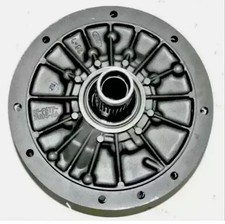
This is the wear point most likely to get misdiagnosed as a clutch or converter problem, because the symptoms look identical from the driver's seat. Sonnax's pump gear set documentation is specific about which E4OD pumps are the weak design: pre-1995 E9 and F1 castings have 11 lobes on the outer pump gear, and that design suffers from low pump output as the inner and outer gears wear against each other. Ford superseded it with the F5 casting in 1995 and the F8 casting in 1998, both with 10 lobes on the outer gear and noticeably better wear resistance.
Sonnax ties worn E9/F1 pump gears to fault codes 62, 628, and 1744, plus low line pressure, excess pump noise, visibly damaged gear teeth, and -- this is the part that fools people -- repeated torque converter failure. A shop that keeps swapping converters on an early E4OD without checking pump output is chasing a symptom instead of the cause. The fix for a worn F5 or F8 pump is Sonnax's drop-in 36438A-03 gear set, which needs no machining. If you've got an E9 or F1 casting, Sonnax's guidance is to upgrade to an F5/F8 pump housing first, since the 36438A-03 gear set is designed only for the later castings.
Line pressure modulator wear: the real cause behind soft and harsh shifts
On a transmission this old, soft 1-2 or 2-3 shifts and intermittent harsh shifts both get blamed on "the valve body needs a shift kit" more often than they should. Sonnax's line pressure modulator plunger valve kit page documents the actual mechanism on E4OD, 4R100 and AX4N units: the modulator sleeve wears, and EPC oil leaks past it. That leakage is what produces poor line rise and soft shifts. If the wear gets severe enough, the valve can stick or hang up in the worn sleeve instead, which flips the symptom to intermittent harsh shifts -- so the same root cause can present two different ways depending on how far the wear has progressed.
OE modulator valve diameters on this family run from 0.331 inch up to 0.427 inch depending on application, and Sonnax sells matched plunger-and-sleeve kits at each size plus an oversized 0.500 inch performance version. The point for a high-mileage service check is simple: if a fluid service and fresh filter don't resolve a shift-quality complaint, pull the valve body and inspect this bore before you reach for a shift kit or a used valve body as a parts-swap guess.
The rear case bushing: the one nothing on a scan tool will show you
This wear point produces no fault code and no obvious symptom until it's advanced, which is exactly why it is worth checking proactively on any high-mileage E4OD that's already apart for other work. Sonnax's rear case bushing documentation lists the E4OD specifically, alongside the 4R100, for '95-and-later units with the late-style bushing design (three grooves to the front, one to the back). The factory setup uses two bushings in that bore, and Sonnax attributes premature wear to lack of lubrication, excessive journal clearance, or simply too much load for the bearing area -- conditions a high-mileage truck that tows or has run low or degraded fluid for extended stretches will produce.
Left unaddressed, a worn bushing can spin in its bore and damage the case itself, turning a straightforward bushing job into a case repair. Sonnax's fix is a one-piece replacement bushing -- part 36008B or 36008D -- installed with tool T36008A in place of the factory two-bushing setup, giving more bearing surface and better lubrication than the original design. Any time the tail housing comes off a high-mileage unit, this bore is worth a look even without a specific complaint pointing at it.
The wiring short that gets misdiagnosed as a transmission failure
Not every E4OD symptom is actually the transmission, and this one catches techs who go straight to the valve body. Transmission Digest's TASC Force Tips column on the E4OD/4R100 covers Ford TSB 92-22-5, issued October 21, 1992 for light trucks (1992 Bronco, F Super-Duty, F-150/350) with an overdrive-cancel button on the column-mounted shifter -- but the wiring risk applies to any E4OD/4R100 with that switch. The bulletin's concern: the wiring from the OD-cancel switch can come into contact with a steering-column-cover mounting screw, most commonly near the shift-lever pivot point, and short against it. That short blows the number 17 fuse.
The symptom list in the bulletin reads like a transmission failure: early shifts, loss of power, poor acceleration, 3-4 shift cycling, the transmission control light cycling on and off or going dark entirely, an inoperative OD-cancel switch, loss of the rear anti-lock brake system's electronics, and loss of instrumentation -- tachometer, fuel gauge, and the rest. On 1995-and-later trucks with drive-by-wire throttle control powered through the same fuse circuit, losing that fuse drops the engine straight to idle, which is a much bigger problem at speed than a bad shift. The fix in the bulletin is a replacement shift lever (part F2TZ-7210-F) with a longer wiring pigtail that gives room to reroute the wire away from the pivot point, plus care when reinstalling the boot so it doesn't pinch the wire again. Before you pull a valve body on a truck with electrical symptoms layered on top of a shift complaint, check this wiring first -- it's a five-minute inspection that can save a teardown.
The checklist, in order
- Confirm fluid type and condition. Original MERCON or Ford-approved MERCON V, never SP/LV/ULV/Type F. Dark or burnt-smelling fluid with clutch material is a sign something downstream is already cooking.
- Service the pan and filter on a real interval, not just when a symptom shows up, and inspect the magnet and pan sediment for clutch material versus ordinary wear.
- Identify the pump casting on any pre-1995 unit with low line pressure, pump noise, codes 62/628/1744, or a converter that keeps coming back. E9/F1 castings are the weak design; upgrade before chasing converters.
- Inspect the line pressure modulator bore if a fluid service doesn't resolve a soft or harsh shift complaint, before assuming a shift kit or used valve body will fix it.
- Check the rear case bushing bore any time the tail housing is off on a high-mileage unit, even without a specific symptom.
- Rule out the OD-cancel switch wiring at the shift-lever pivot on any truck with a column-mounted OD-cancel button showing electrical symptoms (dash lights, instrumentation, RABS) alongside a shift complaint.
The exact line-to-lube pressure regulator kit for the pump wear pattern above
If an early E4OD is showing low line pressure, pump noise, or a converter that won't stay fixed, this is the OEM-numbered kit that addresses the regulator-side wear Sonnax documents.
E4OD Line-to-Lube Pressure Regulator Kit at CoreTransmissionParts →Also there: the E4OD deep pan transmission filter for the fluid service covered above.
FAQ
What transmission fluid does a high-mileage E4OD need?
The E4OD was built for original MERCON fluid. Ford's FCSD Chemicals and Lubricants listing for MERCON V states that fluid is recommended for Ford, Lincoln and Mercury vehicles that call for MERCON V or MERCON-type fluid, and is approved for use in automatic transmissions previously serviced with the original MERCON spec. That covers the E4OD, so a high-mileage unit due for service can be switched to MERCON V going forward. Do not use MERCON SP, MERCON LV, MERCON ULV, or Type F -- none of those are approved substitutes for the frictions in this transmission.
How do I know if my E4OD has the early or late pump casting?
Sonnax identifies the casting by the number of lobes on the outer pump gear. Pre-1995 E9 or F1 castings have 11 lobes and are the design that suffers low pump output as the gears wear. 1995-and-later F5 castings and 1998-and-later F8 castings have 10 lobes and take Sonnax's drop-in 36438A-03 gear set without machining. If you cannot pull the pump to count lobes, fault codes 62, 628 or 1744 alongside low line pressure, excess pump noise, or a converter that keeps coming back are the symptoms Sonnax associates with a worn E9/F1 pump.
What causes soft or harsh shifts on an older E4OD?
Sonnax's line pressure modulator plunger valve kit page describes wear at the modulator sleeve as a common cause on E4OD, 4R100 and AX4N units. EPC oil leaking past a worn sleeve produces soft 1-2 or 2-3 shifts and poor line rise, while severe wear can let the valve stick and hang up, producing intermittent harsh shifts instead. The OE sizes run from 0.331 inch up to 0.427 inch depending on application, and replacing the worn plunger and sleeve as a set is the fix -- chasing it with a line pressure adjustment alone does not address a worn sleeve.
My E4OD lost power and the dash lights went crazy -- is that the transmission?
Not necessarily. Ford TSB 92-22-5, covered in a Transmission Digest TASC Force Tips writeup, documents the overdrive-cancel switch wiring shorting against a steering-column mounting screw near the shift-lever pivot, which blows the number 17 fuse. Reported symptoms include early shifts, loss of power, poor acceleration, 3-4 shift cycling, an inoperative or cycling transmission control light, loss of RABS anti-lock electronics, and loss of instrumentation. On 1995-and-later trucks with drive-by-wire throttle sharing that same fuse circuit, the engine can drop straight to idle. Check the OD-switch wiring at the shifter pivot before you assume the transmission itself has failed.
When does a high-mileage E4OD need a rebuild instead of just service?
Regular fluid and filter service, a clean cooler circuit, and catching pump, modulator, or rear case bushing wear early will keep most E4ODs running well past 150,000-200,000 miles. Once you see a spun rear case bushing, fault codes 62/628/1744 that a pump swap does not fully resolve, burnt clutch material in the pan, or shift quality that service and valve body work cannot correct, the wear has moved past what a service interval prevents and it is rebuild-kit territory.
Sources
- Sonnax — "Pump Gear Set" (part number 36438A-03). Backs the pre-1995 E9/F1 pump casting (11-lobe outer gear) versus the 1995-later F5 and 1998-later F8 castings (10-lobe outer gear), the fault codes 62, 628 and 1744 tied to worn E4OD/4R100 pump gears, and the drop-in gear set fix requiring no machining. sonnax.com
- Sonnax — "Line Pressure Modulator Plunger Valve Kit" (part numbers 36948-03K/05K, 96948-01K/05K). Backs the modulator sleeve wear mechanism on E4OD, 4R100 and AX4N units, EPC oil leakage causing soft shifts, valve sticking causing harsh shifts, and the OE valve diameters from 0.331 to 0.427 inch. sonnax.com
- Sonnax — "Rear Case Bushing" (part numbers 36008B, 36008D). Backs the E4OD (and 4R100) factory two-bushing rear case design wearing out from inadequate lubrication, excessive journal clearance or load, the risk of the bushing spinning and damaging the case, and the one-piece replacement installed with tool T36008A. sonnax.com
- Transmission Digest — "E4OD/4R100 Safety Alert," TASC Force Tips by Ed Lee, published February 1, 2003. Backs Ford TSB 92-22-5 (October 21, 1992), the overdrive-cancel switch wiring short against the steering-column mounting screw near the shift-lever pivot, the number 17 fuse, the full symptom list (early shifts, loss of power, 3-4 shift cycling, RABS and instrumentation loss), the 1995-and-later drive-by-wire throttle interaction, and the replacement shift lever part F2TZ-7210-F. transmissiondigest.com
- Ford Customer Service Division (FCSD) Chemicals and Lubricants — official Motorcraft MERCON V product listing. Backs the MERCON V specification and part numbers (XT-5-QMC, XT-5-5Q3M, XT-5-DMC) Ford recommends for vehicles and transmissions previously serviced with the original MERCON spec, and the fluids it explicitly excludes (MERCON SP, MERCON LV, MERCON ULV, Type F). fcsdchemicalsandlubricants.com
- Bullnose Garage — "The Ford E4OD Transmission: A Comprehensive Guide." Backs the approximate 17-quart complete dry fill capacity and the 4th-gear (overdrive) 0.71:1 gear ratio referenced for context. bullnosegarage.com