Both of these four-speeds came out of the same playbook. Ford took the C6 and GM took the TH400, bolted an overdrive section on the front, and handed shifting and line pressure to a computer. The E4OD went into Ford trucks for 1989, and the 4L80E followed into GM heavy-duty trucks and vans a couple of years later. They tow the same kind of loads and get compared in every swap thread, but on the bench they are different animals with different weak spots.
This is a builder's comparison: ratios, how each one is told what gear to be in, what the scan tool can and cannot see, where each one breaks, and the factory test numbers you should have in hand before you condemn either unit.
The Short Version
| Ford E4OD | GM 4L80E | |
|---|---|---|
| Years | 1989-1997 (1997 overlaps the 4R100) | 1991-on, later 4L85E |
| Gear ratios | 2.71 / 1.54 / 1.00 / 0.71, R 2.18 | 2.48 / 1.48 / 1.00 / 0.75, R 2.08 |
| Reverse holding member | Low/reverse multi-disc clutch | Rear band |
| Speed inputs | No turbine or output shaft sensor | Input and output speed sensors |
| Coast braking in OD range | Coast clutch solenoid, PCM controlled | Overrun clutch only in manual ranges |
| TCC control | On/off solenoid (PWM arrived with the 4R100) | PWM solenoid |
Ratios are from ATRA's GEARS ratio reference chart, which lists the 4R100 at 2.71/1.54/1.00/0.71 with a 2.18 reverse and the 4L80E at 2.48/1.48/1.00/0.75 with a 2.08 reverse. The E4OD shares that Ford gearset, and US Shift's E4OD/4R100 spec sheet gives the same forward ratios. GM's own Chevrolet Performance sheet for the 4L85E Supermatic lists 2.482, 1.482, 1.000, 0.750 and 2.077 reverse, which confirms the GM side to three decimals.
What that means in the truck: the E4OD has a deeper first gear (about 9 percent more multiplication) and a taller overdrive. Hooked to a trailer on a grade, the Ford launches a little easier; at highway speed it turns a few less rpm in fourth. The 4L80E has tighter spacing between first and second, so its 1-2 drop is smaller.
How Each One Applies Its Gears
The biggest mechanical difference is in reverse and manual low. ATRA's E4OD quick reference application chart shows reverse on the E4OD using the coast clutch, the direct clutch and the low/reverse clutch, a multi-disc pack. Manual first applies the same low/reverse clutch. The intermediate band only comes on in manual second.
On the 4L80E, the application chart Sonnax published for its overdrive roller clutch article shows reverse using the direct clutch and the rear band, with the overdrive roller clutch holding. Manual second adds the front band. That is classic TH400 hardware, and it is why a 4L80E with a worn rear band or a bad reverse servo gives you a slipping or no-reverse complaint that an E4OD would never show from the same cause.
Practical takeaway: a no-reverse on an E4OD sends you to the low/reverse clutch, the direct clutch and the coast clutch. The E4OD quick reference's line pressure tree says it plainly: pressure low only in R points to the separator reinforcing plate, coast clutch, low/reverse clutch or direct clutch, and the valve bodies. On a 4L80E, start with the rear band, the reverse servo and the direct clutch.
Electronics: Solenoid Logic and What the Computer Sees
Both units use two on/off shift solenoids, but the patterns do not match, so do not carry a solenoid chart from one to the other.
- E4OD (ATRA quick reference): 1st = SS1 on, SS2 off. 2nd = on/on. 3rd = off/on. 4th = off/off. Park, reverse and neutral all command "first" with SS1 on. With overdrive cancelled, the coast clutch solenoid is always on, and it is also on in manual 2 and manual 1.
- 4L80E (Sonnax application chart and the Army 4L80E troubleshooting supplement): 1st = A on, B off. 2nd = off/off. 3rd = off/on. 4th = on/on. The supplement describes both shift solenoids as normally open exhaust valves controlling the 1-2 and 3-4 shift valves.
The second big difference is what the computer can see. The E4OD has no turbine speed sensor and no output shaft sensor; it shifts off vehicle speed, throttle and engine data. US Shift notes that Ford started running the speedometer from the differential speed sensor in 1992, and that the dedicated output shaft sensor did not appear until the 4R100. That is why a lot of generic P-code advice does not apply to an E4OD. If you are chasing lockup complaints on one, see our E4OD P1744 guide.
The 4L80E has both an input speed sensor and an output speed sensor, and the TCM uses them to calculate slip. GM's 2005 OBD-II diagnostic parameter tables for the 4L80E list P0716 and P0717 for the input speed sensor, P0502 and P0503 for output speed, and P0741 for TCC slip of 125 rpm or more with lockup commanded in 2nd or 3rd. High slip in 4th is caught separately by P1870, transmission component slipping. Those same tables show the 2005 4L80E behind the 4.8L, 6.0L and 8.1L in Express, Savana, Suburban, Yukon XL, Silverado, Sierra, Avalanche, P30, W-series and Isuzu NPR.
Bench and Scan Tool Numbers
Before you condemn either unit, get a gauge on it. The Army's 4L80E Transmission Troubleshooting Guide (Warrant Officer Training Material Supplement 7, written around the HMMWV 6.5L diesel application) gives these specs:
- Line pressure in Park, Neutral and the drive ranges: minimum 35 psi at idle, rising to a maximum of 171 psi with throttle. Reverse: minimum 67 psi at idle, up to 324 psi. Use a 325-350 psi gauge.
- Pressure control solenoid override test: at 0.0-0.02 amps you should see 157-177 psi; at 0.50 A, 102-131 psi; at 0.98-1.1 A, 35-55 psi. Pressure must drop as current rises. Consistently high pressure points to the TCM, wiring or solenoid; low points to the pump or a hydraulic leak.
- Resistance: 1-2 and 2-3 shift solenoids 18-24 ohms, pressure control solenoid 3.5-5.2 ohms, TCC solenoid 10-14 ohms.
For the E4OD, the ATRA quick reference gives the transmission fluid temperature sensor curve: 100K-37K ohms at 32-58°F, 16K-5K at 105-158°F, 5K-2.7K at 159-194°F, and 1.5K-0.8K at 231-266°F. A sensor reading cold on a hot unit will keep lockup and overdrive from happening the way the PCM intends. On TCC resistance, GEARS (ATRA) notes the on/off solenoid body used through 1998 has a 20-30 ohm TCC solenoid; the later PWM 4R100 body drops to 10-20 ohms.
Where Each One Breaks
E4OD
- Mismatched parts from a past rebuild. In GEARS, Mike Brown points out that 1989-95 accumulator bodies do not interchange with 1996-and-later ones. The later body has three exhaust slots instead of four, and a four-slot body on a later unit exhausts reverse oil through the line modulator slot and slips in reverse.
- Solenoid body swaps. Ford serviced 1989-94 units with solenoid body E9TZ-7G391-A and 1995-97 (and 1998 non-PWM) with F81Z-7G391-BA. The 1995-up body has no spike suppression diodes because they moved to the ECM, and the harnesses differ. Never swap them directly; the early body only works on a later truck with the earlier harness.
- Range sensor corrosion. US Shift reports that pre-1995 range sensors let water into the connector and corrode the pins. Replace them with the 1995-up style.
- Valve body era. Sonnax's valve body ID guide splits the E4OD into 1989 (E9/E9 main and accumulator castings), 1990-95 (F0 or F1 with E9) and 1996-98 (F6/F6). Match the separator plate and gaskets to the casting or you build in a shift problem.
4L80E
- Overdrive roller clutch. Sonnax's Jim Dial explains that in the OD range the 4L80E's overdrive roller clutch holds by itself in 1st through 3rd. The overrun clutch only applies in the manual ranges. Plow and heavy tow trucks run in OD, overheat, melt the roller cage and lose the roller clutch. The Ford layout backs that roller clutch with a PCM-controlled coast clutch, and Sonnax notes the 4R100 even energizes it on hard throttle launches. That helps explain why the GM unit loses this part more often under abuse.
- Pressure control and solenoids. High line pressure in the Army guide is traced to the pressure control solenoid, the reverse/boost or pressure regulator valves, a bad TCM ground or a solenoid connection. Do the amp-vs-psi test above before buying a valve body.
- Heat. The Sonnax article describes the usual plow-truck teardown: blued fluid, melted plastic parts and discolored bushings. A temperature gauge and running in D3 or manual ranges while pushing snow are the cheapest fixes there are.
4L80E Master Rebuild Kit (1991-2009)
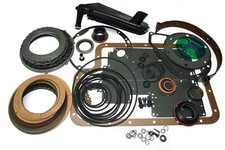
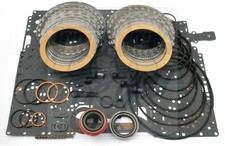
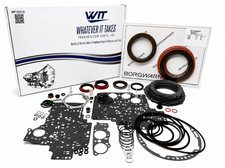
If the GM side of this comparison is the one on your bench, a master kit covers the frictions, steels, seals and gaskets in one box. Inspect the overdrive roller clutch and the rear band while you are in there.
See the 4L80E master rebuild kit →Not the part you need? Browse the full 4L80E parts collection.
Fluid, Weight and Size
The Army supplement calls for DEXRON III in the 4L80E. For the HMMWV it lists a refill of about 5 qt after a filter change, about 11.5 qt dry and 1-2 qt for the cooler and lines. Pickups and vans hold more, so use the dipstick. GM's current 4L85E Supermatic sheet specifies DEXRON VI, 7.7 qt for a pan drop, 13.2 qt dry and a weight of 230 lb dry (255 lb wet) for that version, rated at 650 lb-ft.
US Shift lists the E4OD/4R100 at 270 lb dry with the converter and about 18 qt of MERCON V total including the converter. It also notes that the E4OD came with several bolt patterns (small block, 385-series big block, diesel and modular), which is part of why it shows up in swaps. Both units are physically large, and neither fits a passenger-car tunnel without work.
Which Is Stronger?
Stock, they are in the same class. The question is which weak spot matters for your truck. If the truck pushes snow or tows in overdrive and runs hot, the 4L80E's lone overdrive roller clutch is the known casualty, while the E4OD has a coast clutch behind its roller clutch. If the E4OD has been rebuilt before, its biggest risk is someone else's interchange: wrong accumulator body, wrong solenoid body, mismatched valve body and plate. The 4L80E's input and output speed sensors also make it far easier to diagnose with a scan tool, because the TCM reports slip by gear.
For a swap or a controller build, the 4L80E's sensors and wide aftermarket support make it the easier unit to run standalone. For a Ford truck that already has one, a correctly matched E4OD rebuild is the cheaper path than any conversion.
Need parts for this job?
We stock both sides of this comparison: E4OD master kits, clutch modules, pumps and valve bodies, plus 4L80E master kits, solenoids and sprags. Pick your unit and go.
Shop E4OD parts → Shop 4L80E parts →Shop the 4L80E master kit →
FAQ
Is the E4OD or the 4L80E stronger?
Stock, they sit in the same heavy-duty class. The 4L80E's known abuse failure is the overdrive roller clutch, which holds by itself in the OD range, while the E4OD backs its roller clutch with a PCM-controlled coast clutch. A rebuilt E4OD's biggest risk is mismatched interchange parts such as the wrong accumulator or solenoid body.
What are the E4OD and 4L80E gear ratios?
ATRA's GEARS ratio chart lists the Ford E4OD/4R100 gearset at 2.71, 1.54, 1.00 and 0.71 with a 2.18 reverse. The 4L80E is 2.48, 1.48, 1.00 and 0.75 with a 2.08 reverse. That gives the E4OD a deeper first gear and a taller overdrive.
Does the E4OD have a turbine or output speed sensor?
No. The E4OD has no turbine speed sensor and no output shaft speed sensor, so many generic P-codes written for later units do not apply. The dedicated output shaft sensor arrived with the 4R100. The 4L80E has both input and output speed sensors, so the TCM can calculate slip.
What is the 4L80E line pressure spec?
The Army's 4L80E troubleshooting guide gives a minimum of 35 psi at idle rising to 171 psi in Park, Neutral and the drive ranges, and 67 to 324 psi in Reverse. With the pressure control solenoid commanded to about 1 amp, line pressure should drop to 35 to 55 psi.
Sources
- ATRA GEARS magazine — "Gear Ratios" reference chart, January/February 2006, pp. 58-60. Backs the 4R100 (E4OD gearset) ratios 2.71/1.54/1.00/0.71, R 2.18, and the 4L80E ratios 2.48/1.48/1.00/0.75, R 2.08. atracom.blob.core.windows.net (PDF)
- ATRA — E4OD/4R100 Quick Reference. Backs the E4OD clutch and band application chart (low/reverse clutch in reverse and manual 1, intermediate band in manual 2), the shift solenoid and coast clutch solenoid chart, the low-in-reverse line pressure diagnostic tree, and the fluid temperature sensor resistance table. atracom.blob.core.windows.net (PDF)
- ATRA GEARS magazine, March 2004 — Mike Brown, "Interchanges for the E4OD and 4R100." Backs the E4OD solenoid body part numbers (E9TZ-7G391-A, F81Z-7G391-BA), the diode relocation and no-direct-swap warning, the 20-30 vs 10-20 ohm TCC solenoid, pump interchange, and the four-slot vs three-slot accumulator body reverse slip. atracom.blob.core.windows.net (PDF)
- Sonnax — Jim Dial, "It's Snow Plowing Season Again! Understanding 4L80-E Overdrive Roller Clutch Failure." Backs the 4L80E application chart (rear band in reverse, front band in manual 2, solenoid A/B pattern), the OD roller clutch holding alone in the OD range, overrun clutch only in manual ranges, the 4R100 coast clutch solenoid strategy, and heat damage to the roller cage. sonnax.com
- Sonnax — Ford E4OD Valve Body Identification. Backs the E4OD main valve body and accumulator body casting numbers by year (E9/E9 1989, F0 or F1/E9 1990-95, F6/F6 1996-98) and the lower valve body and spacer plate changes. sonnax.com
- U.S. Army Ordnance Mechanical Maintenance School — Warrant Officer Training Material Supplement 7, "4L80E Transmission Troubleshooting Guide" (AM General HMMWV). Backs the 4L80E line pressure specs, the pressure control solenoid amp-to-psi table, solenoid resistances, shift solenoid description, input and output speed sensors, DEXRON III recommendation and HMMWV fluid capacities. gear-report.com (PDF)
- GM / Chevrolet Performance — Supermatic 4L85E Transmission (19300175) Specifications. Backs the GM ratios 2.482/1.482/1.000/0.750, R 2.077, 650 lb-ft rating, DEXRON VI, 7.7 qt pan / 13.2 qt dry capacity and 230 lb dry / 255 lb wet weight for the 4L85E. chevrolet.com (PDF)
- General Motors — 2005 4L80E Transmission Diagnostic Parameters (OBD-II Mode 6 tables). Backs the 2005 4L80E engine and vehicle applications and the DTC list including P0716/P0717, P0502/P0503, P0741 (125 rpm TCC slip in 2nd/3rd) and P1870. gsi.ext.gm.com (PDF)
- US Shift — Ford E4OD and 4R100 Control and Swap Info. Backs the 1989-1997 production run, 1997 overlap with the 4R100, the 4R100's added output shaft sensor and PWM TCC, the 1992 move to the differential speed sensor, pre-1995 range sensor corrosion, bolt patterns, 270 lb weight and 18 qt MERCON V total capacity. usshift.com