Short answer: TH400 bottom pan bolts torque to 12 lb-ft (144 in-lb). They are 5/16-18 bolts threading into an aluminum case, and that figure comes straight out of GM's own torque tables. The 1975 Buick chassis service manual's Turbo Hydra-matic 400 section lists "Oil Pan to Case, 5/16-18, 12 lb-ft," and the 1976 Chevrolet light truck overhaul supplement lists "Bottom Pan Attaching Screws, 12 ft. lbs." for the TH400/475. Two divisions, two years, same number.
The reason a whole article exists for one number is that the TH400 pan is where most of these units leak, and most of those leaks were made by a wrench, not by age. A bottom pan that has been cranked down to "feels tight" at every service ends up with dimpled bolt holes, a wavy rail and a gasket squeezed out the side. Below is the complete pan-off torque chart from the factory manuals, the refill amount, how to fix a pan rail or stripped hole, and the one number people mix up with the TH350.

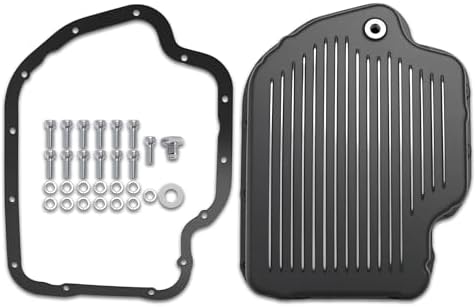

The pan-off torque chart (factory numbers)
Everything you can touch with the bottom pan off, from the TH400 bolt torque table in the 1975 Buick service manual (Section 7D) with the 1976 Chevrolet truck figure alongside where it differs. Thread sizes are from the Buick table.
- Bottom pan to case: 5/16-18, 12 lb-ft (144 in-lb). Buick and Chevrolet agree.
- Filter (strainer) retainer bolt to valve body: 1/4-20, 10 lb-ft. Buick and Chevrolet agree.
- Valve body to case: 8 lb-ft in both manuals. These thread into aluminum and strip easily, so never let an impact near them.
- Detent solenoid to case: 1/4-20, 8 lb-ft per Buick, 7 lb-ft per Chevrolet.
- Governor cover: 5/16-18, 18 lb-ft in both tables; the Buick procedure text gives 15-20 lb-ft.
- Vacuum modulator retainer: 5/16-18, 18 lb-ft; procedure text 15-20 lb-ft.
- Rear servo cover: 5/16-18, 18 lb-ft.
- Line pressure take-off plug: 1/8-27 pipe thread, 10-15 lb-ft per Buick, 13 lb-ft per Chevrolet.
- Cooler connector to case: 1/4-18 pipe thread, 11 lb-ft per the Buick table, 28 lb-ft per the Chevrolet truck table. That is a real disagreement between the two manuals; on a straight-thread fitting with a sealing washer, go with the lower number and check for weeping before going further.
Notice the pattern: the 1/4-20 bolts that thread into the soft valve body and the small solenoid are in single digits, the 5/16 cover bolts are 18, and the pan sits in between at 12 because it is clamping a gasket, not a machined joint. The pan rail is stamped sheet steel. The bolt does not need to be tight; the gasket needs to be evenly loaded.
Do not use the TH350 number (or vice versa)
The same 1976 Chevrolet table lists the Turbo Hydra-Matic 350 "Oil Pan to Case" at 130 in-lb, which works out to about 10.8 lb-ft. That is close to the TH400's 12 lb-ft, but it is a separate spec on a different pan and gasket, and shops that run both units on the same rack mix them up constantly. If your torque wrench is set in inch-pounds from the last TH350, a TH400 pan at 130 in-lb is slightly under spec and usually fine. A TH350 pan with a soft cork gasket hit at the TH400 number, then "a little extra," is how the bolt holes get pulled down into dimples.
Practical note on tools: 12 lb-ft is at the very bottom of most 3/8-drive click wrenches, where they are least accurate. Set a 1/4-drive inch-pound wrench to 144 in-lb instead. On a 5/16 flange bolt the difference between 144 in-lb and an air ratchet is the difference between a dry pan and a leak you chase for a year.
Tightening sequence that actually seals
The factory procedure is simple: new gasket on the pan, install the attaching bolts, torque to 12 lb-ft. What the manual leaves to experience is the order:
- Clean the case pan face and the pan flange completely dry. Any film of ATF under a rubber or molded gasket lets it walk out as the bolts come down.
- Check the flange before it goes back on. Lay the pan upside down on a flat bench and look for daylight at the bolt holes. Every hole that was over-torqued in the past will be pushed down into a crater, and the rail between holes will be bowed up.
- Start all bolts by hand, then snug them in a crisscross pattern, working from the center bolts outward, just until the gasket is lightly compressed everywhere.
- Make a second crisscross pass to the final 12 lb-ft (144 in-lb).
- Run the engine, cycle the selector, recheck the level, and look at the rail after the first heat cycle. Cork and fiber gaskets relax; a retorque to the same 12 lb-ft after cooldown is reasonable on those. Steel-core molded gaskets generally do not need it.
Fixing a dimpled pan rail
If the bolt holes are cratered, support the flange on a flat piece of steel and tap each hole flat with a ball-peen hammer, working the raised metal back into plane, then recheck with a straightedge across the rail. A badly wavy stamped pan is cheaper to replace than to chase. A cast aluminum pan solves the problem for good because its flange cannot be pulled down by the bolts, and many of them add a drain plug, which means the next fluid service does not need the pan dropped at all.
Stripped case threads
The pan bolts thread directly into the aluminum case, and a pulled thread at one corner is common on units that have had a dozen pan drops. Repair the hole with a 5/16-18 thread insert rather than running a longer bolt, since a longer bolt can bottom out or reach internal parts. Builders who drop the pan often, such as on a drag car or a tow rig that sees regular service, convert to studs and nuts so the case threads only get loaded once. Sonnax makes a TH400 oil pan stud kit (28711-01K) for exactly that job.
While the pan is off: filter, O-ring and the PR valve
The filter on most TH400s from 1967 on is a screen-and-intake-pipe assembly that plugs into the case with an O-ring and is held to the valve body by one 1/4-20 retainer bolt at 10 lb-ft. Replace the intake pipe O-ring every time. That O-ring is the seal between the pump's suction circuit and the sump. If it is hard, flattened or cut, the pump draws air along with fluid, and aerated oil means low and unstable line pressure.
Sonnax's "Anatomy of a Transmission" article on oil flow traces why that matters: the pump feeds the pressure regulator valve, the PR valve feeds the converter, the converter feeds the cooler, and the cooler feeds the lube circuit. Whatever starves the pump intake shows up downstream as converter heat, poor cooler flow and dry bushings, not just as a soft shift.
The pressure regulator valve is also reachable once the bottom pan and filter are out. The 1975 Buick manual's procedure for the TH400 PR valve starts with "Remove bottom pan and filter," then compresses the boost valve bushing against the regulator spring to pull the snap ring. Sonnax notes that high-mileage TH400 and TH425 units often lose line pressure control because the hardened PR valve wears the cast-iron pump bore, letting balance pressure leak to the sump. Their published consequence is high cooler pressure and converter, crankshaft or friction element failure. If the unit has a pressure complaint, a pan drop is the cheapest time to look, and a line pressure test at the 1/8-27 take-off plug (10-15 lb-ft on reinstall) will tell you whether to go further.
Refill amount and fluid
GM's 1976 truck lubrication section says to drain the TH400 sump and add approximately 7.5 US pints (about 3.75 quarts) of fresh fluid, then bring the level to the mark on the dipstick. The Buick procedure is the standard check: engine running, selector in Park, vehicle on a level surface, and do not overfill. Overfill on a TH400 gets churned by the rotating parts, foams, and gets pushed out the vent, which looks exactly like a pan leak right after you replaced the pan gasket.
On the 1976 trucks, GM's maintenance schedule called for draining the pan and replacing the filter every 30,000 miles, or every 15,000 miles under heavy city traffic in hot weather, extended idling, commercial use or towing. GM also says to drain the fluid hot, right after operation, and warns that transmission fluid temperature can exceed 350 degrees F, so wear gloves and keep your face out from under the pan when the first bolts come out.
For fluid, the TH400 was born a DEXRON unit; SAE Technical Paper 680038 documents GM's original 1967 DEXRON specification. Today use a licensed DEXRON-VI. Valvoline's DEXRON-VI product sheet states it is GM licensed, fully back-serviceable, and can be used wherever DEXRON-II or DEXRON-III is recommended.
Diagnosing a "pan leak" that is not the pan
Before you pull a pan that was torqued correctly, find where the fluid actually starts. On a TH400 the usual suspects sitting just above the pan rail drip onto it and make the gasket look guilty:
- Modulator: a ruptured diaphragm lets ATF get pulled into the vacuum line and also weeps at the O-ring. Pull the vacuum hose; fluid in it means the modulator is done.
- Detent solenoid connector and the 1/4-18 cooler fittings: both sit on the side of the case above the rail, and a weeping connector O-ring runs straight down to the gasket.
- Governor cover and speedometer driven gear: toward the rear of the case; seepage runs along the case and collects on the pan rail.
- Line pressure plug: a 1/8-27 plug that was tested and reinstalled dry.
Clean the whole case with brake cleaner, dust the lower case with foot powder or a UV dye, drive it to temperature, and look again. Fluid that starts at the top of the pan rail and only at the bolt holes is pan. Anything that starts higher is not.
TH400 pan bolt torque FAQ
What is the torque spec for TH400 pan bolts?
GM lists the Turbo Hydra-Matic 400 bottom pan attaching screws at 12 lb-ft, which is 144 in-lb. The bolts are 5/16-18 thread going into the aluminum case. Both the 1975 Buick service manual and the 1976 Chevrolet light truck overhaul supplement give the same 12 lb-ft figure.
Is the TH400 pan bolt torque the same as a TH350?
No. GM's 1976 truck specifications list the TH350 oil pan to case at 130 in-lb, which is about 10.8 lb-ft, while the TH400 bottom pan screws are listed at 12 lb-ft. The difference is small, but using the TH400 number on a TH350 pan with a soft gasket is how flanges get dimpled.
How tight should the TH400 filter bolt be?
The single strainer retainer bolt that holds the filter and intake pipe to the valve body is 1/4-20 thread and torques to 10 lb-ft per GM. Replace the intake pipe O-ring whenever the filter comes off, since a hard or nicked O-ring lets the pump pull air.
How much fluid does a TH400 take after a pan drop?
GM's 1976 truck lubrication section says to add approximately 7.5 US pints of fresh fluid after draining the TH400 sump, then bring the level to the proper mark on the dipstick. Check the level in Park with the engine running on a level surface, and do not overfill.
Can I use DEXRON VI in an old TH400?
Yes. Valvoline's DEXRON-VI product sheet states the fluid is GM licensed, fully back-serviceable, and can be used wherever DEXRON-II or DEXRON-III is recommended. That covers every factory TH400 application.
Sources
- Buick Motor Division — 1975 Buick Chassis Service Manual, Section 7D, Turbo Hydra-matic 400 (PDF). Backs the TH400 bolt torque table (oil pan to case 5/16-18 at 12 lb-ft, oil filter to valve body 1/4-20 at 10 lb-ft, valve body, governor cover, modulator retainer, rear servo cover, line pressure take-off and cooler connector values), the filter and pan installation procedure, the pressure regulator valve removal through the bottom pan, and the fluid level check procedure. teambuick.com (PDF)
- General Motors / Chevrolet — 1976 Light Truck Service Overhaul Supplement (ST-330-76), Section 0 and Section 7A, plus the Specifications pages (PDF). Backs the TH400/475 "Bottom Pan Attaching Screws 12 ft. lbs." and "Strainer Retainer Bolt 10 ft. lbs." entries, the TH350 "Oil Pan to Case 130 in. lbs." entry, the approximately 7.5-pint refill after a sump drain, the 30,000/15,000-mile pan and filter interval, and the 350 degree F fluid temperature warning. 73-87chevytrucks.com (PDF)
- Sonnax — TH400/TH425 Pressure Regulator Valve Kit 34910-03K. Backs the worn pressure regulator bore failure on high-mileage TH400 units, its consequences (high cooler pressure, converter, crankshaft or friction element failure), and verification by line pressure and pump testing. sonnax.com
- Sonnax — "Anatomy of a Transmission: Oil Flow in the Pump-PR-Converter-Cooler Lube Circuits," Gregg Nader. Backs the pump to PR valve to converter to cooler to lube flow chain, and why a pump intake problem shows up downstream. sonnax.com
- Valvoline — DEXRON-VI ATF Product Information Sheet (PDF). Backs the statement that DEXRON-VI is GM licensed, fully back-serviceable, and usable wherever DEXRON-II and/or DEXRON-III are recommended. valvoline (PDF)
- SAE International — "Dexron Automatic Transmission Fluid," SAE Technical Paper 680038 (1968). Backs GM's original DEXRON specification, the fluid the TH400 was designed and serviced around. saemobilus.sae.org