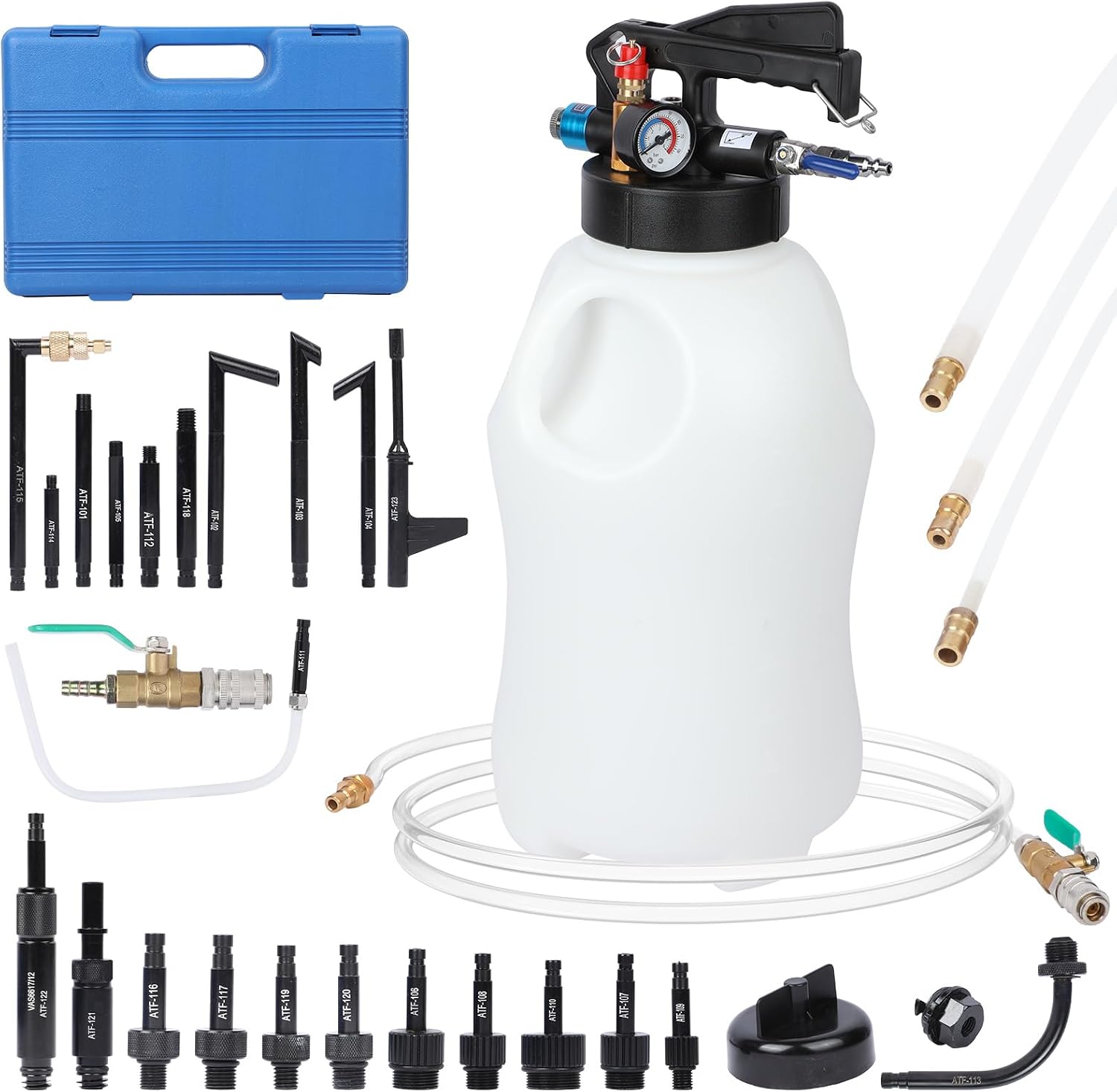
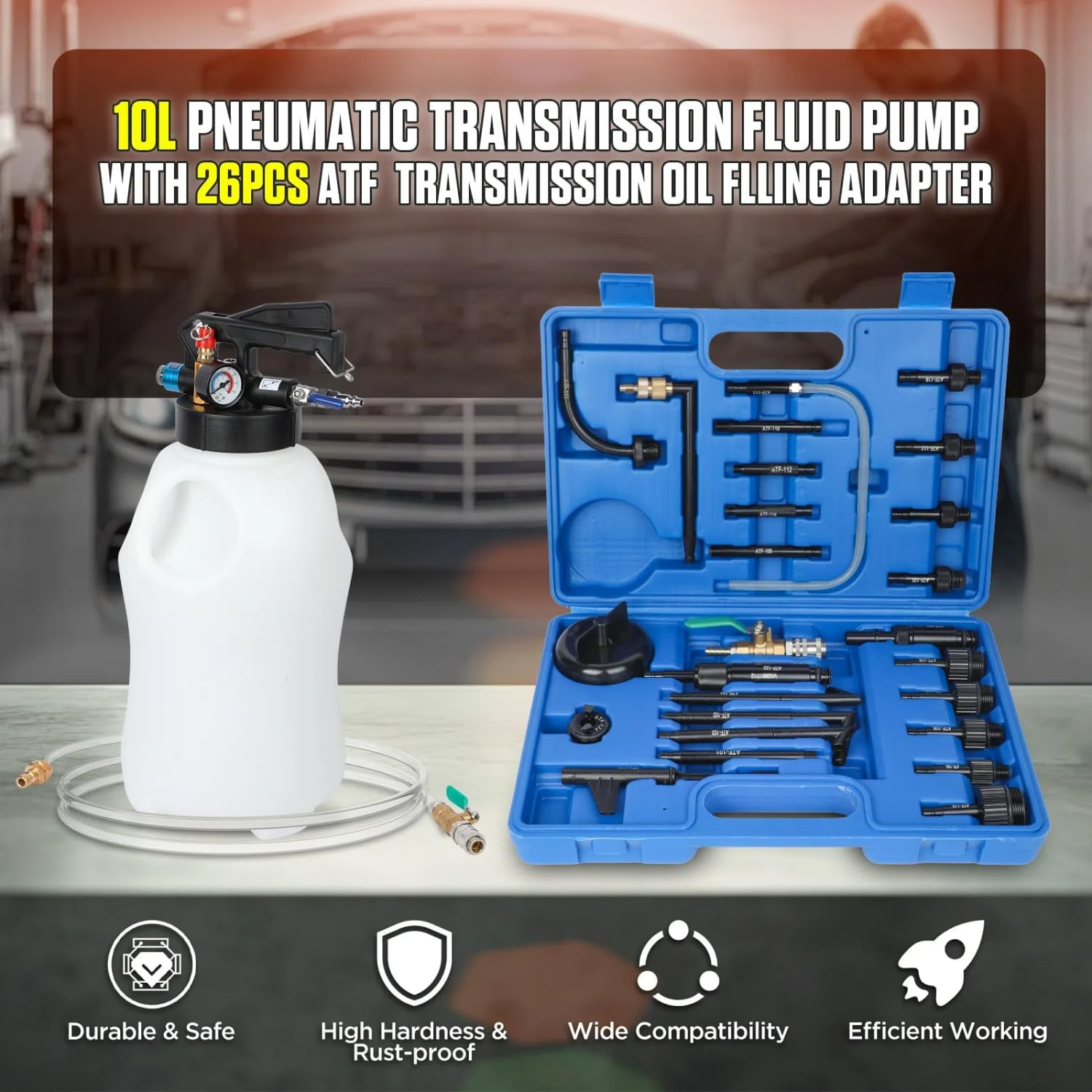
Late-model automatics from ZF, Mercedes, VW/Audi, Ford and GM mostly have no dipstick. Fresh fluid goes in through a threaded plug on the side of the case, usually with the car level on a lift and the engine running, and the level is right when fluid starts to dribble back out. This shop-air pump does that job from one 10 liter tank: it can suck old fluid out, then push new ATF in through whichever of its 26 adapters fits the plug you are working on.
How the pump works
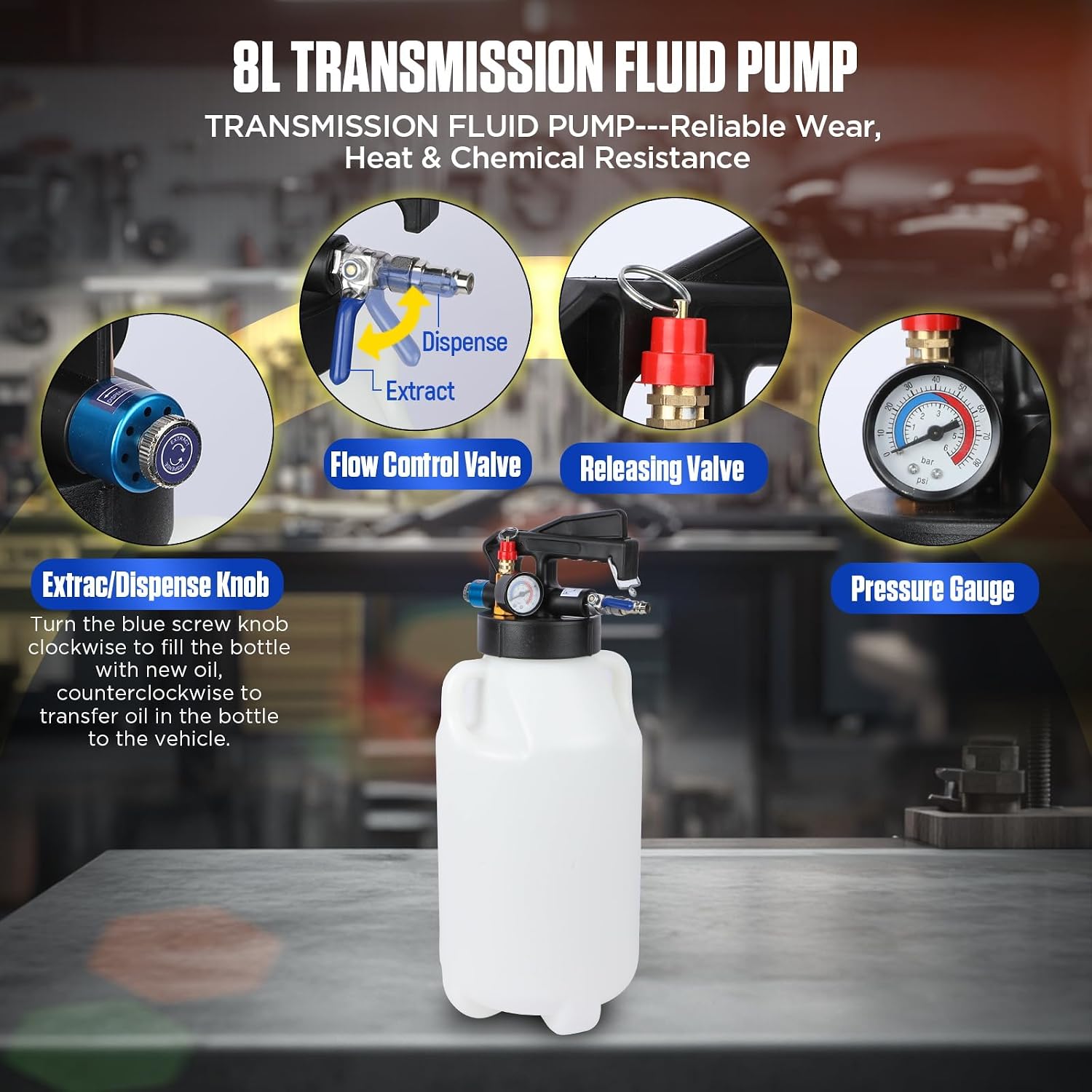
Air from your compressor runs the head on top of the tank. A screw knob and a flow-direction valve decide which way fluid moves. Turned one way, the head pulls a vacuum, so you can draw fluid up out of a pan through the fill hole, or pull fresh ATF straight out of a jug into the graduated tank. Turned the other way, air pressure in the tank pushes fluid down the hose and into the transmission. A 0-80 psi (0-6 bar) gauge on the lid shows tank pressure, and a relief valve vents at 43 psi so a forgotten air line cannot build the tank past that. The main hose carries a quick connector and an inline shutoff, so you can stop flow right at the fill plug the moment fluid shows at the check port.
Where it earns its price
- Sealed units checked hot: many need the level set at a specific temperature window with the engine idling, which leaves no time for a squeeze bottle.
- Big refills: a 7 to 9 quart drain-and-fill goes in from one tank instead of several trips.
- Awkward ports: the 45 and 90 degree adapters clear subframes and exhaust where a straight nipple will not.
- Shops running mixed brands: one rig covers German, domestic and Asian units with the adapter kit in its fitted case.
How to tell if your transmission needs this tool
Look for a dipstick tube. If there is none, find the fill plug and the check or overflow plug in your service information; on many units they are one and the same plug with a standpipe behind it. If you are deciding between a full exchange and a pan service, read flush vs drain and fill, and for fluid type and capacity on two of the most common sealed units see our ZF 8HP fluid guide and 722.9 fluid guide.
Adapter coverage
The 26 adapters are listed for ZF 8HP and 6HP, Mercedes 722.6 and 722.9, VW/Audi DSG and the 09G/09M, Ford 6F and 6R, GM 6L and 8L, plus Volvo, Porsche and Skoda applications. One adapter in the set is marked VAS6617/12, the style used on VW/Audi fill ports. Fill threads change between manufacturers and sometimes between years of the same family, so thread the adapter in by hand first; if it does not start cleanly, stop and try the next size. For thread sizes this set does not cover, a separate 27-piece fill adapter kit uses the same approach. Browse the rest of our service equipment in tools.
Service notes
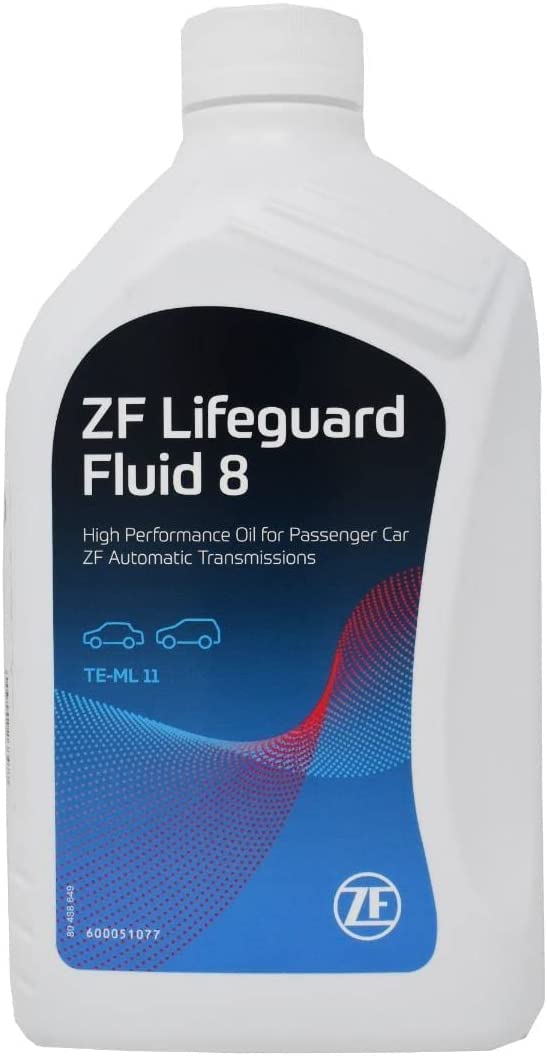
- Start every job with the correct fluid, and run a little of it through the hose so the last job's ATF does not mix in. For an 8HP that means a ZF-approved fluid such as ZF LifeguardFluid 8; Mercedes and VW each publish their own specifications.
- If the pan and filter come off too, a ZF 8HP pan and filter kit replaces the gasket and drain plug at the same time.
- Fill until fluid runs out of the check port at the specified temperature with the engine running, then reinstall the plug with a new seal. Our drain and fill walkthrough covers the order of operations.
- Bleed tank pressure to zero before swapping adapters or opening the lid.
- Keep the tank and hose clean and capped between jobs; dirt in the tank goes straight into the valve body.