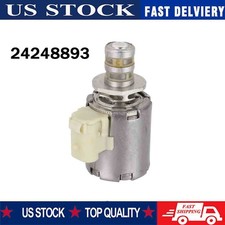
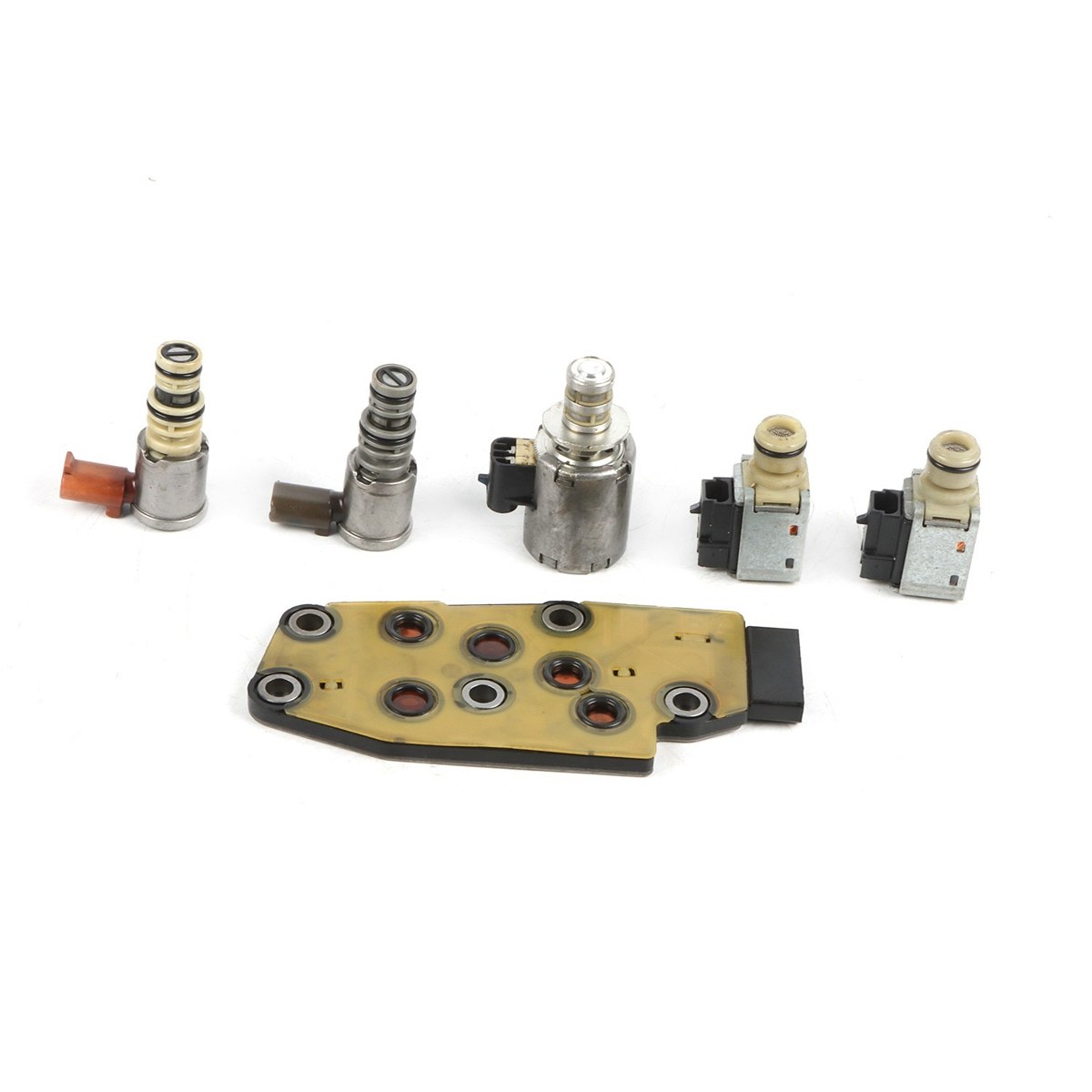
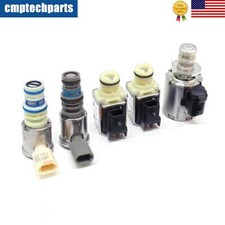
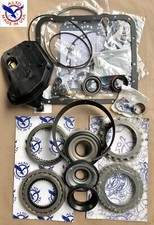
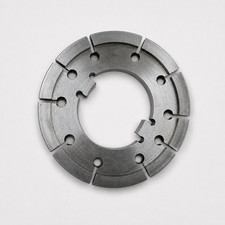
If your 4L70E-equipped Silverado, Sierra, Tahoe, Yukon or Trailblazer SS has started banging into Drive, slurring the 1-2 and 2-3 shifts, or flaring when you pull a trailer up a grade, line pressure is the first thing to look at, and the pressure control solenoid is the part that sets it. This is a new replacement EPC solenoid that interchanges with GM 24248893, the late-style force motor used in the 4L60E family from 2003 on. It is a single solenoid with its O-rings, sold at a price that makes sense to replace while the pan is already off.
What the pressure control solenoid does in a 4L70E
The 4L70E has no throttle cable. The computer reads engine load and throttle position, then sends a pulse-width-modulated current to this solenoid. Inside is a coil and a spool valve that bleeds control oil in proportion to that current, and the resulting signal goes to the pressure regulator and boost valve in the pump. The relationship is inverse: at idle the solenoid draws roughly 0.9 to 1.1 amps and line pressure sits low, and at wide-open throttle the command drops toward zero so line pressure rises to its maximum. Every clutch pack and the 2-4 band in the 4L70E is applied by that one pressure, so a solenoid that sticks, leaks internally or weakens shows up in every gear, not just one shift.
Symptoms of a failing EPC solenoid
- Harsh, thumping engagement into Drive or Reverse, and firm upshifts even at light throttle
- Soft, slipping shifts that get worse once the fluid is hot
- RPM flare on the 2-3 or 3-4 shift under load, the same low-pressure condition that burns the 3-4 clutch this unit is known for
- P0748 for the pressure control solenoid circuit
- Shifts that change from one drive to the next as the solenoid screen collects debris
How to confirm it before you buy
Watch the commanded and actual EPC current on a scan tool. A healthy command should swing from about an amp at idle down toward zero as you go to full throttle; if the current tracks but the shift feel does not change, the problem is hydraulic, not electrical. Then put a gauge on the line pressure port. Low pressure with a correct command points to a worn pressure regulator bore in the pump or worn actuator feed limit valve rather than the solenoid. Sonnax lists erratic line pressure, low line rise and 3-4 clutch failure as signs of regulator bore wear in 4L60-E, 4L65-E and 4L70-E pumps. Our 4L70E EPC solenoid symptoms guide walks through the amperage test step by step, and the 4L70E valve body testing guide covers the bores that mimic a bad solenoid.
Fitment
This is the late-style EPC. GM ran two designs: an early style through 2002 and a late style from 2003 on, with different pin and connector layouts, so the two do not plug into each other's harness. Every 4L70E falls in the late-style period, including the 2006-2013 trucks and SUVs listed above, and the same solenoid interchanges into 2003-up 4L60E and 4L65E units. The listing does not carry a single model year, so compare the connector and body shape in the photo with the solenoid in your pan, or check the number stamped on your old part against 24248893. If you are unsure, send us your year and VIN. The rest of our parts for this transmission are on the 4L70E collection page, and the 4L60E, 4L65E and 4L70E interchange guide explains what crosses over between the three.
Install notes
- Drain the fluid and drop the pan. Check the magnet: heavy clutch material means the job is bigger than a solenoid.
- Remove the filter, unplug the EPC connector, pull the retaining clip and slide the old solenoid out of the valve body.
- Look into the bore for scoring and the old screen for debris. A contaminated solenoid usually means the fluid is carrying wear material from somewhere else.
- Lube the new O-rings with Dexron VI, push the solenoid in square without forcing it, and reinstall the clip so the harness cannot chafe.
- Fit a new filter and make sure the old filter seal is not left in the pump.
- Refill with Dexron VI, check the level hot, clear codes and recheck line pressure with the gauge.
If the truck also has a converter shudder or lockup complaint, the 4L70E TCC solenoid sits a few inches away and comes out the same way. If the pan shows burnt frictions, step up to a 4L70E overhaul kit rather than hoping a new solenoid will bring a slipping 3-4 pack back.