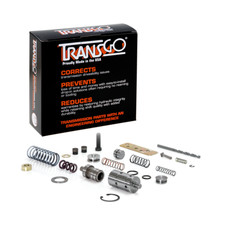
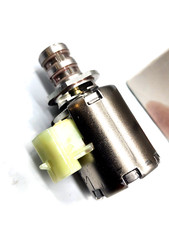
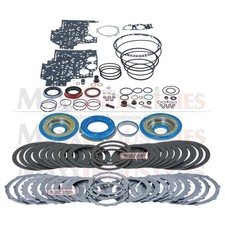
If you are rebuilding the valve body on an early GM heavy-duty four-speed, starting with a 1991 truck or van, and the teardown showed a cooked direct clutch or the truck was flaring on the 2-3 shift, this is the kit to put in it. It is a new TransGo shift kit, shown in the photo with its black CORRECTS / PREVENTS / REDUCES box, the springs, valves, bushings and small hardware. The listing is filed under 4L85E, but 1991 is the first model year of the 4L80E, the unit the 4L85E was developed from, so for a 1991 vehicle you are working on a 4L80E. The same hydraulics run through both, which is why one TransGo kit covers the whole family.
What the shift kit does in a 4L80E or 4L85E
The PCM controls line pressure in this transmission by pulsing the EPC (pressure control) solenoid. That signal does not push on the pressure regulator directly; it acts through a boost valve that rides in a bushing in the pump. TransGo calls that boost valve assembly notorious for wear. When it wears one way, boost is too low, the direct clutch comes on soft during the 2-3 shift and burns. When it wears the other way, boost runs away and the extra pressure can crack the case, the direct drum or the piston. The kit replaces the boost valve and bushing with a hardened, wide-land design that cleans itself, adds a relief valve system that caps EPC boost, and changes regulator and accumulator springs. TransGo describes the result as a slight rise in line pressure with short, smooth shifts, not a harsh street-race feel.
Symptoms this kit is built for
- Soft or long 2-3 upshift, usually worse when hot or towing
- Burnt direct clutch plates, often on a unit that was already rebuilt once
- No upshifts, or low pressure after the solenoid feed filter breaks apart
- Harsh 1-2 shift and a lazy 3-2 downshift
- Broken case, direct drum or piston from runaway pressure
- Codes TransGo lists for the kit: P0731, P0732, P0733, P0734, P0751, P0756, P0894 and P1870 (and flash codes 39, 68, 85, 86 and 87 on early units)
How to confirm before you buy
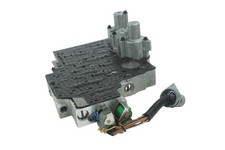
Several of those codes also show up from wiring, a bad solenoid or a worn pump, and a kit will not fix those. Start with a line pressure gauge and a solenoid resistance check; our shift solenoid symptoms guide has the test values and explains the difference between an electrical code and a performance code. If the pressure numbers are off, read the valve body problems and testing guide next, because worn bores elsewhere in the body can mimic a tired boost valve.
Fitment for 1991
TransGo lists this kit for 1991 through 2013 GM vehicles with the 4L80E or 4L85E. For this listing, that means 1991 heavy-duty GM trucks and vans built with the 4L80E. GM made running changes during the run, most notably the 1997 move of cooler return oil to the center support, so if your unit has been swapped or rebuilt with mixed parts, check the pump and valve body you actually have. If you are unsure, send us the year and VIN before ordering. You can see every part we carry for this family on the 4L85E parts page, and our 4L80E vs 4L85E comparison explains how to tell the two apart on the bench.
Install notes
- Install it with the valve body off and the pump apart; the kit touches valve body, case and pump parts, so it fits best into a rebuild or a full valve body service.
- Follow TransGo's printed instructions in order. The kit includes drill bits for specific holes, and the relief valve plate and cup seals go in exact locations.
- Lay out each valve train as you remove it so springs and spacers go back in the right bore.
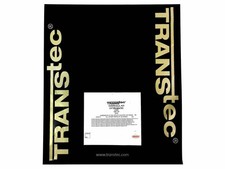
- If the direct clutch is already burnt, the kit alone will not save it. Put it in with fresh frictions and seals, such as our 4L85E overhaul kit for 1991.
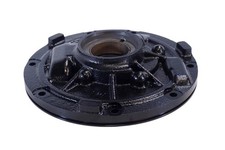
- A worn pump drops pressure no matter what is in the valve body. If the pump bushing or gears are scored, replace it, for example with the 4L85E pump, and match it to your year first.
- Refill with the fluid GM specifies for your vehicle; GM's current spec for the 4L85E family is DEXRON VI.