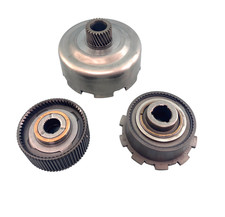
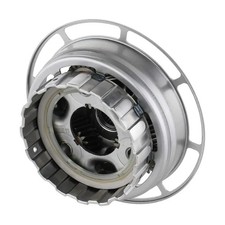
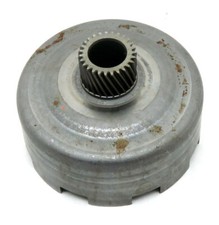
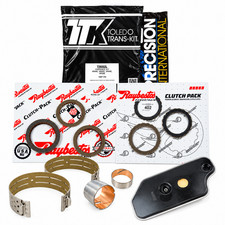
When a 4.0L Ranger, Mazda B4000 or early Explorer with the 5R55E starts grinding under load, whines in only some gears, or drops drive after a bang, the gear train is usually the next stop after the fluid and the valve body. This listing is a used, cleaned and inspected original Ford planet set with its reaction shell for the 4R44E, 4R55E and 5R55E family. It is the non-sensor style shell, and the rear planet is the 10-lug version. You get the pieces shown in the photo, so a rebuilder who found chewed pinions or a split shell can replace the matched hard parts in one order instead of hunting them one at a time.
What the planet set and shell do in a 5R55E
The 5R55E is Ford's electronic five-speed grown out of the A4LD. Behind the overdrive section sits a two-planet gear train that shares a single sun gear, and the shell is the steel bell that carries torque between that sun gear and the reverse/high clutch drum. Depending on which clutch or band is applied, the shell either drives the sun gear or holds it still, and the front and rear planets turn that into first, second, third and reverse. Ford made this a five-speed in 1997 by applying the front servo to give an overdriven first and fifth, so the rear gear train does its work in nearly every range. A worn pinion, a cracked carrier or a shell with rounded lugs therefore shows up across several gears, not just one.
Symptoms of a failed planet set or shell
- A whine or growl that changes with gear selection and is loudest under light throttle in the lower gears
- A loud bang followed by no drive, or drive in some ranges and none in others
- Loss of reverse together with third, which points at the shell and sun gear connection
- Bronze and steel glitter in the pan from worn pinion washers and bushings
- Gear ratio error codes, for example P0731 through P0734, on vehicles whose computer compares input and output speed
How to confirm it before you order
Many 5R55E complaints are hydraulic, not mechanical. Sonnax traces flares and lost fourth and fifth to electronic pressure control and coast clutch valve leaks, and Transmission Digest documented delayed reverse in this family caused by a checkball that starves the direct clutch. Pull codes, check fluid level and smell, and work through our 5R55 harsh or delayed shift walkthrough first. A gear noise that follows the range rather than road speed, or metal in the pan, is the sign to open the case and inspect the planets. Our whine and clunk diagnosis guide explains how to tell gear train noise from pump and converter noise.
Fitment
This set is listed for the 4R44E, 4R55E and 5R55E. The 4R44E appeared in 1995 and the 4R55E backed the 4.0L in 1996, and the five-speed 5R55E followed in 1997. The 5R55E went into 4.0L Rangers and Mazda B4000 trucks through 2011 and into 1997-2001 Explorers and Mountaineers. It does not fit the 5R55W or 5R55S used in 2002-and-later Explorers, Mountaineers, Lincoln LS and Mustang; those units have a different gear train. Inside this family, Ford built shells with and without windows for a speed sensor and used more than one rear planet lug count. Lay your old shell and rear planet next to the photos and match the non-sensor shell, the 10-lug rear planet and the sun gear splines, or send us your year and VIN and we will check it. Every part for this family is on our 5R55 parts page.
Install notes
- Replace the thrust washers and bearings on both sides of the gear train and set end play to spec before the case is closed
- Check the sun gear bushings and splines; a good planet set on a worn sun gear will be noisy again quickly. A separate 5R55E sun gear and shell is available if yours is damaged
- Inspect the reverse/high drum lugs that ride in the shell for a clean fit
- Flush the cooler and lines; the debris that ate the old pinions will ruin the replacement
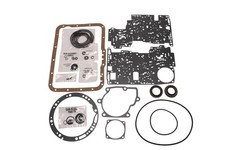
- Install new frictions and seals with a 5R55E overhaul kit, fill with Mercon V and set the level hot with the engine running
- Clear adaptive values and road test so the computer relearns shift pressure
If the overdrive carrier up front is worn too, pair this set with the 1997-2011 5R55E planetary so the whole gear train comes back to the same standard.