A customer rolls in and says the truck "went into limp mode." That phrase covers at least three different things on a GM 10L80, with different causes, different codes and different repairs. One of them is a deliberate protection strategy GM paid dealers to install. Treat them as one condition and you will either replace a good valve body or hand back a truck that eats its clutch packs.
So before anything comes apart, figure out which default mode you are in. The unit tells you, if you know what the gear pattern means.

The 10L80 has three default modes, not one
Per ATRA, the TCM running the 10L series uses adaptive strategy to manage functional failures, with the goal of keeping the vehicle moving while protecting the geartrain. That produces several failsafe behaviors, not the single third-gear limp most of us grew up on.
| What the driver gets | What it means | Where to look |
|---|---|---|
| No movement at all, high line pressure, stuck in park | The TCM has no power. ATRA states this outright as the no-power condition. | TCM power and grounds, fuses, battery, the connector. Not the valve body. |
| Second gear forward and a good reverse | Power-down default drive mode. The default disable (DD) solenoid has dropped out. | Solenoid feed pressure to the DD solenoid, and the default enable and default select valves it controls. |
| Fifth gear only, MIL on, reduced propulsion message | Recall software. It commands this on purpose when it detects valve wear. | Feed limit low valve. The software is a warning, not a repair. |
| Commanded second-gear start that still climbs to eighth | A partial failsafe. Transmission Digest notes the unit can run this depending on whether the fault is hydraulic or electrical. | Scan every module first. This one is frequently not a transmission fault. |
The second row surprises people. Sonnax explains that the DD solenoid is powered on at all times and does not switch off until a default event occurs. With the DD solenoid off, pump output pressure routes through the default enable and default select valves into the exhaust backfill passages, and the clutches apply through their exhaust ports. That combination is the A, B, C and D clutches, which is second gear: a hydraulic fallback built into the casting, not a software gear command.
The feed limit low valve is behind most 10L80 limp complaints
Here is the chain, and it explains the recall, the code and the driveability complaint all at once. The feed limit low valve sits in the boost ball circuitry that controls clutch regulation, and per Sonnax it has a second job: it acts as the limit valve for solenoid feed to the DD solenoid. Wear that bore and solenoid feed pressure to the DD solenoid drops. Now the default enable and default select valves are no longer being held where they belong, and depending on what gear is commanded at that moment, the unit either falls to a lower gear or binds up.
From the driver's seat that shows up as a sudden drop to 2nd while shifting into 7th or 8th, or the drive wheels momentarily trying to lock. Sonnax reports seeing this wear at as few as 35,000 miles on tow trucks and heavy trailer haulers, and a companion Sonnax advisory puts the general failure window at as little as 30,000 miles. Two field clues matter: the complaint is usually heat dependent, so a cooled-off vehicle behaves normally, and there is very often a stored P0747.
What the recall actually did
GM filed safety recall N242480630 with NHTSA as 25V-148 on March 6, 2025, covering 90,081 vehicles: 2019-2020 Cadillac CT6, 2020-2021 CT4 and CT5, and 2020-2022 Chevrolet Camaro built with the 10-speed. GM's defect description says a transmission control valve may be susceptible to excess wear over time, resulting in a gradual loss of pressure within the valve that can cause harsh shifting, and that in rare cases the wheels may momentarily lock. The cause line is blunter: excessive wear in the control valve body can cause a fluid leak leading to a pressure drop that causes certain valves to move unexpectedly.
The remedy is software only, and GM says so in the parts section of the dealer bulletin. Dealers install TCM software that monitors valve performance and detects excess wear approximately 10,000 miles before a lock-up could occur. Once detected, the transmission is limited to fifth gear, because the lock-up happens in a downshift from eighth. The driver gets a service engine light and a reduced propulsion message and experiences it as sluggish. Per Sonnax, the next key cycle will let the driver start in first gear as long as the transmission is still capable.
That is the whole answer to "why is my truck stuck in 5th after the recall." GM's chronology lists 115 field reports of lock-up received between February 17, 2022 and November 12, 2024, with the lock-up itself measured at under 150 milliseconds. A companion recall, N242454440 (NHTSA 24V797), covers diesel applications for the same momentary rear wheel lock-up. ATRA adds that GM extended transmission warranty coverage on these to 10 years or 150,000 miles.
The 2026 SUV recall: 26V085
If the 10L80 is in a 2022 full-size SUV, there is a newer filing to check. GM submitted recall N252536750 to NHTSA as 26V085 on February 18, 2026. It covers 43,732 2022 Tahoe, Suburban, Yukon, Yukon XL, Escalade and Escalade ESV gasoline models with the 10-speed and electronic transmission range select (ETRS), built between March and July 2022. GM's chronology says transmissions built from April to September 2022 contain unique internal hardware that may increase the wear rate in the control valve, and that these trucks left the plant without the wear-monitoring TCM software. The condition GM describes is worse than the car recall: the rear wheels can stay locked until the vehicle comes to a stop, not just for a moment. The remedy is the same 5th-gear software, and GM says every 2023 and later model of those SUVs was built with it. So a 2022 Tahoe with P0747 and a hot downshift to 2nd has a recall to check before anyone quotes a valve body. The same default-mode logic on the Camaro and Cadillac side is covered in our 10L90 limp mode guide.
How the TCM decides to set P0747
P0747 is transmission control solenoid valve 1 stuck on. ATRA's writeup lists the enable criteria, which keeps you from chasing electrical faults the TCM has already ruled out. For either path, the TCM first requires that system battery voltage is normal, no solenoid driver or solenoid electrical faults exist, no speed sensor faults exist, and no engine sensor faults exist. Then it takes one of two routes:
- During a shift: it watches the slip speed ratio calculation of the off-going clutch. If the calculation says torque is still going through that clutch while the solenoid is commanded to release it, the clutch is deemed not to be releasing.
- At steady throttle with no shift commanded: the PCM/TCM startle mitigation program watches for unintended deceleration under steady engine load. If it decides a clutch is applying when it should not be, that is the fault.
ATRA also notes that on the 10-speed, P0747 appears to be set only by mechanical or hydraulic problems, and lists other causes worth ruling out besides the feed limit valve train: a sticking 1-2-3-4-5-6-R clutch regulator valve, a faulty or sticking clutch solenoid, a burned clutch locked up, and cross leaks in the valve body, shaft seals or gaskets.
When limp mode is not the transmission at all
P175E, shift limiting active. Per ATRA this means the TCM has intentionally started a shift and pressure management strategy to protect the unit because of sensor input data on the engine or transmission side. Transmission Digest walked through a 2018 Escalade ESV with a 10L80 barely moving forward and banging: the codes were P0300 random misfire and P175E. The P0300 set the P175E. The shop replaced the transmission, the customer refused the engine repair, and 800 miles later the replacement unit had the same F clutch failure, steels distorted and locked to the hub with the frictions digging into the aluminum drive shell. The bucking during active fuel management was killing transmissions. Scan every module, including the engine, before you quote a unit.
A chassis code changing shift behavior. ATRA's example is worth memorizing: chassis DTC C0267, low brake fluid level, causes no upshifts in Tow/Haul mode, and the vehicle shifts correctly with Tow/Haul deselected. GM's published diagnostics do not connect that code to a driveability symptom.
No-move right after your own valve body job
On shift-by-wire units (RPO EPH), ATRA points at a specific assembly error that produces a no-move with P187E and/or P18AB: the park pawl actuator piston is missing or not engaging. Put the park pawl actuator lever fully forward in the park position, make sure the piston servo opening slot is vertical, and set the valve body in while avoiding contact between the switch housing, magnet carrier and the end of the actuator lever. Positioned right, the valve body drops into place without force. If you are pushing on it, stop.
The diagnostic order that saves you a valve body
- Read every module. Engine, chassis, ABS, TCM. Address non-transmission codes first.
- Check recall status. Run the VIN for N242480630, N242454440 and, on 2022 Tahoe, Suburban, Yukon and Escalade, N252536750 (26V085). If that software is installed and the vehicle is in fifth gear only, you already know what the TCM found.
- Verify power and grounds. Stuck in park with high line pressure is a TCM power problem. A weak battery also blocks adaptation and will stop a fast learn from completing.
- Fluid type and level. DEXRON ULV only. GM's TechLink capacity chart lists a 7.7 liter (8.1 quart) fluid change capacity for 10L80 applications across RPO MQB, MQC, MHT, MI2 and MHS.
- Line pressure on a gauge. Sonnax's practical floor, from the fast learn prerequisites, is 55 to 60 psi minimum in Drive with a clear rise on throttle. Below that you have a hydraulic fault and no relearn will hide it.
- Cold versus hot road test. If it behaves cold and defaults hot, that fits feed limit low wear.
- Vacuum test the feed limit valves. Test the balance end of the feed limit low valve, which is where it wears most. Healthy is 18 in-Hg or higher, and it should match the feed limit high bore, since they are the same valve train with different springs. Below 8 in-Hg means a drop-in valve will not make up the wear.
- Look at the cooler lines while you are under it. GM bulletin 22-NA-182 blames a twisted cooler line on low mileage vehicles for harsh shifting, shudder, surging, stalling, neutral/flare and overheating on 6L80 through 10L1000 units, before or after an overhaul, and notes it may set P27EC on ETRS units.
The repair, and what GM changed in the hardware
GM finally released a hard part fix. Bulletin 25-NA-158 (August 18, 2025) covers 2021-2024 Silverado and Sierra 2500HD/3500HD with the 10L1000 (RPO MGM, MGU, MKM) and a P0747 complaint titled "no shift, transmission in default, only has fifth gear and/or reverse." It replaces the spacer plate, the feed limit valve and its spring rather than the whole valve body.
What matters on the bench:
- The old valve is anodized aluminum; the new one is steel, identified by a dimple on the small diameter end. The aluminum valve used an hourglass or straight spring; the steel valve uses a higher tension straight spring.
- Part numbers per GM and ATRA: 24059372 feed limit low valve, 24279142 spring, 24047335 spacer plate (2024), 24044188 spacer plate (2021-2024 MGM/MGU). The updated plates use different sized balance passages than the previous ones.
- Torque the spacer plate bolts to 53 in-lb (6 Nm) and the control valve bolts, in sequence, to 80 in-lb (9 Nm).
- The valve should come out of the bore with minimal effort. GM's rule: any valve that requires force to remove means the valve body gets replaced. The bore does not get cleaned.
- Do not use brake clean or other solvents on the valve body, and do not use Trans Gel to hold the check balls.
- Do not run this procedure under 7,000 miles, or on a unit with excessive clutch material in the pan. Find out where that clutch debris came from first.
- Service fast learn and MCVM characterization are not required after this repair.
One limitation: as of ATRA's November 2025 writeup, GM had released these parts for the 10L1000 only, not the smaller 10L series. For a Gen. 2 10L60, 10L80 or 10L90 the aftermarket is where the fix lives today. Sonnax's drop-in 105740-54K feed limit low valve kit covers the 10L1000 and Gen. 2 10L60/80/90, with 105740-58K for the high valve, and oversized kits 105740-59K and 105740-60K plus reaming tooling when the bore tests below 8 in-Hg. ATRA's note on the tradeoff is fair: GM's steel valve does not address bore wear, while sleeved aftermarket kits do.
The part that actually ends the 5th-gear limp
Software put the vehicle in fifth gear. The worn feed limit low valve is what the software found. On a Gen. 2 10L60, 10L80 or 10L90 the Sonnax 105740-54K drop-in kit restores that valve without buying a valve body, and it is the same repair that addresses P0747 and the momentary lock-up complaint behind the recall.
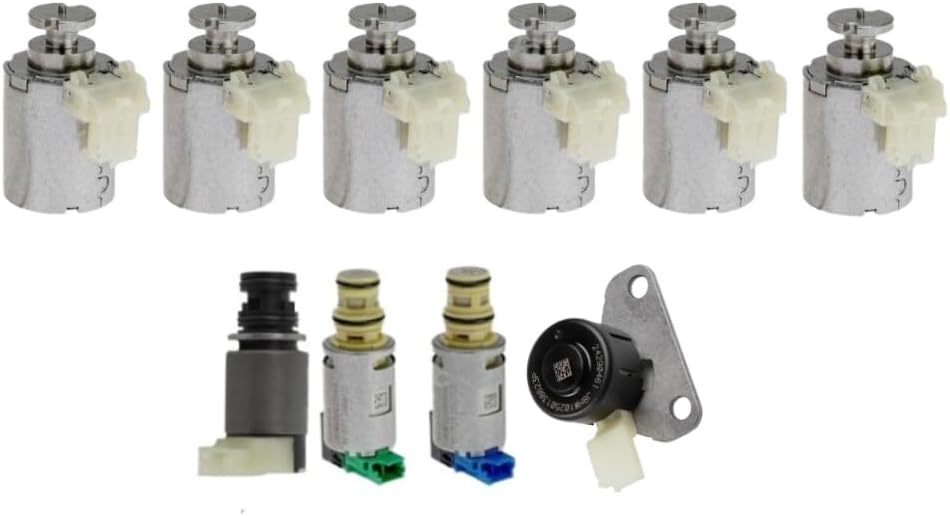
Sonnax 105740-54K feed limit low valve kit at CoreTransmissionParts →Also there: the feed limit high valve kit 105740-58K, the GM OEM shift solenoid kit, and the full 10L80 parts collection.
Keeping the next one out of default
Most of the prevention list is the discipline that keeps this unit shifting well anyway: correct DEXRON ULV at the correct level, a charging system that holds up under load, a filter that is not collapsing, and no cooler bypass keeping the transmission below adaptive learning temperature. Add two items specific to default modes. Vacuum test the feed limit low and high bores on every Gen. 2 valve body you have apart, even when the complaint is something else, because that is the bore with a federal recall behind it. And tell the customer what the reduced propulsion message means. Sonnax is direct about ignoring it: extended driving in this condition destroys clutch packs, because the unit binds up intermittently. A vehicle limping in fifth gear is on a countdown, and the clock does not stop because it drives fine around town.
FAQ
Why is my 10L80 stuck in 5th gear with a reduced propulsion message?
That is almost always the recall software working as designed, not a new failure. GM safety recall N242480630 (NHTSA 25V-148) installs transmission control module software that watches the feed limit low valve and detects excess wear roughly 10,000 miles before the wheels could momentarily lock up. When it sees that wear, it limits the transmission to fifth gear and lights the service engine lamp plus a reduced propulsion message. The valve is still worn, so the software is telling you to service the valve body, not telling you the truck is fine.
What does DTC P0747 mean on a 10L80?
P0747 is transmission control solenoid valve 1 stuck on, and per ATRA it means the TCM decided a clutch is still carrying torque when it was commanded off. The TCM sets it by watching off-going clutch slip speed during a shift, or through the startle mitigation program that looks for unintended deceleration at steady throttle with no shift commanded. Sonnax ties the common version on Gen. 2 units to feed limit low valve wear letting the E clutch stay applied.
Does a 10L80 have one limp mode or several?
Several. With no TCM power, ATRA says the unit sits in park with high line pressure. With the default disable solenoid off, the default enable and default select valves route pump pressure through the exhaust backfill circuit and apply the A, B, C and D clutches, which is second gear plus reverse. The recall software adds a third mode that commands fifth gear only. Transmission Digest notes the unit can also run a commanded second-gear failsafe up to eighth gear depending on whether the fault is hydraulic or electrical.
Can I just reset the TCM or clear the code to get out of limp mode?
Clearing codes will usually give you gears back until the fault repeats, and that is the trap. On the feed limit low failure Sonnax warns that extended driving in this condition destroys clutch packs because the unit binds up intermittently. A clean key cycle that restores normal shifting proves nothing except that the fault is temperature or pressure dependent. Fix the valve.
Is the 10L80 limp mode fix a whole new valve body?
Not necessarily. GM's own hard part update for the 10L1000, bulletin 25-NA-158, replaces just the feed limit low valve, its spring and the spacer plate, and GM states service fast learn and MCVM characterization are not required. For Gen. 2 10L60, 10L80 and 10L90 units, Sonnax sells drop-in kit 105740-54K, or oversized kit 105740-59K with reaming when the bore is too far gone. A full valve body is only mandatory when the wear is in the LPC accumulator or linear pintle solenoid bores.
Sources
- General Motors / NHTSA — Part 573 Safety Recall Report 25V-148 (GM recall N242480630), submitted March 6, 2025. Backs the 90,081 potentially involved vehicles across 2019-2020 Cadillac CT6, 2020-2021 CT4 and CT5 and 2020-2022 Chevrolet Camaro equipped with the 10-speed; the defect description of a transmission control valve susceptible to excess wear causing a gradual loss of pressure and harsh shifting with rare momentary wheel lock-up; the cause statement that excessive wear in the control valve body causes a fluid leak and pressure drop that makes certain valves move unexpectedly; the remedy of TCM software that detects excess wear approximately 10,000 miles before lock-up and limits the transmission to fifth gear with a service engine light and reduced propulsion message, because the lock-up occurs in a downshift from eighth gear; the 115 field reports received between February 17, 2022 and November 12, 2024; and the under-150-millisecond duration of the lock-up. nhtsa.gov (PDF)
- NHTSA — Part 573 Safety Recall Report 26V085, General Motors LLC (GM recall N252536750), submitted February 18, 2026. Backs the 43,732 2022 Tahoe, Suburban, Yukon, Yukon XL, Escalade and Escalade ESV gasoline models with the 10-speed and ETRS; the unique internal hardware in transmissions built April to September 2022 that may increase control valve wear; these vehicles lacking the wear-monitoring TCM software; the condition where the rear wheels may remain locked until the vehicle stops; the 5th-gear software remedy with service engine light and reduced propulsion message; and all 2023 and later models being built with that software. nhtsa.gov (PDF)
- General Motors — Safety Recall N242480630 "Momentary Wheel Lock-Up" dealer bulletin, March 2025 (Revision 00). Backs the condition and correction wording issued to dealers, the stop delivery placed on involved vehicles March 6, 2025, the affected make, model and year table, and the statement that no parts are required for the recall repair because the remedy is software only. nhtsa.gov (PDF)
- ATRA / GEARS Magazine — "Diagnosing The 10L Series Transmission," Keith Clark, June 2024. Backs the statement that with no TCM power the transmission is stuck in park with high line pressure; the adaptive failsafe strategy designed to keep the vehicle moving while protecting the unit; the four applied components required for power flow and the use of bidirectional range commands, a paddle-shifter second-gear start and 4WD LOW when diagnosing a no-move; the shift-by-wire (RPO EPH) no-move after service with DTC P187E and/or P18AB caused by a missing or unengaged park pawl actuator piston, and the correct valve body installation sequence; DTC P175E as shift limiting active initiated by the TCM due to engine or transmission sensor input data; and chassis DTC C0267 (low brake fluid level) causing no upshifts in Tow/Haul mode. gearsmagazine.com
- ATRA / GEARS Magazine — "Checking Out Your Seat Belt to See How Well It Works! P0747 On GM 10-Speed Applications," Steve Garrett, November 2025. Backs P0747 as transmission control solenoid valve 1 stuck on and the risk of wheel lockup or clutch tie-up from too many clutches applying, typically during a forced downshift; the full TCM set criteria including normal battery voltage, no solenoid driver, solenoid electrical, speed sensor or engine sensor faults, the off-going clutch slip speed calculation during a shift, and the startle mitigation program monitoring unintended deceleration at steady throttle; the other causes of P0747 including a sticking 1-2-3-4-5-6-R clutch regulator valve, a sticking clutch solenoid, a burned clutch and cross leaks in the valve body, shaft seals or gaskets; campaigns N242480630 and N242454440 extending transmission warranty to 10 years or 150,000 miles and the note that the software forces limp mode in fifth gear rather than fixing the root cause; and GM part numbers 24279142 spring, 24059372 steel valve, 24047335 and 24044188 spacer plates, with the note that GM had not yet released updated parts for the smaller 10L series. gearsmagazine.com
- Sonnax — "Understanding the '19-Later GM 10-Speed Safety Recall," Jim Dial, May 2025. Backs the feed limit low valve as the root cause of recall N242480630 on the 10L1000 and Gen. 2 10L60/10L80/10L90; the valve's second job as the limit valve for solenoid feed to the default disable (DD) solenoid; the DD solenoid controlling the default enable and default select valves for a power-down default drive mode equal to 2nd gear in Drive plus Reverse; the DD solenoid being powered on at all times until a default event; the design that routes pump output pressure through the two default valves into the exhaust passages to apply the A, B, C and D clutches when the DD solenoid is off; low solenoid feed allowing the unit to drop to lower gears or bind up depending on gear command; the sudden drop to 2nd when shifting into 7th or 8th and the momentary wheel lock complaint; DTC P0747 indicating the E clutch is on when it should be off; wear appearing in as few as 35,000 miles on tow trucks and heavy trailer haulers; the heat-dependent nature of the complaint; the warning that extended driving destroys clutch packs; the vacuum test of the valve's balance end at 18 in-Hg or higher matching the feed limit high bore, with below 8 in-Hg calling for oversized kits; kits 105740-54K, 105740-58K, 105740-59K and 105740-60K; and the recall software commanding 5th gear with the next key cycle allowing a 1st gear start. sonnax.com
- Sonnax — "Overcome the GM 10-Speed Wheel Lockup Recall with a Sonnax Feed Limit Low Valve Kit," June 2025. Backs the feed limit low valve as the root cause of GM Safety Recall N242480630 in 10L1000 and Gen. 2 10L60/10L80/10L90 units; the OE control valve failing in as little as 30,000 miles; and the symptom list of sudden wheel lockup, code P0747 and limp mode after the software update, along with harsh shifts, downshift to 2nd from a high gear, fifth-gear-only operation, reduced propulsion message, burnt clutches and clutch failure. sonnax.com
- Transmission Digest — "A 10L80 with a buck and bang," Wayne Colonna, June 2023. Backs the 2018 Cadillac Escalade ESV 10L80 case with P0300 random multiple cylinder misfire setting P175E shift limiting active; the list of inputs that can set P175E including accelerator pedal position, output, input and intermediate shaft speed sensors, crankshaft position, transmission range, MAP and MAF sensors, EGR valve, fuel injector, transmission control solenoid valve, engine misfire and fuel trim; the statement that this transmission can run a commanded second-gear failsafe to eighth gear with a good reverse depending on whether the problem is hydraulic or electrical; and the repeat F clutch (4-5-6-8-9-10-Reverse) failure in a replacement unit after 800 miles with distorted steels locked to the hub and frictions digging into the aluminum drive shell, traced to the unrepaired engine bucking during active fuel management. transmissiondigest.com
- General Motors — Service Bulletin 22-NA-182, "Information on 6L80 6L90 8L90 10L80 10L90 10L1000 Equipped Vehicles With A Harsh Shift, Shudder, Surge, Stall, Neutral/Flare, Transmission Overheating and/or High Transmission Fluid Temperature," August 2023 (Version 3). Backs the condition list occurring before or after an overhaul, the stated cause of a twisted cooler line on low mileage vehicles, and the note that a twisted cooler line may set DTC P27EC in the TCM on ETRS transmissions (RPO MHS, MQC). nhtsa.gov (PDF)
- Sonnax — "Tips for Success with the GM Transmission Fast Learn Process," Jim Mobley, August 2023. Backs the fast learn prerequisite that line pressure be normal at 55 to 60 psi minimum in Drive with a clear pressure rise on throttle, the requirement for correct and verified ATF level, and the list of blockers including clutch circuit leaks, clutch regulator valve wear and system voltage problems such as a failing battery or faulty alternator output. sonnax.com
- General Motors — GM TechLink "2025 Transmission Capacities & Fluids" reference chart (U.S. and Canada). Backs the DEXRON ULV fluid specification for 10L80 applications and the 7.7 liter (8.1 quart) fluid change capacity across RPO codes MQB, MQC, MHT, MI2 and MHS. gm-techlink.com (PDF)