A 45RFE with 150,000 miles and no service history gets quoted two bad ways. One shop says "never touch the fluid on a high-miler, it'll start slipping" and sends it out on decade-old ATF+4. The other hooks up a flush machine with a can of cleaner and hopes. Neither is a service. A real high-mileage service is a checklist: find out what the transmission is already doing, set the level correctly, read the pan, replace both filters, refill with the right fluid in the right amount, and know which valve body wear points are waiting if the truck already has symptoms.
This is the checklist I work through on a high-mileage 45RFE or 545RFE. Intervals, procedures, torques and capacities are Chrysler's; the valve body wear points are Sonnax's. Sources are listed at the bottom.
What Chrysler actually calls for
Start with the factory position, because it is not "lifetime fluid." Chrysler's maintenance section for the 2007 Commander, which used the 45RFE and 545RFE, lays out two schedules. Schedule "B" is for vehicles operated in any of these conditions: temperatures below 32°F, stop-and-go driving, excessive idling, dusty conditions, short trips under 10 miles, more than half the driving at sustained high speed above 90°F, trailer towing, heavy loading, taxi, police or delivery service, and off-road or desert driving. Schedule "A" is for everything else.
| Schedule | Mileage | Transmission service listed |
|---|---|---|
| B (severe) | 60,000 mi | Drain and refill ATF, replace main sump filter |
| B (severe) | 120,000 mi | Drain and refill ATF, replace main sump filter and spin-on cooler return filter |
| A (normal) | Through 120,000 mi | No ATF change listed (monthly level check applies to both schedules) |
The line in that same section that matters most is a note: Chrysler states that most vehicles are operated under the conditions listed for Schedule "B." A Ram that tows on weekends, a Durango that idles in a school pickup line, a Dakota that lives on short winter trips: all of those are Schedule B trucks by the factory's own definition. So on a high-mileage unit with no records, the assumption is not "it's fine, it's on the normal schedule." The assumption is that it has missed one or two factory services already.
Step 1: Scan and road test before you open anything
A fluid service is maintenance. It is not a repair, and you want to know before the pan comes off whether you are servicing a healthy transmission or one that is already failing. Pull codes and freeze frame first. On this family the codes that point at valve body wear rather than fluid condition are the ones Sonnax lists against the solenoid switch valve: P0841, P0868, P0871, P0988, P1775 and P1776. P0868 (line pressure low) with no other codes is also the code you see when the level is low or the pickup is sucking air, so do not condemn anything on it yet.
Then road test with the scan tool connected and note:
- Transmission temperature. Chrysler notes the true oil temperature can only be read by a scan tool in reverse or a forward gear. Do the level check at operating temperature, not "after it idled for a while."
- Engagement time into drive and reverse, cold and hot.
- Shift quality on the 1-2, 2-3 and 3-4, and whether second gear starts or failsafe ever happen.
- Converter clutch behavior, especially any shudder on light-throttle lockup.
Write it down. If the truck slips or has stored switch valve codes before the service, that is a diagnosis job, and the customer should hear it before the fluid change, not after.
Step 2: Check the level the way Chrysler wrote it
Chrysler's level procedure is specific and most people skip half of it. Vehicle on level ground, selector in Park (the converter fills in both Park and Neutral, but Park gives the accurate reading), engine idling for at least one minute. At normal operating temperature, about 180°F (82°C), the level is correct when it sits in the HOT cross-hatched region of the dipstick. At about 70°F fluid temperature it should be near the upper COLD hole. After adding fluid, wait at least two minutes for it to drain down the fill tube before you recheck.
The level matters in both directions. Chrysler spells out that low fluid lets the pump draw air, so pressure runs low and builds slowly, while overfill lets the geartrain churn the fluid into foam that can push out the vent and get mistaken for a leak. Both lead to overheating, oxidation and varnish. A high-mileage 45RFE that is a quart low has been running on aerated fluid, which alone explains a lot of soft shifts and P0868 complaints.
Step 3: Drop the pan and read it
Unless someone has added a drain plug, the fluid comes out with the pan. Before anything goes in the parts washer, look at the bottom of the pan and the magnet. Chrysler's guidance is that a light coating of clutch material on the bottom of the pan is not a problem unless the vehicle also has a slipping condition or shift lag. Excessive metal or heavy debris sends you to diagnosis, not to the refill.
- Fine gray paste on the magnet, light brown haze: normal wear for the mileage. Clean and continue.
- Friction flakes or black grit you can feel: a clutch pack is wearing out. Match it against what you saw on the road test.
- Bright metal chips or slivers: hard part damage. A filter change will not fix it.
Step 4: Replace both filters, and install the sump seal correctly
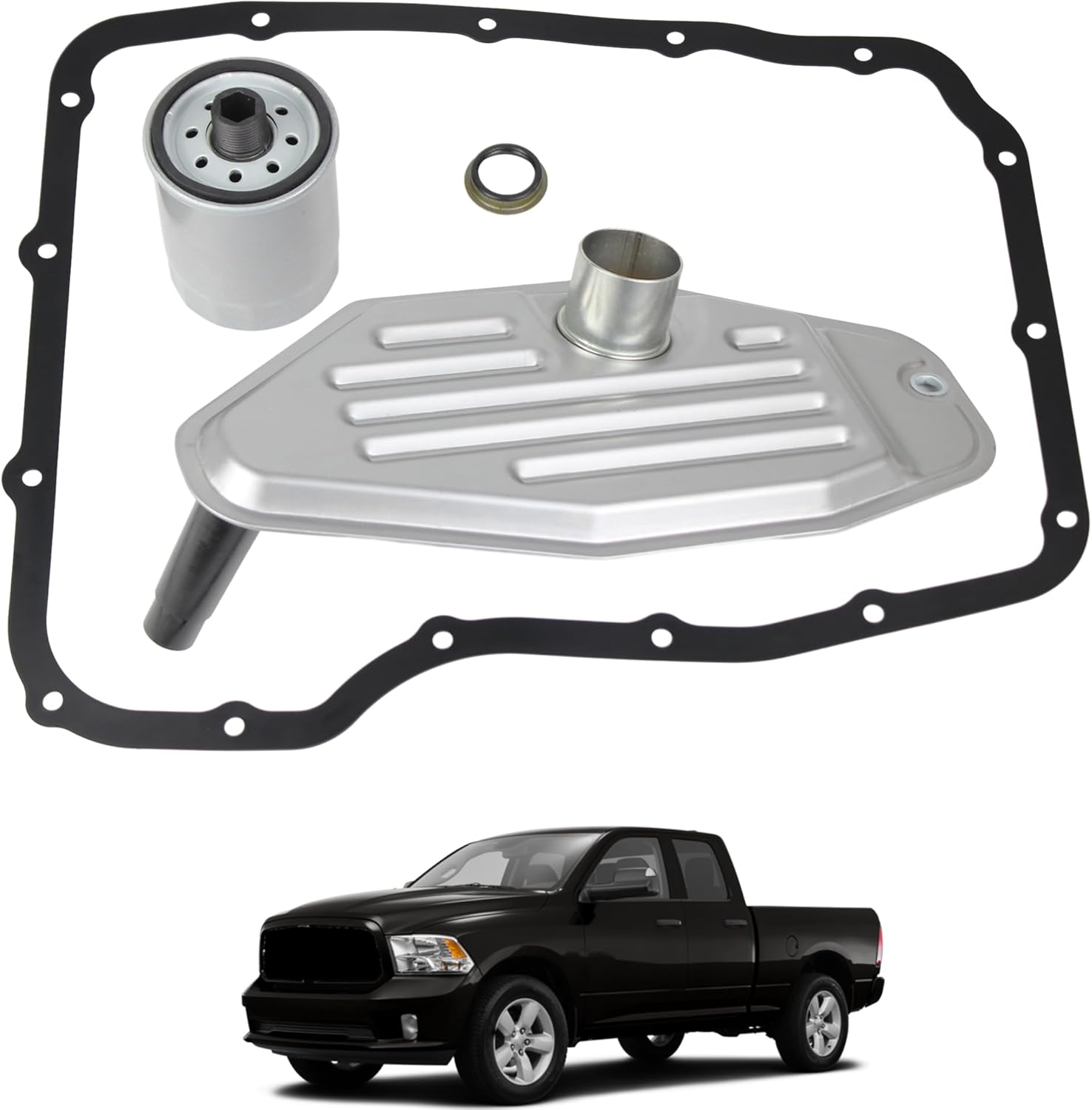
The 45RFE and 545RFE carry two filters: the main sump filter under the pan, and a spin-on cooler return filter on the case. Chrysler's own Schedule B only adds the cooler return filter at 120,000 miles, but on a high-miler with an unknown history I replace both every time. It is the last stop for debris returning from the cooler.
The sump filter detail that ruins pumps is in a Chrysler caution: the primary filter seal must be fully installed flush against the oil pump body, and you must not put the seal on the filter neck and push them in together. Chrysler states that damage to the transmission will result. A seal that rides in on the neck can cock or stop short, and the pump pulls air past it. Pull the old seal, confirm it actually came out, drive the new one in flush, then push the filter in.
The cooler return filter that causes delayed engagement
One more filter detail is worth knowing on 1999 to 2006 trucks. Chrysler bulletin 21-016-05, as summarized in Import Car's tech tip, covers a delayed engagement into drive or reverse after the vehicle sits overnight, often showing up only after the cooler return filter was replaced during a service. The cause was cooler return filter part number 04799662AB, which could let fluid drain back out of the torque converter while the engine was off. The repair called for Mopar filter 04799662. The bulletin notes the condition is not harmful to the transmission, but if you hear "it never did that before you serviced it," check which filter went on.
Step 5: Torque the fasteners in inch-pounds
Almost every fastener on a 45RFE pan service is an inch-pound fastener, and over-torque is the reason so many RFE pans leak after a service. These are Chrysler's values:
| Fastener | N·m | Spec |
|---|---|---|
| Oil pan bolts | 12 | 105 in-lb |
| Primary (sump) filter screw | 4.5 | 40 in-lb |
| Cooler return filter (spin-on) | 9.5 | 84 in-lb |
| Cooler line fitting at transmission | 17.5 | 155 in-lb |
| Pressure test port plugs | 5 | 45 in-lb |
Use a 1/4-inch drive wrench that reads in inch-pounds. If the pan rail is dimpled around the bolt holes from a past over-torque, straighten it or replace the pan. Our 45RFE pan bolt torque guide covers the sealing procedure in full.
Step 6: Refill with ATF+4, and know how much you replaced
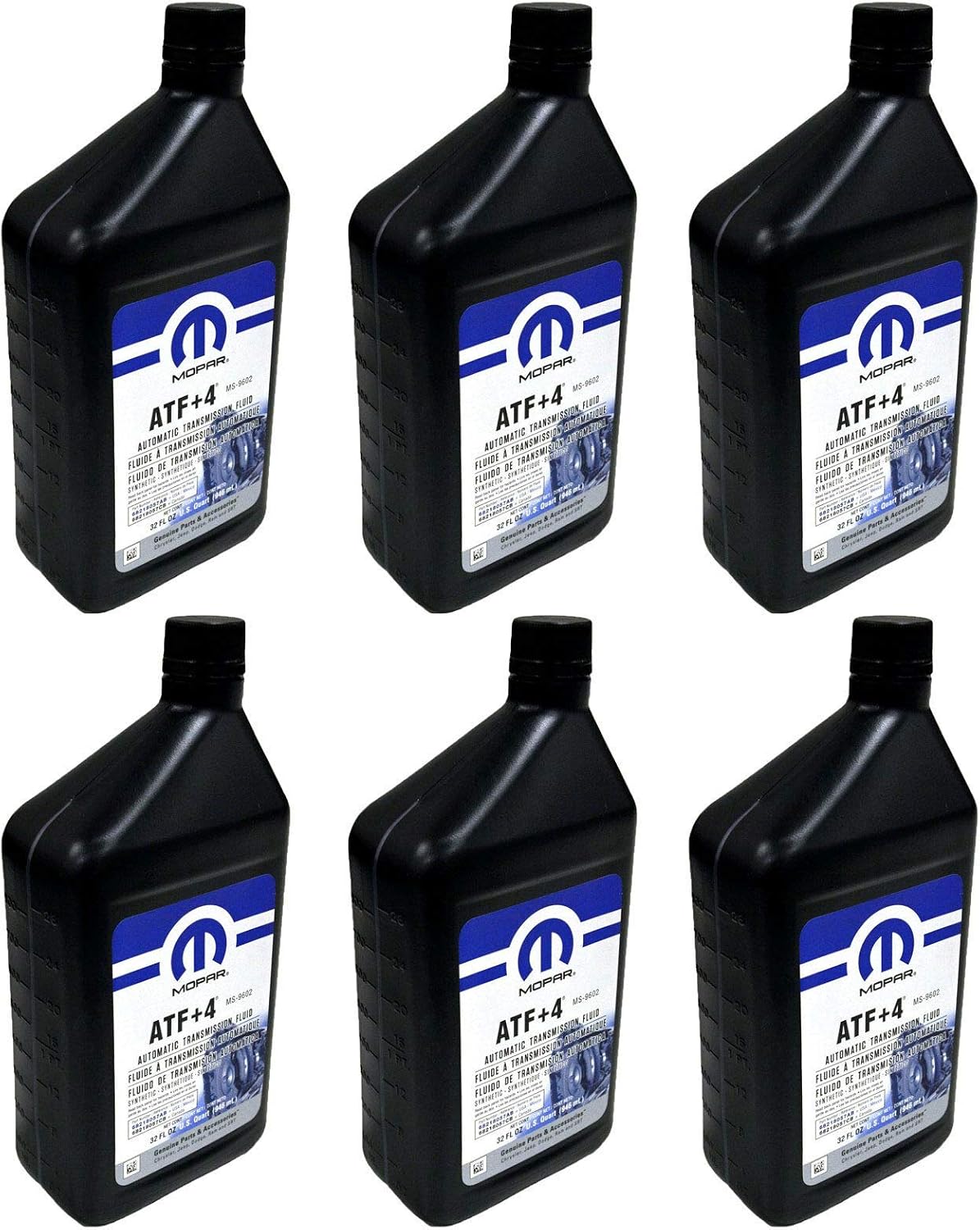
The recommended fluid in Chrysler's 45RFE/545RFE specification table is Mopar ATF+4. Use ATF+4 or a fluid that carries the Chrysler MS-9602 approval on the label, not a multi-vehicle fluid that only says "suitable for" ATF+4 applications. I also do not add shift-improver or stop-leak additives to these units. If the transmission needs a chemical to shift right, it needs a repair.
Chrysler's capacity sheet (Ram Body Builder Guide) lists the 45RFE and 545RFE at:
| Fill | Liters | Approx. US quarts |
|---|---|---|
| Service fill, 4x2 | 5.2 | 5.5 |
| Service fill, 4x4 | 6.2 | 6.6 |
| Overhaul (dry) fill | 14.0 – 16.0 | 14.8 – 16.9 |
Do the math: a pan drop replaces roughly a third to 40 percent of the fluid. The rest sits in the converter, cooler and lines. On a high-miler with dark fluid I would rather do two or three pan-and-filter services a few hundred miles apart, or a cooler line exchange after the pan service, than a solvent flush.
One thing not to use as a gauge: color. Chrysler's service information states that ATF+4 is dyed red, that it normally darkens toward brown with use, and that color and odor cannot be used to judge fluid condition. Judge the service need on mileage, duty cycle and what is in the pan.
Step 7: Check the cooler circuit
Heat kills high-mileage RFEs, so the cooler circuit is part of the service. Check the lines and fittings for seepage (155 in-lb at the case), clear the cooler fins, and ask tow customers whether there is an auxiliary cooler. Sonnax lists low cooler flow, delayed engagement and an overheated converter among the symptoms of a worn torque converter limit valve, so a unit that runs hot with a clean cooler may have its problem in the valve body.
Step 8: Know the high-mileage valve body wear points
If the road test turned up shift complaints, this is where the service turns into a repair. Sonnax's vacuum test guide for the 45RFE, 545RFE, 65RFE, 66RFE and 68RFE maps the critical wear areas, and the ones that show up on high-mileage 45RFEs are:
| Wear point | Symptoms Sonnax lists |
|---|---|
| Solenoid switch valve and bore plugs | P0841, P0868, P0871, P0988, P1775, P1776; burned OD or 4th clutch; failsafe; bind-up; wrong gear starts |
| Low/reverse switch valve | Delayed engagement, low/reverse clutch failure |
| Accumulator pistons | Slide shifts, high CVIs, 1-2 shudder, coastdown clunk |
| Torque converter limit valve | Delayed engagement, engine stall, low cooler flow, overheated converter |
| Pressure regulator valve (pump) | Harsh or soft shifts, erratic line pressure, burnt clutches, restricted converter and lube flow |
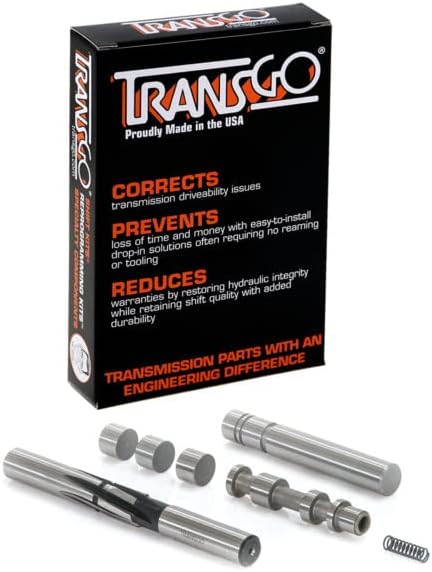
The solenoid switch valve bore is the big one. The bore plug wears, the valve loses its seal, and the unit starts setting switch codes and burning clutches. Vacuum testing at the locations in the Sonnax guide tells you whether the bore needs reaming and an oversize valve or plug kit, and it is worth doing any time the valve body is out. Measure the switch valve before ordering anything: per Sonnax, Chrysler switch valves come with either a .420 in. or a .453 in. large spool, and its 92835-02K plug kit fits only the .420 in. bores, with different kits for .453 in. Sonnax lists vacuum readings below its minimum at the indicated ports, or visible wear, as the call for the repair. If you are pulling the valve body anyway, Chrysler's Quick Learn procedure with a capable scan tool afterward is part of finishing the job.
When a service will not fix it
Fresh fluid and filters will not cure a unit that was already slipping, setting switch valve codes or shedding friction material. The service restores the level, removes debris and gives you an honest baseline. If it slipped before, it still slips, and the next step is pressure testing and valve body work. See our 45RFE slipping guide and valve body testing guide for that path.
The checklist, in order
- Pull codes and freeze frame; road test with the scan tool and note engagement, shifts, lockup and temperature.
- Check level hot (about 180°F, Park, idling, level ground) and record it.
- Drop the pan, inspect the pan and magnet, decide service or diagnosis.
- Replace the sump filter with the seal driven flush into the pump, and the spin-on cooler return filter.
- Seal the pan; torque pan bolts to 105 in-lb, filter screw 40 in-lb, spin-on filter 84 in-lb.
- Refill with MS-9602 ATF+4; plan serial drains or a line exchange on dark fluid.
- Inspect cooler lines, fittings (155 in-lb) and the cooler.
- Recheck the level hot and road test again.
RFE Transmission Filter Kit (1999-up) at CoreTransmissionParts
Sump filter and gaskets for the RFE family, the core of every high-mileage service. Confirm fitment for your unit before ordering. For pans, solenoid packs and valve body parts, browse the full collection.
View the filter kit → RFE family parts45RFE filter kits, pans, ATF+4, solenoid packs, valve bodies and overhaul kits — shipped from the USA.
Shop 45RFE parts →FAQ
How often should a 45RFE have its fluid and filter changed?
Chrysler's Schedule B, which it says covers most vehicles, calls for a drain and refill with a new sump filter at 60,000 miles, and again at 120,000 miles with the spin-on cooler return filter added. Schedule A for light-duty use lists no fluid change through 120,000 miles. Towing, idling, short trips and cold weather all put a truck on Schedule B.
How much fluid does a 45RFE take for a pan and filter service?
Chrysler lists the 45RFE and 545RFE service fill at 5.2 liters (about 5.5 quarts) for 4x2 and 6.2 liters (about 6.6 quarts) for 4x4. A dry fill after an overhaul is 14 to 16 liters. Always finish by checking the level hot, at about 180 degrees F, with the engine idling in Park.
Is it safe to change the fluid on a high-mileage 45RFE that was never serviced?
On a unit that shifts correctly, yes. Fresh ATF+4 and new filters do not cause slipping; they expose a transmission that was already worn. Road test and scan it first, read the pan, and use serial pan drains rather than a solvent flush.
Why does my 45RFE engage late after sitting overnight since the filter was changed?
Chrysler bulletin 21-016-05 traced this on 1999 to 2006 vehicles to cooler return filter 04799662AB, which could let fluid drain out of the torque converter while parked. The repair was a Mopar 04799662 cooler return filter. Chrysler says the condition is not harmful to the transmission.
Sources
- Chrysler — Maintenance Schedules (2007 Jeep Commander service information). Schedule B conditions and the note that most vehicles operate under Schedule B; ATF drain and refill with main sump filter at 60,000 miles and with the spin-on cooler return filter at 120,000 miles; no ATF change on Schedule A. Chrysler maintenance schedules
- Chrysler — Fluid Level Check, 45RFE/545RFE. Park, idle one minute, level ground; HOT region at about 180°F (82°C), upper COLD hole at 70°F; wait two minutes after adding; low and high level both aerate the fluid; true temperature read by scan tool only in reverse or a forward gear. Chrysler fluid level check
- Chrysler — 45RFE/545RFE Specifications and Torque Table. Mopar ATF+4 as the recommended fluid; pan bolts 105 in-lb, primary filter screw 40 in-lb, cooler return filter 84 in-lb, cooler line fitting 155 in-lb, pressure test port plugs 45 in-lb. Chrysler specifications
- Chrysler — Ram Body Builder Guide, Fluid Capacities. 45RFE and 545RFE service fill 5.20 L (4x2) and 6.20 L (4x4); overhaul fill 14.00 to 16.00 L. rambodybuilder.com
- Sonnax — Chrysler 45RFE, 545RFE, 65RFE, 66RFE, 68RFE Vacuum Test Guide. Critical wear areas and symptoms: solenoid switch valve and plugs (codes 841, 868, 871, 988, 1775, 1776), low/reverse switch valve, accumulator pistons, TC limit valve (low cooler flow) and pressure regulator valve. sonnax.com
- Sonnax — Solenoid Switch Valve Plug Kit 92835-02K (part page). Fitment across 45RFE, 545RFE, 65RFE, 66RFE and 68RFE; plug bore wear causing pressure loss, cross-leakage and cocked plugs; codes 841, 868, 871, 988, 1775, 1776, burned OD clutch, failsafe and wrong gear starts; the .420 in. versus .453 in. large spool measurement; vacuum test as the diagnosis. sonnax.com
- Import Car — “Tech Tip: The Durango Won’t Go” (Chrysler bulletin 21-016-05 summary). Delayed engagement after an overnight sit on 45RFE/545RFE vehicles traced to cooler return filter 04799662AB draining the converter; repair with Mopar 04799662; applicable vehicles. import-car.com