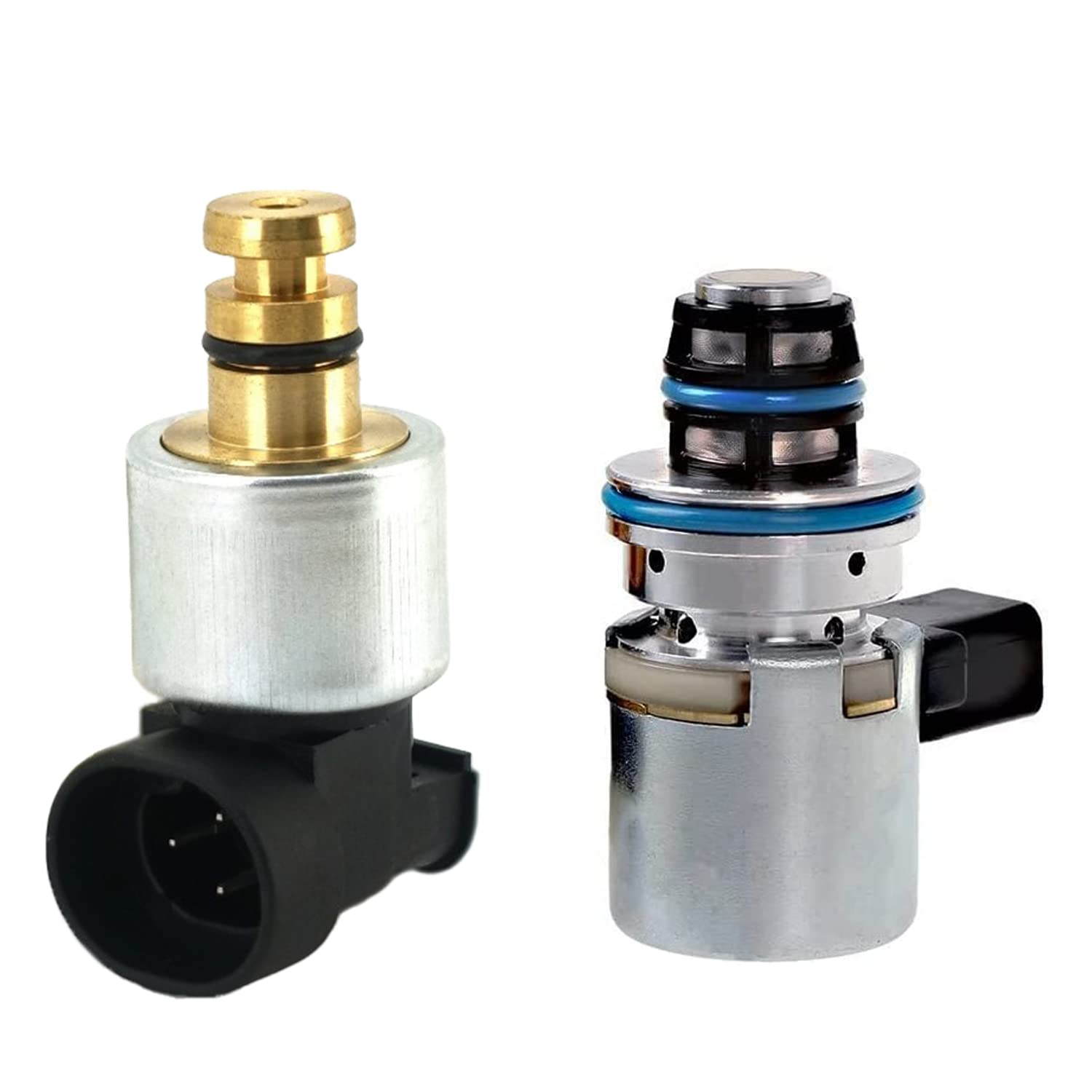
The 46RE does not have an EPC solenoid the way a Ford or a 68RFE does. When a parts counter sells you a "46RE pressure control solenoid," what you get is the governor pressure solenoid, often bundled with the governor pressure sensor (the transducer). Both plug into a small governor body bolted under the valve body transfer plate. This guide covers that system on the gas trucks that carry the 46RE: 1996-up Ram 1500 and gas 2500 trucks with the 5.2L and 5.9L Magnum V8s, plus the 5.9L Durango and Dakota.
Factory numbers come from the 46RE chapter of Chrysler's 2001 Ram service manual, a Chrysler StarParts tech tip and a 1996-1999 Transmission Digest bulletin. Sources are listed at the end.
How the 46RE Makes Governor Pressure
The 46RE shifts its first three gears hydraulically, the same way the old TorqueFlite did. Governor pressure pushes on the 1-2 and 2-3 shift valves, throttle pressure pushes back, and the shift happens when governor wins. The difference: no governor weights on the output shaft. The PCM builds governor pressure with a solenoid.
Per the 46RE Electronic Governor section of the 2001 manual (page 21-541; the inverse-acting solenoid, relay feed and four curves are word for word the same in the 1998 Ram manual, pp. 21-211 to 21-213):
- The solenoid is inverse-acting. Its inlet sees line pressure and it bleeds that down to make governor pressure. One amp of average current gives 0 psi. Zero amps gives maximum governor pressure.
- Power comes from the transmission control relay at 12 volts. The PCM controls the ground side with a duty-cycled signal.
- The sensor closes the loop. The transducer reads what the solenoid actually produced and reports it to the PCM, which corrects the duty cycle.
- The sensor is recalibrated constantly. The manual notes the transducer drifts with barometric pressure and temperature. Every time output shaft speed drops below 200 rpm, and every 3 seconds while it stays there, the PCM fires a 0.5 second pulse at 95% duty cycle to force 0 psi and reads the sensor to learn its zero offset.
- Cold fluid changes the rules. Below 50F sump temperature the solenoid can respond too slowly to reach 0 psi during that pulse, so the PCM throws out those readings and uses the offset it stored at key-on.
- Four curves. Cold fluid (at or below 30F), normal, wide-open throttle, and transfer case low range. The normal curve is load-adaptive: the manual describes grade-hunting prevention, where the PCM holds an upshift on a hill if the engine cannot hold speed in the next gear.
ATRA's GEARS magazine (Dave Skora, July 2006) adds two practical details. First, the PCM will not open the governor solenoid without an output speed sensor signal, so a dead OSS looks like a dead governor. Second, around 40 mph the PCM shuts the solenoid off and sends full line pressure into the governor circuit, which just holds the shift valves up once the 1-2 and 2-3 shifts are done. That is why a failing governor system usually ruins low-speed shifting while the truck cruises fine on the highway.
Symptoms of a Bad 46RE Governor Solenoid or Sensor
Governor pressure decides when the truck shifts, not whether the clutches hold. The complaints are about timing:
- Starts in first and will not upshift, or drops into limp-in with a code. Governor pressure is stuck near zero or the PCM has shut the system down.
- Late, high-rpm 1-2 and 2-3 shifts at light throttle. Governor pressure is lagging behind road speed.
- Early, soggy upshifts or a second-gear start. Governor pressure is too high.
- No downshift when you stop. The truck coasts to a light still in second or third and pulls away like it. The governor test in the manual says a fault exists any time pressure is above 3 psi with the wheels stopped (Test Five, 1998 Ram service manual p. 21-217).
- Abrupt or jerky shifts with a check engine light. This is the exact complaint Chrysler wrote a parts tech tip around, and it usually points at the sensor, not the solenoid (next section).
- Shift timing that changes as the truck warms up, or a 1-2 shift that shuttles back and forth. This one is often not electrical at all. See the valve body section below.
P1762: Chrysler Says Check the Transducer and the Harness, Not the Solenoid
P1762 is Governor Pressure Sensor Offset Volts Too Low or High. It sets when the zero-pressure reading the PCM learns during those calibration pulses is out of range. Chrysler's StarParts tech tip TT9000042 covers it directly for the 42RE, 46RE and 47RE: a complaint of abrupt or jerky shifts, or a check engine light with P1762, may be corrected by replacing the governor pressure transducer (Mopar 56028196AD). The tip says in plain words not to replace the governor pressure solenoid for this concern.
The same tip adds a warning that saves comebacks. Inspect the transmission wiring harness near the solenoid pack. It may have been moved during earlier service, and a misrouted harness can make contact and induce fault codes. Chrysler states that replacing the transducer without repairing the harness will not fix the code.
Transmission Digest's February 2003 Tech Talk covered the same code on 1996-1999 42RE through 47RE units, before or after an overhaul, and gave four causes:
- A defective governor pressure solenoid making pressure that is too high.
- A defective governor pressure sensor.
- An open or shorted ground wire to the sensor.
- A charging system that overcharges. An alternator problem can pull the sensor's 5-volt reference up toward 6 volts, which pushes the sensor's signal above 0.76 volts in Park or Neutral.
Before you order anything for a P1762, check charging voltage with the engine running, then the sensor's 5-volt reference and ground at the connector.
P1763 After a Rebuild: Check Line Pressure
P1763 is Governor Pressure Sensor Volts Too High. The obvious causes are a shorted signal circuit or a failed sensor. The less obvious one shows up on built units. The same Transmission Digest bulletin warns that if line pressure is raised enough to increase converter clutch apply pressure, as some valve body modifications do, the unit can set P1763. GEARS explains why: the sensor tops out at about 100 psi (about 4.8-4.9 volts). Maximum governor pressure equals line pressure, so if line pressure runs past the sensor's range, the signal goes over its limit and the PCM calls it a sensor fault.
The other governor codes on the Ram's DTC list are P1756 (governor pressure not equal to target at 15-20 psi), P1757 (governor pressure above 3 psi in gear at 0 mph), P1764 (sensor volts too low, under 0.10 volt) and P1765 (transmission 12-volt supply relay control circuit). The factory chart sets P1763 above 4.89 volts and P1762 when the sensor reads outside calibration on 3 consecutive Park or Neutral occurrences (1998 Ram service manual, DTC chart p. 25-7). Treat the volts codes as wiring and sensor problems first and the pressure codes as hydraulic problems first.
How to Test It: Scan Tool First, Gauge Second
Step 1: Desired versus actual
Watch Governor Pressure Desired and Governor Pressure Actual on a scan tool. Desired is what the PCM is commanding. Actual is what the transducer says it got. They should track each other. Transmission Digest gives the example to use: desired is 0 psi at 0 mph but actual reads 20 psi. Now put a 0-100 psi gauge on the governor port. If the gauge also reads 20 psi, the sensor is telling the truth and the solenoid is not bleeding off, so the solenoid gets replaced. If the gauge reads 0 psi while the actual PID reads 20, the sensor is lying.
Step 2: The factory governor pressure test
This is Test Five in the 46RE hydraulic pressure test (manual page 21-489). The manual calls for it when shift speeds are wrong or the transmission will not downshift. Run it on the road or on a hoist that lets the rear wheels turn.
- Put the 100 psi gauge (C-3292) on the governor pressure port.
- Move the shift lever two detents rearward from full forward. That is D.
- Run the engine at curb idle with the service brakes firmly applied so the wheels cannot turn.
- Governor pressure should be no more than 3 psi. If it is higher, the manual says a fault exists in the governor pressure control system.
- Release the brakes and slowly raise speed, not over 30 mph on the speedometer. Pressure should rise smoothly, about 1 psi for every 1 mph.
- Return to idle with the brakes applied. Pressure should drop back to 3 psi or less.
Read the result this way. Stuck high at a stop: solenoid not bleeding off, often a debris-packed inlet screen. Low or flat at all speeds: solenoid, sensor, relay feed or PCM, so go back to the meter. Rising but jumpy: look at the fluid and the valve body.
Step 3: Electrical basics
Confirm 12 volts at the solenoid with the key on. No feed is a relay or circuit problem. GEARS lists solenoid resistance at about 3.8-4.0 ohms at 70F and a sensor signal of about 0.60 volts at 0 psi. Measure at the connector and again at the PCM to catch harness damage. Confirm the output speed sensor signal rises with shaft speed before blaming anything in the governor body.
When It Is Not the Solenoid: Governor Plug Bore Wear
This is the trap on high-mileage 46RE valve bodies. Sonnax documents wear in the valve body casting at the large diameter of the 1-2 and 2-3 governor plugs. Governor oil leaks past those plugs, so the shift valves see less governor pressure than the sensor reports. The shift timing drifts with temperature because hot fluid leaks more. Sonnax's point is that the solenoid and transducer feedback loop is often too slow to make up for this leak, so a new solenoid and sensor do not fix it.
The symptoms Sonnax lists for worn governor plug bores are a 1-2 shuttle, oversensitive 2-3 and 3-2 shifts, early upshifts, and shift timing that will not respond to TV linkage adjustment. Their 46-47RH/RE vacuum test guide marks the 1-2 and 2-3 governor plugs as test points. A low vacuum reading at those bores means wear. The fix is Sonnax's drop-in governor plug kit (22771-14K): 1-2 and 2-3 plugs with PTFE seals that install without reaming the bores. CoreTransmissionParts stocks it as the RE governor bore repair kit 22771-14K.
Replacing the Governor Solenoid and Sensor
It is an in-pan job. From the 46RE removal and installation procedure (manual pages 21-542 and 21-543):
- Raise the truck, drain and drop the pan, and remove the filter.
- Unplug the pressure sensor and solenoid connectors.
- Remove the solenoid retainer screws and pull the solenoid and sensor out of the governor body. If the governor body comes off the valve body, clean both gasket surfaces and use a new gasket.
- Replace the o-rings. Lubricate them with transmission fluid, align each part with its bore and push it in.
- Install the retainer and screws, reconnect both connectors, and install a new filter and pan gasket.
- Refill with Mopar ATF+4, check the level hot, and road test.
Order by model year. Transmission Digest lists the governor pressure solenoid as 4617210 for the 1996-1999 units, with the 1996-1999 sensor as 56041403-AA, a 90-degree design. The sensor changed after that, and a sensor from the wrong generation will not fit or read correctly. After the swap, clear codes and drive warm with the scan tool connected. Make a few full stops so the PCM relearns sensor offset before you judge shift quality.
If the old solenoid screen was packed with debris, that debris came from somewhere. A governor code on a slipping, burnt-smelling 46RE is a symptom. Read our 46RE slipping guide and 46RE overheating guide before calling the job done.
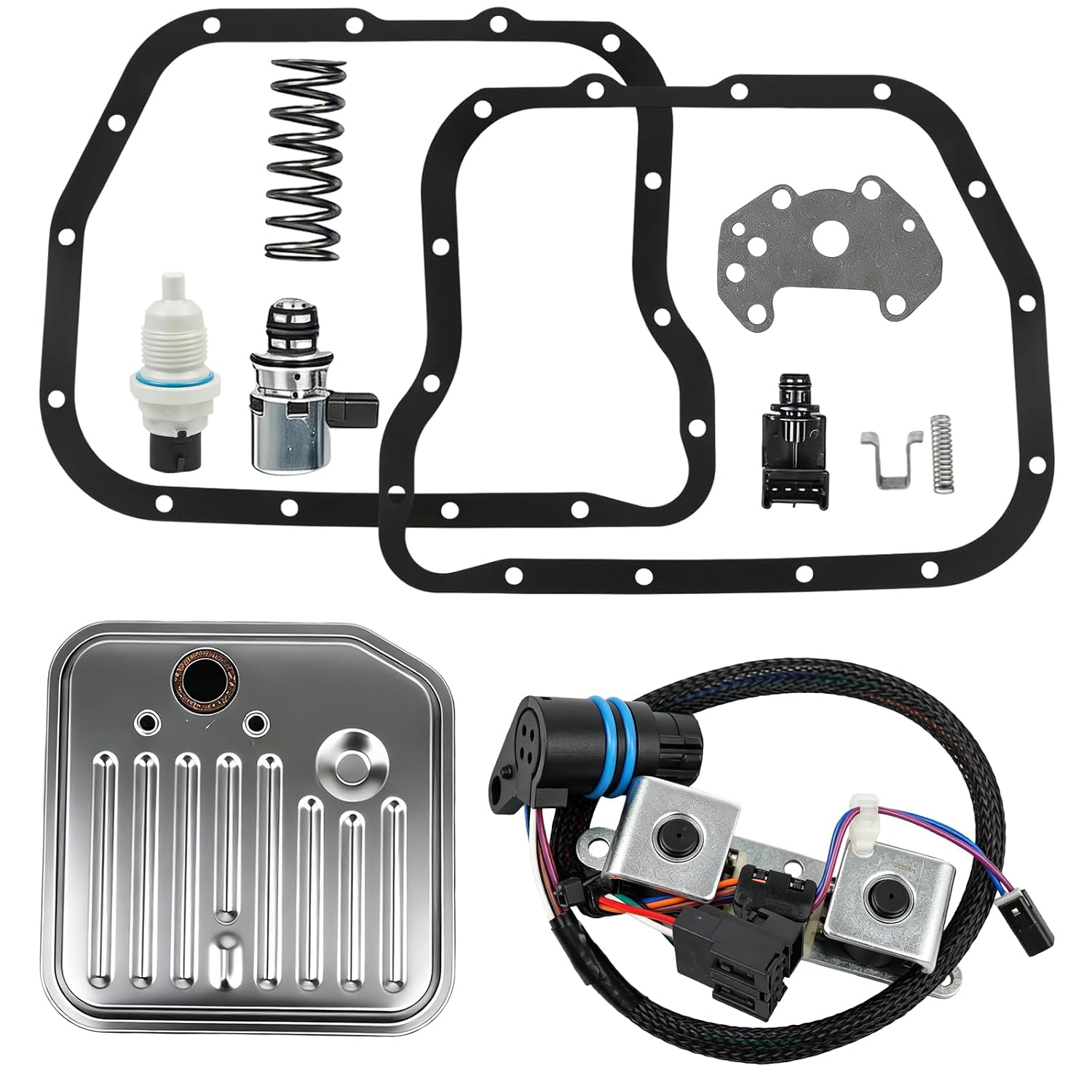
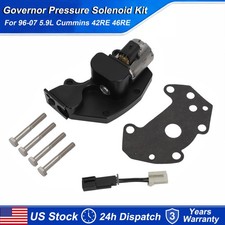
Governor Pressure Solenoid Kit with Sensor for Ram 1500
The solenoid and transducer pair from this guide, replaced together, for the governor body on RE-family Ram 1500 trucks. Sold by CoreTransmissionParts.
View the solenoid and sensor kit →Shop RE-family governor parts →
Frequently Asked Questions
Does the 46RE have an EPC solenoid?
Not in the Ford or 68RFE sense. The 46RE's electronic pressure control is the governor pressure solenoid and the governor pressure sensor (transducer), mounted in a governor body under the valve body transfer plate. Parts sellers list that solenoid, or the solenoid and sensor pair, as the 46RE pressure control or EPC solenoid.
What causes P1762 on a 46RE?
P1762 means the governor pressure sensor offset voltage is out of range. Chrysler tech tip TT9000042 says to replace the governor pressure transducer, not the solenoid, and to inspect the transmission harness near the solenoid pack for misrouting. Transmission Digest also lists a bad sensor ground and an overcharging alternator that pulls the 5-volt reference toward 6 volts.
What should 46RE governor pressure read?
Per the 46RE governor pressure test in the 2001 Chrysler service manual, no more than 3 psi at curb idle in D with the wheels stopped, rising smoothly about 1 psi per mph up to 30 mph, and dropping back to 3 psi or less when you stop again.
I replaced the governor solenoid and sensor and it still shifts wrong. Why?
If desired and actual governor pressure match and a gauge agrees, the electronics are doing their job. On high-mileage 46RE valve bodies, Sonnax documents wear at the 1-2 and 2-3 governor plug bores that leaks governor oil, causing a 1-2 shuttle, early upshifts and oversensitive 2-3 and 3-2 shifts. A vacuum test at those bores confirms it, and a governor plug kit such as Sonnax 22771-14K fixes it.
Sources
- Chrysler — 2001 Dodge Ram Truck (BR/BE) Service Manual, Automatic Transmission - 46RE, Electronic Governor (pages 21-540 to 21-543). Backs the system components, the inverse-acting solenoid (1 amp = 0 psi, 0 amps = maximum), the 12-volt relay feed with PCM ground-side control, transducer drift with barometric pressure and temperature, the 0.5 second 95% duty-cycle calibration pulse below 200 rpm output speed repeated every 3 seconds, the below-50F cold caveat, the four governor curves including grade-hunting prevention, and the removal and installation steps. The original ManualsLib scan no longer resolves. The components list, the inverse-acting solenoid (1 amp = 0 psi), the 12-volt relay feed with PCM ground-side control, the 50F limit and the four governor curves are verified in the 1998 Ram manual, pages 21-211 to 21-213: archive.org. The calibration-pulse timing is from the 2001 manual by page number.
- Chrysler — 1998 Dodge Ram Truck (BR) Service Manual, 46RE/47RE Hydraulic Pressure Test, Test Five - Governor Pressure (page 21-217), and Emission Control DTC chart (page 25-7). Backs the 100 psi gauge C-3292, D range selection, no more than 3 psi at curb idle with wheels stopped, about 1 psi per mph up to 30 mph, the return to 3 psi or less, and the governor DTC definitions: P1756 (not 10-25 psi when 15-20 psi is requested), P1757 (above 3 psi when 0 psi is requested), P1762 (outside calibration on 3 consecutive Park/Neutral occurrences), P1763 (above 4.89 volts), P1764 (below 0.10 volt) and P1765. The 2001 manual's Test Five (page 21-489) carries the same thresholds. Full manual on archive.org
- Chrysler StarParts — GPOP Tech Tip TT9000042, RE series transmission solenoid. Backs the abrupt or jerky shift / P1762 complaint, governor pressure transducer 56028196AD as the correction, the instruction not to replace the governor pressure solenoid for this concern, applicability to the 42RE, 46RE and 47RE, and the misrouted harness warning. starparts.chrysler.com
- Transmission Digest — Tech Talk, February 2003. Backs the 1996-1999 42-47RE P1762 causes (solenoid, sensor, sensor ground, alternator overcharge pushing the 5-volt reference toward 6 volts and the signal above 0.76 volts in Park or Neutral), the desired-versus-actual scan tool check with the 20 psi gauge example, part numbers 4617210 (solenoid) and 56041403-AA (1996-1999 sensor, 90-degree), and raised line pressure setting P1763. transmissiondigest.com
- Sonnax — Governor Bore Plug Kit 22771-14K and Chrysler 46RE/46RH/47RE/47RH Vacuum Test Guide. Backs the valve body wear at the 1-2 and 2-3 governor plugs, governor pressure loss that changes with temperature, solenoid and transducer feedback being too slow to compensate, the 1-2 shuttle / oversensitive 2-3 and 3-2 / early upshift / TV adjustment symptoms, and the governor plug vacuum test locations. Part page and vacuum test guide
- ATRA GEARS Magazine — Dave Skora, "Getting to Know the 42-48RE Series Transmissions, Part 1" (July 2006). Backs the hydraulic first-three-gears design, the output speed sensor requirement for governor solenoid operation, the 40 mph solenoid-off handoff, 3.8-4.0 ohm solenoid resistance at 70F, and the 0.60 volt to about 4.8-4.9 volt sensor range with a 100 psi maximum. gearsmagazine.com (PDF)
Shop 46RE governor pressure solenoids, transducers, solenoid kits, valve bodies and hard parts, shipped fast from the USA.
Shop 46RE parts →Related 46RE guides
- 46RE Shift Solenoid Symptoms, Testing and Replacement
- 46RE Valve Body Problems: Symptoms, How to Test, and Replacement
- 46RE Harsh Shift Causes and Fix: TV Cable, Pressure and Governor Checks
- 46RE Limp Mode Causes and Fix
- 47RE Pressure Control (EPC) Solenoid Symptoms
- Dodge/RAM 48RE Governor Pressure Solenoid Failure: Symptoms and Fix