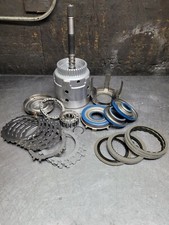
Open a box of 4L60E frictions and you get a stack of plates. Open the input housing sitting on your bench and you find room for a number of plates that may or may not match. That mismatch is where a lot of 3-4 rebuilds go sideways, because the 4L60E family never used one friction count. Depending on the year, the engine it lived behind, and whether it is a 4L60E or a 4L65E, the factory 3-4 pack came with anywhere from five to seven frictions, and the aftermarket will happily sell you kits for eight and nine.
This is not a "more is better" article. The count you can run is decided by hardware you already have in your hands: the apply ring, the apply plate, the backing plate, and the snap ring groove. Get those right and the extra plate is free capacity. Get them wrong and you have a pack that either drags itself to death or never fully clamps. Here is how to read the housing, what each manufacturer's stack-up actually calls for, and the clearance spec that has to land at the end of it.
The short version: Per Sonnax, OE 700-R4 and 4L60E units ran five-friction or six-friction 3-4 packs, while 4L65E and 4L70E units came with a seven-friction pack from the factory. What your housing will accept is set by the height of the 3-4 apply ring and the thickness of the backing plate and snap ring, not by the box the frictions came in. And the clearance spec is not universal — Sonnax calls for .050–.060" with its heavy-duty backing plate kit, while Alto calls for .025–.040" with its PowerPacks. Follow the instruction sheet for the parts you are installing. Do not average them.
Why the Count Varies in the First Place
The 3-4 clutch lives in the input housing and is applied in both 3rd and 4th, so it carries load through the entire top half of the transmission's working life. GM sized that pack to the application. A V-6 S-10 does not need the clutch area a V-8 Suburban needs, and GM built the difference into the housing components rather than the housing casting.
The clearest place to see that is the 3-4 apply ring. Alto's installation procedure states it directly: the total height of the apply ring determines the total number of friction plates that can be installed for a V-6 or V-8 application. Stand the ring on the bench with the tall legs facing up and measure from the bench to the top of the legs. Alto gives 3.975" for a V-6 ring and 3.800" for a V-8 ring. The taller ring pushes the apply plate higher into the drum and leaves less stack room, so the V-6 housing runs fewer plates. The shorter V-8 ring is what opens the door to eight and nine.
One caution on ring specs, because two good sources describe the ring differently. Sonnax's requirement for its heavy-duty backing plate kit is a '91-later apply ring stamped with the number 7, measuring 3.671–3.682" in height. That is a different measurement reference than Alto's bench-to-top-of-legs method, so the numbers are not interchangeable and you should not try to reconcile them. Measure the way the instruction sheet in front of you says to measure.
The other three parts that set your count
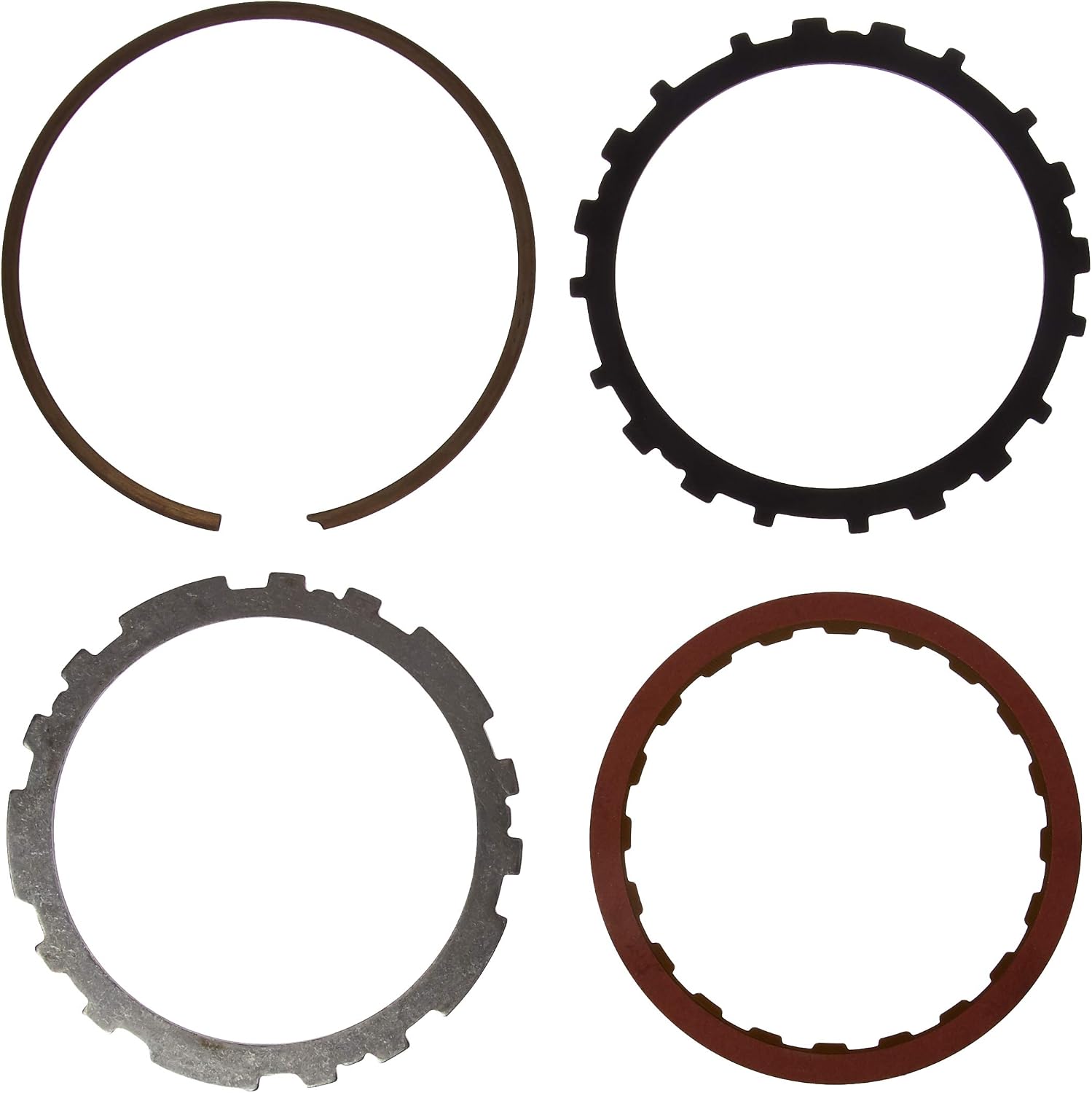
- 3-4 apply plate. Alto notes it can be flat on both sides, stepped on one side, or stepped on both sides on some 1990-and-later models. A stepped apply plate needs a steel plate against it, which burns stack height for nothing. That is why several stack-ups start with "discard the stepped apply plate."
- 3-4 clutch retainer ring. Five short legs that mate to the apply ring, .055" thick. On some units the retainer and apply plate are a single component — a thick plate, flat on both sides, with five extended lugs, measuring .225".
- Backing plate. The factory used several thicknesses, identified by a number stamped on top. Alto reports number 3 at.198" and number 7 at.190" as the two most commonly found. That stamp is worth reading before you order anything.
- Top snap ring. Early housings take a .128" ring, late housings .093", matched to the groove. Alto furnishes a .062" ring specifically for packs that come out too tight.
Those four parts, plus the plate thicknesses you choose, are the whole equation. Count is an output, not an input.
The Stack-Ups, By Application
Alto's BM342 sheet for the 057757B/C/BHP PowerPacks lays out the factory-hardware stack-ups explicitly. This is the most useful table in the 4L60E 3-4 world, because it tells you what count each combination of parts supports rather than leaving you to guess:
| Application | Frictions / Steels | Apply plate | Top plate & snap ring |
|---|---|---|---|
| Early V-6, regular or HD | 7 / 6 | Original.125" apply plate | Furnished.125" backing plate, original.128" snap ring |
| Late V-6 with stepped apply plate | 7 / 6 | Discard stepped plate, use furnished.125" | #3 or #7 top plate, original.093" snap ring |
| Early V-8, regular or HD (opt. 1) | 8 / 7 | Original.125" apply plate | #3 or #7 top plate, original.128" snap ring |
| Early V-8, regular or HD (opt. 2) | 8 / 7 | Original.125" apply plate | Furnished.125" plate, custom.062" snap ring |
| Late V-8 with stepped apply plate | 8 / 8 | Reinstall stepped plate, steel plate on top of it first | #3 or #7 top plate, original.093" snap ring |
| Early V-8, performance or race | 9 / 8 | Original.125" apply plate | Furnished.125" plate,.128" or.062" snap ring |
| Late V-8 performance with stepped plate | 9 / 8 | Stepped plate | #3 or #7 top plate,.093" or.062" snap ring |
Two details in that table are easy to skip and expensive to skip. On the late V-8 stepped-apply-plate stack, Alto is emphatic that you install a steel plate on top of the stepped apply plate first — that is why that stack runs eight steels against eight frictions instead of the usual one-fewer. And for the single-piece retainer/apply plate design, if the apply ring measures 3.800", Alto's guidance is a nine-friction setup with the singular apply plate fully seated on the ring legs and one friction placed directly on top of it.
Set the Clearance, Then Believe the Number
The count is what you build. The clearance is what you verify. Both manufacturers use the same method and land on different numbers, and the difference is real, not sloppiness — it reflects different plate materials and different backing plate stiffness.
Alto (both the 057757 PowerPacks and the 057757A Red Eagle pack): after assembly, air check the pack several times with regulated shop air to seat all components, then insert a feeler gauge between the top friction plate and the bottom of the top backing plate. Target .025–.040" for the best overall 2-3 and 3-2 shift behavior. Too loose? Pull one or two of the.060" steels and install the furnished.076" steels. Too tight, on a stack where you discarded the stepped apply plate? Put another.125" flat plate at the top in place of the #3 or #7 backing plate.
Sonnax, for the 74140-01K heavy-duty backing plate kit: build the pack with seven.067" frictions and six.095" steels, install the five OE 3-4 clutch boost spring assemblies, fit the Sonnax backing plate and OE retaining ring, apply the pack several times with air pressure, then measure between the backing plate and the top friction plate. Target .050–.060", adjusted by substituting different thickness steels.
Both sheets say to air-apply before measuring, and that step is not optional. An unseated pack reads tight, you pull a steel to "fix" it, and you have just built a dragging clutch. Air check, then measure, then adjust with steel thickness — that is the order.
The assembly order that keeps you out of trouble
- Install the apply plate, making sure its five tabs seat securely over the OE 3-4 apply ring.
- Friction against the apply plate face, then a steel, and alternate — ending with a friction on top.
- Install the five boost spring or load-relief spring assemblies. Never leave them out; the OE piston return spring is light and needs the help to keep the apply plate from floating and the clutches from dragging and glazing.
- Backing plate and retaining ring.
- Air apply several times, then measure clearance with a feeler gauge.
- Adjust with steel thickness or top plate/snap ring selection, then re-verify.
If you are running a single-sided friction pack, Alto's warning on the 057757A is worth reading twice: every one-sided disc must go in with the friction lining facing up, or you get a catastrophic failure of the 3-4 pack. Alternate external-splined and internal-splined discs, ending with an internal-splined disc, for a total of six of each plus the two-sided plate. And pre-soak the frictions in the recommended ATF — Alto asks for at least 30 minutes on the 057757A and a minimum of 15 minutes on the BM342 packs — so the paper does not glaze on the first apply.
Upgrade Options, Ranked by What They Actually Buy You
1. Convert a five or six-friction pack to seven
Sonnax's heavy-duty 3-4 backing plate kit 74140-01K exists for exactly this. It can be used to upgrade OE 700-R4 and 4L60E five-friction or six-friction packs to seven frictions, or to improve a stock seven-friction 4L65E/4L70E pack by cutting backing plate flex. Sonnax's reasoning is worth repeating: a thin, weak backing plate is the leading cause of 3-4 clutch distortion and burnup, because even the thickest OE plate flexes during apply and lets heat build unevenly. The kit pairs a significantly thicker, stiffer backing plate with a thinner but stiffer apply plate to reclaim the stack height. Note the prerequisites — '87-later housing, snap ring and ring gear, plus that '91-later apply ring stamped 7.
Sonnax also makes a pointed argument against a common shortcut: other aftermarket solutions typically use a thinner backing plate and thinner steels to make room, which ultimately makes the flex problem worse. Adding a plate by thinning the parts that resist distortion is not a capacity upgrade.
2. Change the friction construction instead of the count
Raybestos takes a different route with the RZP-001 Z Pak for the TH700-R4, 4L60E, 4L65E and 4L70E. Rather than stacking more conventional two-sided plates, it uses seven OD-spline and seven ID-spline single-sided GPZ plates plus a 3-4 GPZ plate, an apply plate, a press plate, and an optional OD-spline shim. Single-sided construction bonds the friction material to a steel core, which puts more friction surface in the same stack height and pulls heat out through the core. Raybestos positions GPZ as a solution for rebuilds where the OE clutch pack is prone to failure, and rates the material as outperforming OE by as much as 20 percent.
3. Change the housing when you have run out of room
At some point the housing itself is the ceiling, and no plate selection gets past it. The Sonnax Smart-Tech input housing is built to make room for a taller pack anchored by a stronger plate, and it supports eight.067" frictions with seven.095" steels, or nine.062" frictions with eight.077" steels. The matching 77734-01K clutch kit ships eight.067" BorgWarner high-energy frictions with seven Lindered steels — five.095" and two.107" — which is one additional OE-thickness friction and steel over stock. The anchor plate is held by fifteen bolts rather than a snap ring, which also retires the 3-4 retaining ring blow-out failure. This is the option for a build that keeps eating packs after everything else is right.
The Caveat That Matters More Than Plate Count
Adding a friction raises the pack's capacity. It does not fix the reason the last one burned. Sonnax is direct about this: low line pressure and leaks of 3rd-gear oil are the root cause of most 3-4 slipping, and the 3-4 circuit is long and interconnected enough that small leaks at several junctions add up to a pressure loss the pack cannot survive. A nine-friction stack that only sees partial apply pressure burns just like a six did, only with more parts in the pan.
So the sequence is: find and seal the leaks, restore line pressure, then decide how many plates the housing will carry. If you have not traced the apply circuits yet, start with our 4L60E 3-4 clutch diagnosis walkthrough before you order a thing, and check endplay and shim selection while the unit is apart.
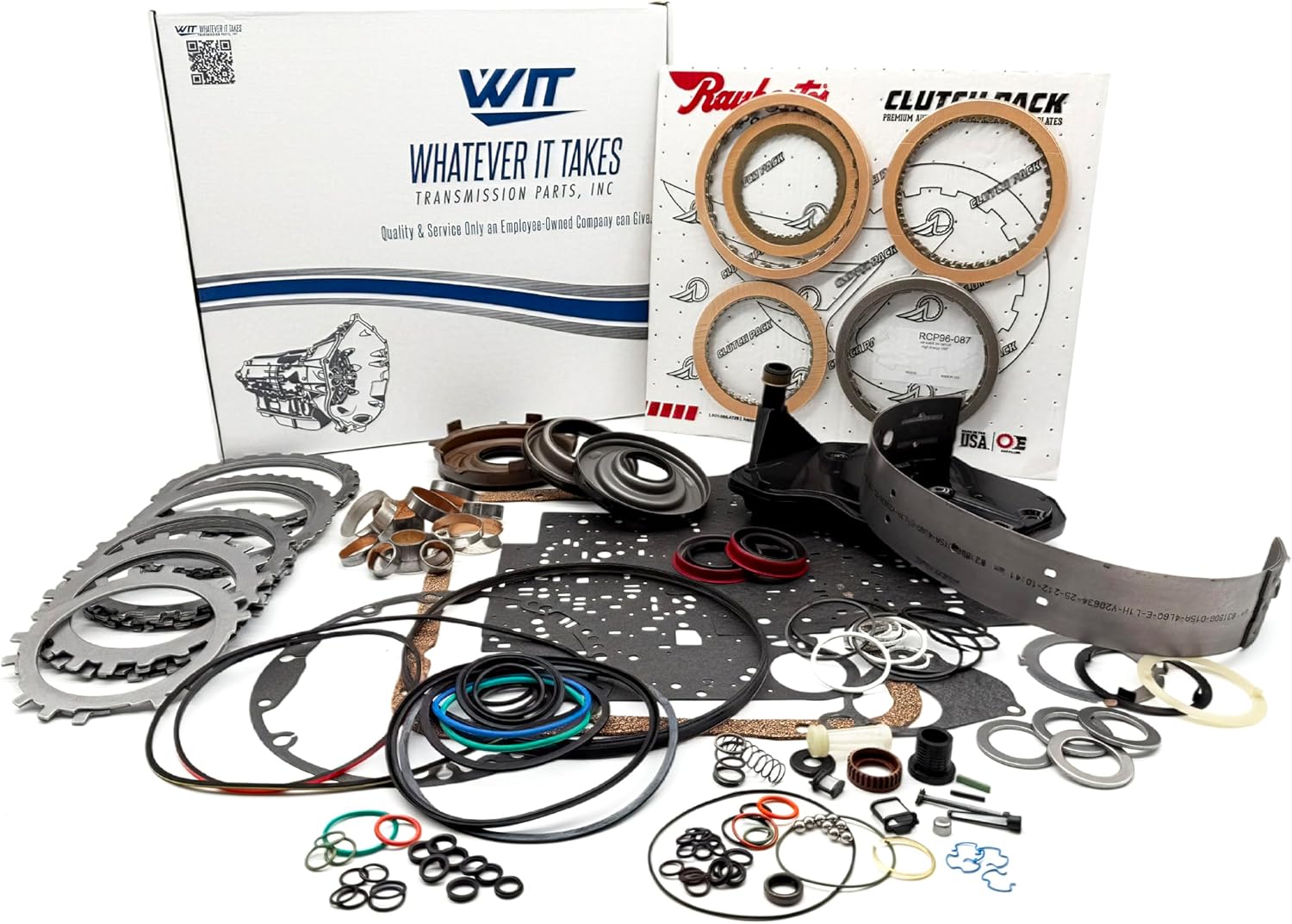
Shop 4L60E 3-4 friction and steel modules, heavy-duty backing plates, apply rings, boost spring kits, bonded pistons and full rebuild kits — shipped fast from the USA.
Shop 4L60E parts →Sources
- Sonnax — Heavy Duty 3-4 Clutch Backing Plate Kit 74140-01K, instruction sheet (PDF). Backs the seven.067" friction / six.095" steel build, the.050–.060" clearance spec measured between backing plate and top friction plate, the five boost spring assemblies, the assembly order, and the '91-later apply ring stamped 7 at 3.671–3.682". sonnax.com — 74140-01K-IN.pdf
- Sonnax — Heavy Duty 3-4 Clutch Backing Plate Kit 74140-01K (part page). Backs the OE five-friction and six-friction 700-R4/4L60E counts, the stock seven-friction 4L65E/4L70E pack, the weak backing plate as the leading cause of 3-4 distortion and burnup, and the argument against thinner plates and steels. sonnax.com/parts/4544
- Alto Products — BM342 installation sheet, 3-4 Clutch PowerPack 057757B/057757C/057757BHP (PDF). Backs the V-6 3.975" / V-8 3.800" apply ring heights, the.055" retainer ring, the #3 (.198") and #7 (.190") backing plate stamps, the.128"/.093"/.062" snap rings, every application stack-up in the table, and the.025–.040" clearance procedure. altousa.com — 01-262-BM342.pdf
- Alto Products — BM375 installation sheet, 700R4/4L60E/4L65E/4L70E 3/4 Clutch PowerPack 057757A (PDF). Backs the six internal / six external single-sided Red Eagle construction, the #7 apply ring and.223" OE apply plate, the five load relief springs, the lining-facing-up warning, and the 30-minute ATF pre-soak. altousa.com — 01-250-BM375.pdf
- Sonnax — 4L60-E Smart-Tech Input Housing Kits. Backs the eight.067" frictions with seven.095" steels and nine.062" frictions with eight.077" steels options, and the fifteen-bolt anchor plate that eliminates retaining ring blow-out. sonnax.com/smart_tech_input_housings
- Sonnax — Smart-Tech Clutch Kit 77734-01K. Backs the kit contents: eight.067" BorgWarner high energy frictions with seven Lindered steels (five.095" and two.107"), described as one additional OE-thickness friction and steel. sonnax.com/parts/5785
- Raybestos Powertrain — 3-4 Z Pak Clutch Pack Module RZP-001. Backs the single-sided GPZ construction (seven OD-spline and seven ID-spline plates plus the 3-4 GPZ, apply plate, press plate and optional shim) and the stated GPZ performance margin over OE material. raybestospowertrain.com/friction-clutch-packs/rzp-001
- Sonnax — All Over the Map: Attacking 4L60/E Burnt 3-4 Clutches with Confidence. Backs low line pressure and 3rd-gear oil leaks as the root cause of most 3-4 slipping, the interconnected 3-4 circuit, and the instruction never to leave the load release springs out. sonnax.com/tech_resources/659