A fluid change on a fourth-gen Camaro 4L60E is a simple job that people get wrong in three predictable ways: they buy the wrong amount of fluid because they read the overhaul capacity, they set the level cold and overfill it, or they "flush" a neglected high-mileage unit and wonder why it slips a week later. This guide covers what GM actually specifies for the 1993-2002 Camaro, how to do the pan service and set the level the way the factory procedure reads, and what it really costs in parts.
The short version: GM filled these cars with DEXRON-III; licensed DEXRON-VI is the approved replacement today. A pan drop and filter takes about 5.0 quarts (4.7 L), not the 8.8 or 10.8 quart overhaul figure. Change fluid and filter every 15,000 miles if the car is driven hard, in heat, or towing, otherwise every 50,000 miles. Set the final level hot, at 180-200°F, on the red-handled dipstick at the back of the engine.


What GM Specifies for the Camaro 4L60E
Every automatic fourth-gen Camaro from 1993 to 2002 used the 4L60E, behind either the V6 or the V8. The 1998 and 2002 Camaro owner manuals give the same transmission figures for both the 3800 V6 (VIN engine code K) and the 5.7L V8 (VIN engine code G, the LS1), so the numbers below hold for the late cars and are a safe reference for the earlier ones.
| Item | Spec | Source |
|---|---|---|
| Factory fluid | DEXRON-III | GM 2002 Camaro owner manual |
| Current replacement fluid | Licensed DEXRON-VI | GM bulletin 04-07-30-037A; SAE 2006-01-3242; Valvoline PI sheet |
| Drain and refill (pan and filter) | 5.0 qt (4.7 L) | GM 1998 and 2002 Camaro manuals |
| Overhaul, 3800 V6 | 8.8 qt (8.3 L) | GM 1998 and 2002 Camaro manuals |
| Overhaul, 5.7L V8 | 10.8 qt (10.2 L) | GM 1998 and 2002 Camaro manuals |
| Severe-service interval | Fluid and filter every 15,000 mi (25,000 km) | GM 2002 Camaro owner manual |
| Normal interval | Fluid and filter every 50,000 mi (83,000 km) | GM 2002 Camaro owner manual |
| Hot check temperature | 180-200°F (82-93°C) | GM 2002 Camaro owner manual |
| Fluid between marks | Generally less than one pint (0.5 L) | GM 2002 Camaro owner manual |
The overhaul figure is what a dry, rebuilt unit with an empty converter and cooler takes. A pan drop only removes what is in the pan. Look at the ratio on a V8 car: 5.0 quarts out of a 10.8 quart system is a little under half. That lines up with what GEARS Magazine (ATRA) reports from the field, that a pan drop and filter change usually gets about half of the used fluid out of the system. On the V6 it is closer to 57 percent. Either way, one pan service does not give you fresh fluid; it gives you a mix.
DEXRON-III Is Gone. Use Licensed DEXRON-VI.
The Camaro manual tells owners to use only fluid labeled DEXRON-III. That fluid is no longer licensed, so the question every Camaro owner asks is what to buy now. GM answered it in service bulletin 04-07-30-037A (August 2005): 2005 and earlier models that use DEXRON-III may use DEXRON-VI as a replacement. The engineering background is in GM's own SAE paper on the specification (SAE 2006-01-3242), which describes DEXRON-VI as GM's global service-fill fluid, written to be backward compatible with DEXRON-III applications [3]. In other words, the replacement was designed in from the start, not approved after the fact.
Fluid makers say the same thing on their spec sheets. Valvoline's DEXRON-VI product sheet [4] states that its GM-licensed fluid is fully back-serviceable and can be used wherever DEXRON-II or DEXRON-III is recommended. The key word is licensed. Look for the DEXRON-VI license on the bottle, not "suitable for use in" multi-vehicle language. A 4L60E shifts on friction characteristics, and a fluid that only claims compatibility has not been through GM's friction durability testing.
Mixing DEXRON-VI with whatever is left in the converter is fine. That is exactly how GM expected the changeover to happen, since no pan service removes all the old fluid.
Pick the Right Interval: Most Camaros Are Severe Service
The 2002 Camaro manual calls for a fluid and filter change every 15,000 miles if the car is mainly driven under any of these conditions: heavy city traffic where it regularly reaches 90°F or more, hilly or mountainous terrain, frequent trailer towing, taxi, police, or delivery use, or high performance operation. That last one is listed in the Camaro manual specifically, and it covers a lot of Z28s and SSs. If none of those apply, the interval is 50,000 miles.
Be honest about how the car is driven. GEARS Magazine's high-mileage article makes the point that the severe-service definitions in owner manuals describe most real driving, and that following the severe schedule cuts a typical 100,000-mile normal interval in half. On a Camaro that sees summer heat, hard launches, or a track day, the 15,000-mile interval is the right call. Heat is what kills ATF, and a 4L60E behind an LS1 makes plenty of it.
The Pan Service, Step by Step
The factory 4L60E pan has no drain plug, so the job is a pan drop. Plan on a mess the first time; a pan with a drain plug makes every service after that clean.
- Test drive first, including Reverse. GEARS Magazine closes its high-mileage article with advice learned the hard way: make sure the car goes into Reverse before you service it. If it does not, you want to know that before you touch it, not after.
- Get it on stands, level. Level matters for the final check, and you will be running the engine for the hot check.
- Drop the pan. Loosen all the pan bolts, remove the ones on one end, and let the pan tip so the fluid drains from one corner into your bucket. Then support it, pull the rest of the bolts, and lower it carefully. It still holds fluid.
- Read the pan before you clean it. Fine gray paste on the magnet is normal wear. Brass or bronze flakes point to bushings or thrust washers. Steel chips or a magnet covered in fur mean hard parts are wearing, and burned black fluid with friction material means the clutches are going. A fluid change will not fix any of that; it will only tell you about it.
- Pull the filter and its seal. The filter neck seal often stays in the case bore when the filter comes down. Check that the old seal is out before you push the new filter in. Two seals stacked in the bore, or a new filter that is not fully seated, lets the pump suck air and causes whine, low pressure, and slipping.
- Clean the pan and magnet, install the new gasket. Run the bolts down evenly in a crisscross pattern. Overtightening a stamped pan bows the flange between bolts and causes leaks, so tighten to the service manual spec, not by feel.
- Refill with about 4 quarts first. Add through the dipstick tube with a long funnel, start the engine, then bring it up to level using the hot check below. Have 6 quarts on hand so you are not short at the end.
Setting the Level: The Factory Hot Check
This is where most overfills happen. GM's Camaro procedure is specific, and following it exactly avoids both damage modes the manual warns about: too much fluid can blow out onto hot exhaust parts and start a fire, and too little lets the transmission overheat.
Get the fluid to temperature
The level is correct only at 180-200°F. GM says to drive about 15 miles when it is above 50°F outside. Below 50°F, drive in AUTOMATIC OVERDRIVE until the engine temperature gauge moves and then stays steady for 10 minutes. If you have just been driving at high speed, in heavy traffic, in 90°F heat, or towing, wait at least 30 minutes before checking, because the fluid will be hotter than the dipstick is calibrated for and will read high.
If you have a scan tool that shows transmission fluid temperature, use it. It takes the guesswork out of "warmed up."
Check it the way the manual reads
- Car level, engine running, parking brake set, lever in PARK.
- Foot on the brake, move the lever through every range, pausing about three seconds in each, then back to PARK.
- Let it idle three minutes or more.
- The dipstick has a red handle near the back of the engine on both the V6 and the V8. Flip the handle up, pull the stick, wipe it, push it all the way back in, wait three seconds, and pull it again.
- Check both sides and read the lower level. Hot, it must be in the HOT area or the cross-hatched area.
- Push the stick fully in and flip the handle down to lock it.
GM notes that it takes very little fluid to move the level, generally less than one pint between marks. Add in small amounts and recheck. The cold check (after the car sits eight hours, then idles five minutes) is a reference only; the manual says to add fluid only after a hot check.
The Dipstick Stop Bracket Trap on Swapped Units
If the Camaro still has its original transmission, you can skip this. If it has a junkyard, rebuilt, or truck-sourced 4L60E, read it. Sonnax documented that in 1998 GM gave the C/K/G trucks and vans a deeper 4L60E pan with a longer dipstick, tube, and dipstick stop bracket, while standard-pan models got a redesigned stop bracket. After 1998, every model except the Corvette used a stop bracket. The bracket is what the dipstick bottoms against, and that is what makes the reading accurate.
Mix the parts and the stick lies. Sonnax's testing found that a standard pan with no bracket can underfill by up to 0.5 quart while the stick reads normal, and a deep dipstick with no bracket can underfill by up to 0.75 quart. A deep dipstick and tube on a regular pan reads normal while the actual fluid capacity is much lower. The newer brackets also need a chamfer that only 1998-and-later valve bodies have, so they will not fit an earlier valve body. If the level has always looked right but the car slips on hard turns or hot days, check that the bracket, pan, tube, and stick all belong together.
High Mileage: Flush or Drain and Fill?
A lot of fourth-gen Camaros are past 150,000 miles with no service records. GEARS Magazine's guidance is the conservative path: skip the full exchange, drop the pan, inspect the deposits and the magnet, replace the filter, and top off with fresh fluid without trying to drain the converter. The article explains why. Fresh ATF has strong detergents, and on a neglected unit a full exchange can dislodge material that ends up in solenoids and valves. Replacing about half the fluid at a time is gentler.
The same article suggests adding an in-line magnetic filter to the cooler return line on a high-mileage unit for another layer of protection. If the old fluid is badly burned, plan two pan services a few thousand miles apart to work the fluid fresh in stages instead of one big exchange.
One honest note from the bench: if a high-mileage Camaro is already slipping, flaring, or burning fluid, the fluid change did not cause the failure. The clutches were already worn and the old fluid was masking it. Diagnose first. Our Camaro slipping guide covers that.
What It Costs in Parts
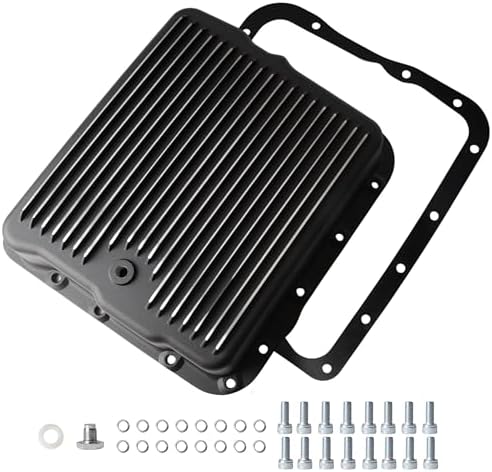
DIY parts are fluid, a filter kit with a gasket, and optionally a pan with a drain plug. Buy enough fluid to cover the refill plus a margin: 6 quarts for one pan service. A 12-quart case covers two services, which fits the two-pan-drop approach on a neglected unit. A stock-depth replacement pan with a drain plug is the one upgrade worth doing on a Camaro you plan to keep; every service after that starts by pulling a plug instead of wearing four quarts of ATF.
Stay with a stock-depth pan on a Camaro. The deep truck pans add capacity, but the F-body sits low, and the dipstick, tube, and bracket must match the pan, as covered above. If you are paying a shop, ask the quote to list the fluid by name and spec, the quantity, and whether the filter and gasket are included. "Transmission service" with no detail can mean a drain and fill with no filter.
4L60E Filter Kit with Pan Gasket, GM 24200796
The standard-pan 4L60E filter and gasket for a Camaro pan service. For pans, drain plugs, and every other 4L60E part, the full lineup is here.
See the filter kit →FAQ
What transmission fluid does a 4L60E Camaro take?
GM filled the 1993-2002 Camaro 4L60E with DEXRON-III. That fluid is no longer licensed, and GM bulletin 04-07-30-037A says 2005 and earlier DEXRON-III models may use DEXRON-VI as a replacement. Use a fluid that carries the GM DEXRON-VI license on the bottle.
How much transmission fluid does a Camaro 4L60E take for a fluid change?
GM lists 5.0 quarts (4.7 L) for a drain and refill with a pan and filter change. The 8.8 quart (V6) and 10.8 quart (V8) figures are overhaul capacities for a dry unit. Buy 6 quarts so you have enough to set the level hot.
How often should I change the transmission fluid in my Camaro?
The 2002 Camaro owner manual calls for fluid and filter every 15,000 miles if the car is mainly driven in heavy traffic in 90 degree heat, in hilly terrain, towing, or in high performance use. Otherwise the interval is 50,000 miles. Most hard-driven Camaros belong on the 15,000-mile schedule.
Should I flush the transmission on a high-mileage Camaro?
On a high-mileage unit with no service history, a pan drop and filter change is the safer choice. GEARS Magazine notes it replaces about half the fluid and is gentler than a full exchange, which can dislodge material into the valve body. Repeat the pan service a few thousand miles later to freshen the fluid in stages.
Where is the transmission dipstick on a Camaro?
On both the V6 and V8 fourth-gen Camaro, the transmission dipstick has a red handle near the back of the engine. Flip the handle up to release it, and check the level hot with the engine running in Park after cycling through the gears.
Keep the numbers at the bench. Our free transmission fluid spec chart lists the correct ATF type for the 4L60E and dozens of other units, so you never top off with the wrong fluid.
Sources
- General Motors — 2002 Chevrolet Camaro Owner Manual. Backs: DEXRON-III as the factory fluid, the 15,000-mile severe (including high performance operation) and 50,000-mile normal fluid and filter intervals, the hot check procedure (180-200°F, 15-mile warm-up, AUTOMATIC OVERDRIVE below 50°F, 30-minute wait, cycling the ranges, reading the lower level), the red-handled dipstick location, the less-than-one-pint top-off, the overfill fire warning, and the 5.0 / 8.8 / 10.8 qt capacities. GM: 2002 Camaro owner manual (PDF)
- General Motors — 1998 Chevrolet Camaro Owner Manual. Backs: the same 5.0 qt drain and refill, 8.8 qt V6 (VIN K) and 10.8 qt V8 (VIN G) overhaul capacities, and the 15,000 / 50,000-mile fluid and filter intervals for the first LS1 year. GM: 1998 Camaro owner manual (PDF)
- SAE International — "General Motors DEXRON-VI Global Service-Fill Specification," Technical Paper 2006-01-3242. Backs: DEXRON-VI as GM's global service-fill fluid and its backward compatibility with DEXRON-III applications such as the 1993-2002 Camaro 4L60E. saemobilus.sae.org: SAE 2006-01-3242
- Valvoline — DEXRON-VI ATF Product Information Sheet. Backs: GM-licensed DEXRON-VI being fully back-serviceable and usable wherever DEXRON-II or DEXRON-III is recommended. Valvoline: DEXRON-VI ATF PI sheet (PDF)
- Sonnax — How to Avoid a Dipstick Move in 4L60-E Series Transmissions. Backs: the 1998 deep pan, dipstick, tube, and stop bracket changes on C/K/G trucks and vans, brackets on all post-1998 models except Corvette, the valve body chamfer, and the 0.5 qt and 0.75 qt underfill figures from mismatched parts. sonnax.com/tech_resources/941
- GEARS Magazine (ATRA) — Is It Safe to Change Transmission Fluid in High-Mileage Vehicles? (Pat Burrow, December 2024). Backs: severe-service definitions covering most driving, the pan drop replacing about half the fluid, fresh-fluid detergency risk with a full exchange on neglected units, the in-line magnetic return-line filter, and checking Reverse before service. gearsmagazine.com: high-mileage fluid changes