"It takes off like it's in second." That one sentence walks into shops every week attached to a 4L60-E, and it gets a solenoid set thrown at it about half the time. Sometimes that works. Often it does not, because a 2nd-gear start is not one complaint. It is at least three different complaints that all feel identical from the driver's seat, and only one of them is a bad solenoid.
The good news is that the 4L60-E tells on itself. Two on/off shift solenoids select the gear, the ratio is measurable on a scan tool, and the manual valve is mechanical. Between those three facts you can sort a 2nd-gear start into the right bucket in about a ten-minute road test, before the pan ever comes down.
Three complaints that all feel like a 2nd-gear start
Get the customer's description straight first, then confirm it yourself. These are not the same job:
| What it actually does | What that means |
|---|---|
| Starts in 2nd, still upshifts once, no overdrive. Two forward gears total. | Shift solenoid A is not turning on. Electrical, and this article is about it. |
| Starts in one tall gear, never shifts again, MIL on, reverse fine. | Failsafe. The PCM has quit commanding shifts. See our 4L60E failsafe walkthrough. |
| Starts in 2nd but shifts through all four gears normally after that. | Hydraulic or calibration, not a dead solenoid. The 1-2 shift valve or the tune. |
Most people never separate these, and that is why the parts cannon comes out. The distinction costs nothing to establish: drive it, count the shifts, and note whether overdrive ever arrives.
The state table is the whole diagnosis
The 4L60-E has no governor and no throttle valve cable. The computer runs the shifts with two on/off solenoids, and the combination of their states picks the gear:
| Gear | Shift solenoid A (1-2) | Shift solenoid B (2-3) |
|---|---|---|
| 1st | ON | ON |
| 2nd | OFF | ON |
| 3rd | OFF | OFF |
| 4th (overdrive) | ON | OFF |
Now cover up the rows that need solenoid A energized. First gear is gone. Fourth gear is gone. What is left is 2nd and 3rd — and the unit will still make a clean shift between them, because that transition only needs solenoid B to drop out.
Barry Bartlett, a diagnostician at Certified Transmission and an ASE Master with L1, put it in exactly those terms in Transmission Digest: if solenoid A is not turning on you get second-gear starts, the transmission will still shift into third, and you will also have no fourth gear — second and third being the only forward gears that function. That is the fingerprint. Two forward gears, the lower one gone and overdrive gone, with a normal-feeling shift in between.
Bartlett describes the mirror image too, and it is worth knowing so you do not misread the road test: if solenoid B is the one not turning on, you get fourth-gear starts instead, with manual second and third available at around 30 mph. A customer who says "it feels like it's in high gear" is describing solenoid B, not solenoid A.
Why a dead solenoid feed gives you 3rd, not 2nd
This is the single most useful thing on that chart and almost nobody uses it. Look at the third-gear row again: both solenoids off. So if the entire solenoid feed dies — blown fuse, lost ignition feed, a connector out at the case — the valve body settles in third, not second.
Bartlett spells out the consequence: with no power to any of the solenoids you get third gear with no upshift or downshift in Drive, while manual second still works because it is shifted hydraulically by the manual valve without any solenoid involvement. So a truck that starts in a tall gear and will not shift, but still gives you second when you pull the lever into 2, is telling you the shift solenoids have no power at all. That is a fuse, a feed, or a ground — not a solenoid.
Flip it around and you get the rule that matters for this article: a genuine 2nd-gear start means solenoid B still has power and is still being commanded on. The circuit is alive. Only solenoid A's side of it is broken. That single deduction eliminates the shared power feed, the shared ground, and the fuse in one step, and it points you at one wire, one driver and one solenoid.
The ten-minute road test that names the circuit
Set up a scan tool with these on screen: commanded gear, shift solenoid A state, shift solenoid B state, transmission gear ratio (or ISS and OSS, and do the division yourself), TFT and TP. Then drive it.
Watch the ratio, not the tach. The 4L60-E runs a 3.06 first gear from the factory, and Gordon Kehler's Transmission Digest case study on a 2001 S-10 gives you the rest as measured values: 1.6:1 is second, 1.0:1 is third, and 0.69:1 is fourth. If the scan tool commands 1st and the ratio reads 1.6:1, the unit is in second while the computer thinks it is in first. That is your confirmation, and it is far more reliable than seat-of-the-pants.
Three checks turn that into a diagnosis:
- Does solenoid A's commanded state actually change? If the scan data shows solenoid A commanded ON in first gear and the ratio still says 1.6:1, the command is leaving the PCM but the solenoid is not acting on it.
- Command the solenoids at rest. On most GM trucks and cars you can actuate the shift solenoids with a scan tool and listen for the click, which tells you both that the solenoid moves and that the computer can turn it on and off. Listen for the click going on and the clack coming off. A click with no clack is a real finding, not a nothing.
- Pull it into manual Low. If manual Low gives you a first-gear ratio, the hydraulics can reach first and the fault is on the electronic side. If it still launches in second in manual Low, the 1-2 shift valve is not stroking and no solenoid on earth is going to fix that.
Those three answers put you in one of two columns before you own a single part.
Electronic causes, in the order they actually show up
1. The solenoid A control circuit
Both shift solenoids are powered from the same fused ignition source and switched to ground by low-side drivers in the PCM. Kehler confirmed exactly that layout on the S-10 — both solenoids fed from the cluster fuse straight to the transmission, with the control side landing at PCM connector C2, terminals 51 and 52.
GM's diagnostic charts call for 19 to 31 ohms on the shift solenoids. That is the number to judge a part by. But do not stop at a static ohm reading, because it puts a few milliamps through a coil that normally carries about half an amp. Load-test the circuit: ammeter inline from the driver terminal to ground, key on. Kehler's readings are a good calibration point — 0.49 amps on the 1-2 circuit worked out to 26.5 ohms by Ohm's law, and the 2-3 circuit calculated to 27 ohms. Both well inside spec.
Codes to expect on this circuit: P0753 (shift solenoid A electrical) when the PCM sees an open or short, and P0751 / P0752 (performance, stuck off/on) when the PCM commanded a shift, watched the speed sensors, and did not get the ratio it asked for. The performance codes are ratio math. They cannot tell a dead solenoid from a shift valve that would not move, so never let one condemn a part on its own.
2. The internal harness and case pass-through
Every solenoid circuit in the unit runs through one internal harness in hot fluid and out through a single case pass-through connector. It is the most common electrical failure point in the box, and GM has said so in writing: service bulletin PIP5009 directs technicians to replace the internal transmission wiring harness and TCC enable solenoid, part number 24237980, on 2012 Colorado, Canyon, Express, Savana, Silverado and Sierra models with the 4L60-E built after 10/01/11, when the MIL is on with a P0741 stored and a harsh 1-2 shift.
That bulletin is year-specific but the lesson is not. If you are in the pan on a high-mileage 4L60-E chasing an intermittent solenoid circuit, and the harness is original, replace it while you are in there. Also inspect the pass-through terminals for spread or push-back before you condemn the solenoid behind them — a terminal that reads fine on a meter can still lose contact under vibration.
3. A slow or failing PCM low-side driver
This is the one that survives every meter test. On the S-10 above, every static and dynamic electrical test passed — resistance in spec, current in spec, solenoids clicking on the remote button — and the truck still would not make the shift. The tell came from a lab scope on the low-side driver. Solenoid A's trace snapped cleanly between 13V and 0V. Solenoid B's trace made the same trip, but the turn-off took 15 to 27 seconds to complete, which matched the 20-to-25-second lag between commanded and actual gear on the road test. The driver inside the PCM was failing slowly rather than failing outright. The repair was a PCM.
Apply that to a 2nd-gear start: if solenoid A ohms correctly, load-tests correctly and clicks on command, back-probe its control wire and scope the driver before you buy anything. And capture the waveform — nobody signs off on a computer on a hunch.
4. The range signal from the pressure switch manifold
From 1993 to 2008 the 4L60-E used a pressure switch manifold — the transmission fluid pressure (TFP) manual valve position switch — to tell the computer which gear the driver selected. It is a stack of pressure switches with the fluid temperature sensor built into the same unit, mounted on the valve body, and the PCM reads the manual valve position from the combination of switches that ground.
The PCM picks the shift schedule from that signal. Feed it an invalid or wrong combination — from a heat-damaged switch, a chafed harness, or fluid in the connector — and the computer can end up running a schedule that does not match the range the driver is actually in. Look for P1810 (TFP valve position switch circuit) and the range-switch codes alongside your solenoid codes. If P1810 is present with a 2nd-gear start, fix the range signal first and re-evaluate; do not chase solenoid A while the PCM is being lied to about what gear the shifter is in. The switch lives in the pan, so it is a same-visit repair once you are down there anyway.
5. Speed sensor inputs
Solenoid performance codes are calculated from input and output shaft speed. A dropping-out output speed signal will make a perfectly good solenoid look bad on paper, and on some applications will drive the PCM into a default strategy on its own. Before condemning the shift circuit, watch ISS and OSS live through the launch. A speed trace that hashes or drops to zero for a beat is the fault, not the solenoid. Our 4L60E speed sensor guide covers the signal patterns.
6. The calibration itself
Worth ruling out before you spend a dime, especially on anything modified. Standalone controllers and aftermarket tunes used behind LS swaps and retrofits routinely expose a second-gear-start option, and shift tables get edited by people who are no longer answering the phone. If the unit starts in 2nd but then shifts through all four gears normally and sets no codes, the transmission is doing exactly what it was told. Read the tune before you pull the pan. That is a five-minute check that has saved more than one needless valve body.
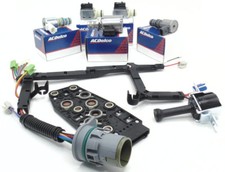
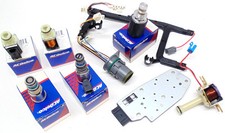
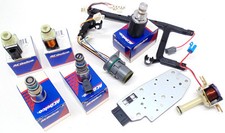
4L60E Solenoid and Filter Service Kit — shift, EPC, TCC, internal harness, filter and gaskets (1993-Up)
When the fault does land on the electrical side, this is the set that covers it in one pan-down visit: both shift solenoids, EPC and TCC, plus the internal wiring harness that causes most of the intermittents in the first place. Doing the harness with the solenoids is what keeps this job from coming back.
View the kit at CoreTransmissionParts →Individual solenoids, TFP switches and filters: browse the full 4L60E parts collection.
When it is not electronic
If manual Low still starts you in second, stop testing wires. The 1-2 shift valve is staying upshifted and the electronics are innocent. That is a valve body job, and on a unit with any miles on it the usual reason is bore wear rather than a broken part. Sonnax is blunt about this on the 4L60-E: bore wear is common, and all circuits should be vacuum tested to identify leaks, with some repairs requiring reaming. A vacuum test stand and Sonnax's valve body layout for the 4L60-E / 4L65-E / 4L70-E will tell you which bore is leaking in an afternoon, where guessing will not.
The other mechanical impostor is the low roller clutch. If manual Low does give you a first-gear ratio and Drive does not, that is the valve body. If manual Low gives you first and Drive gives you nothing off the line at all, look at the low roller assembly instead. The lever position is the cheapest diagnostic tool in the building.
One more housekeeping item while the pan is down: a 2nd-gear start that has been driven on for weeks means the band has been carrying every launch. Look at the 2-4 band and the sun shell before you close it up. Our 4L60E valve body wear guide covers the bores worth testing.
Shift solenoids, EPC and TCC solenoids, TFP pressure switches, internal harnesses, filters, pan gaskets and valve body components for the 4L60E — shipped fast from the USA.
Shop 4L60E parts →The short version
A 4L60-E that starts in 2nd, shifts once, and has no overdrive is solenoid A not turning on — and because solenoid B is clearly still working, the shared power feed and ground are already ruled out. Confirm it with gear ratio on the scan tool rather than feel: 1.6:1 with 1st commanded is the whole case. Then work one circuit. Ohm it against 19 to 31 ohms, load-test it near half an amp, click-and-clack it with the scan tool, and scope the low-side driver if all of that passes. Check the range signal and the speed sensors before you condemn anything, and read the tune if the truck is modified. And if manual Low still starts in second, put the meter down — the 1-2 shift valve is your problem, not the electronics.
Sources
- Transmission Digest — "Diagnosing Shifting Issues," Barry Bartlett (diagnostician, Certified Transmission; ASE Master with L1), February 1, 2016. Backs the 4L60E solenoid application logic used throughout this article: both solenoids on in first, shift solenoid A off for second, both off in third; that a solenoid A that is not turning on produces second-gear starts with a shift into third and no fourth gear, leaving second and third as the only forward gears; that a solenoid B not turning on produces fourth-gear starts with manual second and third around 30 mph; that no power to any solenoid gives third gear with no upshift or downshift in Drive while manual second still works hydraulically; and the scan-tool solenoid actuation "listen for the click" test. transmissiondigest.com
- Transmission Digest — "Diagnosing an unusual problem: A slow-to-respond solenoid," Gordon Kehler (ASE Master/L1, GM master tech 1991-2019, Certified Transmission), January 26, 2023. Backs the measured gear ratios of 1.6:1 in second, 1.0:1 in third and 0.69:1 in fourth; the GM diagnostic chart shift solenoid resistance specification of 19-31 ohms; both shift solenoids being fed from the cluster fuse and switched by PCM low-side drivers at connector C2 terminals 51 and 52; the inline ammeter load test reading 0.49 amps and calculating to 26.5 ohms on the 1-2 circuit and 27 ohms on the 2-3 circuit; the "click clack" command test and the missing turn-off clack; and the lab scope capture showing a 15-to-27-second driver turn-off that condemned the PCM. transmissiondigest.com
- Sonnax — "Building the Killer 4L60E: Top Tips for Optimizing Your Transmission Upgrades." Backs the OE 4L60-E first-gear ratio of 3.06, and the guidance that bore wear is common in the 4L60/E so all circuits should be vacuum tested to identify leaks, with some repairs requiring reaming. sonnax.com
- Sonnax — "GM 4L60-E, 4L65-E, 4L70-E Valve Body Layout," October 8, 2021. Backs the valve-train reference used to locate and test the 1-2 shift valve and the rest of the 4L60-E valve body, including the exploded location guide and the symptom-to-repair mapping for each valve train. sonnax.com
- General Motors service bulletin PIP5009 (Replace the Internal Transmission Wiring Harness and TCC Enable Solenoid), hosted by NHTSA (PDF). Backs the internal wiring harness and TCC enable solenoid replacement direction, part number 24237980, for 2012 Chevrolet Colorado, Express and Silverado and 2012 GMC Canyon, Savana and Sierra with the 4L60E built after 10/01/11, on a MIL-on complaint with DTC P0741 set and a harsh 1-2 shift. static.nhtsa.gov (PDF)
- Tomorrow's Technician (Babcox Media) — "4L60E Pressure Switch Manifold Quick Tip," featuring Wayne Colonna, May 12, 2010. Backs the statement that from 1993 to 2008 the GM 4L60E used a pressure switch manifold to tell the computer which gear was selected, and that it is a recognized diagnostic trouble spot on the unit. tomorrowstechnician.com