A Silverado 1500 with a 4L65E behind the V8 is one of the most common trucks to roll into a transmission shop, and most of them come in with one of the same four complaints. The 3-4 clutches are gone. The 1-2 shift has turned into a bang and the check engine light is on. It slips in every forward gear right after somebody put a new input housing in it. Or it was rebuilt six months ago and it is already cooked.
None of those are mysteries. GM has published bulletins on three of them, and the fourth is the most documented failure in the whole 4L60E family. This guide walks through each one the way I would on a truck in the bay: what the driver feels, what the scan tool and the pan tell you, what actually broke, and what fixes it so the truck does not come back.
The short version: Confirm it really is a 4L65E (RPO M32 on the glovebox label). Burnt 3-4 clutches are the number one failure, and they are a symptom of low line pressure or a 3rd-oil leak. A harsh 1-2 with P1870 or P0894 is usually converter clutch control, not the 1-2 parts themselves. After any repair, air check the input housing and flow test the cooler, because GM has bulletins on both.

First: Make Sure It Is Actually a 4L65E
Silverados of this era were built with three versions of the same four-speed, and they are close to impossible to tell apart under the truck. GM's own bulletins identify them by RPO code: M30 is the 4L60E, M32 is the 4L65E, and M70 is the 4L70E. GM Preliminary Information PIP5072, for example, lists 1999-2006 Silverado, Sierra, Avalanche, Tahoe, Suburban and Express applications "equipped with 4L60E, 4L65E or 4L70E (RPO M30, M32 or M70)." The 4L65E was the unit for the heavier V8 applications.
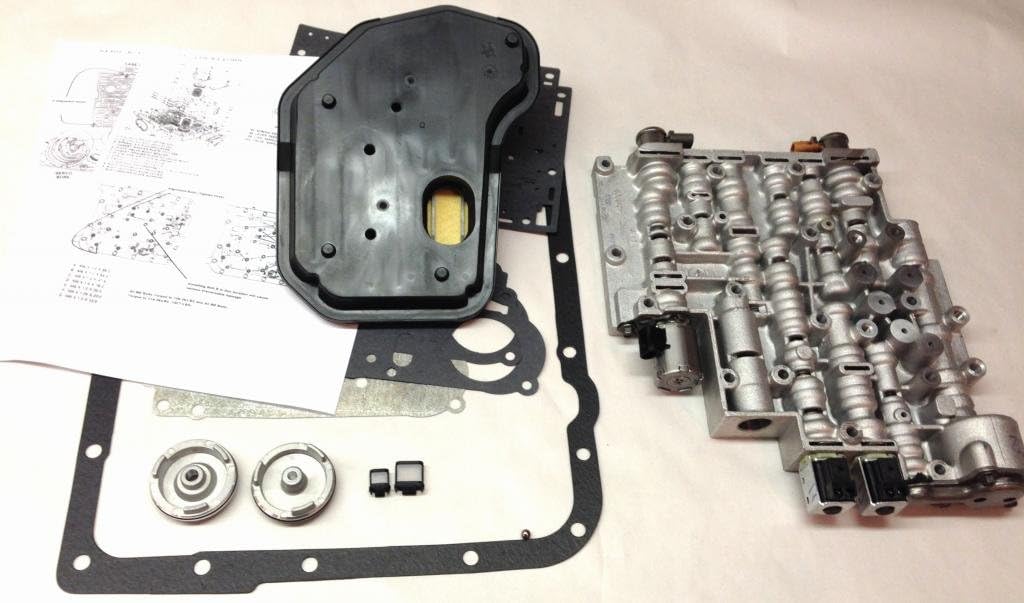
Pull the Service Parts Identification label (usually inside the glovebox lid) and look for M32 before you order a single part. Rebuild kits, input housings, planetaries and valve bodies are year- and model-specific, and a truck that has already been swapped once may not match its label, so check the transmission ID tag on the case too.
The numbers that matter for diagnosis come from GM's Chevrolet Performance Supermatic spec sheet for the 4L65-E:
| Item | 4L65E (GM Supermatic sheet) |
|---|---|
| Maximum engine torque | 430 lb-ft |
| Fluid | DEXRON-VI |
| Dry fill | 11.2 qt (10.6 L) with 300 mm converter |
| Oil pan to case | 18 ft-lb (24 N-m) |
| Cooler pipe nut to case | 28 ft-lb (38 N-m) |
1. Burnt 3-4 Clutches (No 3rd or 4th)
What the driver feels: the 2-3 shift starts to flare, the engine runs up between 2nd and 3rd, then it slips in 3rd and eventually just has 1st and 2nd. In a Silverado that tows, this often happens all at once on a long grade. The fluid comes out dark with a burnt smell and there is friction material on the pan magnet and in the filter.
Why it happens: Sonnax's 3-4 clutch guide is blunt about it: low line pressure and leaks of 3rd gear oil are the root cause of most 3-4 slipping in this family. The 3-4 apply circuit is long. It runs through the pump, the stator support sealing rings, the input shaft and the input housing, with the servo and 3rd accumulator checkball tied in along the way. Every one of those joints can leak a little, and a 5,000-pound truck pulling a trailer has no capacity to spare.
On the scan tool: watch commanded gear against the actual input-to-output ratio during the 2-3 and 3-4 shifts. A pack that is starting to go shows up as a stretched shift time and engine rpm flaring above the target before the ratio settles. Ratio or slip codes for 3rd and 4th usually set on the way out.
What to check on the bench (from Sonnax's checklist):
- Input housing checkball. Vacuum test it. Sonnax treats anything below 25 in-Hg as an unacceptable leak. A clogged ball causes partial apply from centrifugal force, which burns the pack just like a leak does.
- 3rd accumulator checkball capsule. Sonnax calls a leaking capsule a leading cause of 3-4 failure, and new ones can leak out of the box. Test it, do not just replace it.
- Stator support bushings and sealing ring surfaces. Worn bushings let the input shaft move and the rings stop sealing.
- Pump. Vacuum test the boost and pressure regulator valves and make sure the slide moves freely.
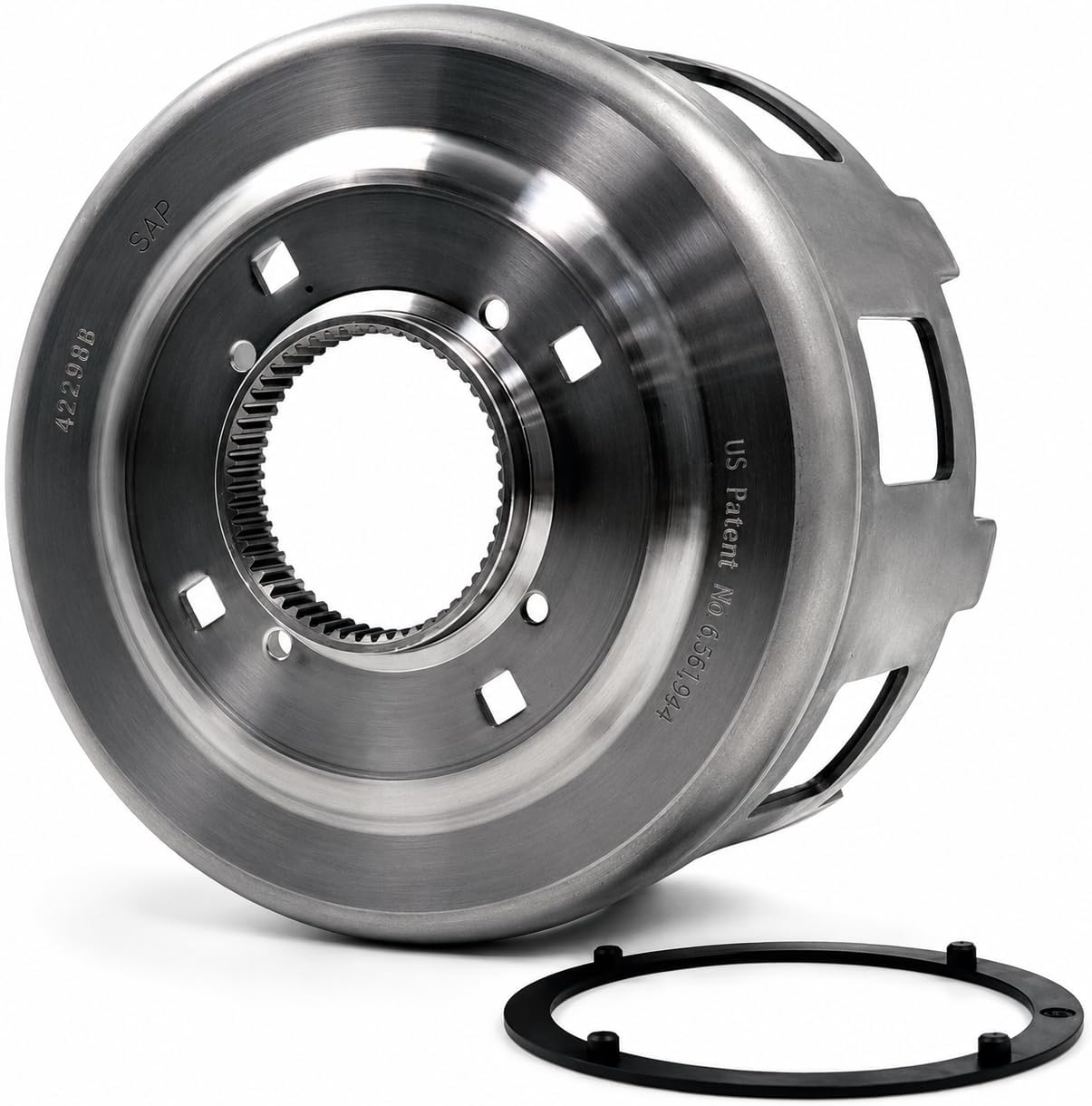
- Backing plate and load release springs. The OE backing plate flexes; a heavy-duty plate spreads the load evenly.
The fix: new 3-4 frictions and steels, a heavy-duty backing plate, and the leak hunt above. Put a new pack in on top of an existing leak and you will see the truck again. The full teardown process is in our 4L65E 3-4 clutch failure guide.
4L65E 3-4 Power Pack Friction Clutch Kit
Adds 3-4 clutch capacity for a Silverado 4L65E that burned its pack. It only lives if you fix the leak that killed the last one.
Shop the 3-4 Power Pack kit →Need a different part? Browse the full 4L65E parts collection.
2. Harsh 1-2 Shift With P1870 or P0894
What the driver feels: a hard bang on the 1-2 upshift, usually with the check engine light on. Sometimes it starts right after the truck had a converter or a replacement transmission installed.
Why it happens: most techs go straight to the 1-2 accumulator, but that is often the wrong place to start. Transmission Digest's 4L60E harsh 1-2 article points out that many of these complaints are really converter clutch slip problems: P1870 or P0894 sets, and the controller puts the transmission into high line pressure mode. High line pressure is what makes the 1-2 harsh. Fix the TCC slip and the shift goes back to normal.
GM documented the post-repair version of this in PIP5340A. It covers a MIL, a harsh 1-2 upshift, and P0894 or P1870 setting after a torque converter or service replacement transmission is installed on 4L60E (M30) and 4L65E (M32) applications, Silverado and Sierra included. GM's instruction is to duplicate the concern and contact technical assistance, so check for that before you pull a brand-new unit back out of the truck.
How to diagnose it:
- Pull codes first. If P1870 or P0894 is stored, chase converter clutch control before touching the 1-2 shift parts. Our 4L65E P0894 guide covers the TCC side.
- Put a pressure gauge on the line tap and measure the pressure control solenoid current with a meter. Transmission Digest specifically warns not to trust the commanded PC solenoid amperage PID; it can read correct when the controller driver has failed.
- Rule out engine-side causes the same article lists: lean misfire and MAF sensor problems can raise line pressure too.
- If line pressure is right and there are no codes, then look at the 1-2 hardware.
The 1-2 hardware (per Transmission Digest): check the accumulator valve for sticking and a cocked spring, confirm the servo has the right apply piston for the application (most trucks use the 553 or 159 piston), and confirm the #8 checkball is in place. That ball forces band apply oil through the .067-.086 in. orifice in the separator plate on the 1-2 shift. Leave it out or drill the orifice bigger and you get a harsh 1-2. A 4-3 sequence valve stuck inboard can also cause it.
A worn TCC regulator valve bore in the valve body is the common mechanical cause of P1870 on these, and the cure is a bore repair kit or a valve body that has already been updated. More on shift quality in our 4L65E harsh and delayed shifts guide.
3. Slips in Every Forward Gear Right After an Input Housing Replacement
What the driver feels: the transmission was apart for a 3-4 job, it got a new input housing, and now it slips or will not engage any forward gear. Reverse may be fine.
Why it happens: GM caught this one in PIP5072, which lists 1999-2006 Silverado and other M30, M32 and M70 trucks. GM says some service input housings, part number 17803687, can have an incorrectly drilled input shaft. That connects the forward clutch and 3-4 clutch feed circuits, so forward clutch oil escapes.
How to check it: with the input housing fully assembled with seals and clutches, apply regulated air to the forward clutch feed hole and then to the 3-4 clutch feed hole, one at a time. Air should not come out of the other hole. If it does, GM says to replace the housing with part number 19125752 (input housing and turbine shaft assembly). GM also notes that a small air leak between the shaft and housing on an assembled unit is normal, since the press fit seals oil, not air, so do not scrap a housing just for that.
This is a 5-minute check on the bench. Do it on every input housing before it goes in the case, new or used.
4. Fresh Rebuild Burns Up Fast: Cooler Flow
What the driver feels: the rebuilt or replacement transmission shifted fine for a while, then started to slip and smell hot, often while towing or in summer traffic.
Why it happens: GM's cooler bulletin 02-07-30-052J, which covers 2011 and earlier GM trucks, states that insufficient oil flow through the cooling system will cause premature transmission failure. A Silverado that burned a 3-4 pack pushed friction material and metal into the radiator cooler and lines. Bolt a fresh unit to that cooler and the debris and restricted flow go right back into it.
How to do it right:
- Flush the cooler and lines, then flow test them. GM's bulletin specifies its J-45096 TransFlow machine with DEXRON-VI, and the minimum flow rate depends on fluid temperature (the supply fluid has to be at least 65 F for the test).
- Hook the lines up the right way. The same bulletin lists the 4L60-E family cooler feed (out of the transmission) as the bottom connector and the return as the top connector. GM's Supermatic sheet says the same.
- If the radiator cooler will not flush clean or flow to spec, replace it. A radiator is cheaper than a second rebuild.
- Torque the cooler pipe nuts to 28 ft-lb (38 N-m) per GM's spec sheet.
For trucks that tow, add an auxiliary cooler. GM's Supermatic sheet says to plumb it after the fluid leaves the radiator and before it returns to the transmission. Our 4L65E overheating guide covers temperature limits and cooler setup.
5. Also on the List: Reaction Shell and Planetary Damage
The other big hard-parts failure in this family is a stripped reaction (sun) shell or a failed rear planet bearing: sudden loss of 1st and 2nd, a whine that changes with road speed, and steel on the magnet. It is covered in detail, along with the 2007 planetary parts change that causes endplay problems, in our 4L65E common problems guide. If you are in there for any reason, put a heavy-duty shell in it.
Keeping a Silverado 4L65E Alive
- DEXRON-VI, checked hot. Low fluid aerates and drops line pressure, and low line pressure is what burns 3-4 clutches.
- Use Tow/Haul when loaded and keep the cooler and radiator fins clean.
- Treat a check engine light as urgent. P1870 or P0894 is the cheap stage. Burnt clutches are the expensive one.
- On any repair: vacuum test checkballs, air check the input housing per PIP5072, and flow test the cooler per GM's bulletin. Those three steps prevent most repeat failures.
Keep the numbers at the bench. Our free transmission fluid spec chart lists the correct ATF for the 4L65E and dozens of other units, so nobody tops off a Silverado with the wrong fluid.
FAQ
How do I know if my Silverado 1500 has a 4L65E or a 4L60E?
Read the RPO codes on the Service Parts Identification label, usually in the glovebox. GM uses M30 for the 4L60E, M32 for the 4L65E and M70 for the 4L70E, and its bulletins list Silverados with all three. The two units look nearly identical from the outside, so the label is the reliable check before you order parts.
What is the most common 4L65E failure in a Silverado 1500?
A burnt 3-4 clutch pack: flare on the 2-3 shift, then slipping or no 3rd and 4th. Sonnax traces most 3-4 slipping to low line pressure and leaks of 3rd gear oil, so the fix is new clutches plus finding the leak, not clutches alone.
Why does my Silverado shift hard from 1st to 2nd after a transmission or converter replacement?
GM documents exactly this in Preliminary Information PIP5340A: a MIL, a harsh 1-2 upshift, and P0894 or P1870 setting after a torque converter or service transmission is installed on M30 and M32 trucks. Transmission Digest explains why: those converter slip codes put the transmission into high line pressure, which makes the 1-2 harsh. Fix the converter clutch control problem and the shift usually comes back.
What fluid does a 4L65E take and how much?
GM's Supermatic spec sheet lists DEXRON-VI and a dry fill of 11.2 quarts (10.6 L) with the 300 mm converter. A pan and filter service takes far less, so add a few quarts, start the engine, and set the final level hot on the dipstick rather than pouring in a fixed amount.
Sources
- General Motors Preliminary Information PIP5072 (via NHTSA). Backs: RPO M30/M32/M70 identification on 1999-2006 Silverado and related trucks, incorrectly drilled service input housing 17803687, the forward/3-4 feed hole air check, normal shaft-to-housing air leak, and replacement part 19125752. GM PIP5072 (NHTSA PDF)
- General Motors Preliminary Information PIP5340A (via NHTSA). Backs: MIL, harsh 1-2 upshift, and P0894 or P1870 after torque converter or service transmission replacement on 4L60E (M30) and 4L65E (M32) vehicles including Silverado and Sierra. GM PIP5340A (NHTSA PDF)
- General Motors Bulletin 02-07-30-052J, Automatic Transmission Oil Cooler Flow Test (via NHTSA). Backs: insufficient cooler flow causes premature transmission failure, J-45096 flush and flow test with DEXRON-VI, 65 F minimum supply temperature, and 4L60-E cooler feed bottom / return top. GM 02-07-30-052J (NHTSA PDF)
- General Motors / Chevrolet Performance — Supermatic Transmission Specifications (covers 4L65-E 19260380). Backs: 430 lb-ft rating, DEXRON-VI, 11.2 qt dry fill, pan and cooler pipe torque, cooler line orientation, and auxiliary cooler placement. Chevrolet Performance Supermatic spec sheet (PDF)
- Sonnax — "All Over the Map: Attacking 4L60/E Burnt 3-4 Clutches with Confidence." Backs: low line pressure and 3rd gear oil leaks as the root cause of most 3-4 slipping, the 25 in-Hg checkball limit, 3rd accumulator checkball capsule leakage, stator bushings, pump checks, and backing plate flex. sonnax.com/tech_resources/659
- Transmission Digest — "4L60E Harsh 1-2 Shift." Backs: P1870/P0894 converter slip putting the unit into high line pressure, measuring PC solenoid current with a meter instead of trusting the PID, lean misfire and MAF causes, 553/159 servo pistons, the #8 checkball and .067-.086 in. orifice, and the 4-3 sequence valve. transmissiondigest.com/4l60e-harsh-1-2-shift