A Silverado 1500 with a 4L65E rarely comes in with a clean complaint. The owner says it "shifts funny." On the road test that turns out to be a 1-2 that bangs hard enough to chirp the tires, a 2-3 that flares, a truck that pulls away from a light in second, or one that never leaves third. Those are four different failures, and only one of them usually needs the transmission out of the truck.
This is the shift-quality companion to our Silverado 1500 4L65E common problems rundown and the Silverado slipping guide. Here we stay on one question: when the shift itself is wrong, how do you prove whether the computer, the solenoids, the valve body or the hard parts are to blame?
The short version: Pull codes from both the engine and transmission side, then watch commanded gear, shift solenoid commands and PC solenoid current while you drive. Harsh everything with no transmission codes often means the engine is feeding the TCM a bad torque signal. Second-gear starts point at low line or AFL pressure, a leaking 1-2 accumulator or a solenoid. Stuck in third is the fail-safe, so look for power and wiring first. Only after that do you blame the band, servo or clutches.
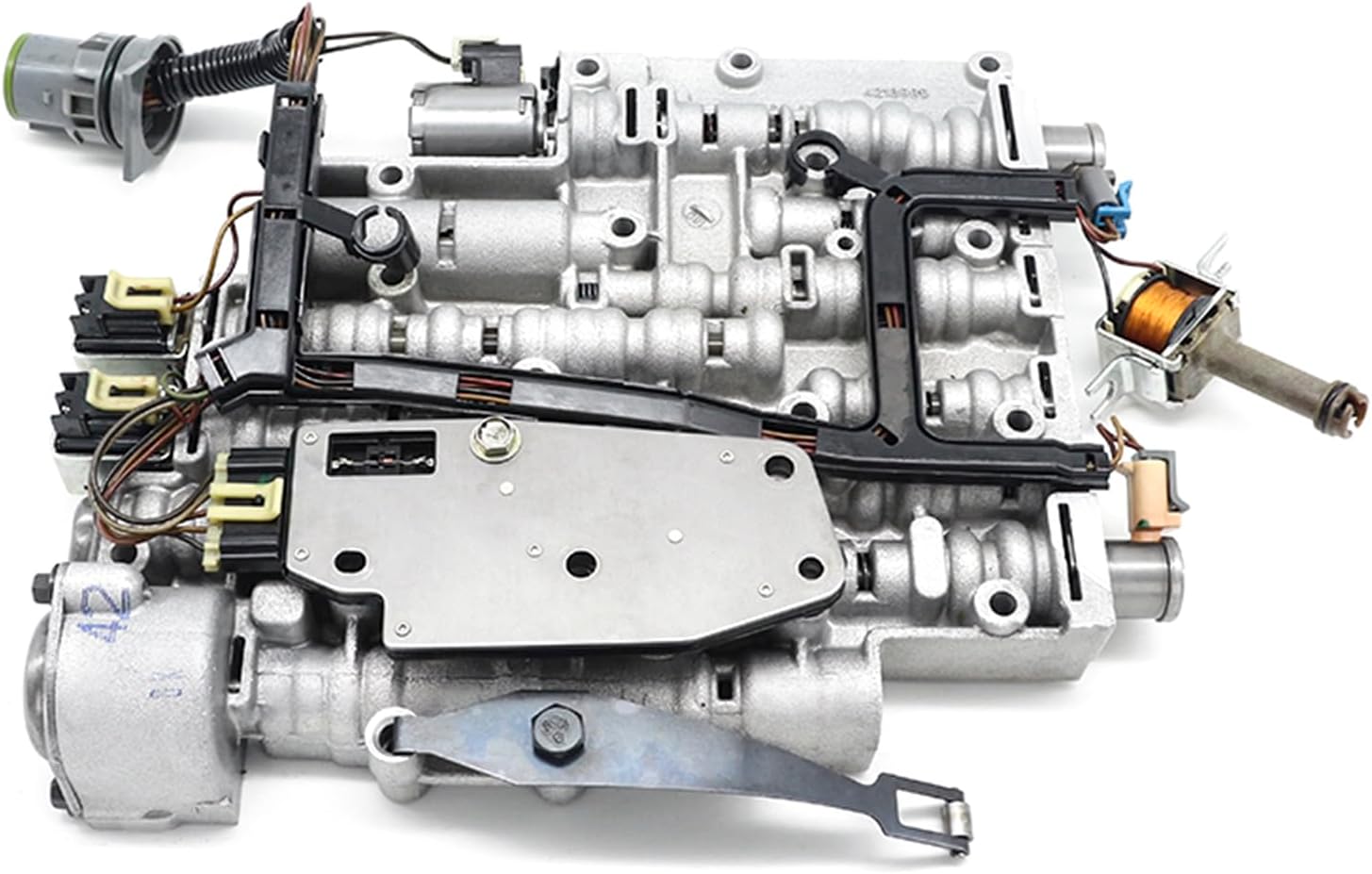

How a 4L65E decides when to shift
Silverados of this era were built with the 4L60E (RPO M30), the 4L65E (M32) and the 4L70E (M70). They look nearly identical, so read the RPO label in the glovebox before you order parts. The 4L65E is the heavier-duty version: Chevrolet Performance rates it at 430 lb-ft of maximum engine torque, versus 495 lb-ft for the 4L70E, with ratios of 3.059 first, 1.625 second, 1.000 third and 0.696 fourth (Chevrolet Performance spec sheet).
Gear selection comes from two on/off shift solenoids, the 1-2 (A) and 2-3 (B). The pattern is simple enough to memorize:
| Gear | 1-2 solenoid (A) | 2-3 solenoid (B) |
|---|---|---|
| 1st | ON | ON |
| 2nd | OFF | ON |
| 3rd | OFF | OFF |
| 4th | ON | OFF |
Two things follow from that table. First, with both solenoids off the unit sits in third, which is why a truck with no power to the solenoids, a blown fuse or an unplugged 20-way connector drives around in third with a hard engagement. Second, shift feel is not set by these solenoids at all. Firmness comes from line pressure, which the TCM controls through the pressure control (PC, or EPC) solenoid, and from the accumulators that cushion each apply. So a harsh or soft shift is a pressure or accumulator problem far more often than a shift solenoid problem.
Sort the complaint before you scan it
Drive the truck cold and hot and write down exactly what it does. The pattern points you at a circuit:
| What the truck does | Most likely area | First check |
|---|---|---|
| Every shift and engagement is harsh, no transmission codes | PC solenoid command or engine torque signal | PC solenoid amps on the scan tool, engine codes, fuel |
| Harsh 1-2 only, often after a repair | 1-2 accumulator, PC solenoid, TCM calibration | P0894 / P1870, accumulator spring and valve code |
| Starts in 2nd from a stop | Line or AFL pressure, 1-2 accumulator piston, 1-2 solenoid, speed signal | Line pressure gauge, accumulator seal |
| Never leaves 3rd, firm engagements | Fail-safe: no solenoid power or a code-driven default | Fuse, 20-way connector, stored DTCs |
| Soft or late 1-2 and 3-4 | 2-4 band and servo, low line pressure | Line pressure, servo pin travel, band lining |
| 2-3 flare, then no 4th | 3-4 clutch | See our 3-4 clutch failure guide |
Step 1: Codes and the data that matter
Read both modules. On these trucks the transmission strategy depends on engine data, and some of the worst shift complaints set codes only on the engine side. Transmission codes worth knowing: P0751 and P0756 (1-2 and 2-3 solenoid performance), P0753 and P0758 (their electrical circuits), P0748 (PC solenoid electrical), P0894 (component slipping) and P0716/P0717 (input speed sensor).
Then drive it with these on the screen: commanded gear, 1-2 and 2-3 solenoid commands, PC solenoid actual current, engine load, transmission fluid temperature, input and output speed, and TCC slip speed. If the commanded gear changes and the ratio does not follow, the problem is hydraulic or mechanical. If the commanded gear itself is wrong, the problem is upstream in the computer or its inputs.
Do not skip the speed sensors. GM's PIP5084A covers 2013 Silverados with the 4L60E that arrive with a harsh shift and P0716 or P0717 in history. It has the tech install the J 44152 breakout on the 20-way connector, test the TCM ground from terminal E to terminal V, and check TCM pins 45 and 49 for continuity; no continuity means replacing the TCM and the input speed sensor (24244544), otherwise just the sensor (GM PIP5084A via NHTSA). It is written for a later 4L60E, but the lesson carries over to every M32 truck: an erratic input speed signal makes the TCM think the shift is going wrong and it overcorrects with pressure.
Step 2: Harsh shifts and engagements
Start with the PC solenoid, because it sets line pressure for every shift. It works backward from what most people expect: more current means less pressure. GEARS Magazine gives the working numbers for GM units: about 0.9 to 1.1 amps at idle with roughly 10% engine load, falling to 0.2 to 0 amps at wide-open throttle just before the 1-2 shift (GEARS, "Controlling Pressure: General Motors"). The same article shows why you check with an amp clamp on the solenoid wire and a gauge on the line tap, not just the scan PID. In their 4L60E case the scan tool showed steady current while the meter and the gauge both swung around, and the computer turned out to be the fault.
If the scan tool shows little or no commanded current, line pressure goes to maximum and every shift lands hard. ATSG's Wayne Colonna documents exactly this on Silverados with the 5.3 non-flex-fuel engine: harsh shifts and engagements, no transmission codes, no amperage command to the EPC solenoid, lean codes in the ECM, and sometimes ABS or stability lights. The cause was a lean-running engine, including E85 put into a truck not built for it, which corrupts the engine torque signal the TCM uses to set pressure (Transmission Digest / ATSG). Fix the fuel or the lean condition and the shifts come back. No valve body on earth will fix it.
If the harsh 1-2 showed up right after a converter or transmission was replaced, check for P0894 or P1870. GM's PIP5340A lists that exact combination, a harsh 1-2 upshift with the MIL on after converter or transmission replacement, on 4L60E and 4L65E trucks including 1998-2000 Silverados, and directs the tech to contact GM technical assistance once it is duplicated (GM PIP5340A via NHTSA). In practice that means confirming the replacement unit, its calibration and its adapts before anyone tears the new transmission apart.
When pressure and electrical both check good and the 1-2 or 3-4 is still too firm or too soft, look at the accumulator valve. Sonnax explains that late 4L60E-family valve bodies use three OE accumulator valve sleeve sizes stamped CX, DX and YZ, with DX the most common, and that the spring must match the sleeve code; changing the combination moves shift feel from light to firm (Sonnax accumulator valve codes). A swapped valve body with the wrong code, or a worn sleeve, is a common reason a "rebuilt" truck shifts nothing like it did before.
Step 3: Second-gear starts
This one fools people into buying solenoids. The 4L65E valve body sits in second by default with the engine off. Once the engine starts, line and AFL pressure have to reach about 48 psi to push the 1-2 shift valve against its spring and into first. Anything that holds pressure below that gives you a second-gear start (Transmission Digest / ATSG).
In that ATSG case the shop had already replaced both shift solenoids and a complete valve body with no change. Line pressure read a correct 62 psi in Drive, which ruled out the pressure side. The real fault turned up when the truck bound up in manual low: the 1-2 accumulator piston had no seal, so accumulator oil fed past it into the band apply circuit and applied the 2-4 band. A new seal fixed it. The lesson is the order: gauge first, then the accumulator, then solenoids.
On 2004-2005 trucks there is also a software angle. GM bulletin 05-07-30-013, as it is commonly reported, describes an intermittent vehicle speed signal causing the PCM to command second for about two seconds on launch, corrected with a reprogram. If the scan tool shows 2nd commanded at a stop, chase the speed signal and the calibration before you touch the transmission.
Step 4: Stuck in third or no upshift
Both solenoids off equals third gear, so a truck that will not leave third is usually not broken inside. Check for stored codes, the transmission fuse, battery feed at the 20-way case connector, corrosion on its pins, and the internal harness. Command the solenoids with a bidirectional scan tool and listen or measure; a solenoid that clicks and changes the ratio is working. If one solenoid circuit is open, replace the solenoid or harness, and measure it against the resistance spec in the service information for that model year before you condemn the TCM. If it upshifts to third and refuses fourth with the solenoids commanded correctly, read our won't shift into overdrive guide, because that is a 2-4 band or 3-4 clutch problem.
Step 5: Soft, late or flaring shifts
The 2-4 band carries second and fourth, so a soft 1-2 and a sloppy 3-4 together point at band holding power. Check line pressure first, then servo pin travel and the band lining. On trucks that tow, the common rebuild upgrade is more servo apply area. Sonnax markets its 2nd gear "Corvette" ratio servo kit, 77701-04K, for 4L60E and 4L65E units specifically for increased apply area and firmer 1-2 and 3-4 shifts (Sonnax 77701-04K). That is a holding-power fix, not a cure for leaks, so it only belongs in a unit whose band and drum are healthy.
A 2-3 flare that keeps getting worse is the start of a burned 3-4 pack. Sonnax ties most 3-4 failures to low line pressure and leaks of 3rd gear oil, so the fix is to find the leak, not just add clutches (Sonnax burnt 3-4 clutches).
Fluid and service numbers
A low or wrong fluid fill will make a healthy unit shift badly, so get this right before any diagnosis. Set the level hot on the dipstick with the engine running.
| Item | Spec |
|---|---|
| Fluid | DEXRON-VI |
| Dry fill, 300 mm converter | 10.6 L (11.2 qt), approximate |
| Oil pan to case bolts | 18 lb-ft (24 N-m) |
| Drain plug (if equipped) | 25 lb-ft (34 N-m) |
| Cooler pipe connector nut | 28 lb-ft (38 N-m) |
| Filter kit / pan gasket | GM 24208576 / 08654799 |
All of these come from the Chevrolet Performance Supermatic specification sheet for the 4L65E. A pan drop only replaces part of the 11.2 quarts, so fill to the hot mark rather than pouring in a set amount.
The repair order that works
- Fluid level and condition, hot.
- Engine and transmission codes. Fix lean, misfire and sensor codes first.
- Scan data on a drive: commanded gear, solenoid commands, PC current, speed sensors.
- Line pressure gauge plus amp clamp on the PC solenoid.
- Electrical: fuse, 20-way connector, internal harness, solenoid resistance.
- Valve body: accumulator valve code and spring, 1-2 accumulator piston seal, solenoid O-rings, AFL valve.
- Hard parts last: 2-4 band and servo, 3-4 clutch.
Most Silverado shift complaints end somewhere in steps 2 through 6. The ones that reach step 7 usually have a burned pan that told you so on day one.
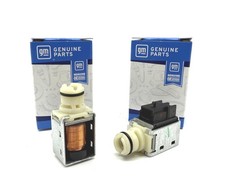
4L65E Shift Solenoid Set A & B, OEM 24230298
If the circuit tests and the bidirectional test point at a sticking or leaking 1-2 or 2-3 solenoid, this is the GM-number pair for 1993-2014 4L65E units. Replace both at once with new O-rings.
View the shift solenoid set →Need something else? Browse all 4L65E parts.
Keep the numbers at the bench. Our free transmission fluid spec chart lists the correct ATF for the 4L65E and dozens of other units, so nobody tops off a Silverado with the wrong fluid.
FAQ
Why does my Silverado 4L65E shift so hard all of a sudden?
The usual reason is that the transmission computer is commanding high line pressure. More current to the pressure control solenoid means less pressure, so if the scan tool shows little or no PC solenoid current, every shift lands hard. ATSG has traced this on 5.3 Silverados to a lean-running engine, including E85 in a non-flex-fuel truck, which corrupts the torque signal the TCM uses. Check engine codes and fuel before touching the transmission.
Why does my Silverado start off in second gear?
The 4L65E valve body rests in second with the engine off and needs roughly 48 psi of line and AFL pressure to stroke the 1-2 shift valve into first. Low pressure, a leaking 1-2 accumulator piston seal or a sticking 1-2 solenoid will leave it in second. Put a gauge on the line tap first; a correct reading around 62 psi in Drive sends you to the accumulator and solenoid.
Why is my 4L65E stuck in third gear?
Third is what the transmission gives you with both shift solenoids off, so it is the fail-safe. A blown fuse, a corroded 20-way connector, a damaged internal harness or a stored code that put the TCM in default can all cause it. Check codes and solenoid power before assuming internal damage.
Will replacing the shift solenoids fix harsh shifting?
Usually not. The 1-2 and 2-3 solenoids only choose the gear; shift firmness comes from line pressure set by the pressure control solenoid and from the accumulators. Replace shift solenoids when the scan data shows the wrong gear or a solenoid fails its circuit or bidirectional test, not for a harsh but correct shift.
What fluid and how much does a 4L65E take?
GM specifies DEXRON-VI. Dry fill with a 300 mm converter is about 10.6 liters (11.2 quarts), but a pan drop replaces only part of that, so set the final level hot on the dipstick with the engine running.
Sources
- Chevrolet Performance, Supermatic Transmission Specifications (4L65-E 19260380). Backs: 430 lb-ft maximum engine torque for the 4L65E, gear ratios, DEXRON-VI, 10.6 L (11.2 qt) dry fill, pan/drain/cooler nut torques, filter kit 24208576 and pan gasket 08654799. Chevrolet Performance Supermatic spec sheet (PDF)
- GM Preliminary Information PIP5340A (Feb 2016), "MIL Illumination Harsh 1-2 Shift And P0894 Or P1870 Setting After Torque Converter Or Transmission Replacement," via NHTSA. Backs: the harsh 1-2 plus P0894/P1870 condition on M30/M32 units including 1998-2000 Silverados. static.nhtsa.gov/odi/tsbs/2016/SB-10096073-2280.pdf
- Transmission Digest (ATSG, Wayne Colonna), "Avoiding 4L60E harsh shifts and engagement." Backs: Silverado 5.3 non-flex-fuel harsh shifts with no EPC amperage command, lean codes, and E85 as a cause. transmissiondigest.com/avoiding-4l60e-harsh-shifts-engagement
- Transmission Digest (ATSG, Wayne Colonna), "Fixing 4L60-E 1-2 shift issues." Backs: valve body defaulting to second with the engine off, the 48 psi needed to stroke the 1-2 shift valve, 62 psi Drive line pressure, and the missing 1-2 accumulator piston seal applying the band. transmissiondigest.com/fixing-4l60-e-1-2-shift-issues
- GEARS Magazine (ATRA), "Controlling Pressure: General Motors." Backs: PC solenoid current of about 0.9-1.1 A at idle and 0.2-0 A at WOT, more current meaning less pressure, and verifying with an amp clamp and gauge. gearsmagazine.com/magazine/controlling-pressure-general-motors
- Sonnax, "GM 4L60 (700-R4), 4L60-E Accumulator Valve Codes." Backs: CX, DX and YZ sleeve codes, DX most common, and spring selection changing shift feel. sonnax.com/tech_resources/1061