When a Silverado 1500 owner says "it slips," that one word can mean five different failures. The engine might flare on the 2-3 shift. It might rev up in 4th on the highway with a trailer behind it. It might take a long breath before it grabs reverse. Or the converter clutch might be letting go at 50 mph and the transmission itself is fine. Each of those has a different cause and a different parts bill, so the job is to turn "it slips" into a specific circuit before anyone orders a rebuild kit.
This guide is the slip-specific companion to our Silverado 1500 4L65E common problems rundown. Here we go deeper on one complaint: how to prove where the slip is on the truck, what each slip pattern points to, and the repair order that keeps it from coming back.
The short version: Confirm the slip is in the transmission and not the converter. Set the DEXRON-VI level hot. Map which gears slip, because the pattern names the circuit. Read line pressure with a gauge and PC solenoid current with an amp clamp. Then fix the leak that starved the clutch, not just the clutch. If the truck just had an input housing replaced or a rebuild, check GM's PIP5072 and flow test the cooler.
First, prove it is a 4L65E and know its limits
Silverados of this era came with the 4L60E (RPO M30), the 4L65E (M32) and the 4L70E (M70), and GM's own bulletins list Silverado applications for all three. They look nearly the same under the truck, so read the RPO codes on the Service Parts Identification label in the glovebox before you order anything.
Then remember what the 4L65E was built to handle. Chevrolet Performance rates its 4L65E Supermatic at a maximum engine torque of 430 lb-ft, versus 495 lb-ft for the 4L70E (Chevrolet Performance Supermatic spec sheet). A stock truck is inside that envelope. A tuned 6.0 that tows heavy is not, and a unit that keeps slipping after good repairs on a modified truck is often simply being asked for more than it was rated for.
Step 1: Converter slip or gear slip?
Before anything comes apart, put a scan tool on it and drive. The two PIDs that matter are current gear and TCC slip speed (engine rpm versus turbine rpm). With the converter commanded on in 3rd or 4th, slip speed should sit low and steady. If engine rpm drifts up and slip speed climbs with it while the gear does not change, the converter clutch is letting go. That is a converter, TCC solenoid or TCC regulator problem, and a rebuild kit will not fix it.
If the flare happens during the shift itself, or the engine and output speeds do not match the gear ratio with the converter released, the slip is inside the transmission. For reference, GM's spec sheet lists the 4L65E ratios as 3.059 first, 1.625 second, 1.000 third, 0.696 fourth and 2.294 reverse. Engine rpm way above what the ratio and road speed should produce, with the converter unlocked, is a slipping clutch or band.
Step 2: Fluid level and what the pan tells you
Low fluid is still the cheapest slip there is. A 4L65E starved for oil aerates at the pickup, line pressure falls, and the first clutch to complain is usually the 3-4 pack. Check it on the dipstick at operating temperature on level ground with the engine running, and use DEXRON-VI, which is what GM specifies for the 4L65E (Chevrolet Performance spec sheet).
The numbers you need for the service:
| Item | Spec |
|---|---|
| Fluid | DEXRON-VI |
| Dry fill, 300 mm converter | 10.6 L (11.2 qt), approximate |
| Oil pan to case bolts | 18 lb-ft (24 N-m) |
| Drain plug (if equipped) | 25 lb-ft (34 N-m) |
| Cooler pipe connector nut to case | 28 lb-ft (38 N-m) |
| GM filter kit / pan gasket | 24208576 / 08654799 |
All of those come from GM's Supermatic specification sheet. A pan drop only replaces a fraction of the 11.2 quarts, so set the final level hot on the stick instead of pouring in a fixed amount.
While the pan is down, read it. A light gray haze on the magnet is normal wear. Black friction paste, flakes of lining, or bright steel and brass mean something is already destroyed, and fresh fluid will not cure the slip. Sonnax also recommends adding a second pan magnet so debris stays away from the pressure control solenoid (Sonnax).
Step 3: Map the slip by gear
The 4L65E uses different clutches and a band in each range, so which gears slip tells you which circuit is losing oil. Drive it in each range and write down exactly where it flares.
| Slip pattern | Element involved | Look at |
|---|---|---|
| 3rd and 4th, often a 2-3 flare first | 3-4 clutch | Line pressure, 3rd oil leaks, 3rd accumulator checkball, boost valve, input housing checkball |
| 2nd and 4th | 2-4 band | Band lining, servo seals and pin bore, servo cover |
| 1st through 3rd, 4th feels fine | Forward clutch / forward sprag | Forward clutch seals, input housing feed holes, forward abuse valve bore |
| Reverse only, or late reverse engagement | Low/reverse and reverse input clutches | Reverse abuse valve bore, boost valve, reverse input drum |
| Every gear including reverse | Whole hydraulic system | Fluid level, pump, pressure regulator, PC solenoid, AFL valve |
On a Silverado, the top row is the one you will see most. The 3-4 clutch is the pack that burns, and it usually announces itself with a sloppy 2-3 shift before it lets go completely.
Step 4: Read line pressure and PC solenoid current
Every slip pattern in the table gets worse when line pressure is low, so measure it before you blame a clutch. Put a gauge on the line pressure tap and an amp clamp on the pressure control solenoid wire, then compare the two against engine load.
GEARS Magazine gives the relationship for GM's pressure control systems: at idle, around 10% engine load, PC solenoid command should be roughly 0.9 to 1.1 amps, and at wide open throttle just before the 1-2 shift it should fall to about 0.2 to 0 amps. Less current means more line pressure (GEARS, Controlling Pressure: General Motors). If the command looks right on the scan tool but line pressure is low, the problem is hydraulic: the solenoid, the AFL valve feeding it, the pressure regulator valve, or the pump.
Trust the clamp, not just the PID. In the same GEARS article, a 4L60E case showed a steady scan-tool amperage while the clamp reading and the gauge both jumped around during a stall test; the computer turned out to be the fault. Also clear any engine codes first. Sonnax points out that TP, MAP and MAF faults can change the commanded line pressure, and a pressure switch or solenoid can pass a bench test and still fail in the truck (Sonnax).
Step 5: When it is the 3-4 clutch, find the leak
Here is the part that separates a fix from a comeback. Sonnax's position is blunt: low line pressure and leaks of 3rd gear oil are the root cause of most 3-4 slipping (Sonnax, All Over the Map). The 3-4 apply circuit is long and shares oil with several other circuits, so a handful of small leaks can add up to a burned pack. Put in new clutches without finding the leak and you will be back in the same truck.
The checks Sonnax calls out, in the order I run them:
- Input housing checkball: it must hold at least 25 in-Hg on a vacuum test. Anything less is a leak, and a clogged ball causes partial apply and burnup.
- 3rd accumulator checkball capsule: vacuum or wet-air test it, including a new one out of the box. Do not cup-plug it. The ball also vents the circuit, and plugging it causes soft 2-3 shifts and 3-2 flares. The Sonnax replacement is 74480D.
- Boost valve: these leak, especially at high line pressure, and the sleeve wears the pump bore. Late units use the Sonnax 77898E-14K (.421 in.) or 77898E-16K (.472 in.) O-ringed kits.
- Backing plate: the OE 3-4 backing plate flexes and heats the pack unevenly. The heavy-duty fix is Sonnax 74140-01K with the correct apply ring stamped "7."
- Stator support and pump: new stator bushings, check the sleeve for rotation that blocks feed holes, and check the pump faces and passages for hairline cracks.
For the full teardown on this one failure, see our 4L65E 3-4 clutch failure guide.
Step 6: Forward or reverse slip and the abuse valves
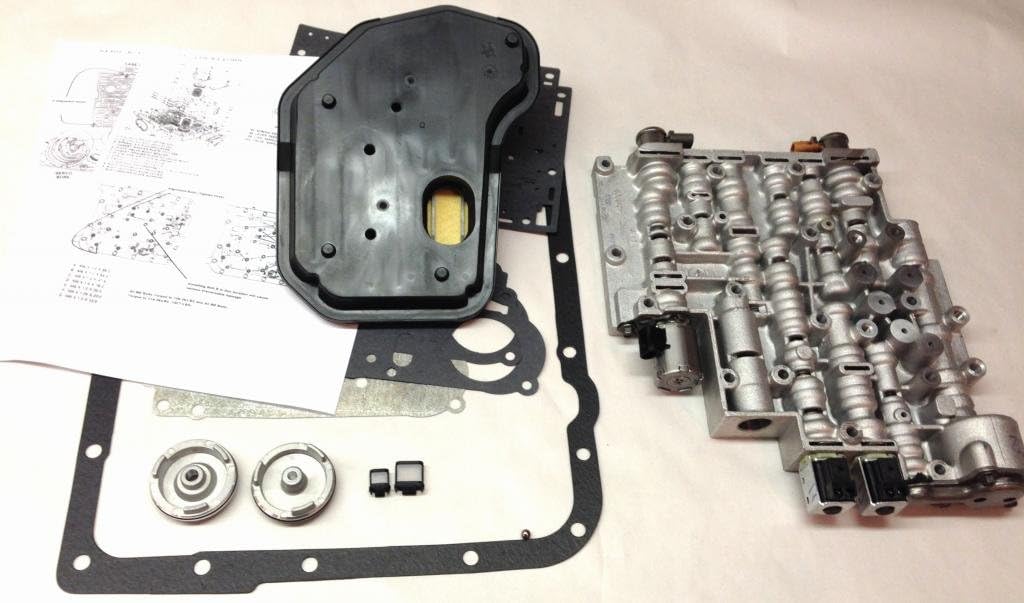
If the truck is slow to engage Drive or Reverse, or the forward or low/reverse clutches show heat, look at the valve body before the clutches. Sonnax explains that continuous oscillation of the forward and reverse abuse valves wears their bores in the 4L60E, 4L65E and 4L70E, which lets clutch feed pressure leak to exhaust. Their listed symptoms are delayed forward, delayed reverse, forward or low/reverse clutch distress, and low line pressure on engagement (Sonnax 77754-35K abuse valve kit).
The Sonnax 77754-35K is a slightly larger, longer drop-in valve with a revised spring that fits either abuse location and raises clutch pressure slightly. For a badly worn bore, the 77754-58K is an oversized kit that needs reaming. Either way, vacuum test the bore. A new clutch pack fed by a leaking abuse valve is just a slower way to burn a new clutch pack.
Step 7: Slipping right after a repair
Two GM documents explain a lot of fresh-repair slips on these trucks.
Input housing feed holes (PIP5072)
GM Preliminary Information PIP5072 covers 1999-2006 Silverados and other trucks with the 4L60E, 4L65E or 4L70E that slip or will not engage any forward gear right after the input housing was replaced. The cause is a service input housing, part number 17803687, with an incorrectly drilled input shaft. With the housing assembled, apply regulated air to the forward clutch feed hole and then to the 3-4 clutch feed hole. Air should not come out of the other hole. If it does, GM's fix is new housing 19125752. GM also notes that a small leak between the shaft and housing is normal and is not a reason to replace it (GM PIP5072).
Cooler flow (GM 02-07-30-052J)
GM bulletin 02-07-30-052J states that insufficient oil flow through the ATF cooling system will cause premature transmission failure, and it covers the J-45096 tool used to flush the cooler and measure flow in gallons per minute (GM bulletin 02-07-30-052J). On a Silverado that tows, a rebuild that cooks itself in a few months almost always traces back to a cooler or line that was never flushed and flow tested after the first failure filled it with debris.
The repair order that works
- Scan and drive. Separate converter slip from gear slip using TCC slip speed and gear.
- Correct the DEXRON-VI level hot and read the pan.
- Map the slip by gear to name the circuit.
- Gauge line pressure and clamp PC solenoid current against load. Fix any engine-side codes first.
- If it comes apart, vacuum test every checkball and valve Sonnax lists, not just the burned pack.
- Air test the input housing feed holes per PIP5072, especially if it is a service housing.
- Flush and flow test the cooler before the truck leaves.
Do it in that order and you only buy the parts the truck actually needs. If the pan shows heavy friction loss across more than one pack, a full rebuild with the 3-4 upgrades is cheaper than two partial repairs.
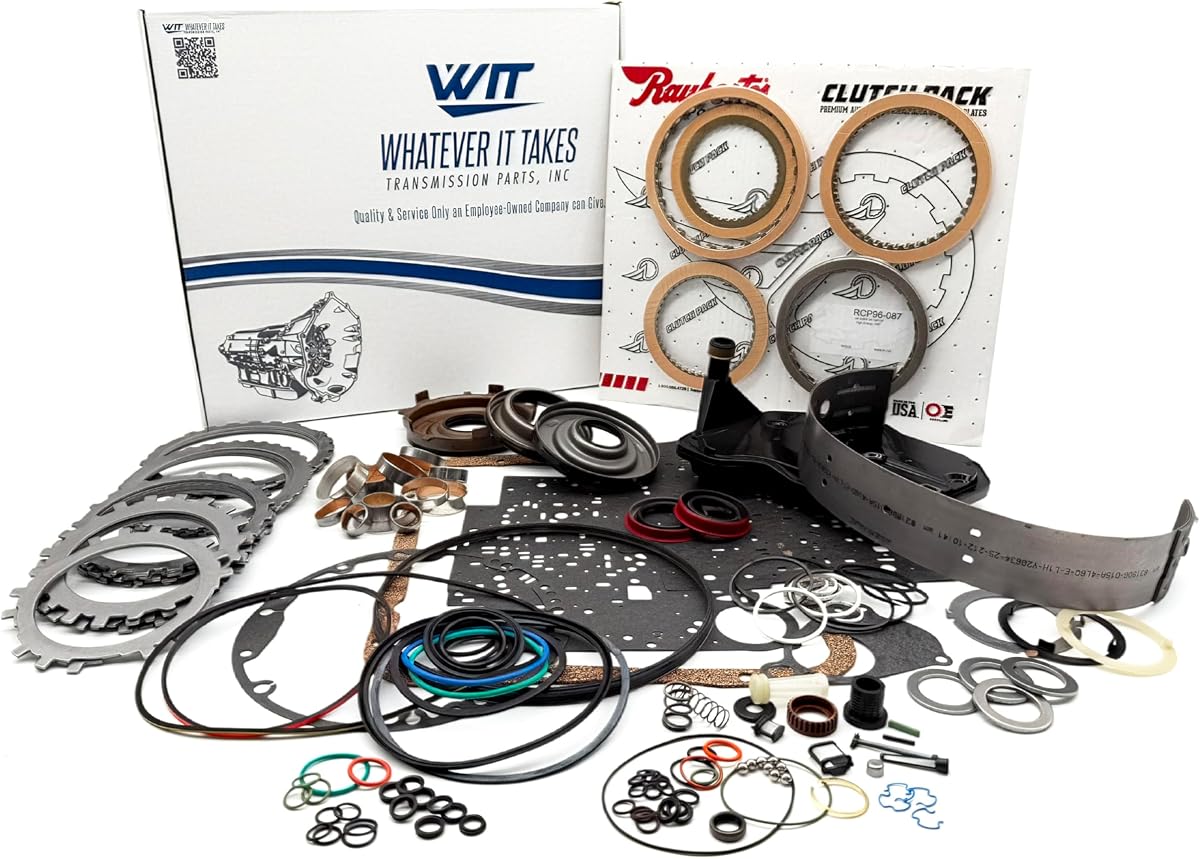
4L65E 3-4 Power Pack Friction Clutch Kit
The most common Silverado 4L65E slip is a burned 3-4 pack. This kit adds clutch capacity to that pack; pair it with the leak checks above so it lasts.
View the 3-4 clutch kit →Need something else? Browse all 4L65E parts.
Keep the numbers at the bench. Our free transmission fluid spec chart lists the correct ATF for the 4L65E and dozens of other units, so nobody tops off a Silverado with the wrong fluid.
FAQ
Why does my Silverado 1500 slip only when it is hot?
Hot fluid is thinner, so every worn seal, bore and checkball leaks more, and line pressure that was marginal cold falls below what the clutches need. Sonnax traces most 3-4 slipping to low line pressure and leaks of 3rd gear oil, and those leaks grow with temperature. Check the fluid level hot, then read line pressure hot before you condemn clutches.
Can a fluid change fix a slipping 4L65E?
Only if the fluid was low, wrong or badly burnt and the clutches still have friction left. GM lists DEXRON-VI for the 4L65E, and a correct hot level matters because low fluid aerates and drops line pressure. If the pan is full of friction material or the slip is tied to one gear, fresh fluid will not bring the clutches back.
How do I tell converter slip from transmission slip on a Silverado?
Watch TCC slip speed and gear on a scan tool. A converter that is commanded on should hold slip low and steady; slip that climbs while engine rpm rises in a locked gear points at the converter clutch. If engine rpm flares on the shift itself, or rpm does not match the gear ratio with the converter unlocked, the slip is inside the transmission.
My 4L65E slips in every forward gear right after a new input housing. Why?
GM documented this in PIP5072. Some service input housings, part number 17803687, were drilled wrong and leak between the forward clutch and 3-4 clutch feed holes. Air test each feed hole with the housing assembled; if air crosses between them, GM's fix is replacement housing 19125752.
Sources
- GM Preliminary Information PIP5072 (Oct 2012), "Slip In Forward Ranges Immediately After Replacing The Input Housing," via NHTSA. Backs: affected 1999-2006 Silverado and other M30/M32/M70 trucks, service housing 17803687, the forward/3-4 feed hole air test, and replacement housing 19125752. static.nhtsa.gov/odi/tsbs/2012/MC-10112523-9999.pdf
- GM Bulletin 02-07-30-052J (May 2015), "Automatic Transmission Oil Cooler Flow Test Essential Tool J-45096," via NHTSA. Backs: insufficient cooler flow causing premature transmission failure, and the flush and flow test procedure. static.nhtsa.gov/odi/tsbs/2015/MC-10113664-9999.pdf
- Chevrolet Performance, Supermatic Transmission Specifications (4L65-E 19260380). Backs: DEXRON-VI, 10.6 L (11.2 qt) dry fill with 300 mm converter, 430 lb-ft maximum engine torque for the 4L65E, all five gear ratios, pan/drain/cooler nut torques, filter kit 24208576 and pan gasket 08654799. Chevrolet Performance Supermatic spec sheet (PDF)
- Sonnax, "All Over the Map: Attacking 4L60/E Burnt 3-4 Clutches with Confidence." Backs: low line pressure and 3rd gear oil leaks as the root cause of most 3-4 slipping, the 25 in-Hg input housing checkball limit, 3rd accumulator checkball 74480D, boost valve kits, backing plate 74140-01K, engine sensor effects on line pressure, and the second pan magnet. sonnax.com/tech_resources/659
- Sonnax, Forward and Reverse Abuse Valve Kit 77754-35K. Backs: abuse valve bore wear in the 4L60E/4L65E/4L70E, the delayed forward/reverse and clutch distress symptoms, and the 77754-58K oversized kit. sonnax.com/parts/2462
- GEARS Magazine (ATRA), "Controlling Pressure: General Motors." Backs: PC solenoid current of roughly 0.9-1.1 A at idle and 0.2-0 A at WOT, lower current meaning higher line pressure, verifying with an amp clamp and gauge, and the 4L60E case where the scan PID hid an erratic signal. gearsmagazine.com/magazine/controlling-pressure-general-motors