A 4L80E in a gas Silverado 2500 that shifts wrong usually comes in with one of four complaints: it takes off in 2nd, it will not go into overdrive, it bangs every shift, or it flares between gears with a trailer behind it. They feel different from the driver's seat, and they come from different places. Some are a $40 solenoid. Some are a worn valve body bore. Some are a sensor the PCM uses to pick shift points, and the transmission itself is fine.
This guide covers the 1999-2007 GMT800 trucks and the earlier GMT400 2500s with the 4L80E. GM's 2005 4L80E diagnostic parameters document lists the unit behind the 4.8L, 6.0L (LQ4) and 8.1L (L18) in the Silverado and Sierra. A Duramax 2500HD of the same years has an Allison, which is a different transmission with a different diagnostic tree.
The short version: Write down the shift pattern the truck actually does (for example 2-2-3-3 or 1-2-2-1), because GM's own code logic sorts stuck solenoids by that pattern. Ohm the solenoids at the case connector: GM-built shift solenoids read 18-24 ohms, the pressure control solenoid 3.5-5.2 ohms. Harsh shifts in every gear point to the pressure control solenoid, an accumulator or a missing check ball. Wrong-gear starts and no 4th with good solenoids point to the AFL valve bore in the valve body. And on a 4x4, check the 4WD Low switch before you blame the transmission.


Start With the Shift Pattern, Not the Code
The 4L80E picks gears with two on/off shift solenoids. The Army's 4L80E troubleshooting guide, written from the GM-built HMMWV application, lists the states: 1st has the 1-2 solenoid (A) on and the 2-3 solenoid (B) off, 2nd has both off, 3rd has A off and B on, and 4th has both on. Because 2nd is the both-off state, a truck that loses power to the solenoids, or blows the fuse that feeds them, drives in 2nd gear only. That is the limp mode.
That table lets you read a stuck solenoid from the seat. GM's 2005 diagnostic parameters spell out exactly what each failure looks like on a 1-2-3-4 upshift run:
| Code | Fault | What the truck does |
|---|---|---|
| P0751 | Shift solenoid A stuck off | 2-2-3-3: starts in 2nd, never gets 4th |
| P0752 | Shift solenoid A stuck on | 1-1-4-4: holds 1st, jumps to 4th |
| P0756 | Shift solenoid B stuck on | 4-3-3-4: wrong-gear launch in 4th, sits in 3rd |
| P0757 | Shift solenoid B stuck off | 1-2-2-1: never reaches 3rd or 4th |
| P0753 / P0758 | A or B circuit electrical | Open, short to ground or short to voltage in the circuit or solenoid |
Two details from that GM document matter on the road test. First, the performance codes (P0751, P0752, P0756, P0757) only run with transmission fluid between about 20 and 130 C, throttle above 10 percent and engine torque above 80 ft-lb. A truck driven gently from cold can shift wrong all morning without setting a thing. Second, GM checks the actual ratio against fixed windows: 2.42-2.52 in 1st, 1.44-1.52 in 2nd, 0.98-1.02 in 3rd and 0.727-0.77 in 4th. If your scan tool shows a ratio PID, compare it to those numbers. Commanded 4th with the ratio sitting at 1.00 is a truck in 3rd, no matter what the gear PID says.
A "performance" code means the computer commanded the gear and the ratio did not follow. That can be the solenoid, but it can also be the hydraulics behind it. That distinction is the whole game on this unit.
Ohm the Solenoids Before You Buy Any
Pull the 20-way connector at the case and test the solenoids through it. The Army guide's component resistance chart gives these values:
| Component | Resistance |
|---|---|
| 1-2 shift solenoid (A) | 18-24 ohms |
| 2-3 shift solenoid (B) | 18-24 ohms |
| Pressure control solenoid (PCS / force motor) | 3.5-5.2 ohms |
| TCC PWM solenoid | 10-14 ohms |
Both shift solenoids and the TCC solenoid share an ignition feed spliced inside the internal harness, so if all three read open at the case, suspect the harness or the feed before the solenoids. Check the reading at the case connector and again at the PCM connector. Matching numbers clear the engine harness. A good reading at the case and an open at the PCM is a wiring fault in the truck harness.
If the solenoids ohm good and the truck still has an electrical code, the PCM is seeing an invalid output state. GM's electrical tests (P0753, P0758) set after 43 bad counts out of 50, so an intermittent connector will set them. Clean the case connector, check for ATF wicking through it from inside the pan, and look at the pins before replacing anything.
Good Solenoids, Wrong Gear: The AFL Valve
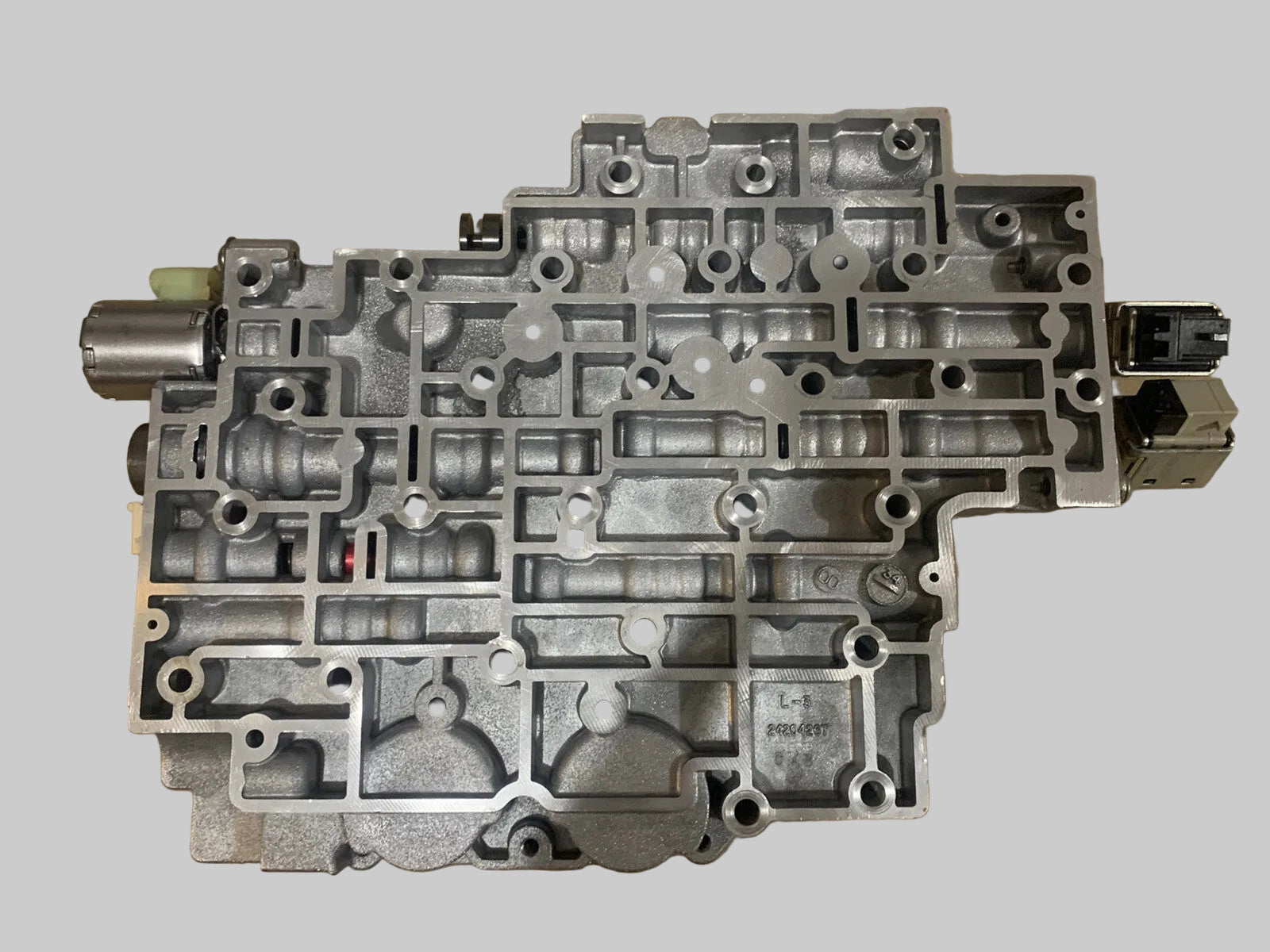
This is where most 2500 shift complaints that come back after a solenoid swap end up. The shift solenoids do not make their own pressure. They are fed by the actuator feed limit (AFL) valve, which regulates line pressure down to a steady solenoid supply. Sonnax puts AFL output for this family of valves typically in the 80-115 psi range. When the AFL bore wears, solenoid feed drops or wanders. Per Sonnax, if feed is too low "the shift valves may not stroke fully."
The symptoms read like a bad solenoid. Sonnax's 4L80-E AFL valve kit (34200-16K) is listed for wrong-gear starts, 2nd-gear starts, no 4th, 2-3 neutral, low solenoid feed pressure, and solenoid performance codes. The difference is that a new solenoid does not cure it, or cures it for a week. Sonnax calls these valves "quite active" and says they should always be vacuum tested for wear. If the truck is high mileage, has had its fluid cooked at least once, and keeps setting P0751 or P0756 with solenoids that ohm good, pull the valve body and vacuum test the AFL bore before you hang another set of solenoids.
While the valve body is off, check the separator plate and the solenoid O-rings. A torn O-ring on a shift solenoid bleeds off the same signal oil a worn AFL valve fails to supply.
Harsh Shifts in Every Gear
A firm shift under heavy throttle is normal on a 2500. The Army guide draws the line clearly: "firm" is a quick apply that is normal at medium to heavy throttle, while "harsh" is noticeable at any throttle and is never acceptable. If it bangs 1-2, 2-3 and 3-4 at light throttle, the guide lists the causes in order of probability:
- Pressure control solenoid stuck in the off (de-energized) position. On this unit, zero current means maximum line pressure, so a dead PCS gives you full line pressure on every shift.
- An accumulator fault: broken or missing piston spring, a damaged piston seal, loose cover bolts or a damaged gasket.
- A valve body check ball missing or out of position, usually after someone else has had the valve body apart.
- The wrong PCM calibration, common on trucks that have had an engine or PCM swapped.
The guide also lists the electrical sensors that cause harsh or erratic shifts without any hard part being wrong. A failing TP sensor causes "erratic shifts, high or low line pressures." A bad input or output speed sensor makes shifts erratic and the converter clutch apply at the wrong time. A pressure switch assembly (the internal range sensor) failure can cause loss of 4th, no converter apply, harsh shifts and high line pressure. A failed fluid or coolant temperature sensor can also take away 4th and converter apply.
So before you open the pan: watch TP percent on the scan tool and make sure it sweeps smoothly with no dropouts. Watch PCS desired versus actual current, which should track each other. And watch the range reading as you move the shifter. GM sets P1810 when the pressure switch assembly reports an illegal combination, or a range that does not match the ratio, for example Park/Neutral while the ratio says a drive gear.
Erratic Shifts and 2nd-Only: The Speed Sensors
The PCM picks shift points from vehicle speed and throttle. Lose the output speed signal and it has nothing to schedule from. The Army guide's default for a lost output speed sensor is second gear only and maximum line pressure, which feels like a harsh, lazy truck stuck in 2nd. GM's 2005 document sets P0502 when output speed reads under 50 rpm while input speed is above 1400 rpm in gear, and P0503 when output speed drops more than 1000 rpm in one step, the signature of a loose sensor or a damaged tone ring. P0716 watches the input speed sensor for jumps of 1300 rpm or more.
The Army guide gives 1000-2000 ohms across the output speed sensor's two pins. Check the reading, then check the sensor for metal fuzz on its tip. On a 2500 that has been run hard, clutch debris collects on the magnet and weakens the signal at low speed, which shows up as erratic downshifts as the truck rolls to a stop.
The 4x4 Trap: 4WD Low Switch
This one only bites 4x4 trucks, and it fools people. The PCM needs to know when the transfer case is in 4-Low so it can correct speed and shift scheduling for the extra reduction. GM's diagnostic document sets P2771 when the 4WD Low switch reads off but the measured transfer case ratio is between 2.65 and 2.76 in two gears, or when the switch reads on but the measured ratio is between 0.95 and 1.05. The second case is the one that matters for shift complaints: a switch stuck on in 2-High makes the truck shift as if it were in Low, so upshifts come late and everything feels wrong. If a 4x4 2500 has odd shift timing and the only code is P2771, fix the switch and the transmission complaint usually goes with it.
Flares Under Load on Tow and Plow Trucks
A flare is not the same as a bad shift. The Army guide defines it as a quick rise in engine rpm with a momentary loss of torque, usually during a shift. On a 2500 that tows or plows, a flare in 1st through 3rd in OD points to the overdrive roller clutch. Sonnax's tech article explains why: in OD range 1st through 3rd, the overrun clutch is not applied, so the OD roller clutch is holding by itself. Plow trucks that shuttle back and forth all night wear it out. Sonnax notes that once the roller clutch goes, it takes the overrun drum, the OD planetary and sometimes the forward drum ring gear with it.
The quick test: if the flare goes away in manual 3 (where the overrun clutch applies and backs up the roller clutch), the roller clutch is your suspect. Sonnax's fix for 1997-later units is its Smart-Tech overrun clutch valve kit (34200-40K), which applies the overrun clutch in every gear except 4th. Our Silverado 2500 slipping guide covers the line pressure test and the 2nd-gear sprag if the flare is in a different gear.
Fluid and Tow/Haul Before You Condemn Anything
Low or aerated fluid makes every complaint above worse. The 2006 Silverado owner manual calls for DEXRON-VI, checked hot at 180-200 F with the engine idling in Park on level ground, and warns not to overfill. It also says Tow/Haul mode changes the shift pattern to reduce shift cycling when pulling a trailer. A driver who tows in plain Drive and complains of hunting between 3rd and 4th may simply need to push the Tow/Haul button.
The Order I Work It
- Check fluid hot and pull codes, including the engine side (TP sensor, speed sensor, 4WD Low).
- Road test and write down the shift pattern. Compare the ratio PID to GM's windows.
- Ohm the solenoids at the case: 18-24 ohms for A and B, 3.5-5.2 for the PCS.
- Watch PCS desired versus actual current and TP percent on the scan tool.
- Solenoids good but wrong gears persist: pull the valve body, vacuum test the AFL bore, check solenoid O-rings and the separator plate.
- Harsh in every gear with the electrical side good: accumulator springs and seals, check balls, then the PCS.
- Flare in 1st-3rd under load: test in manual 3 and look at the OD roller clutch.
A shift solenoid set is the cheap first move when the codes and resistance agree. When the valve body has been through 200,000 miles of towing, a remanufactured valve body with new solenoids saves you from chasing one worn bore at a time.
OEM A and B shift solenoids for the 4L80E
GM 24230288 and 24230289, the matched 1-2 and 2-3 solenoids behind P0751, P0752, P0756 and P0757. Ohm the old ones first; if they read outside 18-24 ohms, this is the fix.
See the solenoid set →Need something else? Browse all 4L80E parts at Core Transmission Parts
Keep the numbers at the bench. Our free transmission fluid spec chart lists the correct ATF for the 4L80E and dozens of other units, so nobody tops off a work truck with the wrong fluid.
FAQ
Why does my Silverado 2500 4L80E start in 2nd gear?
Second gear is the state with both shift solenoids off, so a 4L80E that loses solenoid power or feed pressure starts in 2nd. GM's P0751 logic describes a 2-2-3-3 pattern when shift solenoid A is stuck off. Ohm the solenoid (18-24 ohms is good), and if it tests good, check the AFL valve bore in the valve body, which supplies the solenoids.
What causes a 4L80E to shift harsh in every gear?
The Army's 4L80E troubleshooting guide lists a pressure control solenoid stuck off first, because zero current commands maximum line pressure. Next come accumulator faults such as broken springs, damaged seals or loose cover bolts, then a missing or misplaced check ball and the wrong PCM calibration. A bad TP sensor or speed sensor can also cause harsh, erratic shifts.
How do I test 4L80E shift solenoids?
Unplug the case connector and measure resistance. The Army guide gives 18-24 ohms for the 1-2 and 2-3 shift solenoids, 3.5-5.2 ohms for the pressure control solenoid and 10-14 ohms for the TCC solenoid. Repeat the test at the PCM connector to clear the truck harness.
Can a 4WD Low switch cause 4L80E shift problems?
Yes. GM sets P2771 when the 4WD Low switch disagrees with the measured transfer case ratio. A switch stuck on in 2-High makes the PCM shift as if the truck were in Low, so shift timing is wrong even though the transmission is healthy.
Will Tow/Haul mode change how a 4L80E shifts?
Yes. GM's 2006 Silverado owner manual says Tow/Haul changes the shift pattern to reduce shift cycling when towing. A truck that hunts between 3rd and 4th with a trailer in plain Drive may only need Tow/Haul turned on.
Sources
- General Motors — 2005 4L80E Transmission Diagnostic Parameters (OBD). Backs: 4L80E use with the 4.8L, 6.0L and 8.1L in the Silverado and Sierra; the stuck shift patterns for P0751 (2-2-3-3), P0752 (1-1-4-4), P0756 (4-3-3-4) and P0757 (1-2-2-1); the 43-of-50 count electrical test; the 20-130 C, 10 percent throttle and 80 ft-lb enabling conditions; gear ratio windows; P0502, P0503 and P0716 thresholds; P1810 range logic; and P2771 4WD Low switch ratio checks. GM 2005 4L80E diagnostic parameters (PDF)
- U.S. Army Ordnance Mechanical Maintenance School — 4L80E Transmission Troubleshooting Guide (GM-built HMMWV application). Backs: shift solenoid on/off states by gear and 2nd-gear default; solenoid, PCS, TCC and output speed sensor resistance values; the firm, harsh and flare definitions; the harsh-shift cause list; and the effects of TP, speed sensor, PCS, pressure switch and temperature sensor failures, including 2nd-only with maximum line pressure on output speed loss. Army 4L80E troubleshooting guide (PDF, archive.org)
- Sonnax — "Uncovering the Root Cause of Pressure Complaints: The Critical Role of Solenoid Modulator and AFL Valves." Backs: AFL output typically 80-115 psi, shift valves not stroking fully on low feed, vacuum testing AFL bores, and the 4L80-E kit 34200-16K symptom list (wrong-gear and 2nd-gear starts, no 4th, 2-3 neutral, solenoid performance codes). sonnax.com/tech_resources/1208
- Sonnax — "Outsmarting 4L80-E Overdrive Roller Clutch Failure." Backs: the OD roller clutch holding 1st-3rd alone in OD, the overrun clutch applying only in manual ranges, collateral drum and planetary damage, and the 34200-40K Smart-Tech overrun clutch valve kit for 1997-later units. sonnax.com/tech_resources/625
- General Motors — 2006 Chevrolet Silverado Owner Manual, "Automatic Transmission Fluid (Except Allison Transmission)" and "Tow/Haul Mode." Backs: DEXRON-VI, the 180-200 F hot check procedure, the overfill warning, and Tow/Haul changing the shift pattern to reduce shift cycling. GM: 2006 Chevrolet Silverado owner manual (PDF)