A slipping Suburban 2500 almost always comes in with the same story. It drove fine empty, then the owner hooked up the camper, climbed a long grade, and the engine flared between shifts while TRANS TEMP climbed higher than they had ever seen it. On a 6L90 behind a 6.0L V8 the slip is usually the last symptom in a chain, not the first. Replace only the burnt pack and the new one goes the same way.
This is the slip workup for the Suburban 2500 and Yukon XL 2500. For everything else that fails on this truck, see 6L90 Suburban common problems. For the pickup, see 6L90 Silverado 2500 slipping fix; the Suburban has a dipstick and its own model-year traps.
The short version: Confirm it is a 6L90 (RPO MYD) and not a 2008 4L80E. Set the level hot on the dipstick at 160-200 F. Then sort the slip by gear: 4th-5th-6th is the 4-5-6 clutch, 3rd-5th-Reverse is the 3-5-R side, 1st through 4th is the 1-2-3-4 clutch. Before you condemn any pack, prove line pressure rises with throttle and prove the cooler is flowing. GM PI1393B ties a slipping 4-5-6 clutch (P0796) to low line pressure from a pump scored by converter lining, and GEARS Magazine ties 4-5-6 overheating to a failed cooler bypass valve. Fix the cause, then the clutch.


Confirm the Transmission and Set the Level the Suburban Way
GM's 2008 Suburban owner manual lists both the 4L80-E and the 6L90 in its capacity table, so a 2008 Suburban 2500 can be either one. Read the RPO label in the glovebox: MYD is the 6L90. From 2009 on, the 2500 with the 6.0L is a 6L90 truck. GM's PI1393B also lists the 2015 Suburban and Yukon XL among the trucks built with the 6L80 or 6L90 (MYC or MYD), so on later trucks check the label instead of assuming it is a half-ton 6L80.
Unlike the HD pickups, the 2011 Suburban has a transmission dipstick, at the rear of the engine compartment on the passenger side. GM's procedure: engine running, level ground, shift through every range for about three seconds each, back to Park, idle at 500-800 rpm for at least a minute, and read TRANS TEMP on the driver information center. A cold check at 80-90 F only tells you it is safe to drive. The accurate check is hot, at 160-200 F, with the level in the HOT cross-hatch. GM notes that low is usually less than a pint, and that a pan and filter service takes 6.3 qt of DEXRON-VI.
A unit half a quart low can drive fine in town and still flare on a long hot grade. Get the level right first. If the fluid is black, smells burnt, or the pan has friction material in it, a fluid service is not the fix.
Name the Clutch From the Gears That Slip
The 6L90 is clutch-to-clutch with no bands, and each gear is held by two applied elements. That makes the gear pattern your first diagnostic tool.
| Gear | Applied elements |
|---|---|
| 1st | 1-2-3-4 clutch + low one-way clutch (low/reverse clutch in manual low and engine braking) |
| 2nd | 1-2-3-4 + 2-6 |
| 3rd | 1-2-3-4 + 3-5-R |
| 4th | 1-2-3-4 + 4-5-6 |
| 5th | 3-5-R + 4-5-6 |
| 6th | 2-6 + 4-5-6 |
| Reverse | 3-5-R + low/reverse |
- Slips in 4th, 5th and 6th only: 4-5-6 clutch or its feed. This is the towing failure.
- Slips in 3rd, 5th and Reverse: 3-5-R clutch, its drum weld, or the feed rings.
- Slips in 1st through 4th: 1-2-3-4 clutch, its piston, or its check ball.
- Drops into neutral just after takeoff: not necessarily the 1-2-3-4. More on that below.
- Slips everywhere, worse hot: not one clutch. Level, pump, line pressure, or a converter that is not locking.
Confirm it with data on a loaded drive: input speed, output speed, commanded gear, TCC slip speed and fluid temperature. Input divided by output should match the commanded gear's ratio; if it drifts high with throttle, that gear is slipping. Large TCC slip with the converter commanded on is a converter problem, covered in 6L90 torque converter shudder.
Prove the Heat Path Before You Blame a Clutch
On a Suburban that tows, heat is suspect number one. GM's TechLink article on 6-speed overheating covers the 2014-2020 Tahoe, Suburban and Yukon with the 6L80 (MYC) or 6L90 (MYD), and gives a test you can do with an infrared thermometer and a scan tool:
- Drive until transmission fluid temperature reaches 190 F.
- Shoot the pan with the IR gun. The pan temperature and the scan tool temperature should be close.
- Measure the thermal bypass valve and each cooler line about 6 in. from the valve. On a healthy system the return line is cooler than the line going out to the cooler.
- If both cooler lines are below pan temperature and the bypass valve is hotter than the pan, the valve is not opening and fluid is not going to the cooler.
- If the dash reads more than 15 F above the pan, suspect the temperature sensor, which is part of the TEHCM.
TechLink notes the original valve is fully open at 194 F and the revised valve, stamped "70" and covered in bulletin 21-NA-199, is fully open at 158 F. That revised valve is listed for certain 2016-2020 Suburbans. Steve Garrett's GEARS Magazine article on 6L80/90 clutch failure makes the link to slipping directly: a failed cooler bypass valve typically causes the 4-5-6 clutch to overheat and fail, and his advice is to replace or bypass the valve. On a 2500 that lives at the top of its trailer rating, that valve is worth checking before any teardown and worth replacing during one.
GM's PI1393B adds one more heat clue: a restricted or plugged cooler can set U0101, P0634, or put TRANSMISSION HOT IDLE ENGINE on the cluster. If the owner has seen that message, the cooler circuit is part of the job no matter what the clutches look like.
Put a Gauge on Line Pressure
This is the step that keeps a rebuilt 6L90 from coming back. GM's PI1393B, which covers the 2015 Suburban and Yukon XL, tells technicians to check line pressure as part of diagnosis. Its reasoning: when torque converter clutch lining debonds, it passes through the pump, scores the pump pocket or cover, and drops line pressure. Low pressure then distresses the clutches, and GM names the 4-5-6 clutch as the most likely one, possibly setting P0796. The lining can come loose without setting P0741, so a clean code history does not clear the converter. If line pressure is below spec, GM says the pump and clutches must come apart for inspection.
Sonnax's 6L45-6L90 tech article gives the gauge readings that sort supply problems from clutch problems:
- About 60-68 psi with no rise as throttle increases, and no change with the connector unplugged: the TEHCM line pressure solenoid is stuck in exhaust. A Suburban that cannot raise pressure under load will slip the 4-5-6 every time it pulls a grade.
- Under about 30 psi at idle: the pressure regulator boost valve retaining pin may be missing from the pump, an assembly error on rebuilt units.
Compare readings with the service information table for the year. Pressure has to rise with throttle before any clutch goes in.
When It Is the 4-5-6 Clutch
With heat, level and pressure proven, slip in 4th, 5th and 6th points to the 4-5-6 assembly. GEARS lists three causes specific to it:
- Overheating from a failed cooler bypass valve, covered above.
- A fractured 4-5-6 dampener shaft. The clutch appears not to apply at all, and in severe cases the shaft snaps off the drum. GM changed the manufacturing process, so GEARS recommends replacing the shaft and dampener rather than reusing it.
- A cracked stator support tube or liner. Uncommon, but depending on where the crack is, it generally takes out the 4-5-6.
If the pack is burnt, follow PI1393B before reassembly: inspect the pump pocket and cover for scoring, and if converter lining is the source, replace the converter and filter and flush and flow test the cooler per service information. GEARS adds that pump slide and rotor clearances are selective even with factory parts, so measure them instead of trusting a used pump.
When It Is the 3-5-R or 1-2-3-4 Side
On a 2008 or early 2009 Suburban, slip in Reverse, slip in 5th, or slip when passing goes straight to GM bulletin 09-07-30-004J, which lists the 2008 Suburban and Yukon XL. Its listed conditions include slip or no Reverse, delayed Reverse, DTC P0776, P2715 or P2723, harsh 2-3, and harsh 4-5 or slip in 5th. The cause is a cracked weld on the 1-2-3-4 / 3-5-R housing. The test: brush soap on the weld, hold your thumb over the bleed passage, put air into the 3-5-R feed and watch for bubbles. Any bubbles mean a new housing; GM lists the assembled MYD housing as 24238695.
GEARS fills in the rest of the forward-gear causes:
- Stator support sealing rings. The same rings seal both the 1-2-3-4 and 3-5-R feeds. Early rings leaked, especially cold, giving delayed or slipping engagement, usually into Reverse. The updated rings will not fit older pumps, so the pump has to be replaced or machined.
- Stator support gasket. Hot and cold cycling etches it on high-mileage units, and GEARS warns that once it leaks, clutch failure is imminent. Which clutch fails depends on where it leaks, so vacuum or air test the stator support before you blame a pack.
- Cracked 1-2-3-4 piston or housing. Update early pistons to the later design. Sonnax notes the OE 1-2-3-4 piston fails often enough that most shops replace it on every rebuild.
- Worn or migrating check balls. Early units show significant ball wear, and a ball that moves can cause slipping and clutch damage. Replace them all when the valve body is off.
The low sprag that looks like a 1-2-3-4 failure
Per GEARS, the low/reverse clutch holds the output carrier until about 2 mph, then releases and hands first gear to the low sprag. If the sprag has failed, the truck pulls away and then seems to drop into neutral. It feels like a 1-2-3-4 slip. Inspect the sprag elements and races before ordering a 1-2-3-4 piston.
Doing the Repair So It Survives a Trailer
- Gauge line pressure before and after. It must rise with throttle.
- Replace the bonded pistons on any heat-damaged unit. A piston that leaks hot makes the same complaint as a worn pack.
- Air or vacuum test the stator support and the 1-2-3-4 / 3-5-R housing before final assembly.
- Inspect and measure the pump. Replace the converter and filter and flush and flow test the cooler whenever there is lining or friction debris (PI1393B).
- Check or replace the cooler bypass valve, and confirm with an IR gun that the return line runs cooler than the supply.
- Fill with DEXRON-VI and set the level hot on the dipstick at 160-200 F.
- Tell the owner to use Tow/Haul (GM: best at 75 percent of GCWR or more), watch TRANS TEMP on grades, and change fluid every 50,000 miles when towing.
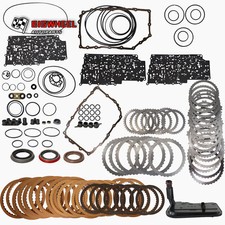
Shop 6L90 rebuild kits, bonded pistons, cooler bypass parts and filters for a slipping Suburban 2500 — shipped fast from the USA.
Shop 6L90 parts →Shop the 6L90 cooler bypass eliminator → All 6L90 parts
Keep the numbers at the bench. Our free transmission fluid spec chart lists the correct ATF for the 6L90 and dozens of other units, so nobody tops off a Suburban with the wrong fluid.
FAQ
Why does my Suburban 2500 slip only when towing up a hill?
Slip that shows up only under load and heat usually points to the 4-5-6 clutch or what feeds it. GM's PI1393B names the 4-5-6 as the clutch most likely to be distressed by low line pressure, and GEARS Magazine ties 4-5-6 overheating to a failed cooler bypass valve. Check the hot fluid level, line pressure rise and cooler flow before replacing the pack.
How do I check the transmission fluid on a 6L90 Suburban?
The Suburban has a dipstick at the rear of the engine compartment on the passenger side. With the engine idling, shift through every range, return to Park, idle a minute and read TRANS TEMP. The accurate check is at 160-200 F with the level in the HOT cross-hatch, using DEXRON-VI.
What does P0796 mean on a 6L90 Suburban?
P0796 is a 4-5-6 clutch circuit fault, typically a slip in 4th, 5th or 6th. GM's PI1393B explains that converter lining passing through the pump can score it, drop line pressure and distress the 4-5-6 clutch. The pump, line pressure and converter have to be checked or a new clutch will fail too.
Can a bad cooler bypass valve make a 6L90 slip?
Yes, indirectly. If the valve does not open, fluid skips the cooler and the 4-5-6 clutch overheats. GM TechLink's test is to bring fluid to 190 F and compare pan, valve and cooler line temperatures with an infrared thermometer; the return line should run cooler than the supply.
Sources
- General Motors — 2011 Chevrolet Suburban Owner Manual. Backs: dipstick location and the 80-90 F cold / 160-200 F hot check procedure, 6.3 qt DEXRON-VI pan and filter capacity for the 6L90, TRANS TEMP and TRANSMISSION HOT IDLE ENGINE, Tow/Haul at 75 percent of GCWR, and the 50,000 mile severe-service fluid interval. 2011 Suburban owner manual (PDF)
- General Motors — Service Bulletin 09-07-30-004J, "Slips in Reverse or Third, Delayed Reverse or Drive Engagement, DTC P0776, P2715, P2723, Harsh 2-3 Shifts" (hosted by NHTSA). Backs: 2008 Suburban and Yukon XL coverage, the slip conditions and codes, the cracked 1-2-3-4 / 3-5-R housing weld soap-and-air test, and MYD housing 24238695. GM 09-07-30-004J (PDF)
- General Motors — PI1393B, "Diagnostic Tips for DTC P0741: Torque Converter Clutch Stuck Off," June 2015 (hosted by NHTSA). Backs: 2015 Suburban and Yukon XL with MYC/MYD coverage, the line pressure check, converter lining scoring the pump, the 4-5-6 clutch as the most likely distressed clutch with P0796, filter replacement and cooler flush and flow test, and U0101 / P0634 / TRANSMISSION HOT IDLE ENGINE from a plugged cooler. GM PI1393B (PDF)
- GM TechLink — "6-Speed Transmission Overheating Conditions Diagnosis," October 2022. Backs: 2014-2020 Suburban coverage, the 190 F IR test of pan, thermal bypass valve and cooler lines, the 15 F DIC-versus-pan sensor threshold, and the 194 F original versus 158 F "70" valve under 21-NA-199. gm-techlink.com 6-speed overheating
- ATRA / GEARS Magazine — Steve Garrett, "Tackling Clutch Failure in the GM 6L80/90," June 2019. Backs: cooler bypass valve failure overheating the 4-5-6 clutch, the 4-5-6 dampener shaft fracture, stator support tube cracks, stator support gasket and sealing ring leaks, 1-2-3-4 piston and housing cracks, check ball wear, the low sprag failure that mimics a 1-2-3-4 slip, and selective pump clearances. GEARS: clutch failure in the 6L80/90
- Sonnax — "GM 6L45/50, 6L80/90 No Movement Conditions: Analysis & Repair Tips." Backs: 60-68 psi no line rise from a stuck TEHCM line pressure solenoid, under-30 psi idle pressure from a missing boost valve pin, and the OE 1-2-3-4 piston failure rate. sonnax.com/tech_resources/1216