On a TH400 the cooler lines are the part of the transmission nobody thinks about until one of them rusts through at a frame clip or gets flattened by a floor jack. They are two steel tubes running from fittings on the right side of the case up to the cooler in the radiator tank, and on a lot of trucks and motorhomes they have been in place for forty or fifty years. When one fails it usually fails fast, and a TH400 run low on fluid on the highway does not last long.
This guide covers how the TH400 cooler circuit works, why a bad line hurts more than heat, what to use for replacement lines, the factory fitting specs, and the flush and flow check GM requires before a repaired unit goes back on the road. The fitting sizes and torques come from GM's own Turbo Hydra-Matic 400 service section; sources are listed at the bottom.
How the TH400 Cooler Circuit Works
The pump sends oil to the pressure regulator, and the regulator feeds the torque converter. Oil leaving the converter is the hottest oil in the transmission, and that is what goes out to the cooler. GM's pump illustrations in the TH400 service section label the passages: the oil pump body has the converter, line and cooler passages, and the pump cover has a dedicated cooler return passage alongside the breather hole and pressure regulator feed.
That return passage matters. Oil coming back from the cooler is not dumped straight into the pan; it comes back in through the pump cover and is used to lubricate the geartrain, bushings and thrust washers on its way back to the sump. So a restricted, kinked or partly plugged cooler line does two things at once: the fluid runs hotter, and the rotating parts get less lube oil. GM's cooler flush bulletin says the same thing in plain words: the flow test machine is a tool for diagnosing transmissions that "have been subject to potential overheating or lack of lubrication," and its service procedure warns that plugged or restricted coolers and lines lead to poor lubrication, high temperatures and premature failure.
This is why I do not treat cooler lines as plumbing. A unit that came in with burnt planetary bushings and a crushed return line will do it again if the line goes back on the way it came off.
When a TH400 Cooler Line Needs Replacing
- Rust-through at the clips. The tube rusts where it sits in a frame clip or rubber grommet that holds water. It weeps first, then splits. Look at the whole run, not just the wet spot.
- Leaking at the tube nut. A tube nut that has been overtightened, or a flare that was cracked when it was last disturbed, will not seal no matter how much torque goes on it. The cure is a new flare or a new line.
- Kinked or crushed tube. Common after a transmission swap, a crossmember change, or someone using the lines as a jacking point. GM's own flush procedure starts with inspecting the lines for "damage or kinks that could restrict oil flow." A kink you can see is a restriction you can measure.
- Cracked rubber splice. Many lines were repaired years ago with a hose section and clamps. If that hose is fuel line or heater hose, it will harden and crack. Replace it with real transmission cooler hose (more on that below).
- After a failure. If the transmission came apart with debris in the pan, the lines and cooler are full of it. Either they get flushed and flow tested, or they get replaced.
Before replacing anything, confirm where the fluid is coming from. Red fluid on the tail of the transmission can come from the filler tube or the front of the case and be pushed rearward by airflow; the TH400 fluid leak guide covers GM's leak-finding procedure with dye and a black light.
Fitting Specs: Thread Size and Factory Torque
GM's TH400 bolt torque table lists two cooler items, and both use 1/4-18 pipe thread:
| Location (GM table) | Thread | Torque (lb-ft) |
|---|---|---|
| Cooler connector to case | 1/4-18 | 11 |
| Cooler connector to radiator | 1/4-18 | 20 |
| Line pressure take-off plug | 1/8-27 | 10-15 |
| Oil pan to case | 5/16-18 | 12 |
Values are from the 1975 Buick service manual's Turbo Hydra-Matic 400 specifications (Figure 7D-231). Note the case side is the lower number. The case is aluminum and the connector is a tapered thread, which acts like a wedge; overtightening a pipe-thread connector is how TH400 cases get cracked bosses. Run the connector in by hand, put thread sealant on the male threads (keep it off the first thread so none gets into the case), and stop at the spec. If a connector weeps at 11 lb-ft, the threads are damaged or the connector is wrong, and more torque will not fix it.
A word on adapters. Not every TH400 case and not every aftermarket fitting uses the same thread form. Aftermarket -6AN and -8AN adapters for the TH400 are sold in both tapered pipe (NPT) and straight pipe (NPS or NPSM) versions, and the straight versions seal on a flare or O-ring, not on the threads. Builders on the hot rod forums also report early cases with a straight thread and a copper sealing washer. Match the adapter to what is actually in the case. A tapered fitting forced into a straight port, or the reverse, either leaks or cracks the boss.
Choosing Replacement Lines
Pre-bent steel lines
For a stock-looking truck, a pre-bent steel replacement set is the cleanest repair: correct routing, correct clearance from the exhaust, and it uses the factory clips. Order by the exact vehicle, engine and transmission, because the routing differs between cars, trucks and motorhome chassis.
Steel line with a hose section
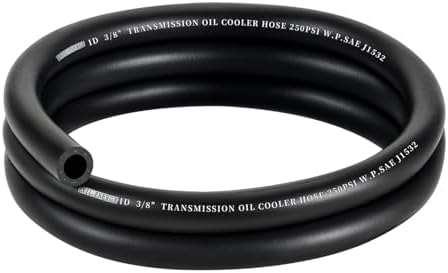
Repairing a rusted section with hose is acceptable if the hose is built for the job. The standard is SAE J1532, Transmission Oil Cooler Hose. Its current revision splits hose into two types: Type A for original equipment or replacement use, and Type B limited to aftermarket auxiliary cooler applications. Earlier revisions of J1532 also defined temperature classes (Types A and B rated to 125°C, the AT and BT types to 150°C) and maximum recommended working pressures of 1.7 MPa (about 245 psi) for Type A and 1.0 MPa (about 145 psi) for Type B. That is why fuel or heater hose has no business on a cooler line. Look for "SAE J1532" printed on the hose.
Practical rules for a hose splice: the steel tube needs a bead or barb for the hose to grip, use fuel-injection style clamps rather than worm clamps that cut the hose, keep the hose away from the exhaust, and keep the splice short. Every splice is two more joints that can leak.
Braided AN lines
For a swap, a hot rod or an aftermarket cooler, -6AN braided PTFE lines with case adapters are the usual choice. Measure the routing with a piece of wire before ordering length, and support the line every foot or so so it does not wear through on a crossmember.
Replacing the Lines Step by Step
- Mark the lines before you disconnect anything. Tag which tube goes to the front fitting and which to the rear, and which goes to the upper and lower radiator fittings. Getting them crossed sends unfiltered converter oil the wrong way through the cooler. If you are not sure of flow direction on a swapped vehicle, confirm it: with the return line loose into a container and the engine at idle in park for a few seconds, the line that pushes fluid is the feed from the transmission.
- Break the tube nuts loose with a flare-nut wrench, and hold the connector with a second wrench. GM's removal procedure simply says to "loosen cooler line nuts and separate cooler lines from transmission," and notes the lines may be easier to remove with the crossmember support out. On a forty-year-old truck, soak the nuts first. Twisting the connector while you fight a seized nut is how the case threads get damaged.
- Plug the open ports so dirt does not get in, and catch the fluid. The lines and cooler hold some fluid that will not drain from the pan.
- Check the connectors. If a connector is rounded, cracked or its seat is damaged, replace it now. Install new connectors to the torque in the table above.
- Fit the new lines loosely first. Start every tube nut by hand at both ends before tightening any of them, so nothing is under tension. Then snug the nuts with the flare-nut wrench while backing up the connector.
- Route and clip the line. Keep the factory clearance from the exhaust pipe and catalytic converter, and reuse or replace the grommeted clips. A line that touches the frame will rub through.
- Flush and flow test the cooler (next section) if the transmission was out or failed.
- Refill and check the level per GM's procedure: start the engine without racing it, move the selector through every range, then check the level in park with the engine running on a level surface. Do not overfill.
- Leak check. Drive to full temperature, then inspect both ends with the engine running and again after shut-off.
Flush and Flow Test: Don't Skip It After a Failure
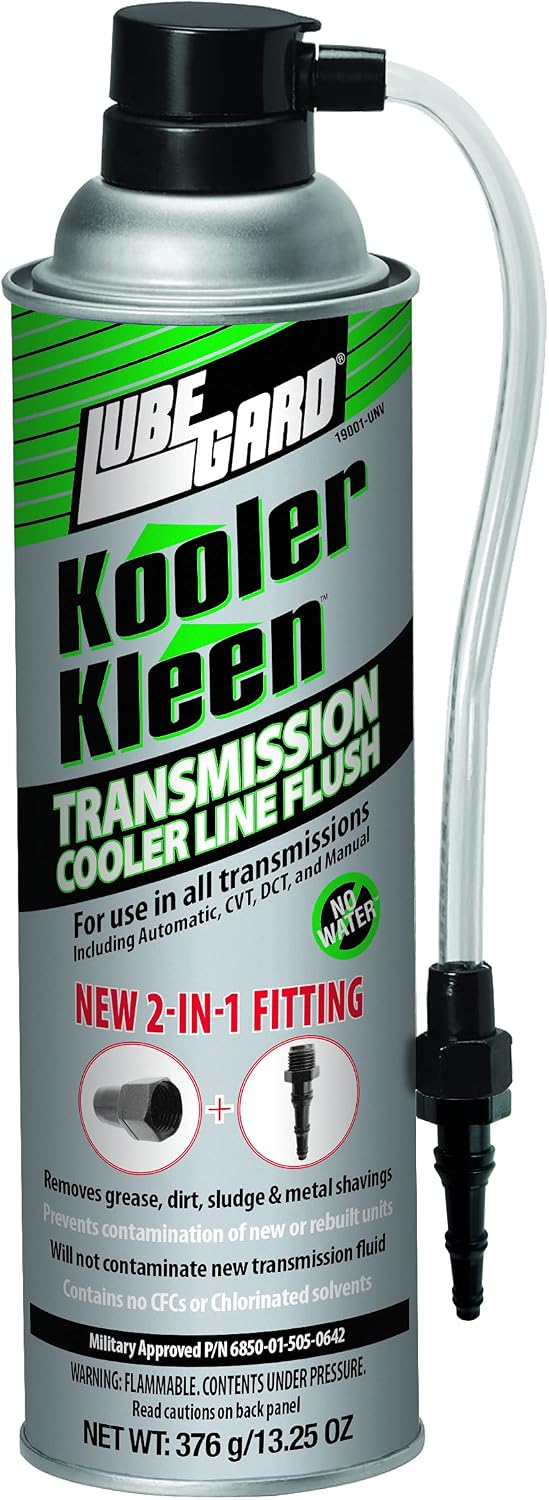
GM's dealer bulletin 17-NA-066 calls for the J-45096 TransFlow machine to flush and flow test the cooler and the cooler pipes, including any auxiliary cooler, after a transmission is removed for repair. The bulletin covers 2010 and later GM vehicles, but the reasoning applies to a TH400: whatever came out of the failed unit is now sitting in the cooler tubes, and it will go straight back into the lube circuit of the new or rebuilt transmission.
The GM procedure, as published in GM-based service information:
- Inspect the lines for damage or kinks first.
- Back flush for 30 seconds against normal flow, then forward flush for 30 seconds in the normal direction.
- Flow test for 15 seconds and compare to a minimum flow rate that depends on fluid temperature and cooler material. A magnet at the cooler flange tells you steel or aluminum.
- If the flow is below minimum, repeat the back and forward flush and retest. If it is still low, replace the cooler.
GM's minimum flow table runs from 0.6 GPM (steel) and 0.5 GPM (aluminum) with 65°F fluid up to 1.8 and 1.7 GPM at 118-120°F; at 75°F it is 0.8 GPM for a steel cooler. Those numbers are for GM's machine on later vehicles, not a TH400 specification, but they are a useful yardstick for a shop doing a timed-flow check with a container. A TH400 cooler that can only dribble well under 0.5 GPM with clean fluid is restricted.
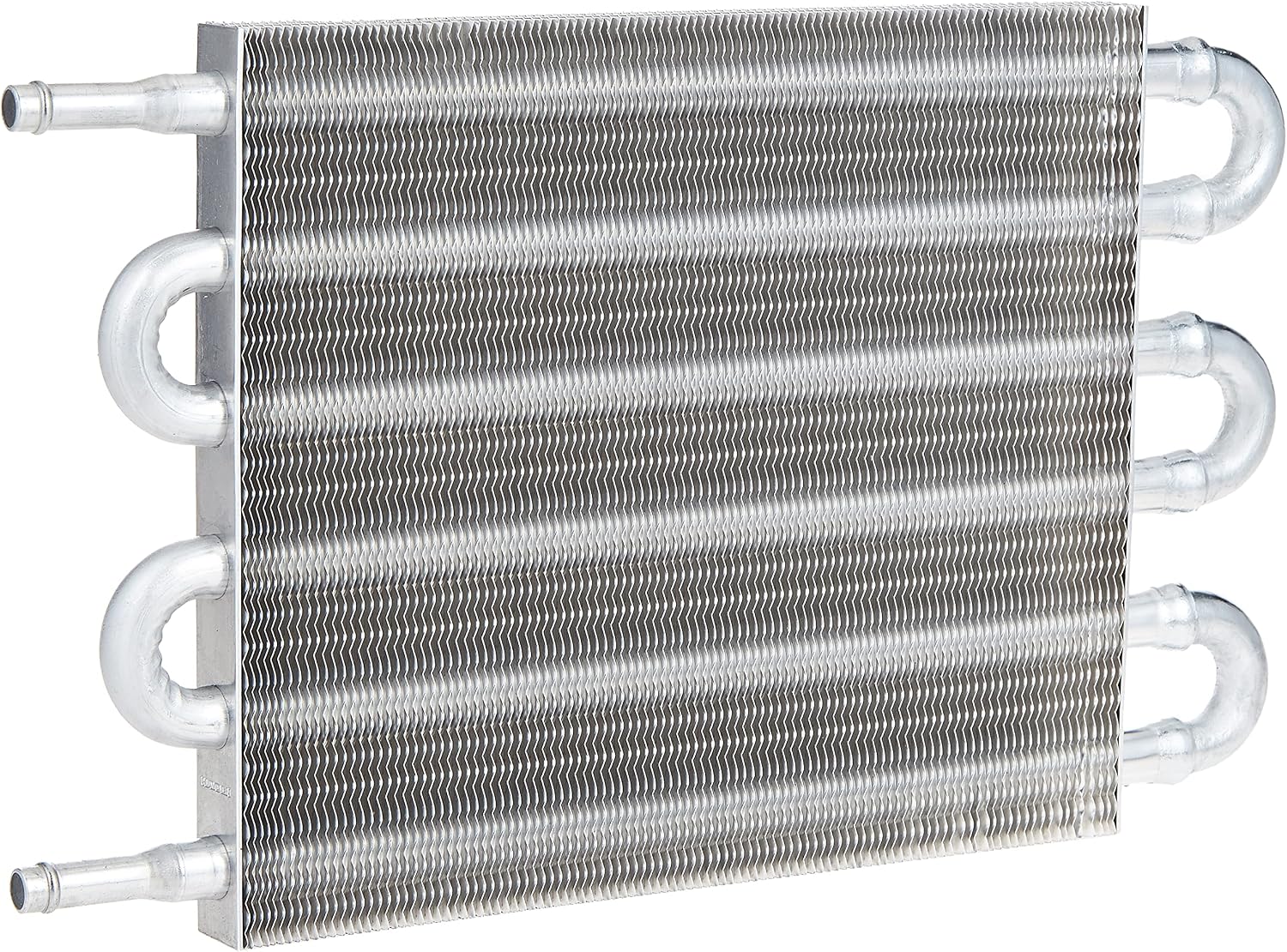
If the radiator cooler is full of clutch material or metal, it is often cheaper and safer to bypass it for an auxiliary cooler or replace the radiator. A plate or tube-and-fin cooler in the return line also adds capacity for towing. For temperature targets and why heat kills a TH400, see TH400 overheating prevention.
Fluid for the Refill
Replacing lines loses some fluid from the lines and cooler, so expect to top off after the first run. Use a GM-licensed DEXRON-VI. Valvoline's DEXRON-VI product information sheet states the GM-licensed fluid is back-serviceable wherever DEXRON-II or DEXRON-III is recommended, which covers the TH400. Capacities and fill procedure are in TH400 fluid type and capacity. If the fluid is dark and smells burnt, the line repair is a good time to do a pan drop and filter as well; see the TH400 filter and pan service guide.
FAQ
What size are TH400 cooler line fittings?
GM's TH400 specification table lists both cooler connectors, at the case and at the radiator, as 1/4-18 pipe thread. Aftermarket adapters are sold in both tapered NPT and straight NPS or NPSM forms, so match the adapter to the threads actually in your case.
What is the torque for TH400 cooler line connectors?
The 1975 Buick TH400 specifications list 11 lb-ft for the cooler connector to the case and 20 lb-ft for the cooler connector to the radiator. The case is aluminum and the threads are tapered, so overtightening can crack the boss; a connector that leaks at spec needs new threads or a new connector.
Can I use rubber hose to repair a TH400 cooler line?
Yes, if it is hose made for transmission coolers. Look for SAE J1532 printed on the hose; the standard defines Type A for original equipment or replacement use and Type B for aftermarket auxiliary coolers. Fuel or heater hose is not rated for hot ATF and will crack.
Do I need to flush the cooler when replacing a TH400?
Yes. GM bulletin 17-NA-066 requires a flush and flow test of the cooler and cooler pipes after a transmission is removed for repair. If flow is still below minimum after a second flush, GM's procedure is to replace the cooler, because debris left in it goes straight back into the lube circuit.
TH400 seal kits, pan gaskets, filters, cooler hose and coolers for doing the line job right the first time — shipped fast from the USA.
Shop TH400 parts →Sources
- General Motors — 1975 Buick Service Manual, Section 7D: Turbo Hydra-Matic 400 Transmission. Backs the pump body and pump cover passage labels (converter, line, cooler, cooler return), the removal step for loosening cooler line nuts and the crossmember note, the bolt torque table (cooler connector to case 1/4-18 at 11 lb-ft, cooler connector to radiator 1/4-18 at 20 lb-ft, line pressure take-off 1/8-27 at 10-15 lb-ft, pan 12 lb-ft), and the fluid level check procedure. teambuick.com (GM PDF)
- General Motors Service Bulletin 17-NA-066 (December 2018), Automatic Transmission Oil Cooler Flush and Flow Test. Backs the requirement to flush and flow test the cooler and cooler pipes with J-45096 after a transmission is removed for repair, and its use for units subject to potential overheating or lack of lubrication. static.nhtsa.gov (GM bulletin PDF)
- GM-based service information (Saab 9-4X 2011, 6T70/6T75) — Transmission Fluid Cooler Flushing and Flow Test. Backs the warning that plugged or restricted coolers and lines cause poor lubrication and high temperatures, the line inspection step, the 30-second back and forward flush, 15-second flow test, the steel versus aluminum minimum flow table (0.6/0.5 GPM at 65°F to 1.8/1.7 GPM at 118-120°F), and the replace-cooler-if-still-low rule. saabwisonline.com
- SAE International — J1532 Transmission Oil Cooler Hose. Backs the hose standard and its Type A (original equipment or replacement) and Type B (aftermarket auxiliary cooler) designations; earlier revisions define the 125°C and 150°C classes and 1.7 MPa / 1.0 MPa maximum working pressures. saemobilus.sae.org
- Valvoline — DEXRON-VI ATF Product Information Sheet. Backs GM licensing of the fluid and its back-serviceability wherever DEXRON-II or DEXRON-III is recommended. go.lupinsys.com (Valvoline PDF)