A Turbo 400 that won't go anywhere is usually an easier diagnosis than one that slips. Because the TH400 is fully hydraulic, with a vacuum modulator, governor and valve body and no computer, a true no-movement complaint can only come from a few places. The pump isn't making pressure. The pressure isn't reaching the forward clutch. Something mechanical between the converter and the output shaft isn't transmitting torque. The job is finding out which one before you pull the transmission.
This guide follows the order in GM's own TH400 service manuals. All specs come from the factory books, linked at the bottom.

Split the Complaint First: Which Ranges Are Dead?
Before you touch a wrench, move the selector through every position with the engine idling and your foot on the brake, and note which ranges engage. The TH400 shares components across ranges, so the pattern points straight at the failed part.
- Nothing in any range (D, L2, L1 and R all dead): no line pressure, or no input to the pump. Think fluid level, filter, pump, pump drive, or a broken connection between the engine and the converter.
- No D, L2 or L1, but Reverse works: the pump is fine, because Reverse needs the most pressure of any range. The forward clutch applies in every forward range, so it or its feed circuit is the suspect.
- No Drive (and no L2 first gear), but L1 pulls: the low roller clutch. In Drive first gear the roller clutch holds the reaction carrier. In L1 the low/reverse band holds it, so the truck moves even with the roller clutch broken.
- Forward gears fine, Reverse dead: that's a different problem. See our TH400 no reverse guide.
GM's 1975 TH400 trouble diagnosis chart lists six possible causes under "No Drive in Drive Range": low oil level, manual linkage adjustment, low oil pressure, the control valve assembly, the forward clutch, and the roller clutch assembly[1]. Every one of them fits into the split above.
Step 1: Fluid Level, Condition and the Modulator
GM's diagnosis sequence for the TH400 starts with checking and correcting the oil level, then the detent switch, the vacuum line and fittings, and the manual linkage. Only then do you install a pressure gauge and road test[1]. Don't skip ahead. A TH400 that is a few quarts low will pull air at the filter, and with the vehicle stationary it can act completely dead.
Check the level hot, in Park, on level ground. While the dipstick is out, look at the fluid itself. The 1975 manual notes that air bubbles in the oil indicate an air leak in the suction lines, which causes erratic operation and slippage. Water in the oil gives it a milky, pink cast[1]. Bubbly fluid with a correct level points you at the filter and its O-ring before anything else.
If the fluid is low and you can't find an external leak, suspect the vacuum modulator. GM's chart notes that a leaking modulator diaphragm will evacuate oil from the unit[1]. The engine draws ATF through the vacuum line and burns it. The factory check is simple: pull the modulator, turn it so the vacuum stem points down, and if transmission oil comes out, the diaphragm is bad[1]. ATF in the vacuum hose is the same tell.
The current fill is DEXRON-VI. Valvoline's product sheet for its licensed DEXRON-VI ATF states it is fully back-serviceable and can be used wherever DEXRON-II or DEXRON-III is specified[6], which covers every TH400 application. After a pan drop and filter change, GM's 1976 light truck supplement calls for approximately 7.5 US pints of fresh fluid to bring the level back to the mark[2]. Bring it to the dipstick and recheck hot. Don't pour in a fixed number of quarts.
Step 2: Manual Linkage and the Manual Valve
On a column-shift truck or any swap with an aftermarket shifter, rule out linkage before you condemn the transmission. If the outer manual lever moves but the selector detents inside don't line up with the quadrant, the manual valve may be sitting between ranges. Disconnect the linkage at the transmission and move the manual lever by hand through its detents. If the truck drives when you select ranges directly at the case, the fault is outside the transmission.
GM's chart also lists the manual valve disconnected from the manual lever as the control valve assembly cause of no drive[1]. That one happens after a valve body job where the manual valve link wasn't re-engaged. If the transmission has just had pan-down work and now won't move, check this first. The factory torque for the manual shaft to inside detent lever is 18 ft-lb, and the manual lever to manual shaft nut is 8 ft-lb[2]. A loose detent lever nut can let the inner lever slip on the shaft.
Step 3: Put a Gauge on It
A pressure gauge on the line tap turns this from guesswork into a diagnosis. Sonnax TASC Force member Jeff Parlee makes the point in Transmission Digest that a gauge checks pump capability, line rise, pressure regulator operation, and minimum and maximum line pressure. He adds that you can even see a cracked filter neck on a gauge without pulling the pan[3].
The factory numbers
From the 1975 GM TH400 pressure check, with the vacuum line connected, brakes holding, and the engine at 1000 rpm[1]:
- Drive, Neutral, Park: 60-90 psi
- L1 or L2: 150 psi
- Reverse: 95-150 psi
With the vacuum line disconnected and the engine at 1200 rpm, the same manual lists about 150 psi in Drive, 150 psi in L1/L2, and 244 psi in Reverse at sea level. Those figures drop with altitude: about 138 psi in Drive and 212 psi in Reverse at 6,000 feet[1]. The line pressure tap plug goes back in at 13 ft-lb[2].
Reading the result
Near zero in every range: the pump isn't picking up oil or isn't turning. GM's low-pressure causes are a filter O-ring that is missing or damaged, a leaking filter neck weld, a blocked filter, porosity in the case intake bore, a stuck pressure regulator, or pump drive gear tangs damaged by the converter[1]. That last one matters. If the converter wasn't fully seated on the pump drive gear when the transmission went in, the converter hub tangs can chew up the gear. You get a transmission that worked on the stand and is dead in the truck.
Good pressure, no forward ranges: the pump is doing its job, so the leak is downstream in the forward clutch circuit. Parlee explains why a line gauge can look almost normal here. Most clutch circuits are fed through an orifice, and if a piston seal is cut, the leak can be larger than the orifice can supply. The clutch never applies, but line pressure drops only slightly[3].
High, erratic pressure: this isn't a no-drive cause by itself, but it tells you about the pump. Sonnax documents that on high-mileage TH400 and TH425 units the steel pressure regulator valve wears its cast-iron bore. Balance oil then leaks to the sump, leaving high and uncontrollable line pressure, delayed converter charge, and poor Reverse engagement[4]. If the pump is coming out anyway, fix that bore while it's on the bench.
For gauge hookup and range-by-range readings, see our TH400 line pressure testing guide.
Step 4: The Pan-Down Checks
If pressure is low across the board, drop the pan before you pull the transmission. Look at the filter O-ring first. It is the single most common cause of a dead TH400 after a service. It can roll, tear, or stay stuck in the case bore when the old filter comes out, leaving the new filter's neck sealing on nothing. Check that the filter neck weld isn't cracked, and look at what is in the pan. Fine gray paste is normal wear. Friction material, brass, or steel chunks mean the transmission is coming out regardless.
Factory torques when it goes back together: strainer retainer bolt 10 ft-lb, control valve body bolts 8 ft-lb, bottom pan screws 12 ft-lb[2].
Step 5: Forward Clutch and Roller Clutch Failures (Unit Out)
Forward clutch won't apply
GM breaks the forward clutch cause into specifics[1]:
- Forward clutch piston cracked, seals missing or damaged, or clutch plates burned
- Oil seal rings missing or broken on the pump cover. These rings feed the forward clutch
- A leak in the feed circuits, or a mispositioned or damaged pump-to-case gasket
- Forward clutch drum ball check stuck or missing
The pump cover sealing rings deserve a close look on any unit that has been apart before. A broken scarf-cut ring or a worn ring groove on the stator support bleeds off forward clutch apply oil, and the symptom is often a delayed engagement that gets worse as the fluid heats up and eventually turns into no drive. Our TH400 delayed engagement guide covers that early stage.
When the pump is out, look at the thrust surfaces as well. GEARS magazine (ATRA) calculates that with about 60 psi of converter charge pressure, the forward clutch housing on a 400 sees about 47 lb of rearward thrust from charge oil and about 152 lb more from lube pressure, roughly 199 lb in total. That load is hard on the #22 thrust bearing and the output shaft-to-case washers[5].
Low roller clutch
If your range test showed no Drive but a good L1, the roller clutch in the reaction carrier is the part. GM lists the condition as a broken spring or damaged cage[1]. Inspect the outer race for scoring or wear, and check the rollers and springs for damage. Don't just reload new rollers into a worn race. Replace the race too, or the new rollers will fail in the same spot.
Pump and converter
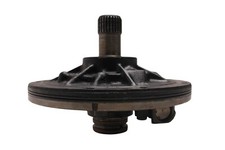
When the pump comes apart, GM's spec for pump body face to gear face clearance is 0.0008-0.0035 in[1]. Check the drive gear tangs for damage from the converter. Then check the converter. GM's procedure says that if converter end clearance is 0.050 in or more and the oil looks like it has been mixed with aluminum paint, replace the converter[1]. Torque the pump cover bolts and pump-to-case bolts to 18 ft-lb, and the converter-to-flexplate bolts to 35 ft-lb[2].
One last outside-the-case check on a dead-in-every-range unit: with the engine running, look through the inspection cover and confirm the converter is actually turning with the flexplate. A cracked flexplate or sheared converter bolts make a healthy transmission look completely dead, and you can find that in thirty seconds.
Pump coming out?
TH400 pumps, master rebuild kits, filters, clutch drums and valve bodies are in stock and ship fast.
Shop TH400 parts →FAQ
Why won't my TH400 move in Drive or Reverse?
When a TH400 won't move in any range, the usual cause is low or zero line pressure, because every clutch and band needs pump pressure to apply. GM's diagnosis chart lists low fluid level, a missing or damaged filter O-ring, a cracked filter neck, a blocked filter, a stuck pressure regulator, and pump drive gear tangs damaged by the converter. Check fluid level and linkage first, then put a pressure gauge on the line tap before you pull anything.
What does it mean if my TH400 moves in Reverse but not Drive?
Reverse working proves the pump is making pressure. The forward clutch applies in every forward range, so no Drive, no L2 and no L1 with good Reverse points at the forward clutch or its feed circuit: a cracked piston, missing seals, burned plates, broken pump cover sealing rings, or a mispositioned pump-to-case gasket.
My TH400 moves in L1 but not Drive. What failed?
That points at the low roller clutch. In Drive first gear, the roller clutch holds the reaction carrier. In L1, the low/reverse band holds it instead, so the truck still pulls. GM's chart lists a broken spring or damaged cage in the roller clutch assembly as the cause of no drive in Drive range.
What should TH400 line pressure be at idle?
GM's 1975 TH400 spec, with the vacuum line connected, brakes holding, and the engine at 1000 rpm, is about 60-90 psi in Drive, Neutral and Park, 150 psi in L1 or L2, and 95-150 psi in Reverse. A reading near zero in every range means the pump is not picking up oil or not being driven.
Can a bad vacuum modulator cause no movement?
It can, indirectly. GM notes that a leaking modulator diaphragm can evacuate transmission oil into the engine, and low fluid level is the first cause on the no-drive chart. Pull the vacuum hose off the modulator. Any ATF in the hose or on the stem means the diaphragm is leaking, and you should replace it before refilling.
Sources
- GM / Buick — 1975 Buick Chassis Service Manual, Section 7D, Turbo Hydra-Matic 400. Backs the "No Drive in Drive Range" cause list (filter O-ring, filter neck weld, case intake porosity, pressure regulator, pump drive gear tangs, manual valve, forward clutch piston/seals/sealing rings/gasket/ball check, roller clutch spring and cage), the diagnosis sequence, the oil condition notes, the modulator diaphragm test, the line pressure tables, the 0.0008-0.0035 in pump gear clearance, and the 0.050 in converter end clearance limit. teambuick.com
- GM / Chevrolet — 1976 Light Duty Truck Service and Overhaul Supplement (ST-330-76), Turbo Hydra-Matic 400/475. Backs the 7.5 pint refill after pan drop and the torque specs: pump cover and pump-to-case 18 ft-lb, valve body 8 ft-lb, pan 12 ft-lb, strainer retainer 10 ft-lb, line pressure plug 13 ft-lb, manual shaft and lever, and converter-to-flywheel 35 ft-lb. 73-87chevytrucks.com
- Transmission Digest — "Diagnosis with Pressure Gauges," Jeff Parlee, Sonnax TASC Force. Backs the use of a pressure gauge to check pump capability and regulator operation, spotting a cracked filter neck on a gauge, and why a cut clutch seal behind a feed orifice shows almost no drop on the line gauge. transmissiondigest.com
- Sonnax — TH400/TH425 Pressure Regulator Valve Kit 34910-03K. Backs the pressure regulator bore wear mechanism and its high, uncontrollable line pressure, delayed converter charge, and poor Reverse symptoms. sonnax.com
- GEARS Magazine (ATRA) — "Improve Your 400 and 4L80 Rebuilds." Backs the forward clutch housing thrust figures (about 47 lb from converter charge plus about 152 lb from lube, about 199 lb in total) and their effect on the #22 thrust bearing. gearsmagazine.com
- Valvoline — DEXRON-VI ATF Product Information Sheet. Backs that licensed DEXRON-VI is back-serviceable wherever DEXRON-II or DEXRON-III is specified. valvoline.com