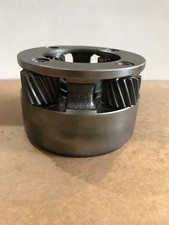
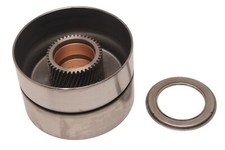
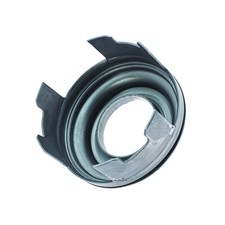
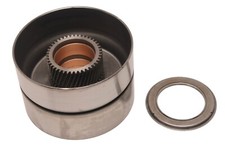
If your 1990s Buick LeSabre, Park Avenue or Regal, Oldsmobile 88, Pontiac Bonneville or Grand Prix, or Chevrolet Lumina with the 4T60E has started to whine louder as road speed climbs, has lost a gear outright, or showed glittering steel on the pan magnet at the last service, the gear train is the place to look. This is a remanufactured GM planetary carrier for the 4T60E. The listing photo shows a carrier with helical pinion gears riding inside its shell, the kind of hard part that gets replaced when a pinion bearing goes rough or a carrier is scored and blued from running low on oil.
What the planetary does in a 4T60E
The 4T60E is GM's electronically shifted four-speed transaxle for transverse V6 cars. Engine torque reaches it through the converter and a drive chain, then passes into two planetary gearsets, called the input and reaction sets, before a third planetary set in the final drive multiplies torque into the differential. Each carrier holds pinion gears on steel pins with needle bearings. The clutches and bands hold or drive a sun gear, ring gear or carrier, and that combination is what makes first through fourth. When pinion needles wear, the gears tip on their pins, mesh poorly and start to sing; when they fail outright the pinion can lock or shed teeth, and the transaxle loses whatever gears depend on that set.
Symptoms of a worn 4T60E planetary
- A whine or howl that tracks vehicle speed rather than engine rpm, often worse in one gear
- Loss of one or more gears while the others still pull normally
- Fine steel or larger metal chunks on the pan magnet and in the filter
- A clunk on engagement or under load when pinion end play is excessive
- Blue or black heat discoloration on the carrier after a low-fluid or overheat event
How to confirm before you buy
Noise diagnosis comes first. A planetary whine changes with road speed and gear, while a pump whine follows engine rpm in Park and Neutral, and a wheel bearing hums with no change when you shift. Pull the pan: clutch material points to slipping packs, while bright steel points to bearings and gears. Once the unit is apart, spin each pinion by hand. Any roughness, side play on the pin or chipped teeth condemns the carrier. Our 4T65E common problems guide covers the same gear-train checks, because the 4T65E grew directly out of this transaxle, and the delayed engagement guide helps separate a pressure problem from a mechanical one.
Fitment
This listing is a GM remanufactured part for the 4T60E with no single model year attached. The 4T60E ran through several running changes in the 1990s, and the input, reaction and final drive carriers are different parts with different pinion counts and splines. Lay your old carrier next to the photo and match the pinion count, spline count and overall height before you order, or send us your year and VIN and we will check it. GM began replacing the 4T60E with the 4T65E in 1997, so a late-1990s car can have either unit; read the tag on the case. For a 1995 transaxle, compare against our used 1995 4T60E planetary as well. Everything for this family is on the 4T60E and 4T65E parts page.
Install notes
- Replace the thrust washers and needle bearings on both faces of the carrier; a new carrier on worn bearings will not stay quiet.
- Flush or replace the cooler and lines after any metal failure, or debris returns to the new gears.
- Check total input clutch housing end play. Sonnax gives 0.005 to 0.020 inch including gasket crush, and notes the torqued case gasket alone adds 0.005 to 0.008 inch.
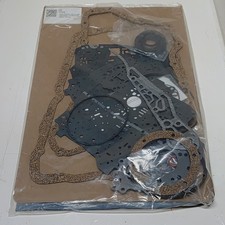
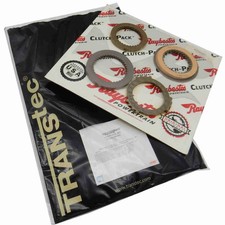
- A 4T60E banner rebuild kit supplies the seals, gaskets and frictions that a gear-train job opens up anyway, and the filter and pan gasket kit finishes the reseal.
- Fill with Dexron VI, which is back-serviceable into older Dexron transaxles, and set the level hot.