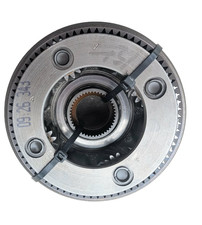
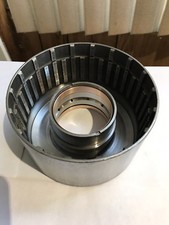
The 1997 model year was the first for GM's 4T65E, and it went first into cars with the supercharged 3.8 plus some 3.4 and naturally aspirated 3.8 applications. If a first-year Pontiac Grand Prix, Buick Regal, Park Avenue or similar front-drive GM car with that transaxle is now howling at cruise, has dropped a gear, or turned up chunks of steel in the pan, a planetary carrier is a likely casualty. This is a used original-equipment 4T65E carrier for 1997. The listing photo shows the carrier face with four pinion pins and a stamped date code, so you are getting a factory GM part, not an aftermarket copy.
What the planetary does in a 4T65E
Transmission Digest describes the 4T65E as the big brother of the 4T60E, and its power flow follows the same plan. The converter turns a drive chain, the chain turns the input shaft, and the shaft feeds an input planetary set and a reaction planetary set whose sun gears, carriers and ring gears are held or driven by the clutches and bands to produce four ratios. A final drive planetary then multiplies torque into the differential. The carriers are the parts that carry the load: each pinion gear spins on a hardened pin and a set of needle rollers, and every shift loads those needles in a new direction. On the supercharged cars this unit was built for, the gear train sees more torque than the 4T60E ever did, which makes pinion needles and thrust surfaces the wear points to watch.
Symptoms of a failing 4T65E planetary
- Whine that rises and falls with road speed and changes pitch with each upshift
- One gear missing while the rest still pull, or no drive at all after a pinion fails
- Steel glitter or chipped gear fragments on the pan magnet
- Clunk or bind when the throttle is applied and released
- A growl that stays with the car in every gear, pointing at the final drive set rather than the input or reaction carrier
How to confirm before you buy
Rule out the cheap causes first. Check the fluid level and smell, then drop the pan and read the magnet: friction material says clutches, bright steel says bearings and gears. Road test in each gear and note whether the noise follows road speed. Our 4T65E common problems guide walks through the slip and pressure checks, and the speed sensor symptoms guide helps when the computer is logging ratio errors alongside the noise. With the unit apart, spin every pinion; roughness, rocking on the pin or chipped teeth mean the carrier is done.
Fitment
This carrier is listed for the 1997 4T65E. GM made running changes to this transaxle over its life, including heavier-duty versions behind the supercharged engines and an all-wheel-drive version in the 3.4 Montana from 1999, so later carriers are not automatically interchangeable. Compare pinion count, spline count and height with your old part, read the transaxle ID tag, or send us your year and VIN and we will match it. A newer-year carrier is listed as our 4T65E planetary, and the full catalog for this family is on the 4T65E parts page.
Install notes
- Replace the thrust bearings and washers on both sides of the carrier, and inspect the sun gear bushings for scoring.
- Set final drive differential end play. Transmission Digest gives 0.005 to 0.025 inch on the front-drive 4T65E, adjusted with one of ten selective thrust washers from 0.055 to 0.095 inch.
- Check input clutch housing end play at 0.005 to 0.020 inch per the Sonnax procedure.
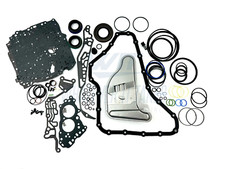
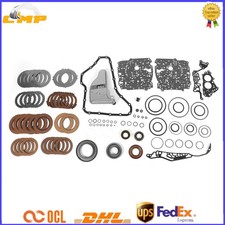
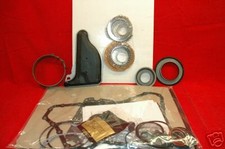
- A 1997 4T65E master rebuild kit covers the seals and frictions, and a used part on a first-year unit is the time to inspect the 4T65E sprag clutch as well.
- Flush the cooler and lines after any metal failure, then refill with Dexron VI and check the level hot.