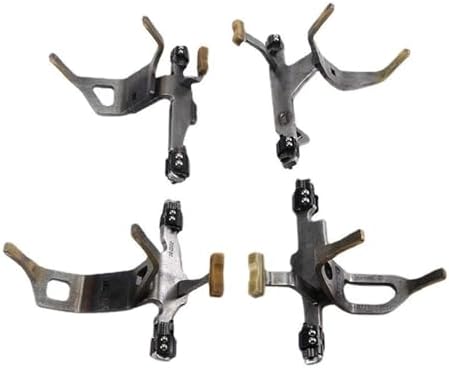
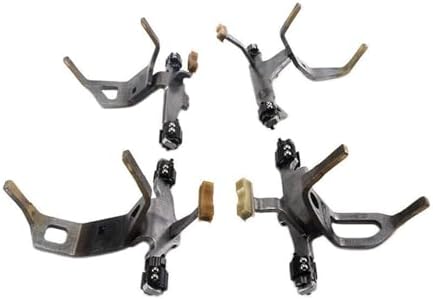
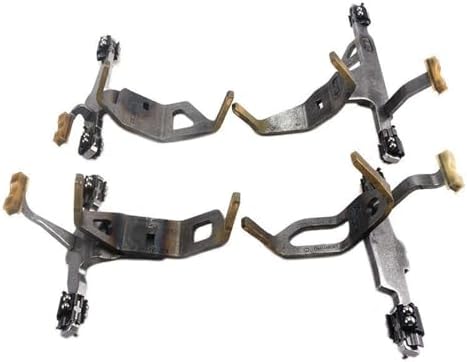
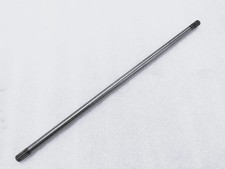
A six-speed DSG that suddenly drops a gear, refuses 2nd and 4th, or limps along on only half its gears is not always a mechatronic or clutch failure. Inside the gearbox, four selector forks move the gear sleeves, and when a fork, its bearing carriers or its slide pads wear, the gearbox cannot engage or hold a gear reliably. This is a complete set of all four gear shift forks for the 02E, also called the DQ250, the wet dual-clutch DSG used in VW Golf, GTI, Jetta, Passat and Audi A3 and TT models.
What the selector forks do in a DQ250
Volkswagen's Self-Study Program 308 explains that the 02E selects gears with forks, just like a manual gearbox, but moves them hydraulically instead of with rods. Each fork runs on ball bearings inside a cylinder. The mechatronic unit feeds oil to one side of the cylinder, the fork slides, and its locking collar engages the gear; the fork then returns to a no-pressure position and a detent holds the gear in place. Each fork handles two gears. VW lists them by their travel sensors: G487 for 1st/3rd, G488 for 2nd/4th, G489 for 6th/reverse and G490 for 5th/neutral.
Each fork also carries a permanent magnet. The Hall-type travel sensors in the mechatronic read those magnets to know exactly where every fork sits. That is why a worn or damaged fork often shows up as a sensor or gear actuator fault rather than an obvious mechanical noise.
Symptoms of worn or damaged shift forks
- Gear jumps out under load or on overrun
- One pair of gears missing, such as no 2nd and 4th, or no 6th and reverse
- Grinding or clunk as a gear is selected
- Stored faults for gear actuator travel or position on one of the four travel sensors
- Gearbox drops into limp mode on one half of the transmission
SSP 308 notes that if one travel sensor loses its signal, the control unit isolates that half of the gearbox and those gears can no longer be engaged, so a missing-gears complaint narrows the search to one fork and its sensor.
How to confirm it before buying
Start with a full scan and note which gear pair the fault code names. Check fluid level and condition, then measure pressure, since low line pressure can also stop a fork from moving; our DSG pressure testing guide walks through it. Rule out mechatronic faults, which the DQ250 mechatronic and clutch problems guide covers. If the mechatronic tests good and a gear still pops out or will not hold, remove the mechatronic and check fork travel, the magnets, the ball bearing carriers and the brass slide pads for wear or chipping.
Fitment
These forks fit the 02E / DQ250 six-speed wet-clutch DSG in 6-speed DSG versions of the VW Golf, GTI, Jetta, Jetta SportWagen, Passat, Eos, Beetle and Scirocco, the Audi A3, TT and Q3, and Seat and Skoda models with the same gearbox. They do not fit the 7-speed DQ200 (0AM) dry-clutch box or the DQ381. If your car has the DQ200, its clutch release parts are a different kit, the DQ200 clutch release lever kit. Check the gearbox code on the case or build sticker, or send us your year and VIN. The full range is on the DSG collection page.
Install notes
- The gearbox has to come out and the case must be split to reach the forks, so plan this as part of a full teardown.
- Inspect the gear sleeves and the locking teeth they engage; a fork that has been popping out often damages the sleeve chamfers too.
- Look at the oil pump and internal parts while the case is apart; the DQ250 pump is worth checking at this stage.
- Refill with VW G 052 182 DSG fluid or an equivalent that meets it, and replace the filter.
- Run the gear actuator and clutch basic settings with a capable scan tool after assembly so the mechatronic relearns each fork's end positions.