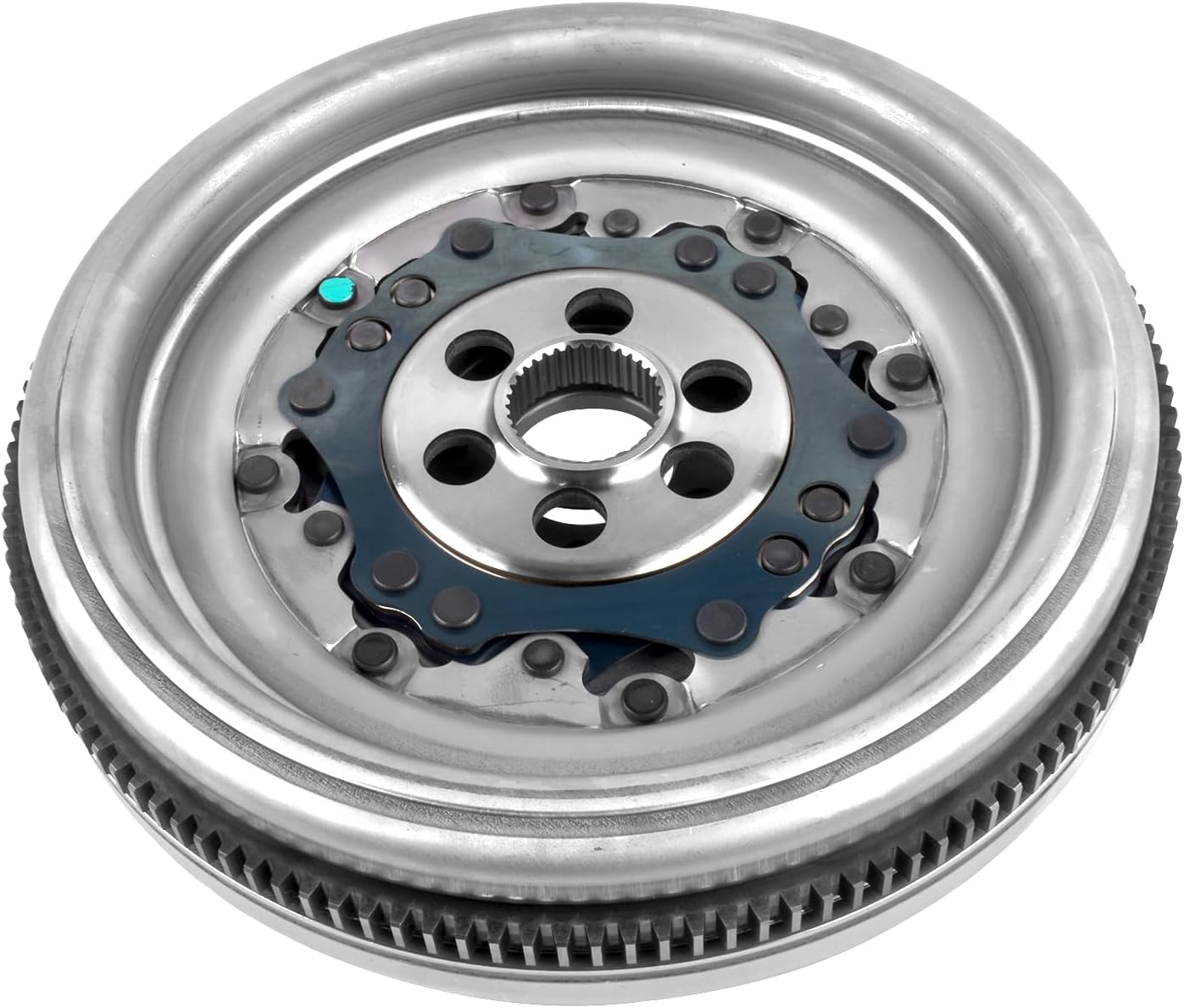
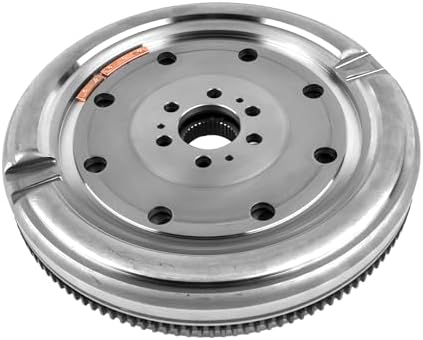
A rattle at idle that changes when you load the engine, a clunk when you switch the car off, or a buzz through the floor at low rpm on a DSG Jetta, Golf, Beetle or A3 is often blamed on the gearbox, when the part that has actually worn out is the dual mass flywheel in front of it. This is a replacement dual mass flywheel for the six-speed DSG (DQ250) behind the 2.0L engine, cross-referenced to DMF126 and 415074009 and to a long list of OE numbers in the 03G105266 and 03L105266 series.
What the dual mass flywheel does on a DQ250
A DSG car has no clutch pedal and no friction face on the flywheel. Volkswagen's training manual for the 02E describes the torque path: torque goes from the crankshaft into the dual mass flywheel, and the flywheel's splines drive the input hub of the double clutch, which feeds the two wet multi-plate clutches inside the gearbox. The flywheel itself is two masses joined by a spring pack. The primary mass bolts to the crank, the secondary mass drives the gearbox, and the springs absorb the firing pulses so they are not hammered into the clutches and gear sets. Those springs and their guides are what wear, and once they do, the engine's pulses come through as noise and vibration.
Symptoms of a worn DSG flywheel
- Rattle or growl at idle in Park or Neutral that changes with A/C or electrical load
- Clunk or shake at engine shutdown
- Vibration through the floor around 1,200 to 1,800 rpm
- Low-speed shudder on engagement that persists after a fluid service and clutch adaptation
- Worn or rusted splines where the flywheel meets the double clutch input hub
How to confirm it before you buy
Rule out the gearbox side first. Scan the transmission module, and if the complaint is shudder rather than noise, do the fluid service and clutch adaptation before pulling anything; our DQ250 mechatronic and clutch guide explains how to tell clutch and mechatronic shudder apart, and the DSG overheating guide covers heat-related judder. Idle rattle that changes with load, plus a shutdown clunk, points at the flywheel. With the gearbox out, check the free rotational play and rocking between the two masses and look at the springs through the windows; excessive play or a dry, noisy spring pack confirms it.
Fitment
The listing covers the six-speed DSG with the 2.0L engine in 2009-2010 Volkswagen Jetta, 2010-2013 Golf, 2013-2015 Beetle and 2010-2013 Audi A3. These cars used several flywheel part numbers depending on engine and build date, and most numbers on this cross-reference come from the 2.0 TDI diesel flywheel family, so a 2.0T gasoline GTI or GLI may use a different part. Read the number stamped on the flywheel you remove and match it to the OE list (03G105266BD, CH, BK, CJ, CP, CS, Q, AR and 03L105266AE, AF, DC, DD, EH, EJ), or send us the year and VIN. A separate flywheel is listed for the 1.9 TDI cars; see the 02E DSG flywheel for the 1.9 TDI Jetta. The full range is on the DSG collection page.
Install notes
- The gearbox has to come out, so replace the flywheel whenever the DSG is out for clutch or rear main seal work.
- Use new flywheel bolts and tighten them in the factory sequence and stages; the old stretch bolts are one-use.
- Clean the crankshaft flange, check the rear main seal while the flywheel is off, and inspect the double clutch input hub splines that engage the flywheel.
- Do not resurface a dual mass flywheel; there is no friction face on a DSG unit.
- After the gearbox goes back in, set the DSG fluid level and run the clutch adaptation. The 02E external filter and gasket kit is worth fitting while the car is apart.