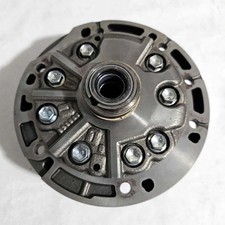
A Toyota Corolla or Auris with a K-series CVT that whines with engine speed, takes a beat to pick up Drive or Reverse, or flares and slips once it is warm may not need a belt or a whole transmission. If the pressure that clamps the belt is falling short, the oil pump is the place to look. This is a remanufactured oil pump assembly for the K310 family, listed with a K313 reference, ready to bolt into a unit that is otherwise worth saving.
What the oil pump does in a K310 CVT
A belt CVT lives or dies on hydraulic pressure. The K310 family sets its ratio with two pulleys whose halves are squeezed together by oil pressure, and a steel belt runs between them. The oil pump at the front of the case is turned directly by the torque converter. In the K313, Transmission Digest notes that the converter neck uses a double-ear drive that indexes into the inner pump gear, so every engine revolution turns the pump. That flow becomes line pressure for the primary and secondary pulleys, for the forward clutch and reverse brake that pick direction, for converter lockup, and for lube to the belt. When the gears, bushing or housing wear, internal leakage rises and the pump cannot hold pressure at low engine speed or when the oil is hot and thin. The computer can only command pressure; it cannot make a tired pump produce it.
Symptoms of a worn K310 or K313 pump
- Whine that rises and falls with engine RPM, present in Park and Neutral as well as Drive
- Delayed engagement into Drive or Reverse, worst after the car is fully warm
- Engine flare or belt slip on takeoff or under load, with RPM climbing faster than road speed
- Shudder or a soft, slow-to-respond feel that gets worse as fluid temperature rises
- A leaking front seal, or seal material burned onto the converter neck after a severe overheat
- Limp mode with pressure or ratio related codes once the computer sees the pulleys are not keeping up
How to confirm before you buy
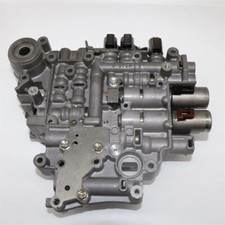
Check the fluid level the correct way, hot and with the engine running, and look at the condition. Dark, burnt fluid and a pan full of fine metal means the belt and pulleys have already been hurt and a pump alone will not save it. On the K313, the secondary pulley pressure sensor on the rear cover can be read with a capable scan tool, which gives you a real number instead of a guess. Low pressure at idle that recovers with RPM points at the pump; normal pressure with slipping points elsewhere. Our CVT slipping under load guide and CVT limp mode guide walk through both cases, including when a solenoid or the K310 valve body is the real problem.
Fitment
This pump is listed for the K310 with a K313 reference. The K310/K311 series went into production in September 2006 behind 1.5L and 1.8L engines in models such as the Corolla, Corolla Axio, Auris, Allion, Premio and Wish. In North America the CVT Corolla arrived for 2014 with the 1.8L and the K313. Pump details changed across these versions, so compare the transmission code on the case tag and the casting and bolt pattern of your old pump with the photo before you order, or send us your year and VIN and we will check it. Browse every unit we support on our CVT parts page.
Install notes
- Fit a new front seal and pump O-ring, and lube the seal lip before the converter goes in.
- Inspect the converter neck: worn or chipped drive ears, scoring, or melted seal material mean the converter needs attention, or the new pump will not last.
- When installing the converter, rotate it until the drive ears drop into the inner pump gear and the converter is fully seated before the transmission meets the engine. Never use the bell housing bolts to pull it in.
- Torque the pump bolts evenly in a cross pattern and check that the input turns freely.
- Fill with the Toyota CVT fluid specified for your unit. Transmission Digest lists the K313 at nearly 8 quarts of Toyota CVT Fluid FE; earlier K310/K311 units call for CVT Fluid TC. Set the level hot using the level check plug in the pan.
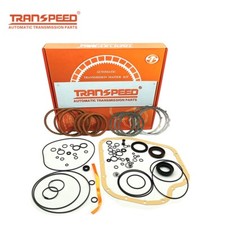
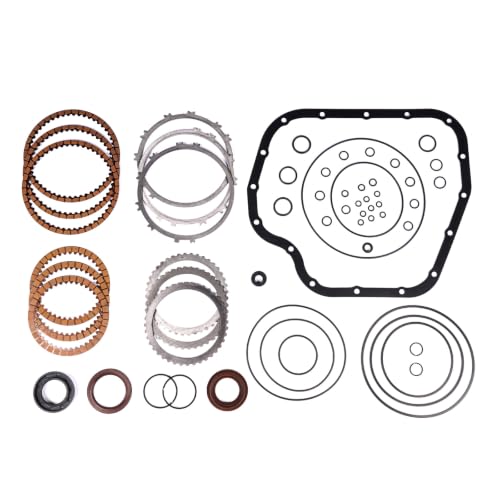
If the unit is coming apart anyway, reseal it with the K310 overhaul kit at the same time, and if the forward clutch or reverse brake is worn, the K310 master rebuild kit adds frictions and steels.