A 46RE with 150,000 miles on it is not a lost cause. The hard parts in this family hold up well; ATRA's GEARS Magazine puts it plainly that the RE hard parts "seem to stand up to heavy abuse" and that the common weak spot is the valve body, not the gear train. What kills high-mileage 46REs is neglect that stacks up: varnished fluid, bands that have never been adjusted, a cooler that has been half plugged since the last failure, and a governor pressure circuit that has been drifting for years.
This is the checklist we run on a high-mileage 46RE in a Ram, Durango, Dakota or Grand Cherokee before deciding whether it gets a service or a rebuild. It is ordered the way the work flows in the bay: road test and scan data first, fluid and pan second, bands and adjustments third, cooler last. Every number below comes from factory data or a recognized transmission authority, listed at the bottom.

Step 1: Road Test With a Scan Tool and a Gauge
Do not drop the pan on a high-mileage unit until you know how it drives. A fresh filter and new fluid can change shift feel enough to hide the symptom you needed to see.
The first three gears of a 46RE are still hydraulically shifted. Dave Skora's ATRA troubleshooting article says it directly: governor pressure strokes the shift valves, just like the old three-speeds. The electronics only create that governor pressure through a duty-cycled solenoid. So the core health check is governor pressure:
- Governor pressure should read zero at a stop and rise about 1 psi per mph up to roughly 40 mph. Above about 40 mph the system routes line pressure to the governor port, so it stops tracking road speed (ATRA GEARS, Oct. 2006).
- Compare three numbers on the road: Governor Desired (the PCM's command), Governor Actual (the transducer signal) and your gauge on the governor pressure port. All three should match. If they do and the shifts are still wrong, the problem is mechanical: sticking shift valves or burnt clutches.
- Transducer voltage on 1996-2003 gas RWD trucks is on PCM pin B29: about 0.60-0.66 V at zero psi, about 3.0 V at 60 psi and about 4.5 V at 110 psi, with a 5 V reference on pin B31.
- Watch Actual at wide-open throttle in 3rd or 4th. Skora flags anything over 105 psi as excessive line pressure or a bad transducer.
- Transmission temperature should climb as the truck warms. Early units use an NTC thermistor; some 1999-up vehicles switched to a PTC sensor. A reading that starts hot and cools off as you drive usually means someone installed the wrong sensor.
- Output shaft speed should read 0 mph when stopped. Any noise on the OSS circuit makes the PCM think the truck is moving and commands governor pressure at a stop, which shows up as third-gear starts.
Note what the converter clutch is doing too. Slip, shudder on apply or a lockup that comes and goes points at the cooler and converter circuit covered in Step 5, and at the valve body wear in Step 4.
Step 2: Read the Fluid Before You Change It
Check the level hot, engine running, selector in Neutral. Then look at what is on the stick. Dark fluid with a burnt smell on a high-mileage unit means the friction material has already been cooked; a service will not bring it back and may only make a slipping unit slip sooner. Clean but dark fluid with no burnt odor is normal for a unit that has been neglected but not abused.
The 46RE takes Mopar ATF+4 (Chrysler MS-9602). Chrysler's Ram fluid capacity chart lists the 46RE service fill at 3.79 liters (8 pints) and the overhaul fill at 8.99 to 9.46 liters (19 to 20 pints), and notes that dry fill varies with cooler type and line length (2004 Ram DR fluid capacities). That gap is the reason one pan drop only replaces a bit under half the fluid. On a unit that has gone 60,000 miles or more without service, plan on two or three pan drops a few hundred miles apart rather than one, and check the level hot after each. Our 46RE flush vs drain-and-fill guide lays out the trade-offs.
Step 3: Pan, Filter and Magnet
The pan tells you more about a high-mileage 46RE than any other ten minutes of the job.
- Fine gray paste on the magnet is normal wear. A thin film is fine at any mileage.
- Friction material in clumps or flakes means a clutch pack or band is coming apart. That unit needs an overhaul, not a service.
- Bright aluminum points at a pump, bushing bore or valve body wear.
- Needle rollers or hardened steel chips mean a planetary or thrust bearing has failed.
The filter is held by three screws. Chrysler's 1998 Ram Truck service manual (Group 21, pages 21-308 and 21-309) torques the filter screws to 35 in-lb and the stamped pan bolts to 13 ft-lb (156 in-lb) in a cross pattern. The pan bolts thread into aluminum. Overtightening is the most common reason a freshly serviced 46RE leaks at the pan. Our 46RE pan bolt torque guide covers the gasket choices and the thread checks.
If you are going to keep servicing this truck, a deep pan with a drain plug makes every later pan drop faster and cleaner.
Step 4: Adjust Both Bands
On a high-mileage 46RE the bands are the most skipped item on the checklist, and the cheapest fix for soft 2-3 shifts, flare on the 1-2 and slipping in manual low or Reverse. Band lining wears, the clearance grows, and the servo has to travel further before the band grabs. Chrysler's own severe-service schedule called for a fluid, filter and band adjustment at 30,000-mile intervals on trucks that tow, idle a lot or run short trips. Most of these trucks never got it.
Both bands use the same method: loosen the locknut, torque the adjusting screw to 72 in-lb (inch-pounds, not foot-pounds), back it off a set number of turns, then hold the screw and tighten the locknut.
- Front (kickdown) band: adjusting screw on the driver side of the case, just ahead of the shift linkage. The 2001 Ram factory manual lists 72 in-lb, then back off 2-7/8 turns on the 46RE, with the locknut at 30 ft-lb.
- Rear (low-reverse) band: adjusted from inside with the pan off on the 46RE. The same manual lists 72 in-lb, then back off 2 turns, with the locknut at 25 ft-lb.
The back-off count changes by year and application, and that is where most bad band adjustments come from. The 1998 Ram factory manual shows how far apart the two units are in the same year: 2-7/8 turns front and 2 turns rear for the 46RE, but 1-7/8 turns front and 3 turns rear for the 47RE. Put 47RE numbers on a 46RE and the front band ends up a full turn too tight. Use the figure for your exact model year, use an inch-pound wrench that actually reads in its range at 72 in-lb, and count the turns carefully. A band that is too tight drags; one that is too loose slips and burns.
Throttle valve cable
While you are underneath, check the throttle valve cable adjustment. On the 46RE the cable sets throttle pressure, which works against governor pressure to set shift timing and firmness. A cable that is too loose gives early, soft shifts and slip; too tight gives late, harsh shifts.
One warning for high-mileage units: if the cable will not dial in, the cable may not be the problem. Keith Clark's GEARS article on the RE valve body describes exactly this case: back the adjustment off and the truck is in third at 25 mph with no kickdown, tighten it a little and the 1-2 hangs until 25 mph. His diagnosis is leaking throttle oil from a worn throttle valve bore, which works together with the governor plugs (GEARS, RE valve body).
Step 5: Valve Body Wear Is the High-Mileage Failure
The RE valve body has no separator gaskets and carries every hydraulic control circuit in the unit, so it has a built-in leak that gets worse with every mile. Clark names four areas that wear the most: the throttle valve bore, the switch valve bore, the 1-2 and 2-3 governor plugs, and the line pressure plug and sleeve. Two of those matter most on a high-mileage service check:
- Switch valve. It controls converter charge and lockup apply and release. Clark's line on it is that once the valve has seen more than 100,000 miles, "all bets are off." Overheated converters, TCC applying at idle, lugging or stalling the engine, and TCC slip all trace back here.
- Line pressure plug and sleeve. Wear here shows up as delayed engagement, slip in Reverse, poor converter and cooler charge, a soft or slipping TCC apply and unstable line pressure.
If your road test showed matching governor numbers but bad shift timing, or the TCC is acting up with a clean cooler circuit, the valve body is next. On a high-mileage 46RE a rebuilt valve body with the bores repaired is often the difference between a service and a full overhaul. See our 46RE valve body testing guide for the vacuum test.
Step 6: Test the Cooler Circuit, Every Time
This step gets skipped more than any other and costs more transmissions than any other. Bob Warnke's Sonnax article on 46-47RH/RE cooler and converter flow calls cooler restriction "by far the most common issue," and lists the restriction points: the drainback fitting, auxiliary and radiator coolers, and the lines. The effect varies with the cooler lines and can become a problem as head pressure nears 80 psi or more. The symptoms he ties to it are P0740/P1740 converter codes, TCC slip at high torque, delayed engagement, slow converter fill, high stall, hydraulic noise and lube failures (Sonnax, Cooler and Converter Flow).
Two quick checks:
- Air check. A GEARS case study on a 47RE describes looping the cooler lines to bypass the cooler, then blowing air into the rear cooler fitting at no more than 40 psi. Air should go through with minimal resistance (GEARS, A Dead Stop).
- Bypass test. Sonnax calls a temporary cooler bypass the most effective way to prove a restriction. If the TCC slip or the noise goes away with the cooler out of the loop, the problem is in the cooler or lines, not in the transmission.
If this unit has already been rebuilt once, check the cooler with extra suspicion. Pat Barrow of Lubegard, writing in Transmission Digest, points out that coolers contaminated by a previous failure are often why replacement transmissions fail early. He recommends catching the flush in a clear container: heavy metal means replace the cooler; little or none means an inline filter on the low-pressure return line is cheap insurance (Transmission Digest). If the truck tows, our 46RE overheating guide covers sizing an auxiliary cooler.
Step 7: Electrical Odds and Ends
- Case connector. Pin 1 at the transmission case connector powers the solenoids and should have system voltage with the key on. Skora notes that if pin 1 loses power the system goes into limp mode with full line pressure on the governor circuit. A corroded, oil-soaked connector on an old truck is a common cause of intermittent limp mode.
- Governor body and solenoid. A loose or warped governor body and a crossleaking solenoid both cause governor pressure in Drive at a stop and third-gear starts. If the road test showed governor pressure where there should be none, check here before anything else. See 46RE limp mode causes.
- Codes. Read and record history codes before you clear anything. A stored governor or converter code tells you where to look even when the truck drives fine that day.
The Checklist, Condensed
- Road test with a scan tool and a gauge on the governor port: Desired, Actual and gauge match, 0 psi stopped, about 1 psi per mph to 40 mph.
- Check the fluid level hot in Neutral and read condition and smell.
- Drop the pan, read the magnet, replace the filter (35 in-lb screws).
- Adjust both bands to the factory figures for your year (72 in-lb, then back off).
- Check the throttle valve cable; if it will not dial in, suspect throttle valve bore wear.
- Air-check and flow-test the cooler; bypass it if TCC slip or noise is present.
- Inspect the case connector and governor body; record history codes.
- Reinstall the pan at 13 ft-lb, refill with ATF+4, recheck hot, and repeat the pan drop in a few hundred miles on a neglected unit.
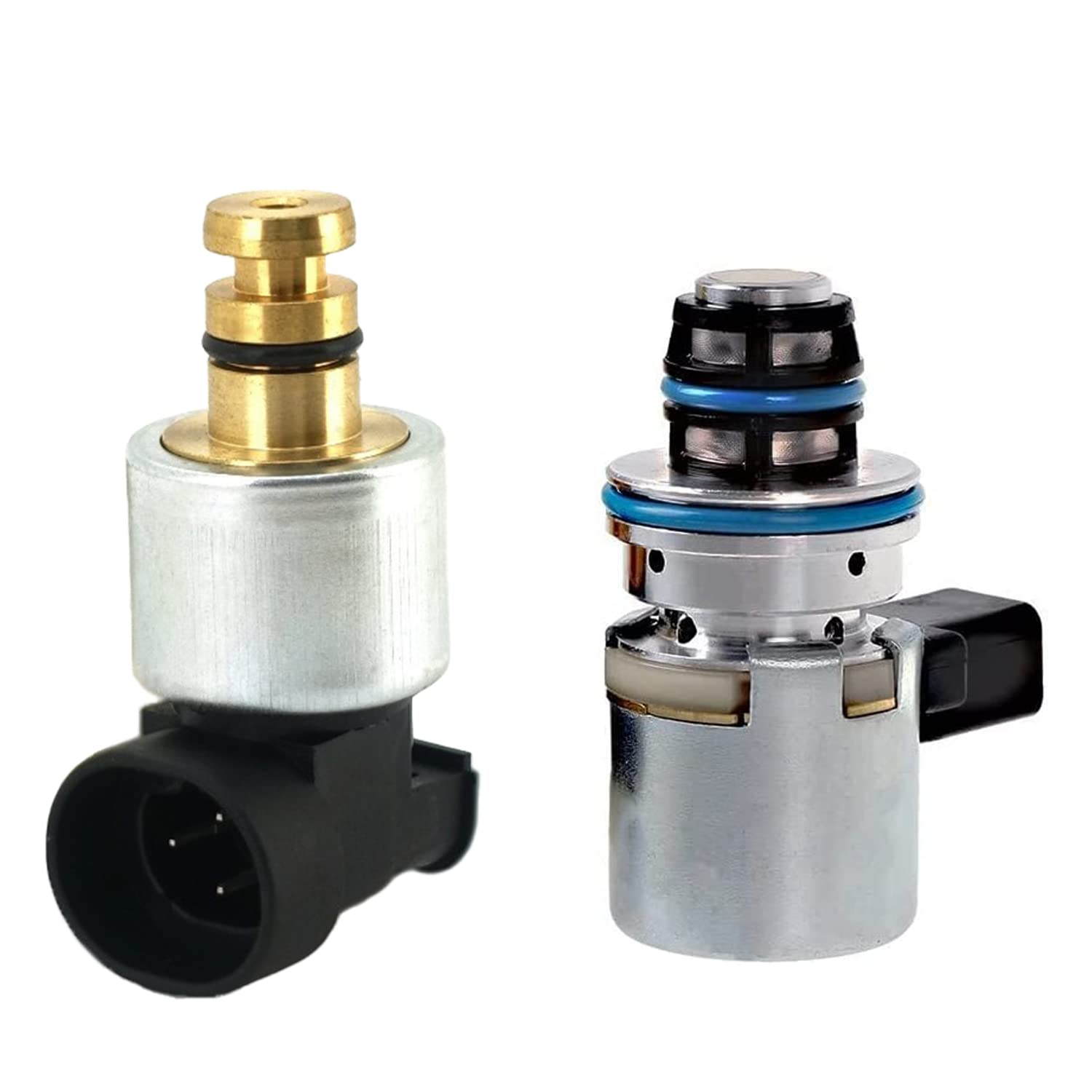
Governor Pressure Solenoid and Sensor Kit (4617210)
If your road test shows Desired, Actual and gauge governor pressure disagreeing, this is the solenoid and transducer pair that sets it. Confirm the part number on your unit before ordering.
View the 4617210 governor kit →Shop the part for this fix
Filters, pan gaskets, bands, governor solenoids and rebuild kits for the Dodge RE family, shipped fast from the USA.
Shop Dodge RE transmission parts →Frequently Asked Questions
How often should a high-mileage 46RE be serviced?
Chrysler's severe-service schedule called for fluid, filter and a band adjustment every 30,000 miles on trucks that tow, idle a lot or make short trips, and most high-mileage 46RE trucks fit that description. On a unit that has been neglected, do two or three pan drops a few hundred miles apart, since one pan drop replaces only about 8 of the 19 to 20 pints in the unit.
Should I service a 46RE that has never had the fluid changed?
Read the fluid first. If it is dark and smells burnt, or the pan magnet shows clumps of friction material, the clutches are already worn and a service will not save it. If the fluid is dark but not burnt and the magnet only has a light gray paste, a careful pan drop, filter, band adjustment and cooler check is the right move.
What fluid and how much does a 46RE take?
The 46RE uses Mopar ATF+4. Chrysler's Ram capacity chart lists a service fill of 3.79 liters (8 pints) and an overhaul fill of 8.99 to 9.46 liters (19 to 20 pints), with the exact dry fill depending on the cooler and line length. Always set the final level hot, engine running, in Neutral.
Do 46RE bands need to be adjusted?
Yes. Both bands are adjustable and the lining wears with mileage, which causes soft or flared shifts and slipping. Torque the adjusting screw to 72 inch-pounds, then back it off the number of turns your model year's factory manual specifies before tightening the locknut. The back-off count changed over the years, so use the figure for your exact year.
What is normal governor pressure on a 46RE?
Governor pressure should be zero at a stop and rise about 1 psi per mph up to roughly 40 mph, after which the system feeds line pressure to the governor circuit. The PCM's Desired value, the transducer's Actual value and a gauge on the governor port should all agree. On 1996-2003 gas trucks the transducer reads about 0.60 to 0.66 volts at zero psi.
Sources
- Dave Skora, ATRA GEARS Magazine — "Troubleshooting the 42-47RE Transmissions" (October 2006). Backs governor pressure stroking the shift valves, 0 psi stopped and about 1 psi per mph to about 40 mph, the Desired/Actual/gauge comparison, the PCM pin B29 transducer voltages and B31 5 V reference, the 105 psi WOT limit, case connector pin 1 power, governor body crossleaks, OSS noise, and the NTC/PTC temperature sensor change. atracom.blob.core.windows.net (PDF)
- Keith Clark, ATRA GEARS Magazine — "Bringing it Back to Life: A Logical Approach to the RE Valve Body." Backs the hard parts standing up to abuse with the valve body as the common concern, the gasketless design and natural leak, the four highest-wear areas, the TV cable that will not dial in from leaking throttle oil, the switch valve past 100,000 miles, and line pressure plug and sleeve symptoms. gearsmagazine.com
- Bob Warnke, Sonnax — "46-47RH/RE Cooler and Converter Flow." Backs cooler restriction as the most common issue, the restriction points, the 80 psi head pressure note, the code and symptom list, and the cooler bypass test. sonnax.com
- ATRA GEARS Magazine — "A Dead Stop! A Typical Dodge 47RE Problem With an Unexpected Solution." Backs the looped-line cooler air check at no more than 40 psi into the rear cooler fitting. gearsmagazine.com
- Pat Barrow (Lubegard), Transmission Digest — "To Flush Or Not To Flush." Backs contaminated coolers causing early failure of replacement transmissions, the clear-container contamination check, cooler replacement after heavy metal, and the inline filter on the return line. transmissiondigest.com
- DaimlerChrysler / Ram Body Builder — 2004 Ram Truck (DR) Fluid Capacities. Backs ATF+4 and the 46RE service fill of 3.79 L (8 pints) and overhaul fill of 8.99-9.46 L (19-20 pints), and the note that dry fill varies with cooler and line length. rambodybuilder.com (PDF)
- Chrysler Corporation — 1998 Dodge Ram Truck Service Manual, Group 21 Transmission (pages 21-308/21-309). Backs the 46RE band back-off figures (front 2-7/8 turns, rear 2 turns at 72 in-lb) against the 47RE figures (front 1-7/8, rear 3), the 35 in-lb filter screw torque and the 13 ft-lb pan bolt torque. archive.org
The 46RE band figures (front 72 in-lb then 2-7/8 turns with a 30 ft-lb locknut; rear 72 in-lb then 2 turns with a 25 ft-lb locknut) and the 30,000-mile severe-service fluid, filter and band interval are from the 2001 Dodge Ram Truck (BR/BE) factory service manual, transmission and lubrication and maintenance sections. The 46RE and 47RE band back-off comparison and the filter screw and pan bolt torques are from the 1998 Ram Truck service manual listed as source 7.
Need parts for this job?
46RE pans with drain plugs, filters, governor solenoids, coolers and master rebuild kits — shipped fast from the USA.
Shop 46RE parts →