A 46RE that will not move in Drive or Reverse sounds like the worst case, but it is one of the easier calls on this transmission if you test in order. Most 46RE failures still leave you with something: stuck in first, a third-gear start, no overdrive, a slip in reverse. When both directions are gone at once, the list shrinks to parts that every range depends on: fluid supply, the pump and its drive, the shift linkage, the gear train, and the driveline behind the transmission.
This guide is written for the gas-engine 46RE behind the 5.2L and 5.9L Magnum V8s in 1996-2003 Ram pickups and vans, Dakotas, Durangos and some Grand Cherokees. That matters. On a Cummins 47RE the usual "engine revs, truck sits" story is a sheared input shaft from added power. On a high-mileage gas 46RE, we more often find a pump that is not pulling oil, a filter seal sucking air, or a gear train worn out from lost lubrication. Sources are at the end.

Why Losing Both Directions Narrows the List
Start with power flow, not the scan tool. In Drive first gear, the 46RE applies the rear (forward) clutch and uses the overrunning clutch to hold the rear planetary. In Reverse it applies the front clutch and the low/reverse (rear) band. Those are separate clutches and separate holding devices. The factory diagnostic chart splits them the same way. It has one cause list for "No Drive Range (Reverse OK)" and another for "No Reverse (D Ranges OK)."
When the truck will not go either way, the factory diagnosis chart's "No Drive or Reverse (Vehicle Will Not Move)" entry (1998 Ram service manual, p. 21-223) is the one to work. It lists:
- Gearshift linkage or cable loose or misadjusted
- Broken U-joint, axle or transfer case
- Plugged filter
- Damaged oil pump (confirm with a pressure test)
- Valve body malfunction
- Damaged internal component
- Park sprag not releasing (check stall speed)
- Torque converter damage
The electronics are not the reason it will not move
In GEARS (October 2006), Dave Skora described the 42-47RE family as basically hydraulically controlled through the first three gears. The PCM duty-cycles a governor solenoid whose pressure strokes the shift valves, and runs the overdrive and TCC solenoids. None of those circuits applies the forward clutch or the reverse clutch.
Skora also explains what happens when the electronics fail. In limp mode the PCM de-energizes the governor solenoid. That sends full line pressure into the governor circuit, and the truck starts in third gear. A third-gear start is sluggish, but the truck moves. Governor codes on a truck that will not move are a second, smaller problem. Do not buy a solenoid kit or a pressure sensor for this complaint.
Skora's 1996-2003 gas RWD pin chart gives the governor pressure transducer signal as about 0.60-0.66 V at zero psi and about 3.0 V at 60 psi. Governor desired, governor actual and a gauge in the governor port should all agree, rising about 1 psi per mph to roughly 40 mph. If they agree, the problem is mechanical or hydraulic.
Step 1: Prove the Transmission Is the Problem
The chart puts the driveline on the list for a reason. On a 4x4, make sure the transfer case is fully in 2H or 4H. Look for a dropped driveshaft, a sheared U-joint or a broken axle shaft. The fast split: chock the front wheels, raise the rear, and select Drive at idle. If the driveshaft turns, the transmission is doing its job and the problem is behind it. If the driveshaft is dead, stay with the transmission.
Step 2: Fluid Level, Checked in Neutral
The RE units are checked hot, at 180 F (82 C), idling on level ground in Neutral after cycling through every range, per the factory fluid level procedure in the 1998 Ram service manual. A 46RE that reads full in Park can be low enough in Neutral that the pump pulls air at the filter on a turn, a hill or a hard stop. Use ATF+4 only.
Read the dipstick for clues, not just level:
- Low and clean red: top up, find the leak (front pump seal and cooler lines are the usual spots), and retest before condemning anything.
- Well over full with the engine running: the converter has drained back into the pan and the pump is not pulling it out. That points to a pump that is not turning or not priming. Go straight to the pressure test.
- Dark, burnt, or full of glitter: something already failed inside. The chart lists a plugged filter as its own cause, but a filter packed with friction material or metal is a symptom too. Replacing it alone is not a repair.
While the pan is down, check the filter's O-ring and the fit of the filter neck in the valve body. A filter that is not sealed pulls air instead of fluid, and the pump loses prime in the same way as a low fluid level.
Step 3: Linkage, Manual Valve and Park
The gear indicator can say D while the manual valve sits in Neutral. Disconnect the shift cable or rod at the transmission and move the manual lever through every detent by hand. You should feel clean detents at P, R, N, D, 2 and 1. A broken detent spring or a worn manual lever shaft inside the pan does the same thing.
The park sprag is the other mechanical trap. A truck parked hard on a grade, or one with a damaged park rod, can stay locked in Park with the lever in Drive. The chart's note is to check stall speed. A stuck sprag loads the engine down hard, while a broken input path or a stripped gear lets it rev with almost no load. Keep any stall check to a few seconds.
Step 4: Line Pressure Decides the Job
Put a gauge on the accumulator port. The factory pressure test for the RE family raises the rear wheels, chocks the fronts, and disconnects the throttle valve (TV) cable so you can move the TV lever by hand. The stock figures from the 1998 Ram service manual's 46/47RE hydraulic pressure tests (pp. 21-217 and 21-218) are:
- Drive, Manual 1 or Manual 2 at 1,000 rpm: 54-60 psi with the TV lever at idle, rising to 90-96 psi at full TV.
- Reverse at 1,600 rpm (rear servo port): 145-175 psi at idle TV, rising to 230-280 psi at full TV.
A shift-kitted valve body will read differently. Now sort the truck into one of two groups.
Zero or very low pressure in every range
The oil is not being pressurized. Work from cheapest to most expensive:
- Filter and filter seal. A plugged filter, a missing or rolled O-ring, or a cracked filter neck lets the pump suck air.
- Pump not being driven. The converter hub drives the inner pump gear on two flats. If the converter was not fully seated before the bellhousing bolts were tightened, the first start can break the pump gear or the hub drive. If the truck quit right after a transmission or converter job, start here.
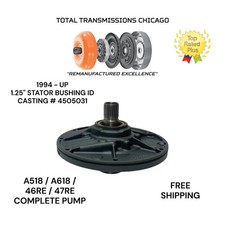
- Worn pump. A galled pump bushing, worn gear pockets or a leaking stator support all cost volume.
- Pressure regulator valve. Sonnax's write-up on the Chrysler RWD regulator says debris and constant oscillation wear the regulator spools. It ties that wear to delayed engagements and poor line control. A regulator stuck wide open dumps line pressure, which looks like a pump failure on the gauge.
Keith Clark makes the point in GEARS (January 2023) that every hydraulic control circuit on the RE units lives in the valve body. These valve bodies run without gaskets and leak by design, so a worn line pressure plug and sleeve or a warped casting shows up first as delayed engagement and a slip in reverse.
Normal pressure, but no movement
Good pressure means the pump, filter and regulator are fine and oil is reaching the clutches. The failure is in a part that carries torque:
- Input shaft, forward clutch retainer or converter spline. Less common on gas trucks than diesels, but a stripped turbine spline or a broken input shaft gives the textbook "engine revs, truck sits" result.
- Gear train worn out by lost lube. This is the 46RE failure we see most on gas trucks with high mileage. Sonnax lists the result of RE lube failure as galled governor supports, seized output shafts, and rounded sun and planetary gears. Its piston retainer kit (22754N-01K) for the 46RE targets the cause. Excess clearance between the overdrive piston retainer and the intermediate shaft cuts lube to the gear train, and the OE support often does not seal well against the case. The listed failures are the reverse drum, the retainer and the planets.
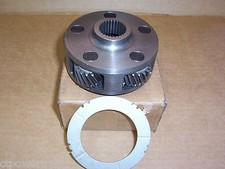
- Front planetary. The chart lists a broken front planetary under "No Drive." A stripped sun gear or shattered planet can take out first gear and reverse together.
- Overdrive section. In first through third, the overdrive unit runs in direct. A broken intermediate shaft or a failed direct clutch in the overdrive stops torque from reaching the output in every range.
A quick gear train check with the connector unplugged
This one is our bench habit, built on Skora's limp-mode description. With the rear wheels raised, unplug the transmission connector. The governor solenoid goes dead, full line pressure reaches the governor circuit, and the 46RE starts in third. Third gear locks the gearset with both input clutches, so the sun gear and planets carry no reaction load. If the driveshaft now turns in Drive but not in first or Reverse, suspect the sun gear, a planetary or the reverse drum. If it still will not turn, look at the input path, the overdrive section or the output. Treat it as a pointer, not a verdict.
Step 5: Teardown and the Fix
Once pressure says hard parts, the transmission comes out. Check these in order:
- Converter hub drive flats and the turbine spline
- Pump gears, pump bushing, and stator support flatness
- Input shaft and forward clutch retainer for cracks
- Sun gear splines, the sun shell, and both planetaries for rounded teeth or bluing
- Reverse drum and overdrive piston retainer, plus retainer-to-intermediate shaft clearance
- The overdrive direct clutch, its spring, and the intermediate shaft
The repair follows from what you find:
- Driveline, fluid or linkage: fix that and road test.
- Pump not driven after an install: replace the pump gears or the pump, usually the converter too. Seat the converter fully into the pump drive before tightening the bellhousing bolts.
- Lube-starved gear train: this is a rebuild. Replace the damaged sun gear, sun shell, planets or reverse drum, and fix the lube loss at the overdrive piston retainer so it does not happen again. Sonnax offers an oversized retainer kit (22754N-02K) for when the reverse drum is already damaged.
If the unit made metal, flush the cooler and lines before the rebuilt transmission goes back in.
Prevention
Run ATF+4, check it hot in Neutral, and keep the cooler clear. On a high-mileage 46RE, a rebuild is the time to address lube flow, not just friction and seals: check the overdrive piston retainer fit, the line pressure plug and sleeve, and the pressure regulator.
Shop the part for this fix: Sonnax Heavy Duty Input Shaft 22121B-01
One-piece replacement for the stock two-piece input shaft. It fits 46RE, 47RE and 48RE units, and it is the part to use when teardown shows a broken input shaft.
View the input shaft →Need a pump, retainer or a full kit instead? Browse the 46RE/47RE/48RE family parts collection at Core Transmission Parts.
FAQ
Why won't my 46RE move in Drive or Reverse?
Drive and Reverse use different clutches and holding devices, so losing both points at something they share: low fluid, a plugged filter or leaking filter seal, a pump that is not being driven, a disconnected shift linkage, a park sprag that will not release, a damaged converter, a failed gear train part, or a broken driveline part behind the transmission. A single burnt clutch pack does not take out both directions.
Can a bad governor pressure solenoid or sensor stop a 46RE from moving?
No. The 46RE is hydraulically controlled through third gear, and the governor pressure solenoid only controls the pressure that strokes the shift valves. A governor or sensor fault leaves the truck stuck in first or puts it in limp mode with a third-gear start, but the truck still moves. Codes may be real, but they are not the reason it will not move.
How do I know if my 46RE pump is bad?
Put a gauge on the accumulator port. RE-family factory figures are 54-60 psi in Drive at 1,000 rpm and 145-175 psi in Reverse at 1,600 rpm with the throttle valve at idle, per the factory service manual. Near-zero pressure in every range points to the filter, the filter seal, the pump or the pump drive. A dipstick that reads well over full with the engine running is another tell that the pump is not pulling oil out of the pan.
Is a 46RE that will not move worth rebuilding?
Usually, yes. If line pressure is low, the fix may be a filter, a pump, or pump gears and a converter. If pressure is normal and the truck still will not move, the unit needs a teardown, and on a high-mileage gas 46RE the damage is often lube-related: a sun gear, planetary or reverse drum. Price the rebuild once you know which parts failed.
Sources
- Chrysler Corporation, 1998 Dodge Ram Truck Service Manual, Group 21, 46/47RE diagnosis chart (p. 21-223/224). Backs the "No Drive or Reverse (Vehicle Will Not Move)" cause list (fluid level, linkage, U-joint/axle/transfer case, plugged filter, pump, valve body, internal damage, park sprag with the stall speed check, converter), the separate no-drive list with the front planetary entry, and the hot Neutral fluid level procedure at 82 C (180 F). archive.org
- Chrysler Corporation, 1998 Dodge Ram Truck Service Manual, Group 21, 46/47RE hydraulic pressure tests (pp. 21-217/218). Backs the test setup (gauge at the accumulator port, throttle and shift cables disconnected), 54-60 psi rising to 90-96 psi in 1, 2 and D at 1,000 rpm, and 145-175 psi rising to 230-280 psi at the rear servo port in Reverse at 1,600 rpm. archive.org
- ATRA GEARS Magazine — Dave Skora, "Troubleshooting the 42-47RE Transmissions" (October 2006). Backs the hydraulic control through third gear, governor pressure rising about 1 psi per mph to about 40 mph, limp mode giving a third-gear start, and the 1996-2003 gas RWD transducer voltages. atracom (GEARS PDF)
- ATRA GEARS Magazine — Keith Clark, "Bringing it Back to Life: A Logical Approach to the RE Valve Body" (January 2023). Backs all RE hydraulic control circuits living in the valve body, the gasketless design, and the line pressure plug and sleeve symptoms. gearsmagazine.com
- Sonnax — "The Cure for the Common (Chrysler RWD) Cold" (2004). Backs pressure regulator spool wear from debris and oscillation, and the lube-failure results: galled governor supports, seized output shafts, and rounded sun and planetary gears. sonnax.com
- Sonnax — Piston Retainer Kit 22754N-01K. Backs 46RE fitment, the overdrive piston retainer to intermediate shaft clearance cause, the reverse drum, retainer and planet failure, and the oversized 22754N-02K for damaged drums. sonnax.com
Shop 46RE pumps, rebuild kits, planetaries and valve bodies — shipped fast from the USA.
Shop 46RE parts →