Everybody can recite 4L60E gear ratios. Far fewer people can tell you what those numbers do once the transmission is bolted to an axle and a set of tires, and fewer still can use them to find a problem. The ratio spec is not trivia — it is a diagnostic tool. It tells you what the scan tool should read in each gear, why the 1-2 shift beats parts to death, why a 3.42 truck on 33s feels gutless, and whether the unit on your bench is actually in the gear the computer thinks it is.
This is the working reference: the numbers, where they come from inside the case, and the math that turns them into engine RPM at 70 mph.
The numbers: 1st 3.06, 2nd 1.63, 3rd 1.00, 4th (overdrive) 0.70, Reverse 2.29. Every 4L60E, 4L65E and 4L70E shares them — the pinion count and clutch capacity change between those units, the ratios do not [1][2]. The 4L60E has no internal final drive; on a rear-wheel-drive vehicle the final drive is the rear axle ratio.
The Published Ratios, and Why Two Sources Disagree
Chevrolet Performance publishes the ratios for the 4L65-E and 4L70-E as 1st 3.06, 2nd 1.62, 3rd 1.00, 4th 0.70, with a 430 lb-ft torque limit on the 4L65-E and 495 lb-ft on the 4L70-E [1]. The ATRA GEARS gear ratio reference chart lists the same family — 4L60 / 4L60E / 4L65E — as 3.06, 1.63, 1.00, 0.70, reverse 2.29 [2].
That 1.62 versus 1.63 is not two different gearsets, it is rounding on the same hardware, and you will see both in GM literature. Sonnax uses 1.63 in its own product data for the 4L60 family [3]; the difference is well inside sensor noise. Reverse shows up as 2.29 in the ATRA chart and 2.30 in Sonnax's powerflow write-up [2][4] — again, the same gear train.
| Gear | Ratio | Holding / driving members applied |
|---|---|---|
| 1st | 3.06:1 | Forward clutch + low/reverse roller (sprag) holds reaction carrier |
| 2nd | 1.63:1 | Forward clutch + 2-4 band holds reverse input drum / sun shell |
| 3rd | 1.00:1 | Forward clutch + 3-4 clutch (direct drive) |
| 4th | 0.70:1 | 3-4 clutch + 2-4 band (overdrive) |
| Reverse | 2.29:1 | Reverse input clutch + low/reverse clutch |
Where the Ratios Physically Come From
The 4L60E makes all five ratios with two planetary sets: the input (front) carrier and the reaction (rear) carrier, tied together by the output shaft and the reaction sun shell.
In first gear, the forward clutches apply and the low/reverse roller clutch prevents the reaction carrier from turning backward. Power goes in at the input sun gear; the input carrier pinions walk around it and drive the output shaft. Per Sonnax's powerflow breakdown, that produces 3.06:1 — the input shaft turns 3.06 times for one turn of the output shaft — and combined with roughly 2.0:1 of torque converter multiplication at stall, you have about 6.12:1 leaving the transmission before the axle ever gets involved [4].
Second gear releases the low/reverse element and applies the 2-4 band, which holds the reverse input drum. The drum is tanged to the sun shell, which is splined to the reaction sun gear, so all three lock together and the reaction planetary adds its share of reduction. Third applies the 3-4 clutch alongside the forward clutch for 1:1 direct drive. Fourth applies the 3-4 clutch and the 2-4 band together, driving the carrier and overdriving the output shaft to 0.70:1. Reverse routes power through the reverse input clutches to the reaction sun gear while the low/reverse clutch holds the reaction carrier, spinning the output shaft backward at 2.30:1 [4].
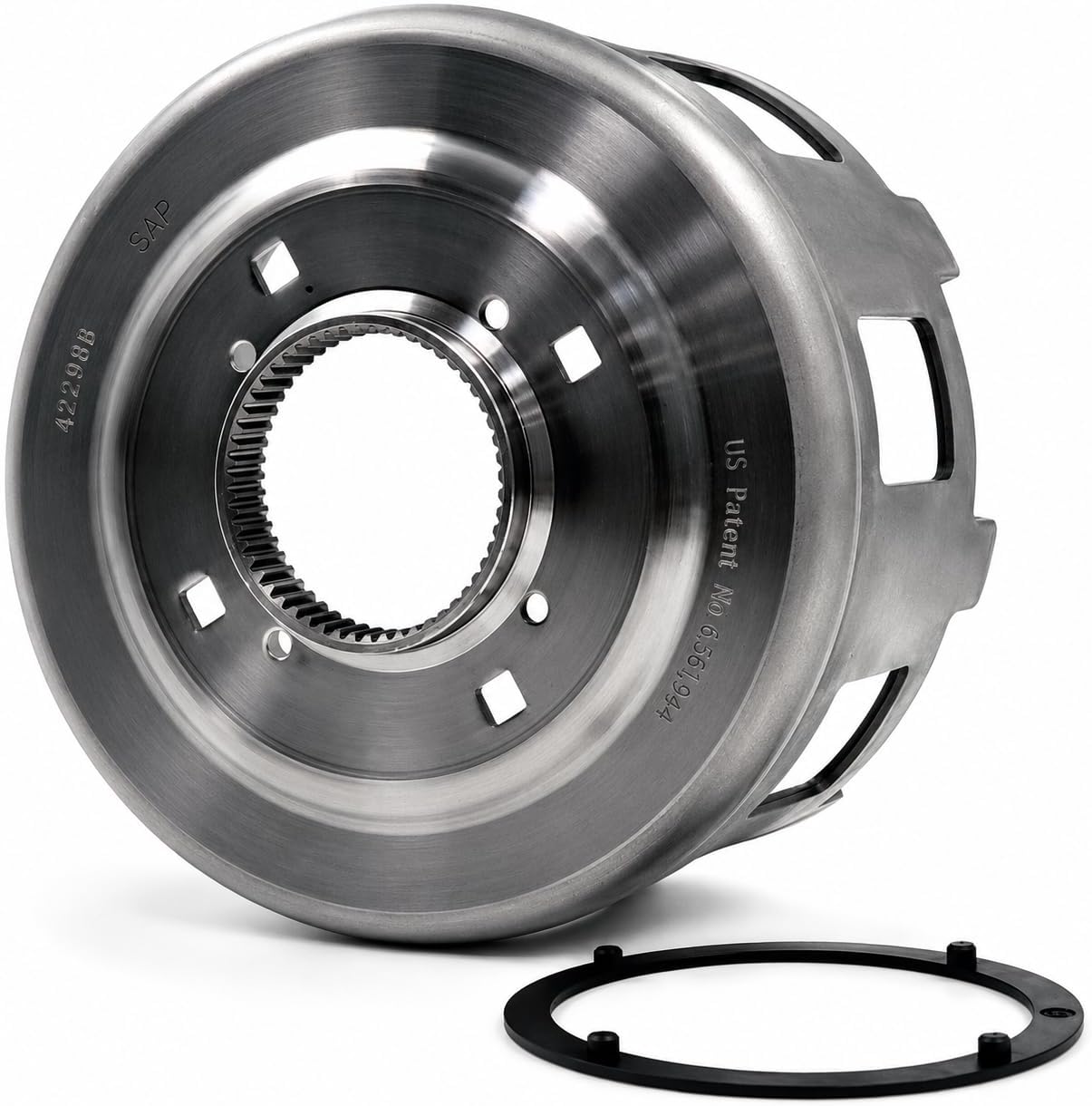
Two takeaways for the bench. First, the 2-4 band and the sun shell are in the power path for both 2nd and 4th — that is why a cracked sun shell shows up as a slip in second and fourth, not one or the other. Second, the pinion count on the input carrier — four pinion versus five pinion versus an aftermarket six — changes load capacity, not ratio. A five-pinion carrier is still 3.06.
Ratio Steps: Why the 1-2 Shift Is So Hard on Parts
The number that matters on a shift is not the ratio, it is the step between ratios — the old ratio divided by the new one. That step is how far engine speed falls the instant the shift completes, and how much energy the applying element has to absorb.
| Unit | 1-2 step | 2-3 step | 3-4 step | Overall spread (1st ÷ top) |
|---|---|---|---|---|
| 4L60E (3.06 / 1.63 / 1.00 / 0.70) | 1.88 | 1.63 | 1.43 | 4.37 |
| 4L80E (2.48 / 1.48 / 1.00 / 0.75) | 1.68 | 1.48 | 1.33 | 3.31 |
| 200-4R (2.74 / 1.57 / 1.00 / 0.67) | 1.75 | 1.57 | 1.49 | 4.09 |
| 4R70W (2.84 / 1.55 / 1.00 / 0.70) | 1.83 | 1.55 | 1.43 | 4.06 |
Ratios for the comparison units are from the ATRA GEARS chart [2]; the steps are simple division. Sonnax calls the 3.06 first gear "the steepest first gear ratio of any four-speed automatic," and the 1-2 shift a "dramatic RPM drop" [3]. A 1.88 step means engine speed falls to about 53% of where it was: shift at 6,000 and you land at roughly 3,200. On a stock truck that is a fuel-economy feature. On a 500-plus horsepower engine with a narrow torque peak, it drops you out of the powerband and dumps the difference into the 2-4 band and the input components as heat.
That is the entire argument for a ratio change. Sonnax's 77284-K input carrier kit converts the unit from the OE 3.06 / 1.63 to a closer 2.84 / 1.55, which shrinks the 1-2 step from 1.88 to 1.83 and, more importantly, cushions the ratio change that damages the band, shafts and sprag [3][4]. Note the fitment warning on that kit: it cannot be used with an '07-or-later reaction shaft without an earlier shaft or the Sonnax 74602-01K heavy duty reaction shaft kit [3].
4L60E 5-Pinion Front Planetary Set
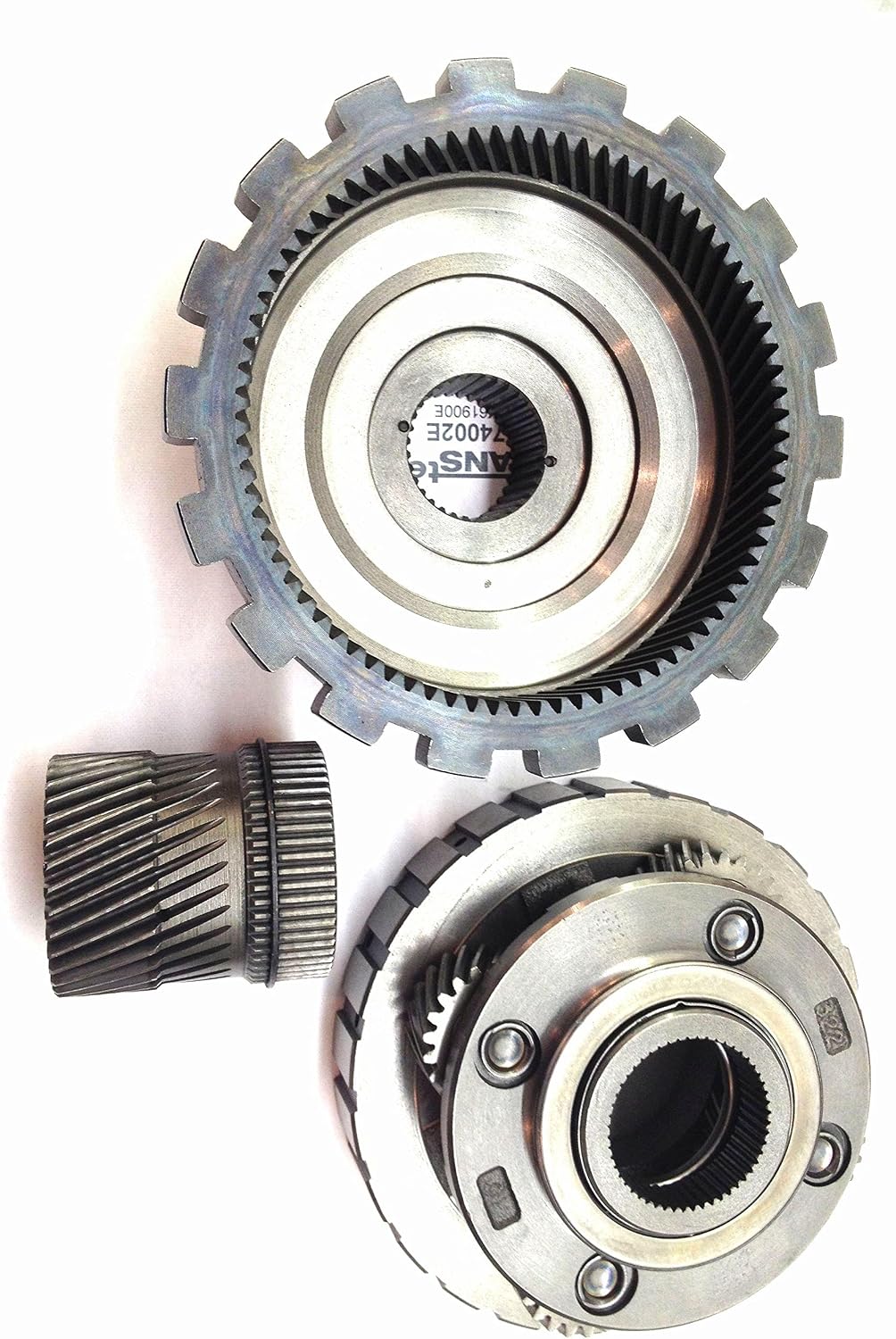
The input carrier is the part that actually produces the 3.06 first-gear reduction, and it eats the entire 1-2 ratio step every shift. If the pinions are blued, the pins are loose, or a needle has walked, the carrier is done — you cannot shim your way out of it. This is the five-pinion OE-spec front planet, in stock and shipping from our sister store.
See the 5-pinion front planet →Or browse the full 4L60E parts collection → — including the extra heavy-duty reaction sun shell that carries 2nd and 4th.
Final Drive: The Axle Is the Other Half of the Ratio
The 4L60E is a longitudinal rear-drive unit with no internal final drive gear. Whatever comes out of the tailshaft goes through the driveshaft to the ring and pinion, so your overall ratio in any gear = transmission ratio × axle ratio. The EPA uses the same two terms in its certification data: every tested vehicle carries an axle ratio field and an N/V ratio field, defined as engine RPM divided by vehicle speed in miles per hour [5]. N/V is the number that actually describes how a vehicle is geared, and it is the product of the top-gear ratio, the axle ratio and the tire size.
| Axle ratio | 1st (3.06) | 2nd (1.63) | 3rd (1.00) | 4th (0.70) | Reverse (2.29) |
|---|---|---|---|---|---|
| 3.08 | 9.42 | 5.02 | 3.08 | 2.16 | 7.05 |
| 3.23 | 9.88 | 5.26 | 3.23 | 2.26 | 7.40 |
| 3.42 | 10.47 | 5.57 | 3.42 | 2.39 | 7.83 |
| 3.73 | 11.41 | 6.08 | 3.73 | 2.61 | 8.54 |
| 4.10 | 12.55 | 6.68 | 4.10 | 2.87 | 9.39 |
Add the converter and the numbers get large fast. A 3.42-geared truck launching on a stock converter is running 3.06 × 3.42 = 10.47, and near stall with about 2.0:1 of multiplication that is roughly 20.9:1 at the tire. That is why a 4L60E truck feels strong off the line and why the 1-2 shift is such a cliff.
Cruise RPM: the working formula
Engine RPM = (MPH × axle ratio × transmission ratio × 336) ÷ tire diameter in inches. The 336 is 63,360 inches per mile divided by 60 minutes divided by pi — it is not a fudge factor, it is unit conversion.
Take a common GMT800 half-ton on 265/75R16 tires. That size works out to 16 + 2 × (265 × 0.75 ÷ 25.4) = 31.65 inches tall. At 70 mph in overdrive:
- 3.08 axle: 1,603 RPM
- 3.23 axle: 1,681 RPM
- 3.42 axle: 1,780 RPM
- 3.73 axle: 1,941 RPM
- 4.10 axle: 2,134 RPM
Same truck, same 70 mph, but with overdrive locked out and the trans in 3rd (1.00), the 3.42 combination runs 2,543 RPM. That 763-RPM jump is exactly what you are asking the converter and the 3-4 clutch to live with when a customer tows in Drive with a fluttering lockup — and it is also the output shaft speed you should expect to see at 70 mph, because in direct drive the output shaft and the turbine turn together.
Tire size silently regears the truck
Tire diameter divides into the final drive, so a taller tire is a numerically lower axle ratio in everything but name. Put LT285/75R16 tires (32.83 inches tall) on that 3.42 truck and the effective ratio becomes 3.42 × (31.65 ÷ 32.83) = 3.30. To get back to the factory feel you would need 3.42 × (32.83 ÷ 31.65) = 3.55, which in practice means stepping to 3.73.
The same change makes the speedometer read 3.7% slow: an indicated 70 mph is really 72.6. On a 4L60E that correction lives in the PCM — the vehicle speed signal comes off the output shaft speed sensor and is scaled in software by tire size and axle ratio, so a tire or gear change that is not retuned also skews shift points, TCC apply speed, and the odometer.
Using the Ratios on a Scan Tool
Gear ratio is measurable, live, in the driveway. Ratio = input (turbine) speed ÷ output shaft speed. On units with an input speed sensor, use ISS ÷ OSS directly. On earlier 4L60Es without an ISS, use engine RPM ÷ OSS with the converter unlocked and accept a few percent of converter slip on top of the true ratio; with TCC applied, engine RPM ÷ OSS should land right on the mechanical ratio.
| Commanded gear | Expected ISS ÷ OSS | Acceptable window |
|---|---|---|
| 1st | 3.06 | 2.95 – 3.15 |
| 2nd | 1.63 | 1.58 – 1.68 |
| 3rd | 1.00 | 0.97 – 1.03 |
| 4th | 0.70 | 0.68 – 0.73 |
Those windows are tight on purpose. If the PCM commands 4th and you measure 1.00, the 2-4 band is not holding — the unit is stuck in 3rd. If it commands 2nd and you read 3.06, the band is not applying at all. A calculated ratio that drifts with load rather than sitting at a wrong fixed value is slip, not a wrong gear, and points at clutch or band capacity or line pressure. This is also the logic behind the incorrect-ratio codes (P0730 and the gear-specific P0731–P0734): the PCM is doing this same division and comparing it to a table.
One more field note: measure OSS against your own arithmetic. Using the formula above, 70 mph with a 3.42 axle on 31.65-inch tires should show about 2,543 RPM of output shaft speed. If the scan tool disagrees by more than a couple of percent, the tire size or axle ratio programmed in the PCM does not match what is under the truck, and every ratio you calculate from that point is built on a bad number.
The Parts That Carry the Ratio, and One Interchange Trap
Because ratio is a function of hardware, gear-train part changes matter when you are sourcing. Transmission Digest documented a real one: all 4L60E/65E/70E units built on or after 3-12-07 (Julian date 7071) changed the input carrier to reaction carrier shaft bearing, and the input carrier and reaction carrier shaft were both dimensionally modified to accept it, for bearing capacity and durability. The current-design components must be used as an assembly to back-service earlier builds — bearing 24236092, four-pinion input carrier 24241241, five-pinion input carrier 24241248, reaction carrier shaft 24241255 [6].
In plain terms: you cannot mix a late carrier with an early shaft, or the reverse, and the ratio is identical either way — so if a "new" planet does not fit, the problem is the build date, not the gearset. This is the same '07 dividing line that shows up in Sonnax's fitment warning on the 2.84 carrier kit [3].
Front and rear planetary sets, heavy-duty reaction sun shells, 2-4 bands, servos, thrust washer kits and the bearings that hold the gear train stack together — shipped fast from the USA.
Shop 4L60E parts →Picking an Axle Ratio Behind a 4L60E
With a 4.37 overall spread, the 4L60E is more forgiving of a numerically higher axle than a close-ratio four-speed would be — the 0.70 overdrive gives back most of what the axle takes. Practical guidance for a stock-ratio unit on 31–33 inch tires:
- 3.08 / 3.23: highway-biased and unloaded, 1,600–1,700 RPM at 70. The converter will unlock on every grade under load, and repeated unlock/apply cycles is how 4L60E converter clutches get cooked.
- 3.42: the balanced half-ton choice. 1,780 RPM at 70 leaves enough headroom to stay locked on rolling hills.
- 3.73: the answer when you tow, run 33s, or both. 1,941 RPM at 70 sounds busy on paper and pays for itself in converter and 3-4 clutch life.
- 4.10 and up: for large tires, heavy loads or a 2.84 ratio change. Over 2,100 RPM at 70, so plan on loud and thirsty at cruise.
Do the arithmetic before you buy the ring and pinion, and retune the PCM for tire size and axle ratio afterward. A 4L60E cannot be geared correctly by feel, but it can be geared correctly on paper in about five minutes.
Sources
- Chevrolet Performance (General Motors) — Performance Transmissions spec listings, source for the published SuperMatic 4L65-E and 4L70-E gear ratios (1st 3.06, 2nd 1.62, 3rd 1.00, 4th 0.70) and the 430 lb-ft / 495 lb-ft torque limits. chevrolet.com/performance-parts/transmissions
- ATRA — GEARS magazine, January/February 2006, "Gear Ratios" reference chart, source for the 4L60 / 4L60E / 4L65E ratios 3.06 / 1.63 / 1.00 / 0.70 with 2.29 reverse, and for the comparison ratios used for the 4L80E, 200-4R and 4R70W. atracom.blob.core.windows.net/bulletins/quick/2006-01_58.pdf
- Sonnax — 2.84 Ratio Input Carrier Kit 77284-K product data, source for the OE "wide ratio" 3.06 / 1.63 to "close ratio" 2.84 / 1.55 conversion, the "steepest first gear ratio of any four-speed automatic" statement, and the '07-and-later reaction shaft fitment warning (74602-01K). sonnax.com/parts/3734-2-84-ratio-input-carrier-kit
- Sonnax — "The Evolution of Automatic Transmissions Part 2: Inner Workings of Hydraulic Planetary Transmissions," Jason Larochelle, March 30, 2021. Source for the gear-by-gear powerflow, the 3.06:1 first-gear reduction, the 6.12:1 figure with 2.0:1 converter multiplication, the 0.70 overdrive apply logic and the 2.30:1 reverse. sonnax.com/tech_resources/983
- U.S. EPA — Fuel Economy Test Car List field definitions, source for the certification data definitions of AXLE-RATIO and N-V-RATIO ("engine RPM divided by vehicle speed in miles"). epa.gov/sites/default/files/2016-07/documents/test-car-list-definitions.pdf
- Transmission Digest — "4L60E/65E/70E Input Carrier Change," Transmission TECH/TALK, October 21, 2020. Source for the 3-12-07 (Julian 7071) input carrier and reaction carrier shaft bearing change, the as-an-assembly interchange rule, and part numbers 24236092, 24241241, 24241248 and 24241255. transmissiondigest.com/4l60e-65e-70e-input-carrier-change