The 4L80E in a Chevy Express 2500 or 3500 is the same transmission that goes in a 3/4-ton pickup, but a work van uses it harder than almost anything else GM put it in. Plumbers, electricians, shuttle operators and parcel fleets run these vans loaded to the roof, stop and go all day, with the engine sitting inside the cab under a doghouse cover. GM's 2005 transmission diagnostic document for the 4L80E lists the Express and Savana by name, "when used with" the 4.8L, 6.0L (LQ4) and 8.1L (L18). Most of the vans that come into the shop are one of those three, most of them rear-wheel drive, and usually past 150,000 miles.
The pickup side of this transmission is covered in our Silverado 2500 4L80E problems post. This one sticks to what is different about the van.
The short version: Express and Savana 2500/3500 gas vans used the 4L80E through 2009; GM's 2010 Express manual lists only the 4L60-E and the 6L90. If the van's GVWR is over 8,600 lb, GM calls for a fluid and filter change every 50,000 miles no matter how it is driven. A rear-wheel-drive van needs a working case-mounted output speed sensor and an output carrier with an exciter ring; a carrier from a 1994-up 4x4 core causes late shifts and gear-ratio codes. Pan-drop refill is about 7.7 qt.

First: Confirm It Is a 4L80E
The Express line used three different automatics, and the parts are not close to interchangeable. GM's 2008 Express owner manual lists transmission capacities for the 4-speed 4L60-E (5.0 qt), the 4L80-E (7.7 qt, 7.3 L) and a "4L80-E Heavy Duty" (also 7.7 qt) in one table, because the book covers 1500, 2500 and 3500 vans together. GM's 2010 Express manual drops the 4L80-E from that table entirely and lists the 4L60-E (5.0 qt) and the six-speed 6L90 (6.3 qt). So a 2010-and-later heavy Express is a 6L90 van, and a light-duty 1500 is a 4L60E van.
Before ordering anything, pull the RPO label from the glovebox. MT1 is the 4L80E. If you find the six-speed, our 4L80E vs 6L90 post shows how to tell them apart under the van.
| Item | GM spec (Express owner manuals) |
|---|---|
| Transmission fluid | DEXRON-III, H-Specification (2005); DEXRON-VI (2008) |
| 4L80-E pan-drop refill | 7.7 qt (7.3 L), same for the Heavy Duty unit (2008) |
| Normal fluid temperature for a level check | 180-200 F (82-93 C) |
| Severe-service fluid and filter change | Every 50,000 mi, or always if GVWR is over 8,600 lb (2005) |
| Normal-service change | 100,000 mi |
| Last 4L80E model year in Express | 2009 (2010 manual lists 4L60-E and 6L90 only) |
1. Worn Out Early: The Van Is Always on the Severe Schedule
What the owner says: it started slipping or flaring around 100,000 to 120,000 miles, and "it's never needed a fluid change." The fluid is dark and smells burnt.
Why it happens on a van: the 2005 Express owner manual is unusually direct about this. It says to change both the fluid and the filter every 50,000 miles if the vehicle's GVWR is over 8,600 or if it is mainly driven in heavy city traffic where it regularly reaches 90 F, in hilly or mountainous terrain, when doing frequent trailer towing, or in "taxi, police, or delivery service." Only vans outside all of those conditions get the 100,000-mile normal interval. The 2008 manual keeps the same severe-service list.
So a heavy 2500 or 3500 van lands on the severe schedule from its weight rating alone, and a delivery van qualifies twice. That is how so many of them reach 120,000 miles on the original fluid.
What to do: check the GVWR on the driver's door label. If it is over 8,600 lb, set the van up on a 50,000-mile fluid and filter interval and stick to it. If the fluid is already burnt and the van is slipping, a fluid change will not bring the clutches back; see our 4L80E slipping guide for how to separate a pressure problem from worn friction material before you spend money.
2. Late Shifts and Gear-Ratio Codes After a Swap: The Missing Exciter Ring
What the owner says: the van just got a used or rebuilt transmission and now it holds 1st and 2nd way too long, runs with very firm shifts, and the check engine light is on. The shop already replaced the speed sensor and maybe the computer.
Why it happens on a van: a Transmission Digest technical bulletin from March 2001, written specifically for "GM trucks and vans with 4L80-E," explains it. Starting with the 1994 model year, GM eliminated the output shaft speed sensor on all K (4x4) trucks, and the speed-sensor exciter ring on the output carrier went with it. Those trucks get their output speed from the transfer case. Every two-wheel-drive application still needs a working case-mounted output speed sensor and a carrier with the ring.
A rear-wheel-drive Express falls in that second group, so it depends on that ring. The trouble starts when a 4L80E that came out of a 1994-up 4x4 truck, or a carrier pulled from one, goes into a van. The bulletin says the output sensor still sits close enough to the carrier's park lugs to make a signal, but the signal is wrong. The scan tool picture it describes: line pressure at maximum, code 85, P0730 or P1871 for an undefined gear-ratio error, a 1st gear ratio reading zero, 2nd reading 2.48 (really a 1st gear ratio), 3rd reading 1.09 with input and output speeds not equal, and 4th reading 0.78.
How I check it:
- On the scan tool, watch input speed and output speed in 3rd gear. 3rd is 1:1, so they should match. If output reads low, suspect the signal source before the sensor.
- Compare vehicle speed with a GPS reading on a road test. A ring-less carrier reads far slower than the van is actually going.
- Pull the case output speed sensor and look through the hole. No ring on the carrier is your answer.
- Ask where the transmission came from. If it was a 4x4 truck core, plan on swapping the output carrier for one with a ring.
GM's own speed checks show how sensitive the PCM is to this signal. In the 2005 diagnostic document, P0502 (vehicle speed sensor low input) sets when output speed is under 50 rpm with input speed above 1,400 rpm, throttle at 10% or more and the selector out of Park/Neutral. GM even tunes how fast it reacts by engine and axle: 3.5 seconds on a 6.0L, 3.0 seconds on an 8.1L with 3.73-4.10 axles, and 2.5 seconds on an 8.1L with 4.56-5.13 axles. P0503 (vehicle speed sensor loss) flags an output speed drop of more than 1,000 rpm in a drive range.
4L80E Input and Output Speed Sensor Set, OEM 24203876
The case-mounted input and output sensors for the 4L80E. On a rear-wheel-drive Express the output sensor is the one the PCM shifts on, but confirm the carrier has its exciter ring before you replace a good sensor.
Shop the speed sensor set →Need a different part? Browse the full 4L80E parts collection.
3. Bad Fluid Readings: The Engine Is in the Cab
On an Express the dipstick is under the hood but tucked deep in the engine compartment. GM's 2008 manual says it is "located near the center of the engine compartment," and both the 2005 and 2008 manuals open the check procedure by saying it "can be a little difficult" and offering to have the dealer do it. That is GM admitting the obvious: a lot of van fluid checks are done wrong.
GM's procedure, from the Express manuals:
- Wait at least 30 minutes before checking if the van has been driven above 90 F outside, at high speed for a while, in heavy traffic in hot weather, or while pulling a trailer.
- Check at normal operating temperature, 180-200 F. Drive about 15 miles to get there when it is above 50 F outside.
- Park level, engine running, parking brake on. With your foot on the brake, move the lever through each range and pause about three seconds in each, then return to Park and idle at least three minutes.
- A cold check after the van sits eight hours is a reference only. If it reads low cold, check it hot before adding.
GM's 2005 manual also says it generally takes less than a pint (0.5 L) to go from low to full on a hot check, and warns that too much fluid can come out and land on hot engine or exhaust parts, while too little lets the transmission overheat. On a van that has just finished a delivery route, a reading taken right away is off. Read it the GM way, and do not top it off by the quart.
4. Heat in a Stop-and-Go Van
A delivery van spends its life at low speed with the converter unlocked, which is where a 4L80E makes the most heat. The 2008 Express manual shows a TRANSMISSION HOT IDLE ENGINE message on the driver information center that comes with a chime when the fluid gets hot. GM's instruction is to stop and let the van idle so the transmission can cool, and not to drive with the warning showing. A van that throws that message on hot afternoons needs a cooler and airflow check, not just a fluid change.
The PCM's temperature reading matters here too. GM's 2005 document lists P0711 for a transmission fluid temperature sensor that is stuck (changes less than 2.25 C) or jumps unrealistically (more than 20 C), and P0712/P0713 for circuit faults. If the sensor is wrong, the PCM's heat strategy is wrong. On a van with a hot-running complaint, compare the TFT reading against an infrared reading at the pan before you condemn anything else. More cooling fixes are in our 4L80E overheating guide.
5. Converter and 4th Gear Codes
Heavy vans at highway speed lean hard on the converter clutch and 4th gear, and GM's 2005 document is specific about how these codes set:
- P0741 (TCC stuck off): 125 rpm or more of converter slip with the TCC commanded on, in 2nd or 3rd gear only.
- P0894 (transmission component slipping): 100 to 550 rpm of slip in 4th with the TCC fully locked, with fluid between 20 C and 130 C and engine speed between 1,250 and 5,000 rpm. GM's note says high TCC slip in 4th is caught by this code rather than P0741.
- P0742 (TCC stuck on): slip between -15 and +15 rpm when the TCC is commanded off.
- P2761: an open or short in the TCC PWM solenoid circuit.
A P0894 on a high-mileage van is often the 4th clutch or the converter clutch itself, not a solenoid. Log TCC slip in 4th under a steady load before you replace parts. Our P1870 TCC slip guide covers the older code for the same condition.
6. Mixed-Year Valve Bodies in Fleet Vans
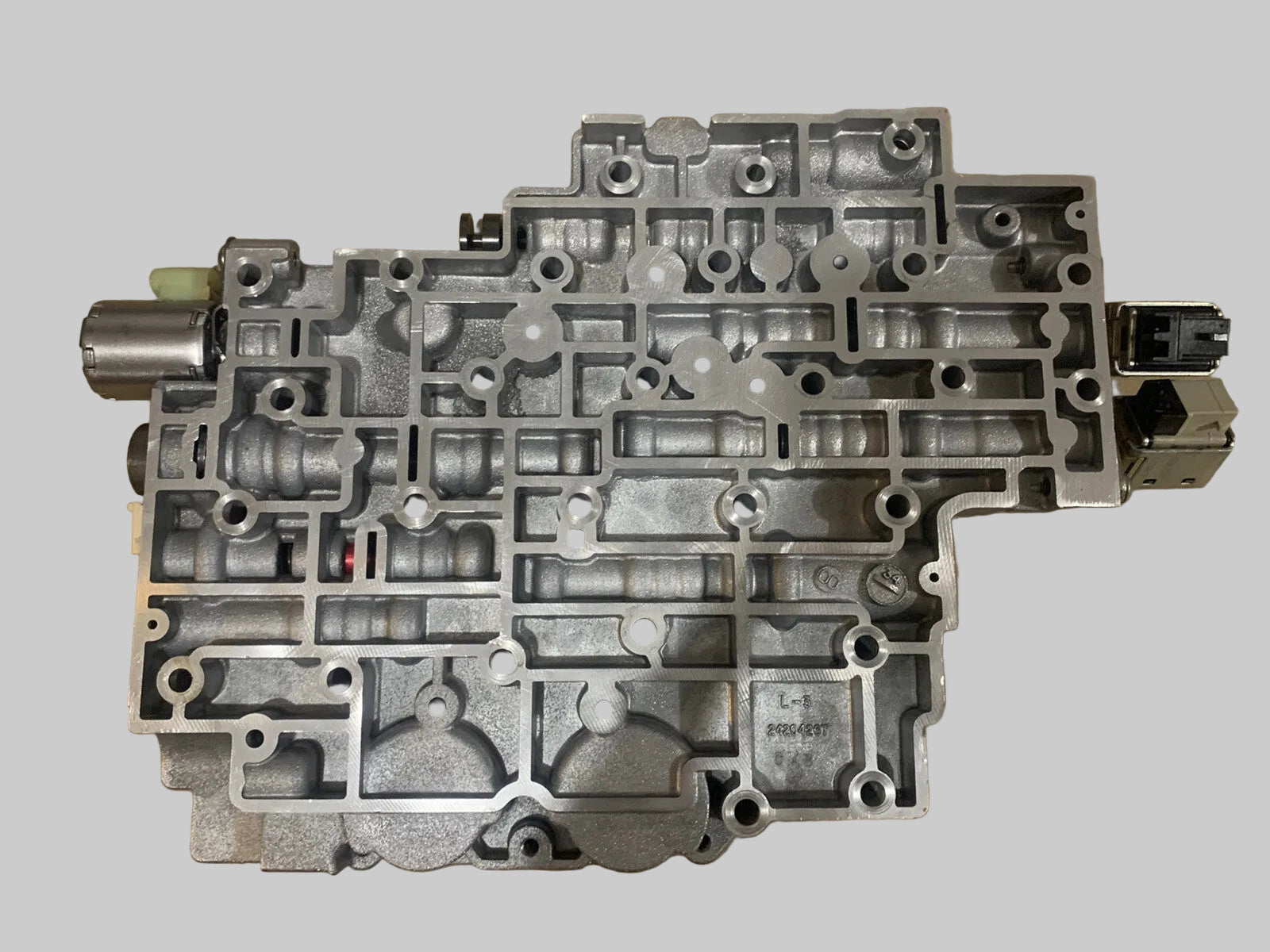
Fleet vans get transmissions swapped more than any other 4L80E application, and the units do not always come from the same year. Sonnax's 4L80-E valve body identification guide breaks them into GM026 for 1991-1992, GM027 for 1992-1996, GM028 for 1997-2003 and GM029 for 2004-later, which uses the late-style EPC solenoid with the silver canister. Sonnax notes that 1991-1996 bodies have two small holes on the upper right side that later units do not. Match the valve body and internal harness to the case year. If a van keeps setting shift solenoid codes (P0751-P0758) or the PSA code P1810 (an illegal range combination from the pressure switch assembly) after parts were swapped, check that the valve body and harness actually belong together. Our 4L80E valve body wear guide covers what to do when the bores themselves are worn.
When It Is Time for a Rebuild
If the pan has metal or heavy friction material, or the van has run on burnt fluid past 100,000 miles, rebuild it. On an Express, add these to the usual list: make sure the output carrier has its exciter ring, put back a valve body and harness from the correct year, flush the cooler and lines, and send it out on a 50,000-mile fluid and filter schedule. A good rebuild on a van comes back early for one of two reasons: a ring-less carrier, or a fleet that never changes the fluid.
Keep the numbers at the bench. Our free transmission fluid spec chart lists the correct ATF for the 4L80E and dozens of other units, so nobody tops off a work van with the wrong fluid.
FAQ
Which Chevy Express vans have a 4L80E transmission?
GM's 2005 4L80E diagnostic document lists the Express and Savana with the 4.8L, 6.0L and 8.1L engines, and the 2008 Express manual lists the 4L80-E and a 4L80-E Heavy Duty at 7.7 quarts. By 2010 the Express manual lists only the 4L60-E and the 6L90, so 2010-and-later heavy vans are six-speeds. Check the RPO label in the glovebox; MT1 is the 4L80E.
How often should an Express 2500 or 3500 4L80E get a fluid change?
GM's 2005 Express owner manual calls for a fluid and filter change every 50,000 miles if the van's GVWR is over 8,600 lb, or if it is used for delivery, towing, hilly terrain or hot city traffic. Only vans outside all of those conditions get the 100,000-mile normal interval. Check the GVWR on the driver's door label.
How much fluid does an Express van 4L80E take?
GM's 2008 Express manual lists 7.7 quarts (7.3 L) for the 4L80-E and the 4L80-E Heavy Duty. That is a pan-drop service figure, not a dry fill. Finish the fill on the dipstick with the fluid at 180-200 F.
Why does my Express van shift late after a transmission swap?
A common cause is an output carrier without the speed-sensor exciter ring. Transmission Digest reports GM dropped the ring on 1994-up 4x4 truck units, but every 2WD application still needs it, so a 4x4 core in a rear-wheel-drive van gives a false low output speed. The result is late shifts, maximum line pressure and gear-ratio codes such as P0730 or P1871.
Sources
- General Motors — 2005 4L80E Transmission Diagnostic Parameters (OBD). Backs: 4L80E use with the 4.8L, 6.0L (LQ4) and 8.1L (L18) in the Express and Savana; P0502 and P0503 set conditions including the engine- and axle-specific timers; P0711-P0713, P0741, P0742, P0894, P2761, P0751-P0758 and P1810 definitions. GM 2005 4L80E diagnostic parameters (PDF)
- General Motors — 2005 Chevrolet Express Owner Manual. Backs: the 50,000-mile fluid and filter change when GVWR is over 8,600 or under severe conditions, the 100,000-mile normal interval, DEXRON-III H-Specification, the hot-check procedure and 180-200 F operating temperature, and the less-than-a-pint low-to-full note. GM: 2005 Chevrolet Express owner manual (PDF)
- General Motors — 2008 Chevrolet Express Owner Manual. Backs: 4L60-E 5.0 qt, 4L80-E and 4L80-E Heavy Duty 7.7 qt (7.3 L) capacities, DEXRON-VI, the dipstick location and 30-minute wait conditions, the TRANSMISSION HOT IDLE ENGINE message, and the severe-service conditions. GM: 2008 Chevrolet Express owner manual (PDF)
- General Motors — 2010 Chevrolet Express Owner Manual, Capacities and Specifications. Backs: the 2010 table listing only the 4L60-E (5.0 qt) and 6L90 (6.3 qt), showing the 4L80E was gone from the Express by 2010. GM: 2010 Chevrolet Express owner manual (PDF)
- Transmission Digest — March 2001 technical bulletins, "GM Trucks and Vans With 4L80-E Transmission: Gear-Ratio Error." Backs: the 1994 elimination of the output shaft speed sensor and exciter ring on K (4x4) trucks, the requirement for a working sensor and ringed carrier on all 2WD applications, and the scan tool ratios and codes (85, P0730, P1871) caused by a carrier with no ring. transmissiondigest.com/march-2001-issue
- Sonnax — "GM 4L80-E Valve Body Identification." Backs: GM026/GM027/GM028/GM029 valve body years, the identifying holes on 1991-1996 bodies, and the silver-canister late EPC on 2004-later. sonnax.com/tech_resources/379