A GMC Sierra 2500 with a 4L80E can be one of two very different trucks. One is the old-body (GMT400) Sierra, built through 2000, where the 4L80E went behind the heavy-duty engines, including the 6.5L turbo-diesel. The other is the 2001-2007 Sierra 2500/2500HD, where it backs the gas 6.0L and 8.1L. GM's 2005 diagnostic document for the 4L80E lists it "when used with" the 4.8L, 6.0L (LQ4) and 8.1L (L18) in the Sierra, Silverado, Yukon XL, Savana and others.
A Duramax Sierra 2500HD has an Allison, not a 4L80E; the 2006 GMC Sierra owner manual covers it in its own sections. Confirm what is in the truck with the RPO label and case tag first. Our 4L80E identification guide shows where to look.
The short version: On a 1994-and-up 6.5L diesel Sierra, a worn injection pump can burn the clutches by over-fueling at low throttle, so the computer never commands enough line pressure. On 1991-95 trucks, mixing Bosch and Holley pressure control solenoids, or using the wrong output carrier, causes high line pressure or late upshifts. On every year, no reverse is often a band and drum mismatch, and heat is the common killer: GM rates 180-200 F as normal and goes into protection mode at about 265 F.
If you have a gas 2500 that plows or tows, also read our Silverado 2500 4L80E problems guide. Its roller clutch, AFL valve and converter clutch failures apply here too.
The Numbers to Have on the Bench
These come from GM's Chevrolet Performance spec sheet for the 4L85E (19300175), the heavy-duty 4L80E. The 2006 Sierra owner manual also calls for DEXRON-VI.
| Item | GM spec |
|---|---|
| Fluid | DEXRON-VI |
| Pan removal refill | 7.3 L (7.7 qt) |
| Dry fill | 12.5 L (13.2 qt) |
| Oil pan to case | 18 ft-lb (24 N-m) |
| Drain plug | 25 ft-lb (34 N-m) |
| Filter / pan gasket | GM 24212452 / 08677743 |
The 2006 Sierra owner manual puts a truck on the severe-service fluid and filter schedule if its GVWR is over 8,600 lb, or it mainly tows, works hills, or runs in 90 F city traffic. Most 2500s qualify.
1. Burned Clutches on the 6.5L Diesel: Blame the Injection Pump First
What the driver says: the shifts are soft and long, it flares under load, and a fresh rebuild is already slipping. The teardown shows burned forward, intermediate and direct clutches.
Why it happens: Transmission Digest's TASC Force covered this in "Low Line Pressure in 4L80-E in Diesel-Powered Trucks." In 1994 GM put an electronic injection pump on the 6.5L. There is no throttle cable. An accelerator pedal position (APP) sensor sets both how much fuel the engine gets and how much line pressure the transmission gets. The 1994-98 pumps can wear internally and leak, so fuel goes past the electronic controls. The truck then pulls away from a stop on 2-10% throttle instead of the usual 50-100%. The computer sees low throttle and commands low line pressure. TD's summary: more fuel means less throttle, which means less line pressure, which means clutch slip.
TD notes GM extended coverage on these pumps from 5 years/100,000 miles to 11 years/120,000 miles under special policy bulletin 00064A, and that 1994-95 pumps are the most likely to wear.
How I check it, before I touch the transmission:
- Engine hot, transmission in Park or Neutral. Bring the engine up slowly and try to hold 2,000 rpm. A good pump holds. A worn pump keeps climbing with your foot steady.
- On the scan tool, watch fuel rate. TD gives 10-13 mm at idle as normal, rising with engine speed. If you hold the pedal at 2,000 rpm and engine speed rises while fuel rate falls, the computer is trying to pull fuel back and losing. An idle fuel rate under 6 mm is another sign of extra fuel.
- Check for oil in the intake. A light film in the plenum is normal; puddles are not. Oil mist on cardboard held at the turbo outlet means leaking turbo seals, and that oil burns as extra fuel.
- Check the APP sensor too. ATRA bulletin 266 gives the normal readings: APP 1 about 0.5 V at idle rising to 4.0-4.25 V at wide open throttle, APP 2 about 4.5 V falling to 1.25 V or less, and APP 3 about 4 V falling to about 2.0-2.25 V.
The fix: repair or replace the injection pump. TD says to flush the fuel lines and tank too, since bad fuel or a failed lift pump scores the pump. Then rebuild the transmission. If you rebuild it first, the new clutches burn the same way.
2. Early-1990s Parts Mix-Ups: PCS, Solenoids and the Output Carrier
An old-body Sierra has often had two or three transmissions and a lot of used parts in it. ATRA Technical Bulletin 266 lists the 1994 changes that cause trouble when parts get mixed.
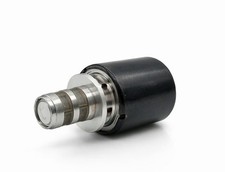
Pressure control solenoid (force motor). 1991-93 units used a Bosch PCS with a silver body (GM 8677314). From the start of 1994 production, GM switched to a Holley unit with a black body (GM 8684216). The valve and its oil passages changed. ATRA warns that a Bosch unit must not replace a Holley, or you get high line pressure. The Holley reads 3-8 ohms. Expect about 50-70% duty cycle at idle on the scan tool, dropping as load goes up.
Shift solenoids. In November 1993 (1994 models), GM changed to a third-design 1-2 (A) and 2-3 (B) solenoid. You can tell the designs apart by color: first design blue/red, second gray/green, third purple/tan. ATRA says the third design (GM 24201004 for A, 24201005 for B) works on any year 4L80E. GM also added a new case connector to stop leaks and stacked codes, so check the connector before you condemn solenoids.
Output speed sensor and carrier. This one catches people swapping a transmission into a 4x4 Sierra. ATRA says that for 1994, GM dropped the transmission output speed sensor and its toothed wheel on 4WD units. Those trucks read speed only at the transfer case. If a carrier without the toothed wheel, or a later transmission, goes into a 1991-93 truck that needs one, you get late upshifts or none. The sensor then counts the 21 machined slots in the output carrier instead of the 40 pulses per revolution the computer expects. Match the carrier, or the whole replacement unit, to the truck.
3. Speed Sensor Codes and Limp Mode on the 2001-2007 Trucks
What the driver says: it suddenly started in 2nd, the speedometer jumped, and the check engine light came on.
GM's 2005 4L80E diagnostic document gives the conditions for each code, so you know what the computer actually saw:
- P0502 (vehicle speed sensor low input): output speed under 50 rpm while input speed is over 1,400 rpm in a drive range, with 10% throttle or more.
- P0503 (vehicle speed sensor loss): an unrealistically large change in output shaft speed. Out of Park/Neutral, the trigger is a drop of more than 1,000 rpm.
- P0717 (input speed sensor): input speed under 100 rpm with the engine running and vehicle speed over 7 mph.
- P1810 (pressure switch assembly): an illegal range combination from the internal pressure switch inputs.
ATRA 266 says the 1995 VSS signal-loss code (code 72, set by the same 1,000 rpm jump) commands 2nd gear only and maximum line pressure, and the input speed code (74) turns off the converter clutch. A sudden 2nd-gear start with hard shifts is often a speed signal problem, not a clutch.
How I check it: watch input and output speed together on a road test. A signal that drops out over bumps points to the connector or harness, not the sensor. Check sensor resistance and the connector pins, and look for metal on the output sensor tip. For P1810, read the range display on the scan tool in each selector position. If it is wrong, check the pressure switch assembly and the internal harness, not the shifter.
4. No Reverse: Check the Band and Drum Pairing
No reverse is common on high-mileage 2500s. Randall Schroeder of Sonnax lays out a three-step method in "Diagnosing the Elusive No Reverse with the 4L80-E."
1. Hydraulic. Reverse uses the direct clutch and the low/reverse band. The direct clutch also works in 3rd and 4th, and the band gives engine braking in manual 1st. If 3rd and 4th are there, the direct clutch works. If manual 1st has no engine braking, suspect the band or checkballs #7 and #11. Put a gauge on line pressure in Reverse, 3rd, 4th and manual 1st.
2. Electrical. Unplug the transmission connector to force the fail-safe pattern. Sonnax notes the computer can lock out reverse if it thinks the truck is moving over 8 mph. If reverse comes back unplugged, check the speed inputs. Unplugged, it runs maximum line pressure, which can hide a leak.
3. Mechanical. Lock the band with a servo lock tool, which can be an old servo cover drilled with a nut welded on. If reverse works with the band locked, the fault is in the band apply system: servo feed passages, the separator plate gasket, sticking valves or checkballs #7 and #11. You can often fix that without pulling the transmission. If there is still no reverse, pull it and air-test the direct clutch reverse passages.
The repeat-failure trap: Sonnax says GM changed the band lining and drum finish in 1995. Early bands are grooved and run on a rougher drum. Later bands are smooth-lined and run on a smooth drum. Put a late smooth band on an early rough drum and it wears fast, sheds lining, and you are back to no reverse. Check the band against the drum year every time. More detail is in our 4L80E no reverse guide.
5. Heat and Fluid Level: What Shortens Every Repair
The 2006 GMC Sierra owner manual gives the numbers: normal transmission fluid temperature is 180 F (82 C) to about 200 F (93 C). At about 265 F (125 C) the driver information center shows TRANSMISSION HOT and the transmission goes into a protection mode that changes the shift pattern. It returns to normal below 260 F (120 C).
- Use Tow/Haul. The manual says it changes the shift pattern to cut shift cycling and improve transmission cooling when towing or hauling heavy loads.
- Check the level correctly. The manual says to wait at least 30 minutes before checking if the truck has been towing, driven at high speed for a long time, in heavy traffic, or in weather over 90 F. Otherwise the dipstick reading is off.
- Clean the cooler after any failure. Clutch material in the lines goes straight back into a fresh rebuild. Cooler and heat fixes are in our 4L80E overheating guide.
When It Is Time for a Rebuild
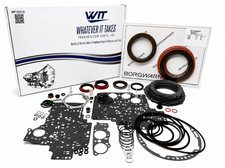
If the pan is full of friction material or metal, or more than one clutch pack is burned, it needs a full overhaul. On a Sierra 2500, do the work around it as well. On a 6.5L diesel, prove the injection pump and APP sensor are good first. On a 1991-95 truck, match the PCS, solenoids and output carrier to the year. On any truck, pair the reverse band to the drum. Match the kit to the year: 1990-96 and 1997-up kits differ.
Keep the numbers at the bench. Our free transmission fluid spec chart lists the correct ATF for the 4L80E and dozens of other units.
FAQ
Does my GMC Sierra 2500 have a 4L80E or an Allison?
GM's 2005 diagnostic document lists the 4L80E with the gas 4.8L, 6.0L and 8.1L in the Sierra, and on the old-body trucks it also went behind the 6.5L turbo-diesel. A Duramax Sierra 2500HD uses the Allison, which the 2006 Sierra owner manual covers in separate sections. Check the RPO label and the case tag before ordering parts.
Why does my 6.5L diesel Sierra keep burning 4L80E clutches?
A worn 1994-98 electronic injection pump can leak extra fuel past its controls, so the truck accelerates on very little throttle. The computer sets line pressure from the pedal sensor, so it commands too little pressure and the clutches slip. Transmission Digest's test is to hold 2,000 rpm in Park: if engine speed keeps climbing and the scan tool fuel rate drops, fix the pump before rebuilding the transmission.
Why did my Sierra 4L80E suddenly start in 2nd gear?
That is usually the fail-safe mode. ATRA bulletin 266 says the speed signal loss code commands 2nd gear only and maximum line pressure. On later trucks GM sets P0503 when output speed drops more than 1,000 rpm at once, so check the speed sensor connectors and harness before you suspect a clutch.
What causes no reverse on a 4L80E after a rebuild?
A common cause is a mismatched band and drum. Sonnax notes GM changed from a grooved band on a rougher drum to a smooth band on a smooth drum in 1995, and a smooth band on an early drum wears out fast. Check servo feed passages, the separator plate gasket and checkballs #7 and #11 as well.
Sources
- General Motors — 2006 GMC Sierra Owner Manual. Backs: DEXRON-VI for the automatic, the 180-200 F normal range, TRANSMISSION HOT and protection mode at about 265 F with return below 260 F, the Tow/Haul description, the severe-service definition (GVWR over 8,600 lb, towing, heat, hills), the 30-minute wait before checking fluid, and the separate Allison sections. GM: 2006 GMC Sierra owner manual (PDF)
- General Motors — 2005 4L80E Transmission Diagnostic Parameters (OBD). Backs: 4L80E use with the 4.8L, 6.0L (LQ4) and 8.1L (L18) in the Sierra and other trucks; the set conditions for P0502, P0503, P0717 and P1810. GM 2005 4L80E diagnostic parameters (PDF)
- General Motors / Chevrolet Performance — Supermatic Transmission (4L85E 19300175) Specifications. Backs: DEXRON-VI, the 7.7 qt pan and 13.2 qt dry capacity, the pan and drain plug torque, and the filter and pan gasket part numbers. Chevrolet Performance 4L85E spec sheet (PDF)
- ATRA — Technical Bulletin #266, "4L80E Updates." Backs: the 1994 change from Bosch (8677314) to Holley (8684216) pressure control solenoids and the high line pressure warning, the 3-8 ohm and 50-70% duty cycle readings, the shift solenoid color codes and 24201004/24201005 part numbers, the new connector, the dropped 4WD output speed sensor and 21-slot versus 40-pulse carrier problem, the 4WD Low circuit 1493, codes 72, 74 and 79, and the 6.5L APP sensor voltages. ATRA bulletin 266 (PDF)
- Transmission Digest (Sonnax TASC Force) — "Low Line Pressure in 4L80-E in Diesel-Powered Trucks." Backs: the 1994 electronic 6.5L injection pump and APP-based line pressure, the 2-10% throttle over-fueling failure, GM special policy 00064A, the 2,000 rpm hold test, the 10-13 mm normal and under-6 mm idle fuel rate, and the turbo seal check. transmissiondigest.com
- Sonnax — Randall Schroeder, "Diagnosing the Elusive No Reverse with the 4L80-E." Backs: the hydraulic, electrical and mechanical split test, the 8 mph reverse lockout, checkballs #7 and #11, the servo lock tool, and the 1995 band lining and drum finish change. sonnax.com/tech_resources/88