Nobody asks what a 4R100 rebuild costs until the truck is already sitting in the lot with a slipping overdrive or a burned smell on the dipstick. By then the owner wants one number, and the honest answer is that there isn't one. There's a floor, which is a clean unit that only needs soft parts. Everything above the floor depends on what's broken inside the case and whether the last person to open it did the job right.
This guide walks through where the money goes on a 4R100 overhaul the way a builder prices it. That means the soft parts that every job gets, the hard parts that turn a routine job into an expensive one, the updates that separate a rebuild that lasts from a comeback, and the questions to ask before you sign an estimate. The specs are from the ATSG 4R100 manual. The failure points and upgrades are from Sonnax and Transmission Digest (full list under Sources).
What you're paying to rebuild
ATSG describes the 4R100 as the updated E4OD, first introduced for the 1999 model year in F-250 through F-550 Super Duty trucks, E-series vans, and the Expedition, Navigator and Excursion with the 5.4L, 6.8L and 7.3L engines. PTO-capable cases were an option on Super Duty trucks of 8,500 lb GVW and up with the 6.8L gas or 7.3L diesel. That matters for cost, because PTO units use different drums and pump parts, as covered below.
Inside, ATSG lists seven friction apply elements (intermediate band plus the coast, overdrive, intermediate, direct, forward and low/reverse multi-disc clutches), three one-way clutches (overdrive roller, intermediate sprag, low roller) and three simple planetary gearsets. Five solenoids handle line pressure, shift scheduling, coast clutch engine braking and TCC apply. It's a big, heavy unit with a lot of friction material, so it has a lot of parts that can be worn or burned. That's why the gap between a cheap rebuild and an expensive one is so wide.
The floor: soft parts every rebuild gets
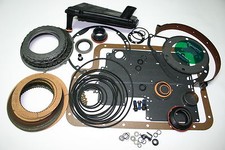
Every honest overhaul replaces the soft parts no matter what the unit looks like: overhaul gasket and seal kit, all friction plates, the band, filter, and usually a steel plate kit. The two ways to buy that are a master rebuild kit (gaskets, seals, frictions, filter, often steels) or an overhaul kit plus a separate friction pack. Kit price varies more with year range and drivetrain than with brand, because plate counts change. ATSG warns that the number of forward plates is model sensitive, so a gas pack and a diesel pack are not interchangeable.
The soft-parts floor is fairly predictable. For a price check, a 1998-and-up master kit runs roughly $300 to $600 depending on what's included and whether steels are in the box (see the recommended parts above). A high-performance kit with upgraded frictions for a towing or modified diesel truck runs well over $1,000. That's a real choice, not an upsell: a truck that pulls a gooseneck at the rated limit needs clutch capacity that a street truck doesn't.
What pushes the bill up: hard parts
This is where two quotes for "a 4R100 rebuild" end up $1,500 apart. When the unit comes apart, a builder inspects every drum, shell, bushing and planetary. What's worn gets replaced, and each one adds to the ticket. The usual suspects on this unit:
Center support and its feed circuits
The center support feeds the intermediate and direct clutches. Sonnax lists its intermediate and direct clutch feed seal kit (36424-24K) for burned clutches and slip conditions. It also makes a center support gasket (36743G) for forward clutch failure and low lube flow, a center support ring (36743-02) for wear at the contact points and input drum wear, and an aluminum shim (36743-01, .204 in.) for cross leaks and feed passage leaks. These are cheap parts. The expensive part is not using them, because new frictions installed over the same leak burn again.
Pump
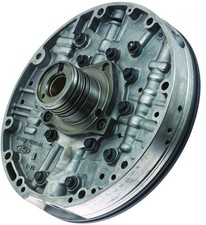
Sonnax lists pump bushing wear (front seal leaks, excess clearance), pump gear wear (low line pressure, pump noise), and line-to-lube regulator valve wear (engine stall on reverse engagement) as recurring pump problems. A pump with a scored body or pocket gets replaced. A pump that's in spec gets a bushing and a reseal. That can be a $60 difference or a $250 difference, and you won't know which until the pump is on the bench.
Drums, shells and one-way clutches
A unit that was driven until the forward or overdrive clutches burned up usually takes the drum surfaces, the sun shell or a sprag with it. Sonnax lists a forward clutch piston (36434A) for burnt forward clutch conditions, a heavy-duty input shaft (36670-HD), and a spiral snap ring (36744-01) described as preventing overdrive loss and catastrophic failure. Replacement drums, sprags and planetaries each typically cost $80 to $300 new. One burned unit can need three of them.
Valve body
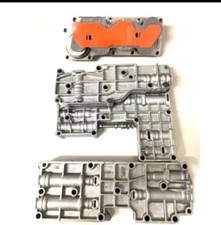
The valve body is the most variable line on the bill. A body with light wear gets a cleaning, new separator plate gaskets, and Sonnax-style repair valves where the bores are worn. Sonnax lists the 1-2/2-3 accumulator control valve kit (36948-13K) for soft shifts, no 2nd and no 3rd, the 3-4 accumulator kit (36948-09K) for no 4th and premature clutch wear, and the oversized manual valve kit (36947-13K) for delayed reverse and reverse slip. A body with several worn bores, or one that was reamed and parted out by the last shop, often costs less to replace outright than to repair valve by valve. Budget for either case until someone has it apart.
Solenoid block
The solenoid pack is serviced as an assembly. Replacement is only needed when testing shows a failed solenoid or a bad connector, not by default on every rebuild. When it's needed, the pump and block have to match (see the interchange section below).
The torque converter line
Rebuilt units need a rebuilt or new converter. Reusing the old one puts the old unit's debris straight back into the new transmission's cooler circuit. This is a line on nearly every legitimate 4R100 estimate. On this unit it's more than a box to check. In a May 2006 Transmission Digest article, Sonnax's Ed Lee explained that the 4R100 turbine hub with a bearing lacks the bypass lube passages the E4OD had, so converter-charge and release oil can pass only through three slots between the turbine shaft and hub. He called for a minimum of 0.035-0.040 in. of endplay to allow enough release oil flow and prevent drag on the cover. A cheap converter built without attention to that endplay is a common reason a fresh 4R100 runs hot or shudders.
Interchange mistakes that add cost later
Mixed-up parts are a hidden cost. Transmission Digest's "Mix and Match Is Not an Option" (Mike Riley, 2014) explains why. In 1998 Ford went to a common F81P pump casting for three pump types: E4OD, 4R100 with on/off lockup, and 4R100 with PWM lockup. Those pumps are told apart by stator support orientation and TCC end-plug depth. On PWM pumps the plug sits about 1/4 in. from the cover O.D. On non-PWM pumps it sits more than an inch out. The solenoid block has to match the pump (PWM vs. non-PWM). Coast clutch drums changed too: non-PTO and PTO drums carry different part numbers (YC3Z-7A387AA and YC3Z-7A387BA, later 1C3Z-7A387AA and 1C3Z-7G387BA). The later PTO drum uses an oil dam washer that can't be fitted to earlier PTO drums without throwing off the stack-up.
A cheap rebuild that mixes these parts may shift fine off the stand and then cook a bearing, cycle the TCC, or fail the stack-up. Then the owner pays twice.
Two cheap updates that protect the whole bill
Two failures on this family take expensive parts with them, and both are worth asking about by name. The first is the front lube/drainback valve. Per Sonnax, the OE plastic ball seat and stop can melt at elevated fluid temperature and restrict the front lube oil feed circuit, which results in overdrive planetary failure. Sonnax's 36425-01K replaces them with aluminum parts and fits both the 4R100 and the E4OD. The kit costs far less than the planetary it protects.
The second is the case connector. Transmission Digest's "Top 10 Problems at Installation, Part 2" singles out the E4OD/4R100 connector for corrosion, in one case eating the solenoid pack pins away in four weeks, and for a lock tab that breaks easily. A loose or corroded connector sets codes and causes shift complaints that look internal, so a fresh rebuild can come back for a problem that is really in the harness. Inspect the connector and lock tab at install and fix them before the truck leaves. The same checks apply to the earlier unit; see our E4OD rebuild cost guide for the 1989-97 version of this breakdown.
Where the labor goes
On most 4R100 jobs, labor costs about as much as parts or more. The bill has three pieces: removal and installation, the bench overhaul, and cooler flushing plus road-test time. Super Duty 4x4 and PTO trucks take longer to remove and install than a 2WD van. The bench time depends on how much measuring the builder actually does. ATSG gives these selective clearances:
| Clutch pack | Clearance (ATSG) | Set with |
|---|---|---|
| Forward clutch | 0.76-1.40 mm (.030-.055 in.) | Selective snap ring, 5 sizes |
| Direct clutch | 1.15-2.06 mm (.045-.081 in.) | Selective snap ring |
| Coast clutch | 0.76-1.27 mm (.030-.050 in.) | Selective snap ring |
ATSG also calls for the oil pump-to-case bolts at 24-31 N·m (18-23 ft-lb) in a criss-cross pattern and the low one-way clutch inner race bolts at 24-34 N·m (18-25 ft-lb). A builder who sets every clearance and torques every fastener to spec charges for that time. It's time well spent. Clutch clearance too tight causes drag and heat. Too loose causes slow, slipping applies. Either way the unit comes back.
Finish with fresh fluid. ATSG's manual specifies Mercon, set at 150-170°F at idle in park on the dipstick. Motorcraft now states that Mercon V is suitable for transmissions previously serviced with Mercon. Figure on roughly a full refill plus converter fill, so buy extra.
Reading an estimate
The FTC's consumer guidance on auto repair makes several points that apply directly to a transmission job. Get a written estimate that names the condition to be repaired, the parts and the expected labor, and says the shop will call before exceeding it. Ask for your replaced parts back, since some state laws require that. Get the warranty in writing, because there is no "standard" repair warranty. The FTC also notes that "rebuilt" and "remanufactured" generally mean the same thing, so ask what the rebuild actually includes rather than relying on the label.
From the builder side, a good 4R100 estimate breaks out:
- Soft parts (master kit or overhaul kit plus frictions), and which drivetrain and year range it's for
- A converter line, rebuilt or new, not "reuse"
- An allowance or teardown call for hard parts: pump, drums, sun shell, sprags, planetaries
- Valve body: cleaned and updated, or replaced
- Center support and feed updates (seal kit, gasket, shim)
- Cooler flush or cooler replacement, and fluid
- Warranty terms, in writing
A quote with no converter line, no mention of the center support, and a single flat price before teardown is either assuming the best case or leaving things out.
Ways to keep the cost down without cutting corners
- Stop driving it once it slips. A slipping forward or overdrive clutch generates heat that takes drums, shells and the converter with it. The difference between a soft-parts rebuild and a hard-parts rebuild is often a few more days of driving.
- Diagnose before you commit. Solenoid, TRS and wiring faults can mimic internal failure. Check codes and line pressure first (see the related guides below).
- Buy the parts to the unit. Confirm year, gas or diesel, 2WD or 4WD, PWM or on/off lockup, and PTO or non-PTO before ordering. Returns cost time, and wrong parts that get installed cost a lot more.
- Do the updates once. The Sonnax center support and feed parts cost very little compared with a second teardown.
Shop the part for this fix: 4R100 Stage 1 master rebuild kit (1998-up)
The soft-parts core of a 4R100 overhaul: gaskets, seals and frictions for 1998-up units in one box. Confirm your year and drivetrain before ordering.
See the 4R100 master kit at CoreTransmissionPartsNeed parts for this job?
Our 4R100 parts page carries master rebuild kits, pumps, valve bodies, drums and sprags, with checkout on site. Match the part to the model year, gas or diesel, and 2WD or 4WD before you order.
FAQ
How much does it cost to rebuild a 4R100?
It depends mostly on what is damaged inside. The floor is soft parts (a 1998-up master kit runs roughly $300 to $600), a rebuilt converter, fluid and labor. Every hard part the teardown turns up, like a scored pump, burned drum, sun shell, sprag or worn valve body, adds to that, which is why two quotes can be $1,500 apart.
Why do 4R100 rebuild quotes vary so much?
Because nobody knows what the hard parts look like until the unit is apart. A quote that includes a converter, center support updates and a hard-parts allowance will be higher than a flat soft-parts price, but it is closer to what the job really costs. The FTC recommends a written estimate and a call before the shop goes over it.
Is it cheaper to rebuild or replace a 4R100?
If the unit was caught early and only needs soft parts, a rebuild is usually cheaper. If the case, drums, pump and valve body are all damaged, a rebuilt or remanufactured unit can come out close to the same price. The FTC notes that rebuilt and remanufactured generally mean the same thing, so compare what is actually included and the written warranty.
Do I need a new torque converter with a 4R100 rebuild?
Yes. The old converter holds debris from the failure. On the 4R100, converter endplay also matters: Sonnax's Ed Lee called for a minimum of 0.035-0.040 in. to allow enough release oil flow, because the 4R100 turbine hub lacks the E4OD's bypass passages.
What fluid does a rebuilt 4R100 take?
The ATSG manual specifies Mercon, checked at 150-170 degrees F at idle in park. Motorcraft states Mercon V is suitable for transmissions previously serviced with Mercon, and that is what most shops fill with today.
Related guides
- Ford 4R100 Transmission: Common Problems, Service Tips, and Rebuild Considerations
- 4R100 Slipping: Causes, Codes and the Fix
- 4R100 Valve Body Wear and the Fix
- 4R100 vs E4OD Differences
- 4R100 Fluid Change Cost
Sources
- ATSG (Automatic Transmission Service Group), Ford 4R100 technical service manual (2003). Backs the 1999 introduction and vehicle applications, PTO availability on 8,500 lb GVW and up Super Duty trucks, the seven friction elements / three one-way clutches / three planetaries, the forward, direct and coast clutch clearances, the pump and inner race bolt torques, the model-sensitive forward plate count, and the Mercon fluid and 150-170°F check temperature. ATSG manual (PDF)
- Sonnax, Ford 4R100 unit page. Backs the center support gasket, ring and shim (36743G, 36743-02, 36743-01), the intermediate/direct clutch feed seal kit (36424-24K), the pump bushing, gear and line-to-lube valve wear symptoms, the forward clutch piston (36434A), the spiral snap ring (36744-01), and the accumulator and manual valve kits (36948-13K, 36948-09K, 36947-13K). sonnax.com
- Transmission Digest, "E4OD/4R100 Component Upgrade: Mix and Match Is Not an Option," Mike Riley (2014). Backs the 1998 F81P common pump casting, PWM vs. non-PWM end-plug identification, solenoid block-to-pump matching, and the coast clutch drum part numbers and oil dam washer restriction. transmissiondigest.com
- Transmission Digest, "4R100 Flow Issues," Ed Lee of Sonnax (May 2006). Backs the turbine hub bypass-passage difference from the E4OD and the 0.035-0.040 in. minimum converter endplay. transmissiondigest.com
- Ford Customer Service Division (Motorcraft), Mercon V automatic transmission fluid product data. Backs Mercon V being suitable for transmissions previously serviced with Mercon. fcsdchemicalsandlubricants.com
- Federal Trade Commission, "Auto Repair Basics." Backs the written estimate, replaced-parts, written warranty, and rebuilt vs. remanufactured guidance. govinfo.gov (FTC PDF)
- Sonnax, Front Lube/Drainback Valve Kit 36425-01K. Backs the melting OE plastic ball seat and stop restricting the front lube circuit and causing overdrive planetary failure on the 4R100 and E4OD, and the aluminum replacement. sonnax.com
- Transmission Digest, "Top 10 Problems at Installation, Part 2." Backs E4OD/4R100 case connector corrosion (solenoid pack pins gone in four weeks), the easily broken lock tab, and codes returning after installation from a broken harness lock tab. transmissiondigest.com