The Escalade is the heaviest, most loaded-up thing GM ever bolted a 6L80 behind. It runs a 6.2L V8 and a lot of curb weight, and it often has AWD and big wheels. Many of them tow. The transmission is the same Hydra-Matic six-speed (RPO MYC) you find in a Tahoe or a Silverado. What differs is which GM bulletins name the Escalade and how hard the truck works the converter and the fluid. If an Escalade comes in with a shift complaint, the model year usually narrows it to one or two causes before you pull a bolt.
This post covers only what GM has published that names the Escalade, plus the high-mileage wear we see on every 6L80 that has lived a heavy life. For the transmission-wide list, see our 6L80 common problems guide. The sister trucks are covered in 6L80 Tahoe problems and 6L80 Silverado 1500 problems.
The short version: 2007 early builds hunt gears at 30-50 mph with P1751 from a bad spacer plate (07-07-30-002). 2013-2015 Silao plant 2 units leak at the stator support gasket and slip warm or clunk 1-2 (PIP5175B). Early 2015 L86 trucks shudder in V4 and need a TCM reflash (PI1279). High-mile trucks wear the TCC regulator and pump pressure regulator bores. Fluid is DEXRON-VI, 6.0 quarts per pan-and-filter service.


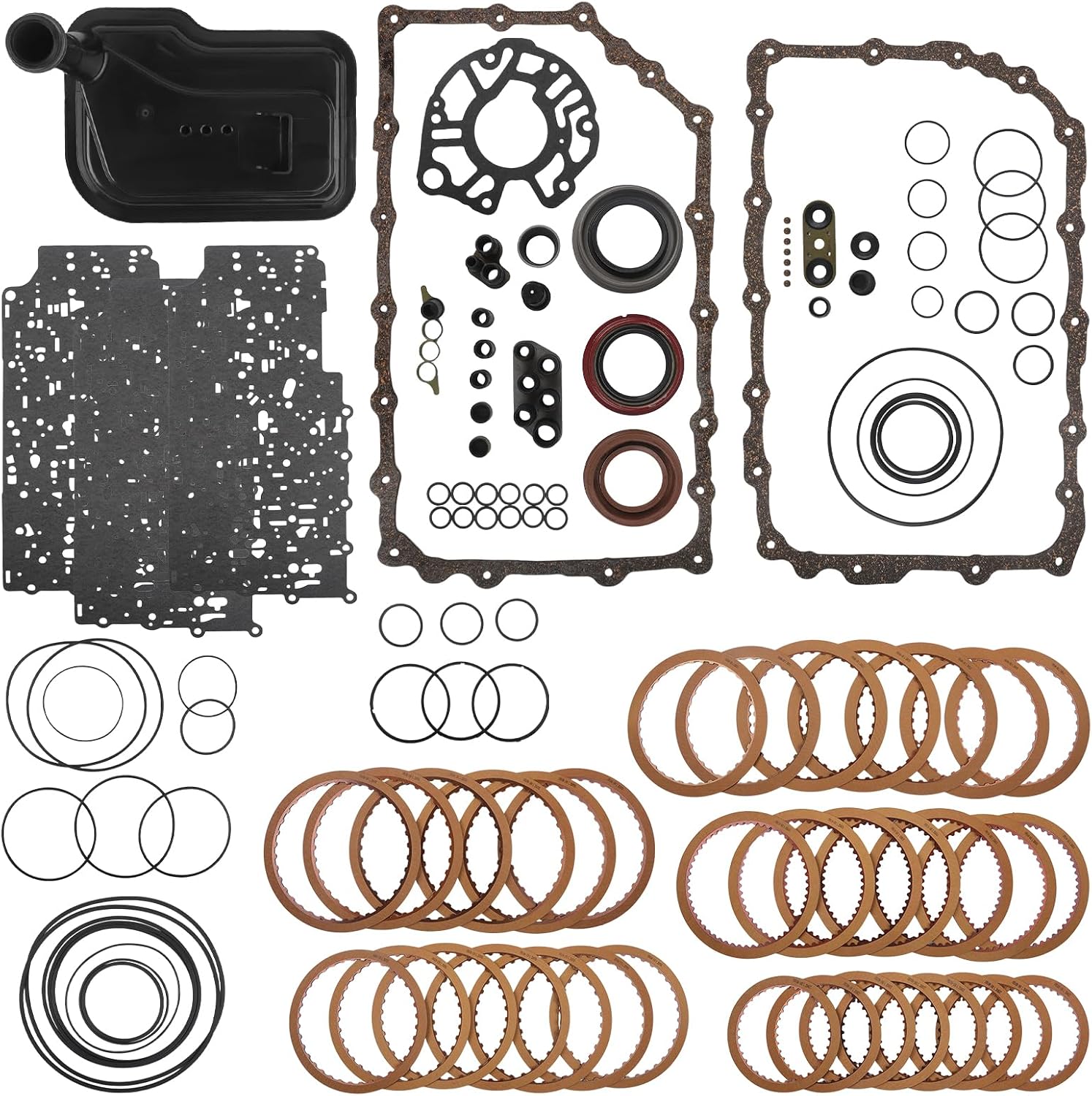
First: Confirm You Are Looking at a 6L80
The Escalade years that matter here run from 2007 to 2015. GM's 2012 Escalade/Escalade ESV owner manual lists the 6.2L V8 (VIN code F) with a Hydra-Matic 6-speed automatic. It also sends Hybrid owners to a separate supplement, and that matters. The 2009-2013 Escalade Hybrid uses GM's two-mode hybrid transmission, which is a different unit, so nothing below applies to it. At the other end, PI1279 lists the 2015 Escalade and ESV with the 6.2L L86 and the 6L80 (MYC). From the 2016 model year the Escalade moved to the eight-speed 8L90, which has its own failure list.
Read the Service Parts Identification label in the glovebox and look for MYC before you diagnose anything. On 2013-2015 trucks you also need the transmission's source code, and I cover why in section 2. If the label says the truck is a Hybrid, stop here.
1. 2007 Early Builds: Busy Shifting at 30-50 mph and P1751
The first model year of the 6L80 Escalade had a production defect GM fixed in the factory partway through. GM bulletin 07-07-30-002 covers the 2007 Escalade, Escalade ESV and Escalade EXT, plus the Yukon Denali twins, built before December 2006. The complaint is busy shifting: frequent up- and downshifts in 3rd, 4th, 5th or 6th gear at roughly 30-50 mph (48-80 km/h). The MIL may be on with DTC P1751 stored in the TCM.
GM's cause is an undersized hole or debris in the control valve body spacer plate. On a 6L80 the TCM, solenoids and valve body are one assembly (the TEHCM), so this is easy to misread as a bad module. The fix is a revised spacer plate. GM changed the plate on the assembly line on November 4, 2006, so a truck built after that date should not have this problem. The parts listed in the bulletin are spacer plate 24242053 (with gaskets) and solenoid filter plate kit 24236934. The bulletin also calls for new electrical connector seals, fluid pump seals and center support seal while you are in there.
One procedural point catches people. On the 2007 trucks GM says the service fast learn adapts must be run after the repair. (The 2006 cars in the same bulletin were told not to run them.) If you skip the fast learn on an Escalade, the shifts can stay harsh or soft and look like a failed repair.
2. 2013-2015: Warm Slip, Delayed Engagement and a 1-2 Clunk
This is the Escalade-era failure I would check first on a late GMT900 truck. GM Preliminary Information PIP5175B (May 2014) covers the 2013-2015 Escalade with the 6L80 MYC, and only units built in the Silao, Mexico plant 2. GM tells you to confirm this with the source code. Per SI document 2610129 it is item 7 on the transmission ID, and a code of (2) is the one that applies. That revision exists only to add the plant check, so don't apply it to every 6L80 that slips.
The complaints are a delayed engagement into Drive, shudder on launch, slipping into 1st through 4th, and a bump or clunk on the 1-2 shift. The tell is that they may only show up once the transmission is at operating temperature. Hot ATF is thinner and leaks past a bad seal more easily, so the same loss that is hidden cold shows up warm.
GM's cause is loose stator support-to-pump cover bolts, which lets the stator support-to-pump cover gasket leak. That leak bleeds the 1-2-3-4 clutch circuit. GM's test, after normal diagnosis comes up empty:
- Drop the pan and remove the transmission control assemblies.
- Wear eye protection and apply compressed air to the 1-2-3-4 clutch apply passage. Check for air coming out of the compensator feed passage in the pump cover.
- If nothing comes out there, listen for heavy air leakage inside the case. Look up through the case opening between the pump stator support and the 1234/3-5-R clutch housing for fluid or a misaligned gasket.
- Check the bolts with your fingers only, or a bare socket turned by hand counterclockwise. GM is explicit: never check them with a tool, because they are torqued at the factory and are never supposed to be loosened.
If any bolt is loose or the gasket is out of place, GM replaces the pump cover (kit 24248573). You then inspect the 1-2-3-4 clutch pack, which uses six friction plates (24224147) and five steels (24258080). GM adds that the adapts must be reset after the pump cover goes in. On a truck that has been slipping warm for a while, expect that clutch pack to be burnt. If it is, you are doing a rebuild, not a pump job.
3. 2015 Escalade: TCC Shudder in V4 Mode and a Firm Cold 1-2
The 2015 Escalade was the first year of the new body. It kept the 6L80 behind the new direct-injected 6.2L L86, which has Active Fuel Management and runs on four cylinders at light load. GM PI1279 (July 2014) covers 2015 Escalade and ESV trucks built before March 28, 2014 with two complaints. One is a TCC shudder on throttle tip-in at low speed while in 3rd gear and V4 mode. The other is a firm cold 1-2 upshift.
The fix is software. Update the TCM through SPS with the latest calibration, with the battery charged and held at 12-15.5 volts during programming. GM wants a Midtronics PSC 550 maintainer or a GR8 in power supply mode on the truck. This is the trap on these trucks. A V4 shudder feels exactly like a failing converter clutch, and people have sold converters to fix a calibration. Check the build date and the calibration on file before you condemn hardware. If the truck already has the latest software and still shudders, go to section 4.
On the scan tool, watch TCC Slip Speed, TCC Pressure Control Solenoid commanded pressure and Transmission Fluid Temperature together, along with the AFM cylinder-deactivation status. A shudder that only happens in V4 and goes away when you force V8 points at calibration. A shudder with slip speed swinging in V8 too points at the converter clutch or its hydraulic control.
4. High Mileage: TCC Regulator and Pump Pressure Regulator Wear
Once an Escalade is past the bulletin years and well up in miles, the failures are wear, not defects. Two valves do most of the damage, and the second one is easy to misdiagnose.
TCC regulator valve bore wear (valve body)
Sonnax lists the symptoms of a worn TCC regulator valve bore on the 6L80. They are overheated fluid, fail-safe mode, harsh shifts, harsh TCC apply, poor fuel economy, excessive TCC slip and P0741/P0742. Bore wear lowers TCC apply and converter charge pressure. A valve stuck applied gives a harsh lockup. One stuck released gives no apply or a slipping clutch. Sonnax's test is a vacuum check at the specified ports. If it reads below their minimum in-Hg, or you can see wear, the bore needs its TCC regulator valve kit 104740-46K. On a heavy Escalade that slips the converter on the highway, that slip makes a lot of heat. That is why so many of these cook their fluid.
Pressure regulator bore wear (pump)
The main pressure regulator lives in the pump, not the valve body, so a valve body swap will not fix it. Sonnax describes three wear patterns. Wear at the balance end of the bore gives high line pressure, harsh shifts and overheating from poor cooler and lube flow. Wear at the outboard spool cuts converter feed and gives low line pressure. Wear at both ends gives erratic pressure. The fix is Sonnax drop-in PR valve 104520-15K, which replaced the older 104520-14K that needed the pump drilled. Do not mix them up. Sonnax warns that the discontinued valve without the drilling gives excessively high line pressure.
A high-mile Escalade that overheats, flares and burns clutches often has both bores worn. A new valve body alone treats half of it.
Slip Bulletins That Name the Escalade
Two more GM documents name the Escalade and are worth knowing before you condemn a whole transmission. GM bulletin 09-07-30-004J covers the 2007-2008 Escalade, ESV and EXT for slips in reverse or fifth, slips when passing, harsh 2-3 shifts and P0776, P2715 or P2723. The cause can be a cracked weld on the 1-2-3-4 / 3-5-R clutch housing, found with soap compound and shop air in the 3-5-R feed hole [7]. GM Preliminary Information PI0773 covers 2007-2012 Escalades with P0796 and slip or no 4th, 5th or 6th, and tells you to tear down the pump whenever the 4-5-6 clutch is burnt, because a scored rotor, vane or cover or a cracked slide will burn the new pack [8]. Our 6L80 Escalade slipping guide works through each slip pattern by gear.
5. Fluid and Heat on an Escalade
Per the 2012 Escalade owner manual, the transmission takes DEXRON-VI, and a pan removal and replacement takes about 6.0 quarts (5.7 L). That is a partial change; the converter and cooler hold the rest. The transfer case on AWD trucks also takes DEXRON-VI, 1.5 quarts (1.4 L). The manual's hot check is done at 160-200°F (71-93°C) fluid temperature. The cold check, at 80-90°F (27-32°C), is only a reference until a hot check can be done. GM notes a cold top-off is usually less than a pint, and you should never overfill it.
The same manual tells the driver to stop if the cluster shows TRANSMISSION HOT IDLE ENGINE, and it defines severe service. That means mostly heavy city traffic in hot weather, mostly hills or mountains, frequent trailer towing, high-speed driving, or taxi, police or delivery use. A lot of Escalades fit at least one of those. If yours does, service it on the severe schedule, not the normal one. When you do service it, drain and look at the pan. Fine gray paste is normal wear. Bronze flakes or chunks of friction material mean the decision is already made.
A Quick Diagnostic Order for an Escalade 6L80
- Confirm MYC on the glovebox label and rule out a Hybrid. Note the model year and build date.
- 2007: busy shifting at 30-50 mph with P1751 on a pre-December 2006 build points at the spacer plate (07-07-30-002). Run fast learn after the repair.
- 2015: shudder only in V4 on light throttle in third on a pre-March 28, 2014 build points at the PI1279 calibration. Check the software before the converter.
- 2013-2015: slipping or a 1-2 clunk only when hot, on a Silao source code (2) unit, points at the stator support air test in PIP5175B.
- Any year: log TCC Slip Speed, TFT and line pressure on a highway road test. High slip with rising TFT and P0741/P0742 points at the TCC regulator bore. Erratic or high line pressure points at the pump pressure regulator.
- Check the fluid level hot at 160-200°F and look at the pan before you quote anything.
FAQ
What years of Cadillac Escalade have the 6L80 transmission?
The 6L80 (RPO MYC) was used in the 2007 through 2015 Escalade, ESV and EXT with the 6.2L V8. GM bulletin 07-07-30-002 names the 2007 trucks and PI1279 names the 2015 Escalade with the L86 and 6L80. The 2009-2013 Escalade Hybrid uses a different two-mode transmission, and the 2016 and later Escalade moved to the 8L90.
Why does my Escalade slip or clunk on the 1-2 shift only when it is warmed up?
On a 2013-2015 Escalade with a Silao plant 2 transmission, GM PIP5175B blames loose stator support-to-pump cover bolts that let the pump cover gasket leak. Hot fluid leaks past the gap more easily, so the slip, delayed engagement or 1-2 clunk shows up warm. The fix is a new pump cover (kit 24248573), a check of the 1-2-3-4 clutches and an adapt reset.
Why does my 2015 Escalade shudder at low speed on light throttle?
GM PI1279 covers a TCC shudder on throttle tip-in in 3rd gear while the L86 is running in V4 mode on 2015 Escalades built before March 28, 2014. The fix is a TCM software update through SPS, not a torque converter. If the latest calibration is already installed and it still shudders in V8 as well, diagnose the converter clutch and the TCC regulator valve.
What fluid and how much does an Escalade 6L80 take?
GM specifies DEXRON-VI, and a pan removal and replacement takes about 6.0 quarts (5.7 L) per the 2012 Escalade owner manual. Check the level hot at 160-200°F and do not overfill. AWD trucks also use DEXRON-VI in the transfer case, about 1.5 quarts.
Sources
- General Motors — 2012 Cadillac Escalade/Escalade ESV Owner Manual (hosted by GM). Backs: 6.2L V8 (VIN F) with Hydra-Matic 6-speed, the Hybrid supplement note, DEXRON-VI for the transmission and transfer case, 6.0 qt (5.7 L) pan-removal capacity, 1.5 qt transfer case, hot check 160-200°F and cold check 80-90°F, the less-than-a-pint top-off, the TRANSMISSION HOT IDLE ENGINE message and the severe-service conditions. 2012 Escalade owner manual (PDF)
- General Motors — Preliminary Information PIP5175B, "Slip Or Shudder During A Launch In First Second Third Or Fourth Gears, Delayed Engagement Into Drive, Clunk Or Bump During The 1-2 Shift," May 2014 (hosted by NHTSA). Backs: 2013-2015 Escalade 6L80 MYC Silao plant 2 coverage, the source code (2) check per SI 2610129, warm-only symptoms, the stator support bolt/gasket leak, the 1-2-3-4 air test, the finger-only bolt check, pump cover kit 24248573, clutch plates 24224147/24258080 and the adapt reset. GM PIP5175B (PDF)
- General Motors — Preliminary Information PI1279, "TCC Shudder on Throttle Tip-in, 1-2 Firm Upshift Cold," July 2014 (hosted by NHTSA). Backs: 2015 Escalade/ESV with L86 and 6L80 built before March 28, 2014, the 3rd-gear V4 shudder, the firm cold 1-2, the SPS TCM recalibration and the 12-15.5 V programming requirement. GM PI1279 (PDF)
- Sonnax — TCC Regulator Valve Kit 104740-46K (6L45/6L50/6L80/6L90). Backs: the worn TCC regulator bore symptoms (overheat, fail-safe, harsh shifts and TCC apply, P0741/P0742, excess slip), stuck-apply vs stuck-release behavior and the vacuum test trigger. Sonnax 104740-46K
- Sonnax — "Why Do I Drill the Pump? Preventing Excess 6L80 Series Line Pressure with a Drop-In Sonnax PR Valve." Backs: the three pressure regulator bore wear patterns and their line pressure effects, the drop-in 104520-15K replacing the drilled 104520-14K, and the high-line-pressure warning. Sonnax PR valve technical article
- General Motors — Service Bulletin 07-07-30-002, "6L80 Automatic Transmission Busy Shifting, MIL Illuminated, DTC P1751 Set" (reprinted by CadillacVNet). Backs: 2007 Escalade/ESV/EXT built before December 2006, the 30-50 mph busy shift, P1751, the spacer plate cause, the November 4, 2006 production change, parts 24242053 and 24236934, and the fast learn requirement for 2007 trucks. GM 07-07-30-002 reprint
- General Motors — Service Bulletin 09-07-30-004J, "Slips in Reverse or Third, Delayed Reverse or Drive Engagement, DTC P0776, P2715, P2723, Harsh 2-3 Shifts," February 2014 (hosted by NHTSA). Backs: 2007-2008 Escalade/ESV/EXT coverage, the slip symptoms and DTCs, and the cracked 1-2-3-4 / 3-5-R housing soap-and-air test. GM 09-07-30-004J (PDF)
- General Motors — Preliminary Information PI0773, "Diagnostic Tips for DTC P0796, Slip or No 4th, 5th or 6th Gear," July 2012 (hosted by NHTSA). Backs: 2007-2012 Escalade coverage and the required pump inspection after a 4-5-6 clutch failure. GM PI0773 (PDF)