Every week somebody asks me whether a 6T45 out of an Equinox will "shift different" in a Malibu, or why the ratio numbers they found online do not quite add up to the 6.11 spread GM advertises. The answers are in GM's own service specification and engineering paper, and they are simpler than the internet makes them look.
This is the spec sheet I keep for the GM 6T40 and its bigger brother the 6T45: gear ratios, final drives, which clutches are on in each gear, fluid capacity, torque ratings, converter sizes, and the generation changes that bite you on interchange. Where a number came from GM, GEARS or SAE, I say so; the full list is at the bottom.


6T40 / 6T45 Gear Ratios
GM's service specification for the 6T40/6T45/6T50 (RPO codes MH8, MH7, MHK, MHH, MHC, MHJ, MNH and MHB) lists one ratio set for the whole family:
| Gear | Ratio | Step from previous gear |
|---|---|---|
| 1st | 4.584 | — |
| 2nd | 2.964 | 1.55 |
| 3rd | 1.912 | 1.55 |
| 4th | 1.446 | 1.32 |
| 5th | 1.000 (direct) | 1.45 |
| 6th | 0.746 (overdrive) | 1.34 |
| Reverse | 2.94 | — |
The step column is my own arithmetic (one ratio divided by the next). It tells you how the unit feels on the road: the 1-2 and 2-3 shifts are big steps, which is why a worn 2-6 or 3-5-R clutch shows up as a flare you can hear, while the 3-4 and 5-6 steps are close enough that a slipping shift can hide behind converter slip.
About the spread. GM Powertrain's product document says the 6T40 and 6T45 share an overall 6.11:1 ratio spread, and the GM engineers' SAE paper rounds it to 6.1. Divide 4.584 by 0.746 and you get about 6.14. That small gap is rounding in the published ratios, not a different gearset. Do not let it convince you there are two versions of the gearing floating around.
The practical takeaway: a 6T40 and a 6T45 have the same ratios. Per GM Powertrain, the 6T45 earns its higher rating with a 1.25-inch output chain instead of the 6T40's 1-inch chain, a five-pinion input carrier instead of four pinions, and a slightly larger case with heavier ribbing. None of that changes what gear you are in.
Final Drive Ratios
The final drive is where applications really differ. GM service information lists final drive ratios of 2.64, 2.89, 3.23, 3.53 and 3.87 for this family. The SAE paper explains why there are so many: the design uses a chain transfer and a planetary final drive, so GM can change the sprocket set and the final drive ratio to match the engine and vehicle.
That matters on a swap. Two units with the same ratios inside can still have different sprockets and final drives, and the TCM calibration expects the one it shipped with. Put the wrong final drive in and the speedometer, shift points and the TCM's own speed-ratio checks are all wrong. Match the RPO code and the tag before you call a used unit a direct fit.
Working out cruise RPM
Engine RPM = MPH × 336 × gear ratio × final drive ÷ tire diameter in inches. As a worked example with a 26.2-inch tire, the 3.87 final drive and 6th gear at 70 mph: 70 × 336 × 0.746 × 3.87 ÷ 26.2 comes out near 2,590 RPM. The same car with the 2.64 final drive would sit near 1,770 RPM. If a customer says the engine is "turning more than it used to" at a steady cruise with the converter locked, compare the actual engine speed against that math before you go looking for a slip that is not there.
Clutch Application by Gear
The SAE paper describes the powerflow as three simple planetary gearsets, three brake clutches and two rotating clutches, the same powerflow as GM's 6T70/6T75. GM names each clutch after the gears it is applied in, which makes the chart easy to rebuild from memory:
| Range | Applied clutches |
|---|---|
| 1st | 1-2-3-4 clutch + low one-way clutch (low and reverse clutch added for engine braking in manual low) |
| 2nd | 1-2-3-4 + 2-6 |
| 3rd | 1-2-3-4 + 3-5-R |
| 4th | 1-2-3-4 + 4-5-6 |
| 5th | 3-5-R + 4-5-6 |
| 6th | 2-6 + 4-5-6 |
| Reverse | 3-5-R + low and reverse |
GM Powertrain spells out the one exception to clutch-to-clutch shifting: the 1-2 upshift uses a freewheeling one-way clutch, so the 2-6 clutch applies while the low one-way clutch simply overruns. Every shift from 2nd through 6th is a timed hand-off between two clutches. That is why adapts matter so much on this unit.
Reading the chart backward is the fastest diagnostic shortcut I know. A unit that slips in 3rd, 5th and Reverse but is fine in 1st, 2nd, 4th and 6th is pointing straight at the 3-5-R clutch. That is the clutch behind the well-known snap ring blowout on these units. Slips in 4th, 5th and 6th only point at the 4-5-6 clutch.
Solenoids That Control Each Clutch
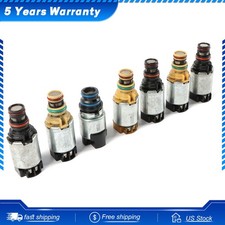
GEARS Magazine lays out the Gen 1 solenoid map. Line pressure control is normally high. PCS2 (normally high on Gen 1) feeds the 3-5-R clutch regulator. PCS3 (normally high) feeds the R-1/4-5-6 regulator. PCS4 (normally low) feeds the 2-6 regulator, and PCS5 (normally low on Gen 1) feeds the 1-2-3-4 regulator and boost valve. The TCC pressure control solenoid is normally low, and a single on/off shift solenoid runs the clutch select valve.
On Gen 2 (8th digit of the ID B, C or D per GEARS), PCS2 flips to normally low, PCS5 flips to normally high, both move on the unit, and the pressure switches are gone. Bench specs are the same on both: 3-5 ohms for every pressure control solenoid and 16-20 ohms for the shift solenoid.
Fluid, Converter, Weight and Ratings
| Spec | 6T40 | 6T45 |
|---|---|---|
| Fluid type | DEXRON-VI | |
| Total fluid capacity | 8.0 L / 8.5 qt | |
| Fluid change (service) capacity | 4.0-6.0 L / 4.2-6.3 qt (6T40 MNH, per GM TechLink) | |
| Engine torque capacity (gas) | 240 Nm (about 177 lb-ft) | 315 Nm (about 232 lb-ft) |
| Engine torque capacity (diesel) | 280 Nm | 380 Nm |
| Torque converter | 205 mm | 236 mm |
| Output chain width | 1.00 in | 1.25 in |
| Input carrier pinions | 4 | 5 |
| Max GVW | 2,000 kg (4,409 lb) | 2,200 kg (4,850 lb) |
| Net weight | 81/86 kg (178/190 lb) | |
| Case | Die-cast aluminum, one piece | |
Torque figures are from SAE 2010-01-0857; converter, chain and pinion numbers are from GM Powertrain; fluid, weight and GVW are from GM's service specification, and the service-fill range is from GM TechLink. The 6T50 is listed at 2,500 kg (5,511 lb) GVW.
Two notes on the fluid. The 8.0 L figure is the whole unit including the converter, so a pan drop replaces only part of it. GM TechLink's 2025 transmission capacities chart lists the fluid change on the current 6T40 (RPO MNH) in the Trax and Envista at 4.0-6.0 L (4.2-6.3 qt) of DEXRON-VI. And GM describes DEXRON-VI in this unit as not needing changes under normal use. I still treat hot-climate commuting and towing as severe service. Either way, set the final level hot at the check plug, never by pouring in a fixed amount.
Both converters use a single-plate lock-up clutch with GM's electronically controlled capacity clutch strategy and a flattened "hyper-elliptical" section to save length. The pump is an on-axis IX gear pump on Gen 1 and Gen 2. GEARS reports that Gen 3 moves the pump off-axis and adds a lube bypass valve that stays closed until line pressure reaches about 85 psi.
Generation Changes That Matter on Interchange
GEARS dates the family this way: the 6T40 launched in the 2008 Malibu, and the unit changed significantly starting in 2012. GM Powertrain calls 2012 the introduction of the "Gen 2" controls architecture. The differences that catch builders:
- Gen 1 (2008-2011): four sealing rings on the ring tower, a 4-5-6 clutch with four frictions and a wave plate, a fluid dam with inner and outer seals, and a compensator feed regulator valve.
- Gen 2 (2012 on): three sealing rings, five frictions with no wave plate, no inner seal on the dam, and no regulator in the dam circuit.
- Gen 3: off-axis pump, lower-offset pressure regulator, aluminum one-way clutch pocket plate and the lube bypass valve. GEARS covers it on 2013-2015 Malibu 2.5L and 2016 Encore 1.4T examples.
GEARS documented what happens when a Gen 2 ring tower and drum go into a Gen 1 unit: the Gen 1 regulator "just sits there wide open." It passes the road test, then comes back later with low line pressure. Match the generation, not just the model number.
After the Rebuild: Fast Learn
Because every shift from 2nd up is clutch-to-clutch, the TCM needs its adapts relearned after an overhaul, valve body or TECHM replacement, a speed sensor, a software update or any shift-quality repair. GEARS lists the conditions for the GDS2 fast learn: drive wheels blocked, parking brake on, fluid temperature 158-239 F (70-115 C), throttle at 0%, and the selector cycled Park to Reverse three times. Skip it and a correctly built unit can still shift badly.
6T40 filter and pan gasket kit (24230708) at Core Transmission Parts
If you are setting the fill on a 6T40 or 6T45 to spec, start with a new filter and pan gasket, then set the level hot at the check plug.
View the 6T40 filter kit →6T40 and 6T45 rebuild kits, solenoid kits, valve bodies and filter kits — shipped fast from the USA.
Shop 6T40 parts →Related guides
- 6T40 Identification Guide
- 6T40 Common Problems and Fixes
- GM 6T40/6T45 Wave Plate Failure
- 6T40 Shift Solenoid Symptoms
- 6T40 Rebuild Cost
FAQ
What are the 6T40 gear ratios?
GM service information lists the 6T40/6T45/6T50 ratios as 4.584 first, 2.964 second, 1.912 third, 1.446 fourth, 1.000 fifth, 0.746 sixth and 2.94 reverse. Final drive options listed are 2.64, 2.89, 3.23, 3.53 and 3.87, depending on vehicle and engine.
Do the 6T40 and 6T45 have different gear ratios?
No. GM's service specification covers the 6T40, 6T45 and 6T50 with one ratio set, and GM Powertrain states the 6T40 and 6T45 share the same 6.11:1 overall spread. The 6T45 gets its extra torque capacity from a 1.25-inch output chain, a five-pinion input carrier, a bigger converter and a stronger case, not from different gearing.
How much fluid does a 6T40 hold?
GM service information lists 8.0 liters (8.5 quarts) of DEXRON-VI for the 6T40/6T45/6T50. That is the full unit including the converter. For a service, GM TechLink's 2025 capacities chart lists a fluid change on the 6T40 (MNH) at 4.0-6.0 liters (4.2-6.3 quarts), so always set the final level hot at the check plug instead of pouring in a fixed amount.
What is the torque rating of the 6T40 vs the 6T45?
The GM engineering paper SAE 2010-01-0857 gives engine torque capacity up to 240 Nm (about 177 lb-ft) gas for the 6T40 and 315 Nm (about 232 lb-ft) gas for the 6T45. The diesel ratings are 280 Nm and 380 Nm.
Is the 6T40 the same as the 6T30 or 6T50?
They are one family with the same basic powerflow and share many parts, and GM's service spec page lists the 6T40, 6T45 and 6T50 together with the same ratios. The differences are torque capacity, chain and carrier content, case size, and gross vehicle weight rating: 2,000 kg for the 6T40, 2,200 kg for the 6T45 and 2,500 kg for the 6T50.
Sources
- General Motors — Transmission General Specifications, 6T40/6T45/6T50 (service manual, as reproduced online). Backs the RPO codes, gear ratios 4.584/2.964/1.912/1.446/1.000/0.746 and 2.94 reverse, final drives 2.64-3.87, 8.0 L / 8.5 qt DEXRON-VI capacity, net weight and GVW ratings. cequinox.com
- GM Powertrain — "2012 Hydra-Matic 6T40 (MH8) / 6T45 (MH7, MHC) Six-Speed Automatic" product information (archived). Backs the shared 6.11:1 spread, 6T45 chain width and pinion count, the 205 mm and 236 mm converters, the freewheeling 1-2 shift with clutch-to-clutch 2-6, the Gen 2 controls in 2012, the IX pump and DEXRON-VI. web.archive.org (gmpowertrain.com)
- SAE International — Singh and Olenzek (General Motors), "General Motors Small Front Wheel Drive Six speed Automatic Transmission Family," SAE 2010-01-0857. Backs the 240/315 Nm gas and 280/380 Nm diesel torque capacities, the three-gearset / three-brake / two-rotating-clutch powerflow shared with the 6T70/75, the 6.1 spread, and the planetary final drive. saemobilus.sae.org
- ATRA / GEARS Magazine — "Understanding GM 6T40 Solenoids" and "Why Doesn't My 6T40 Shift Right?" Backs the PCS-to-clutch map, the Gen 1 vs Gen 2 normally-high/low changes, the 3-5 ohm and 16-20 ohm resistance specs, and the fast learn conditions (158-239 F) and when to run it. gearsmagazine.com (solenoids) · gearsmagazine.com (fast learn)
- ATRA / GEARS Magazine — "It Worked on the Road Test! The 6T40 4-5-6 Drum Interchange Quandary" and "Generation Gap: 6T40 Gen v3." Backs the Gen 1 (2008-2011) vs Gen 2 (2012+) ring tower, 4-5-6 clutch pack and fluid dam differences, the interchange low-pressure problem, and the Gen 3 off-axis pump and 85 psi lube bypass valve. gearsmagazine.com (4-5-6 drum) · gearsmagazine.com (Gen v3)
- GM TechLink — "2025 Transmission Capacities & Fluids (U.S. and Canada)." Backs the 6T40 (RPO MNH) fluid change capacity of 4.0-6.0 L / 4.2-6.3 qt and DEXRON-VI for the Trax and Envista. gm-techlink.com (PDF)