Enclave shift complaints come in a handful of flavors: a bang into Drive, a 1-2 that thumps on light throttle, a firm 2-3, a flare when the driver lifts and gets back into it on the 4-5, or a shudder somewhere around 2nd and 3rd. Every 2008-2017 Buick Enclave has the 3.6L V6 and the 6T75 six-speed transaxle, and GM has written specific bulletins for most of those complaints. Some are fixed with a calibration or a drive learn and never need a wrench. Others are valve body debris or a tired clutch pack. The expensive mistake is treating the first kind like the second. This guide works the Enclave by model year, then by the shift that feels wrong, with the GM or ATRA document behind each step. Numbers in brackets point to the Sources list at the bottom.
First: which Enclave is it?
Split the 6T75 Enclave into two groups before you look at anything else. ATRA's 6T70/75 update notes explain that the 6T75 (RPO M7V and M7X) got a major control system update for the 2013 model year, and that 2013 is a split year: units with that package are Gen II, units without it are Gen I [5]. GM's later Enclave bulletins list the trucks by those same RPOs. PI1364 covers the 2015 Enclave with M7V or M7X [1], and 18-NA-358 lists the 2014-2017 Enclave with M7V or M7X [3]. Read the RPO off the Service Parts Identification label in the glove box rather than trusting the model year [6].
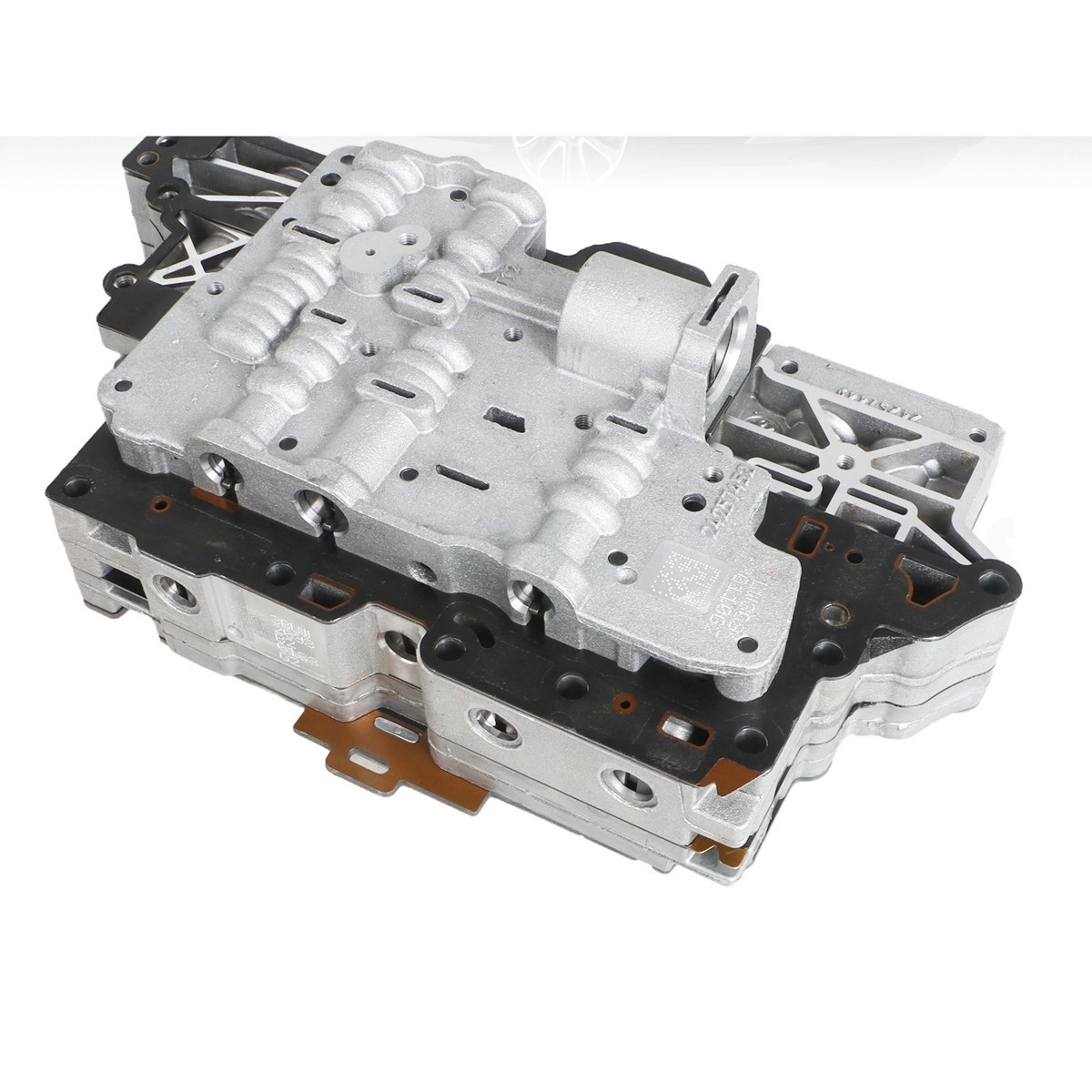
The generation decides which valve body parts fit, too. Sonnax documents that the Gen. 1 pressure regulator valve is bored down the center while the Gen. 2 valve is solid, a change made for a balance orifice added to the Gen. 2 separator plate, so the separator plates do not interchange. A Gen. 1 plate has no notch or a U notch at the ID location; a Gen. 2 plate has a V or double V notch. Gen. 1 has three solenoid dampers in the top cover plate and Gen. 2 has six [7]. Check the plate before you bolt a used or replacement valve body onto an Enclave.
The 2018 redesign is a different vehicle as far as the transmission goes. GM bulletin 18-NA-097 covers the 2018 Enclave with Electronic Transmission Range Select (RPO M3W, M3G, M3H or M3U): it will not shift out of Park with P187D, or it holds only 1st and Reverse, will not go past 25 mph and feels tied up after the 1-2 with P2731, or the PRNDL blinks with U0100. That fix is a TCM calibration followed by Service Fast Learn [1]. None of the 6T75 advice below applies to a 2018-up truck.
Rule out the shifts the Enclave is supposed to make
A fair number of Enclave "shift problems" are the truck doing what Buick designed it to do. The 2014 owner manual describes Automatic Engine Grade Braking: on a downhill grade it commands downshifts on its own to hold speed, in D, in both normal and Tow/Haul mode [6]. A customer who feels the transmission drop a gear coasting down a hill with the brake on is feeling that feature.
The same manual explains Electronic Range Select. Move the lever to L and a number shows next to it in the cluster; that number is the highest gear the transmission is allowed to use, and the plus and minus buttons raise or lower it. Grade braking is switched off while ERS is active [6]. An Enclave that "won't go into 6th" with L5 showing on the cluster is a driver setting, not a failed clutch.
Two cluster messages mean something real. SERVICE TRANSMISSION means the controller has found a problem. TRANSMISSION HOT IDLE ENGINE comes with a chime, and Buick warns that driving with the fluid overheating can damage the transmission [6]. A shift complaint that shows up with either message gets a scan and a fluid check before anything else.
2015 Enclave: delayed, firm or flared shifts (PI1364)
This is the Enclave-specific bulletin most shops never look up. GM's PI1364 covers the 2015 Enclave, Traverse and Acadia with the 6T75 (M7V or M7X). The complaints it lists are specific enough to match against a test drive [1]:
- The 1-2, 2-3 and 3-4 upshifts feel delayed or pushed up.
- The 2-3 upshift is firm under light or moderate throttle.
- The 4-5 or 5-6 flares if the driver lets off the throttle and gets back on it during the shift.
- A firm 1-2 when the truck is slowing on the brake and the brake is released at about 15 mph (24 km/h).
The fix is a revised calibration: update the TCM through SPS with the latest software [1]. GM's notes on the battery matter here, because the TCM lives inside the transaxle and a botched flash means pulling the pan. Battery voltage must be above 12 volts and below 16 before you start and held between 12 and 15.5 volts during programming, with a battery maintainer connected [1]. After any TCM software update, GM's service information calls for Transmission Adaptive Values Learn [4]. If a 2015 Enclave matches that list and has never had the update, flash it before you quote anything mechanical.
2015-2017 Enclave: harsh 1-2 on light throttle, no codes (PIP5363B)
GM's PIP5363B covers the 2015, 2016 and 2017 Enclave, Traverse and Acadia with a harsh 1-2, mostly at light throttle, with no DTCs; in rare cases the 2-3 is harsh too. GM's explanation is that the shift adaptive time may not have learned [2]. The cure is a drive, not a part:
- Put the selector in M5 (L with 5 showing) to hold the transmission in 5th.
- Drive at 38 mph or above with transmission fluid temperature above 30 C (86 F), about 5 miles on flat, level ground at a steady throttle. Cruise control helps hold it steady [2].
- Stop and try some light-throttle 1-2 shifts. Drive another 5 miles if needed.
- If a second learn drive is needed, let the TEHCM power down first [2].
Only if nothing changes does GM send you on to normal harsh-shift diagnosis [2]. Why 5th gear? ATRA explains that the 6T70/75 runs its clutch fill-volume learn (CP Learn) during steady driving: the 4-5-6 clutch learns in 3rd, the 1-2-3-4 and 2-6 clutches learn in 5th, and the 3-5-R clutch learns in 6th. The learn aborts when the controller sees a rough road [5]. A school-run Enclave that never sees five steady miles on smooth pavement can go a long time without learning its 2-6 fill, and the 1-2 shows it.
2014-2017 Enclave: shudder, flare or harsh 2-3 (18-NA-358)
GM bulletin 18-NA-358 lists the 2014-2017 Enclave (M7V, M7X) for a severe launch shudder in 1st, a shudder in 4th, or a shudder during the 2-3 upshift or 3-2 downshift, sometimes with flare, slide/bump, slip or harsh shift. The cause is debris in the upper and/or lower valve bodies, or scratched and scored valves that will not move properly [3]. The bulletin's diagnostic order is worth following exactly:
- Confirm it is not an engine misfire or driveability problem.
- Watch TCC slip on the scan tool during the event. If the converter clutch is applied and slip is moving when the shudder happens, you are chasing TCC shudder, not this bulletin.
- Try to induce the launch shudder by power braking in 1st, for 5 seconds or less so you do not hurt the 1-2-3-4 clutch [3].
- If it reproduces, replace both the upper and lower valve bodies at the same time: upper 24281084 (without manual valve), lower 24257450, plus kit 24264343 [3].
Two notes in the December 2021 revision save money. GM says replacing the TEHCM has not been an effective repair for this concern; performance test it and clean or replace it as needed rather than throwing a module at it. And GM says to look at the input and output speed sensors for collected debris, which points to an internal failure; if the sensors are clean but the valves and bores are scratched, check for a failed final drive bearing [3]. A valve body bolted onto a truck still shedding bearing material will be back.
Map the shift to the clutch behind it
When no bulletin fits, use the shift itself. Each 6T75 shift is one clutch applying while another releases, and GM's symptom tables are written by clutch [4]:
| Complaint | Clutch | GM's checks |
|---|---|---|
| Bang into Drive or Reverse | 1-2-3-4, low/reverse | Idle line pressure below 800 kPa, stuck boost valves, damaged wave plates, low/reverse air bleed, worn splines [4] |
| Harsh or late 2nd and 6th | 2-6 | Worn or wrong-finish plates and backing plate, fatigued cushion spring, damaged piston or delaminating seals, fatigued return spring [4] |
| Harsh or late 3rd, 5th and Reverse | 3-5-R | Plate finish, fatigued waved plate, leaking piston seals, warped 3-5-R/4-5-6 housing, plugged air bleed [4] |
| Harsh 4th, 5th and 6th | 4-5-6 | Leaking piston or seals, plugged dam air bleed, fatigued spring, leaking dam seals, housing porosity [4] |
| Bind on 3-4 or 4-3, maybe P0797 | 3-5-R and 4-5-6 together | Worn case cover hub sleeve ring groove [5] |
Start the harsh engagement complaint at the engine. GM's harsh garage shift chart notes that when the engine controller reports its torque signal as inaccurate, the transmission commands high line pressure and every shift goes firm [4]. Fix the engine code first.
The 2-6 clutch deserves extra attention on an Enclave, because a harsh 1-2 that survives the PIP5363B drive learn ends up there. It lives in the case cover, and GM's list for harsh or late 2nd and 6th is the plates and backing plate, the piston cushion spring, the piston and its seals, and the return spring [4]. ATRA notes the 2-6 snap ring and case snap ring groove were updated [5], so match parts to the case in front of you.
For the 3-4 bind, ATRA traces the tie-up to a worn ring groove on the case cover hub sleeve that leaks between the 3-5-R and 4-5-6 circuits, so both clutches are partly on at once. Pull the hub, check ring-to-groove clearance with a feeler gauge, and replace the case cover if it is over 0.007 in. [5]. New rings in a worn groove bind again.
When the unit is apart, ATRA recommends new-design wave plates in every clutch: 1-2-3-4 24259063, 2-6 24259816, 3-5-R 24254103 and low/reverse 24259817. The 3-5-R plate is the one most likely to break [5], and the 2008-2009 Enclaves are the trucks that made it famous.
Get the basics right before you blame hard parts
Fluid. The Enclave takes DEXRON-VI [6], about 5.0 L (5.3 qt) for a drain-and-refill per the 2012 owner manual [6]. Check it the way ATRA lays out: level ground, engine idling, fluid temperature between 180 and 200 F [5]. A cold check reads low, someone tops it off, and once it is hot the unit is overfull and aerating, which feels exactly like a shift problem.
Adapts. GM requires Transmission Adaptive Values Learn after an overhaul, a valve body repair or replacement, a control solenoid valve assembly replacement, a TCM software update, or any service done for a shift quality concern [4]. Preconditions: drive wheels blocked, parking and service brake applied, zero throttle, fluid between 70 and 100 C (158-212 F), and the selector cycled Park to Reverse three times to purge air from the reverse clutches. When it finishes, shut the engine off and let the module power down; the transmission stays in neutral until you restart [4].
A learn that will not run is a clue. GM's troubleshooting list for an aborted learn includes engine speed failing to rise above 1,500 RPM at test entry, a misadjusted Park/Neutral switch, active DTCs, a vehicle that is moving or vibrating, line pressure that cannot reach 1,000 kPa, and clutches that are not assembled correctly [4]. If everything else checks out and it still aborts, line pressure is the next test.
After the repair: let it learn
Run the adaptive learn, then drive it with some steady miles held in 3rd, 5th and 6th on a smooth road so CP Learn can finish every clutch [5]. On a 2015-2017 truck with a light-throttle 1-2 complaint, finish with the PIP5363B M5 drive [2]. Hand the customer back a truck that has learned, not one that will learn over the next week of complaints.
Shop the part for this fix: 6T75 bonded piston set
GM's harsh and late shift tables keep landing on leaking piston seals in the 2-6, 3-5-R and 4-5-6 circuits. This bonded piston set from CoreTransmissionParts replaces the pistons and seals in one hit when the Enclave unit is already apart.
View the 6T75 bonded piston set at CoreTransmissionPartsNeed something else? See the 6T75 master rebuild kit at CoreTransmissionParts.
Need parts for this job?
Our 6T75 parts page has valve bodies by year, shift kits, solenoid kits, pumps, drums and rebuild kits for the Buick Enclave, all on our own checkout. For fluid specs across every unit, see the transmission fluid spec chart.
FAQ
Why does my Buick Enclave shift hard from 1st to 2nd?
On a 2015-2017 Enclave with no codes, GM bulletin PIP5363B says the 2-6 clutch shift adapts may not have learned. The fix is a drive learn: hold it in M5 at 38 mph or more with fluid above 86 F for about 5 miles at a steady throttle, then retest light-throttle 1-2 shifts. If nothing changes, move on to normal harsh-shift diagnosis.
Is there a software update for Enclave shift problems?
Yes, for the 2015 Enclave with the 6T75. GM bulletin PI1364 covers delayed 1-2, 2-3 and 3-4 upshifts, a firm 2-3, a 4-5 or 5-6 flare when the throttle is lifted and reapplied, and a firm 1-2 when the brake is released near 15 mph. The fix is a TCM update through SPS, followed by the adaptive learn.
What causes a shudder on the 2-3 shift in a Buick Enclave?
GM bulletin 18-NA-358 covers the 2014-2017 Enclave with RPO M7V or M7X for a launch, 4th gear or 2-3/3-2 shudder. The cause is debris in, or scored valves in, the upper and lower valve bodies, and the repair is both valve bodies. GM says replacing the TEHCM has not been an effective fix.
Do I need a relearn after Enclave transmission work?
Yes. GM calls for Transmission Adaptive Values Learn after an overhaul, valve body or control solenoid valve assembly replacement, a TCM software update, or any repair for shift quality. Then drive it with steady miles in 3rd, 5th and 6th so the clutch fill learn can finish.
Related guides
Sources
- General Motors, Preliminary Information PI1364, "Delayed Upshifts, Firm Upshifts or Downshifts and Shift Flare," December 2014 (2015 Buick Enclave, Chevrolet Traverse, GMC Acadia with 6T75, RPO M7V/M7X). Backs the delayed 1-2/2-3/3-4, firm light-throttle 2-3, 4-5/5-6 flare on throttle lift and reapply, the firm 1-2 when the brake is released near 15 mph, the SPS TCM update, and the 12-16 V / 12-15.5 V battery requirements. Also cited: GM Service Bulletin 18-NA-097 (April 2018) for the 2018 Enclave ETRS conditions (P187D, P2731, U0100) and the TCM calibration plus Service Fast Learn fix. PI1364, static.nhtsa.gov (PDF) · 18-NA-097, static.nhtsa.gov (PDF)
- General Motors, Preliminary Information PIP5363B, "6T70/75 Transmission Assembly With Harsh 1-2 Shift With No DTCs," January 2017 (2015-2017 Enclave, Traverse, Acadia). Backs the light-throttle harsh 1-2 (rarely 2-3) with no codes, the unlearned adapt cause, and the M5 / 38 mph / 86 F / 5-mile drive learn with TEHCM power-down between attempts. static.nhtsa.gov (PDF)
- General Motors, Service Bulletin 18-NA-358, "Shudder, 2-3 Upshift or 3-2 Downshift Concern," December 2021 revision. Backs the 2014-2017 Enclave M7V/M7X listing, the launch, 4th gear and 2-3/3-2 shudder with flare, slide/bump, slip or harsh shift, the valve body debris cause, the 5-second power-brake limit, the TCC slip check, the TEHCM performance-test note, the ISS/OSS debris and final drive bearing checks, and parts 24281084, 24257450 and 24264343. static.nhtsa.gov (PDF)
- General Motors 6T70/6T75 service information, fault diagnosis section (as mirrored on SAAB WIS Online): Harsh Garage Shift; Harsh or Late Second and Sixth Shift; Harsh or Late Third, Fifth and Reverse Shift; Harsh Fourth, Fifth and Sixth Shift; Transmission Adaptive Values Learn (when required, 70-100 C, Park-Reverse three times, 1,500 RPM, 1,000 kPa line pressure, abort causes). Harsh Garage Shift · 2nd/6th · 3rd/5th/Reverse · 4th/5th/6th · Adaptive Values Learn
- ATRA, Steve Garrett, "6T70 Product Issues and Updates" seminar. Backs the 2013 Gen I/Gen II controls update by RPO (6T75 = M7V/M7X), the CP Learn gears and rough-road abort, the 3-4/4-3 bind with possible P0797 and the 0.007 in. hub ring groove limit, the wave plate part numbers and the 3-5-R plate as most likely to break, the updated 2-6 snap ring groove, and the 180-200 F fluid level check. atracom (PDF)
- Buick, 2012 and 2014 Enclave Owner Manuals. Back Electronic Range Select top-gear limit behavior, Automatic Engine Grade Braking in normal and Tow/Haul mode, the SERVICE TRANSMISSION and TRANSMISSION HOT IDLE ENGINE messages, DEXRON-VI, the 5.0 L (5.3 qt) drain-and-refill and the Service Parts Identification label. 2012 manual, assets.gm.com (PDF) · 2014 manual, assets.gm.com (PDF)
- Sonnax, "The Greatest Generation: How Small Changes Led to the New Form & Function of Gen. 2 6T70/75 Valve Bodies" (February 2018). Backs the center-bored Gen. 1 versus solid Gen. 2 pressure regulator valve, the Gen. 2 separator plate balance orifice and plate incompatibility, the U notch versus V/double V notch plate ID, and the three versus six solenoid dampers. sonnax.com