The pump is the one part of a TH400 that works every second the engine is running. It is a simple internal gear pump bolted to the front of the case, driven by two tangs on the converter hub, and it feeds everything: line pressure, converter charge, the cooler and the lube circuit. When it wears out the symptoms show up everywhere at once, which is why pump problems get misdiagnosed as clutch problems, valve body problems or a bad converter.
This guide covers how the TH400 pump fails, what each symptom points to, how to confirm it with a gauge before you pull the transmission, the factory inspection specs, and when a rebuilt pump makes more sense than fixing yours. Specs come from GM's Turbo Hydra-Matic 400 service section and Sonnax technical data; sources are listed at the bottom.
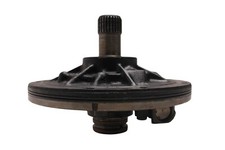


How the TH400 Pump Works
GM describes the TH400 hydraulic system as "pressurized by a gear type pump." The drive gear sits inside the driven gear in a pocket in the cast-iron pump body, with a crescent separating the inlet and outlet sides. The converter hub rides in the pump bushing and its tangs turn the drive gear at engine speed. The pump cover, which carries the stator shaft, holds the pressure regulator valve and boost valve, and two cast-iron oil seal rings on the cover's delivery sleeve feed the forward clutch.
Pump output goes to the pressure regulator, which sets line pressure and sends the excess to the converter. Oil leaving the converter goes to the cooler, and the return oil lubricates the geartrain. GEARS magazine notes that on the 400 the lube oil returns through a passage at the rear of the pump stator shaft, then through the input shaft to the lube circuit, and that converter charge pressure runs about 60 psi under high load with maximum line pressure around 180 psi. Lose pump volume and every one of those circuits loses with it.
TH400 Pump Failure Symptoms
Whine that follows engine rpm
Pump noise is a whine that rises with engine speed in Park, Neutral and every gear, and it does not change with road speed. GM's TH400 diagnosis chart lists the causes under "pump noise": oil level low or high, cavitation from a plugged filter, a damaged intake O-ring, porosity in the intake circuit or water in the oil, and in the pump itself a drive gear assembled backwards, damaged gears or crescent interference. Rule out the cheap ones first. A filter O-ring that rolled on installation sucks air and sounds exactly like a worn pump.
Front seal leak that keeps coming back
Fluid at the bottom of the bellhousing on a TH400 is usually the front pump seal, but GM's leak chart gives several pump-related causes: a seal lip cut by a nicked converter hub, the bushing moved forward and damaged, a missing garter spring, loose pump bolts or damaged bolt seals, a cut pump-to-case O-ring, or a porous pump casting. If a new seal leaks again within a few thousand miles, check the bushing. A worn bushing lets the hub move, and the seal cannot follow it.
Delayed or soft engagement when hot
Gear pumps lose efficiency as clearances open up, and the loss gets worse as fluid thins with heat. The classic pattern is a TH400 that engages fine cold and then takes two or three seconds to pick up Drive or Reverse after a long drive. Reverse runs the highest pressure, so it often goes first. Also see TH400 delayed engagement for the non-pump causes.
Slipping and burnt clutches across the board
Low pump output means low line pressure to every clutch and band. A unit that comes apart with the forward, direct and intermediate packs all burnt, rather than one pack, points upstream to the pump or pressure regulator.
High line pressure, harsh shifts and converter trouble
A worn pump can also fail high. Sonnax notes that high-mileage TH400 and TH425 units often have poor line pressure control from a worn pressure regulator valve bore in the cast-iron pump cover. Balance oil leaks past the valve to the sump, so the valve cannot move fully to the low-pressure position. Sonnax lists the symptoms as high and uncontrollable line pressure, delayed converter charge and poor reverse engagement, with high cooler pressure and possible converter, crankshaft or friction element failure as the result.
Fluid out the vent
GM lists a pump that is shy of stock on its mounting faces, a porous casting, a plugged breather hole in the pump cover, or debris between the pump and case or between pump cover and body as causes of fluid coming out of the vent pipe. Check the fluid level and dipstick first, since overfilling is the most common cause.
Confirm It With a Pressure Gauge First
Do not pull a TH400 for a pump on a guess. Put a gauge on the line pressure tap on the case and compare to GM's numbers. With the modulator vacuum line connected, service brakes applied and the engine at 1000 rpm, GM lists approximately:
| Range | Modulator connected, 1000 rpm | Modulator disconnected, 1200 rpm (sea level) |
|---|---|---|
| Park / Neutral / Drive | 60-90 psi | 150 psi |
| L2 / L1 | 150 psi | 150 psi |
| Reverse | 95-150 psi | 244 psi |
GM also gives a road-test range of 60 psi minimum to 150 psi maximum in Drive. The disconnected readings drop with altitude; at 6,000 ft the chart shows about 138 psi in Drive and 212 psi in Reverse. Test cold, then again at full operating temperature. A pump that makes spec cold and falls 15 or 20 psi below the minimum when hot has internal leakage. Low pressure in every range points to the pump or regulator; low pressure in one range points to a leak in that circuit. Before blaming the pump, check the modulator, the filter and the fluid level. The full procedure is in TH400 pressure testing.
For a high-pressure complaint, disconnect the modulator vacuum line and watch the gauge. If pressure stays high at idle with vacuum connected, the regulator valve or its bore is suspect.
Inspecting the Pump on the Bench
Once the pump is out (GM uses two slide hammers threaded into the pump bolt holes to pull it), mark both gears before removing them so they go back in the same position, with the drive gear tangs up. Then work through GM's inspection list:
- Gear pocket and crescent. Look for scoring, galling or other damage. Scoring on the crescent tip or the pocket wall is the signature of an off-center hub.
- Gear face clearance. With both gears in the pocket, lay a straightedge across the body and measure to the gear faces. GM's spec is .0008" to .0035". More than that and the pump bleeds volume internally.
- Body and cover faces. Check for scores, nicks and overall flatness. Check that all passages are open and not connected to each other.
- Pressure regulator bore. Check for scores or chips and confirm the regulator and boost valves move freely. GM notes the 1971-75 solid pressure regulator valve may only be used in the cover with the squared-off regulator boss.
- Stator shaft. Check the splines and both stator shaft bushings.
- Oil ring grooves and rings. GM states that all service pump seal rings are hook-type cast iron. Worn grooves leak forward clutch apply oil.
- Selective thrust washer face. Check for wear or scoring where the forward drum runs.
- Bushing. Check for scores or nicks. If it is replaced, GM drives the new one in from the gear pocket face until it is flush to .010" below the machined surface.
The Pump Bushing: Root Cause of Most Pump Damage
The factory bushing is babbit-lined. Sonnax puts it plainly: worn babbit pump bushings in the Powerglide, TH350, TH400 and AT-540 let the converter hub and inner pump gear move off-center, which damages the pump gears and the pump housing crescent. That is why a pump with a loose bushing ends up with a scored pocket. The off-center hub also wears the front seal and can let the hub chew on the seal bore.
Sonnax 34034T-01 is a PTFE-lined replacement for OE part 29511860, sold as a direct fit with no machining. For turbocharged racing builds, Sonnax 34234B-01 is a bronze bushing with three times the melting point of babbit, because the factory bushing can melt during staging. On a street truck or motorhome, the PTFE bushing is the right call. Check the converter hub too: a hub with a groove worn in it will ruin a new bushing and seal.
Reassembly Specs That Matter
| Item | Spec (GM TH400) |
|---|---|
| Pump body face to gear face clearance | .0008" - .0035" |
| Pump bushing depth | Flush to .010" below machined surface |
| Pump cover to body bolts | 15-20 lb-ft, after clamping with alignment strap |
| Pump to case bolts | 15-20 lb-ft, new bolt seals |
| Front unit endplay | .003" - .024" |
The order is important. GM installs the cover-to-body bolts and leaves them one turn loose, then clamps the body and cover together with the pump aligning strap (J-21368) before tightening the bolts. Skip the strap and the two halves can shift, the gears bind, and you have a brand-new pump that whines or locks up. Any GM pump alignment band does the job. Install a new pump-to-case O-ring and gasket and new bolt seals.
After the transmission is assembled, check front unit endplay with a dial indicator on the turbine shaft. GM's spec is .003" to .024", controlled by the selective washer between the pump cover and the forward clutch housing. The washers are color-coded from .060-.064" (yellow) up to .126-.130" (purple). For heavy-duty builds, Sonnax offers a pump thrust bearing kit (34211-01K) that replaces this washer with a .126" bearing and shims in .005" steps; in most cases the pump needs machining to fit it.
Rebuild or Replace the Pump?
A TH400 pump is worth rebuilding when the pocket and crescent are clean, the gears are in clearance, the cover is flat and the regulator bore is not worn. The job is a bushing, front seal, seal rings, O-ring, gasket and bolt seals. If the regulator bore is worn, the Sonnax 34910-03K valve kit (fits '71 and later) adds a PTFE seal ring and an O-ringed end plug to stop the balance oil leak without replacing the casting.
Replace the pump when the pocket is scored, the crescent is galled, the gears are out of clearance, or the casting is porous. New gears will not fix a scored pocket, and machining the pocket changes the gear clearance. A known-good or remanufactured pump assembly is often cheaper than chasing a damaged one. Whichever you choose, flush the cooler and lines; the debris from a failed pump is already in them.
Preventing a Repeat Failure
- Keep the fluid level correct and the filter and intake O-ring right. Cavitation wears the pump fast.
- Use a GM-licensed DEXRON-VI, which is back-serviceable for TH400 applications. See TH400 fluid type and capacity.
- Control heat. Hot, thin fluid speeds up pump wear and lowers pressure.
- Check converter hub runout and hub condition on every converter replacement. A bent or worn hub ruins a new bushing.
- Always use an alignment band when bolting the pump halves together.
FAQ
What are the first signs of a failing TH400 pump?
The usual early signs are a whine that rises and falls with engine speed in every range, slow or soft engagement into Drive and Reverse when the fluid is hot, and fluid at the bottom of the bellhousing from the front seal. A pressure gauge on the line tap confirms it: GM lists 60-90 psi in Drive at 1000 rpm with the modulator connected, and a weak pump falls below that when hot.
Can a bad pump bushing ruin a TH400 pump?
Yes. Sonnax notes that worn babbit pump bushings let the converter hub and inner pump gear move off-center, which damages the pump gears and the crescent in the pump housing. A worn bushing also eats front seals, so a TH400 that keeps leaking at the front seal often has a bushing problem, not a seal problem.
What is the pump gear clearance on a TH400?
GM's TH400 overhaul procedure specifies .0008 to .0035 inch from the pump body face to the gear face, measured with a straightedge and feeler gauge with both gears in the pocket. Beyond that, internal leakage goes up and line pressure drops, especially with hot, thin fluid.
What is the torque for TH400 pump bolts?
GM specifies 15-20 lb-ft for the pump cover to body bolts, tightened only after the pump is clamped with an alignment strap such as J-21368, and 15-20 lb-ft for the pump to case bolts with new bolt seals.
Should I rebuild or replace a TH400 pump?
If the gear pocket and crescent are clean, the gears are in clearance and the cover is flat, a pump rebuild with a new bushing, seal, rings and gaskets is normal practice. If the pocket is scored, the crescent is galled, or the pressure regulator bore is worn and you are not fitting an oversize valve kit, a replacement pump assembly is usually the faster and cheaper fix.
TH400 front pump rebuild kit
Pump in clearance and just needs fresh parts? This kit covers the gears, seal, bushing, gasket and O-ring for a TH400 pump rebuild.
View the pump rebuild kit →TH400 pump assemblies, pump alignment bands, rebuild kits and seals — shipped fast from the USA.
Shop TH400 parts →Sources
- General Motors — 1975 Buick Service Manual, Section 7D: Turbo Hydra-Matic 400 Transmission. Backs the gear-type pump description, the noise, leak and vent diagnosis charts, the line pressure tables (60-90 / 150 / 95-150 psi connected; 150 / 150 / 244 psi disconnected, with altitude correction), the pump removal and inspection steps, the .0008-.0035" gear face clearance, bushing depth, hook-type ring note, the 1971-75 regulator valve note, pump bolt torques (15-20 lb-ft) with the J-21368 strap, front unit endplay (.003-.024") and selective washer chart. teambuick.com (GM PDF)
- Sonnax — Pump Bushing 34034T-01 (Powerglide, TH350, TH400, AT-540). Backs the babbit bushing wear mechanism (off-center converter hub and inner gear damaging the gears and crescent), PTFE lining and OE part 29511860. sonnax.com
- Sonnax — Pump Bushing 34234B-01 (bronze). Backs the bronze bushing for turbocharged racing use and its melting point of three times babbit. sonnax.com
- Sonnax — TH400/TH425 Pressure Regulator Valve Kit 34910-03K. Backs the worn regulator bore failure in high-mileage units, its symptoms (high and uncontrollable line pressure, delayed converter charge, poor reverse engagement), the downstream damage, and the '71-later fit. sonnax.com
- Sonnax — TH400 Pump Thrust Bearing Kit 34211-01K. Backs the selective washer location between pump and forward drum, the .126" bearing, .005" shim steps, and the machining note. sonnax.com
- GEARS Magazine (ATRA) — Improve Your 400 and 4L80 Rebuilds. Backs the lube return through the rear of the pump stator shaft, about 60 psi converter charge under load and about 180 psi maximum line pressure on the 400. gearsmagazine.com