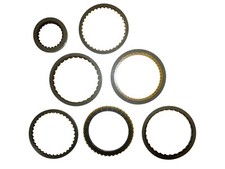
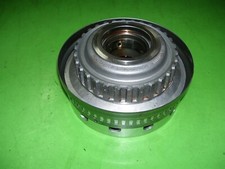
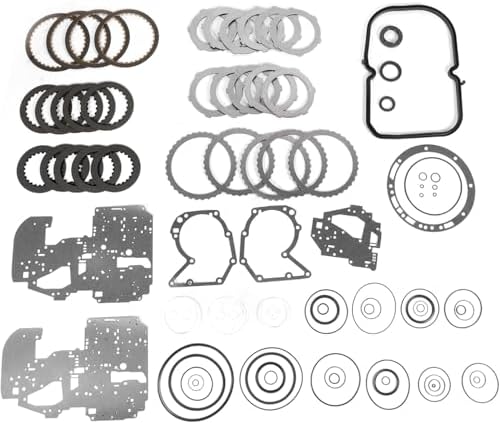
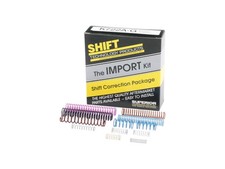
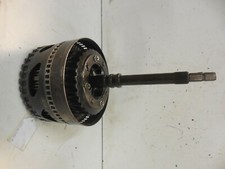
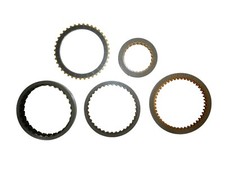
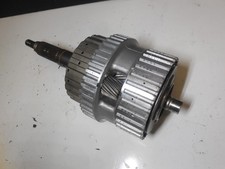
If you are rebuilding a first-generation 722.6 five-speed out of a 1996-2000 Mercedes C-Class (W202), E-Class (W210), S-Class (W140), SL (R129) or G-Class, and the old unit was slipping, flaring on upshifts or coming out of the pan with black, burnt fluid, this is the friction set it needs. It is a new 722.6 friction module, reference R78119, which interchanges with Raybestos RCP96-024. The module is the early version built around the large inside-diameter K2 clutch pack, which is the detail that separates it from the later modules we carry.
What the friction module does in a 722.6
Mercedes designed the 722.6 without bands. It uses three planetary gearsets controlled by three multi-plate clutches (K1, K2 and K3) and three multi-plate brakes, plus two one-way freewheels. Each gear is a particular combination of those packs held on by hydraulic pressure from the valve body. A friction module gives you the lined friction plates for all of those packs in one box, so every clutch and brake goes back together with fresh material at the same wear point. On the early cars this matters because by now most 1996-2000 units have well over 150,000 miles on their original frictions, and a rebuild that replaces only the worst pack tends to come back with the next-weakest one slipping.
Symptoms that point to worn frictions
- Engine speed flares on the 2-3 or 3-4 upshift once the fluid is fully hot
- A long, soft engagement into Drive or Reverse from Park
- Slipping under part-throttle acceleration in one gear while the others feel normal
- Fluid that is dark brown or black and smells burnt, with grey friction paste on the pan magnet
- A drop into limp-home (second gear only) after a hard pull, with ratio-error codes stored
How to confirm it before you buy
The 722.6 has two common faults that feel like slipping clutches but are not. A worn valve body, specifically the working-pressure regulator bore and the overlap control sleeves, causes the same 2-3 and 4-5 flare; Sonnax and Transmission Digest both document it and a vacuum test confirms it. A failing conductor plate (speed sensors and solenoids) also throws the transmission into limp mode with perfectly good clutches. Pull codes, check the level hot, and drop the pan. Lots of friction material in the filter and pan means the packs are done. Our 722.6 common problems guide walks through separating these, and if your car is a W202 the C-Class 722.6 guide covers the fluid level check on that body.
Fitment
This module is listed for the 722.6 from 1996 through 2000 with the large-ID K2 pack. During those years Mercedes also introduced a thicker K3 friction, so a 1998-2000 transmission may need the 1998-up thick-K3 module instead, and units built from 2001 moved to a small-ID K2 friction. The safest way to match is to compare your old K2 frictions' inside diameter and your K3 plate thickness against this set before you start assembly. If you are not sure, send us your year and VIN, plus a photo of the K2 frictions if the unit is already apart. Everything else we stock for this transmission is on the 722.6 / 722.9 parts page.
Install notes
- Soak each new friction in clean ATF for at least 30 minutes before stacking it.
- Check every steel for blue heat marks, scoring and dish. A burnt early unit usually warrants new steels as well.
- Measure each pack's clearance with a feeler gauge or dial indicator and correct it with the selective snap ring; new frictions change stack height.
- Replace piston seals, sealing rings and gaskets in the same job. The 722.6 master rebuild kit covers the soft parts, and inspect both freewheels, such as the 722.6 sprag clutch, while the unit is open.
- Refill with an MB 236.14-approved ATF (or the sheet your car specifies), set the level hot on level ground, and reset adaptations so the controller relearns shift fill times on the new plates.