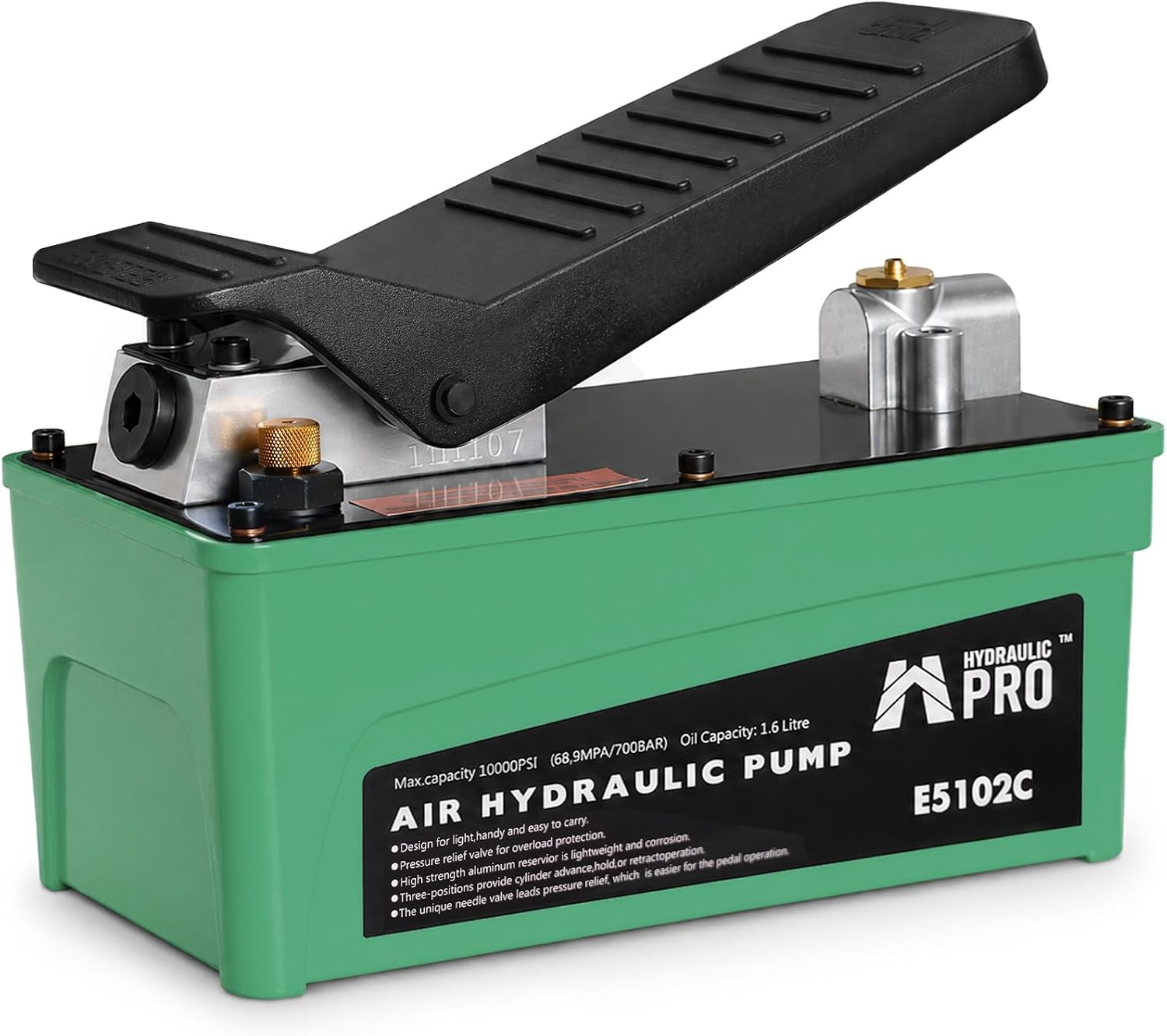
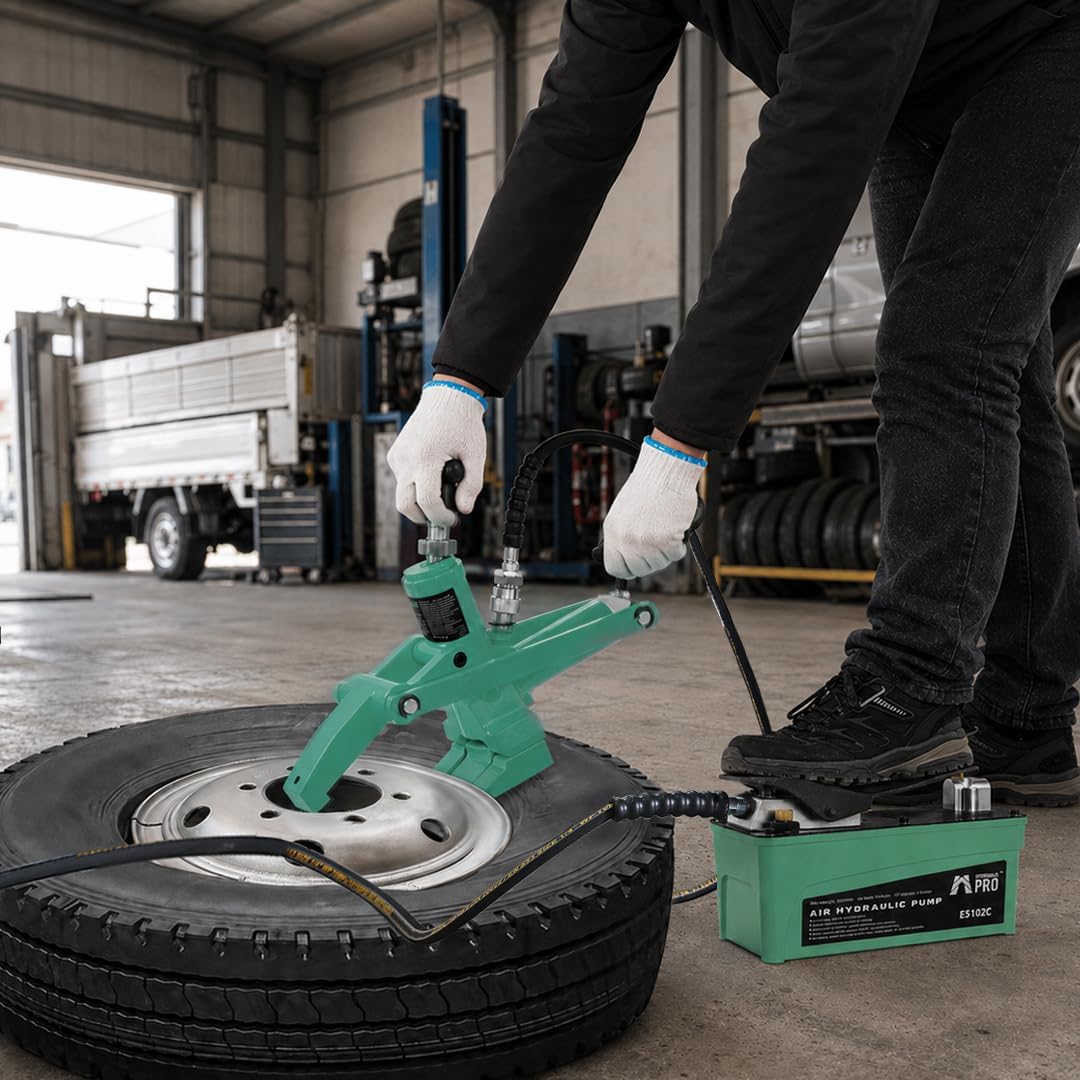
If you rebuild transmissions on a bench, most of the press work happens with both hands busy: one squaring a bushing driver in a pump body, the other holding the case or drum steady. A hand-lever pump takes one of those hands away. This E5102C air over hydraulic foot pump runs off the shop compressor, feeds a single-acting press cylinder up to 10,000 PSI, and is worked with your foot, so the part stays square while it moves.
What this pump does on a transmission bench
The pump turns 90-120 PSI shop air into hydraulic pressure. Compressed air drives a small piston inside the aviation-aluminum body, which pushes oil from the 1.6 liter (98 cubic inch) reservoir out of the 3/8 in NPT outlet to your ram. The pedal label lists three positions: advance, hold and retract. Advance builds pressure, hold keeps the ram where it is while you check alignment, and the release lets the ram come back on its own return spring. The release is two-stage, so you can drop pressure all at once when a stuck bearing lets go, or bleed it off slowly while easing a bushing into a soft aluminum bore. An internal relief valve caps output so the cylinder is not overpressured.
Typical jobs it handles at that bench:
- Pressing front pump, stator support and case bushings in and out
- Driving bearings onto input and output shafts, and seating races
- Pushing out planetary pinion shafts
- Splitting tight bearings off a shaft with a separator plate under the ram
Signs your press setup needs it
- You are holding a driver with one hand and pumping a handle with the other, and bushings go in cocked
- Bushings gall or shave aluminum because pressure came on in jerks
- Parts jump when they release because you cannot dump pressure fast enough
- A long production day of pump and case bushings wears out your arm before the work is done
How to confirm it fits your press
This pump drives a separate, single-acting cylinder through a hose. It does not attach to a bottle jack that has its own built-in pump handle, and it will not power a double-acting ram, which needs pressure on both sides to return. Check that your press cylinder has a hose port and returns on a spring, and that the port matches 3/8 in NPT or that you have an adapter. If you are still choosing a press, a 12-ton H-frame shop press is the size range most transmission benches use. Before pressing anything, our guide to converter hub and pump bushing wear explains how to tell whether a pump bushing actually needs replacing.
Specifications and fit
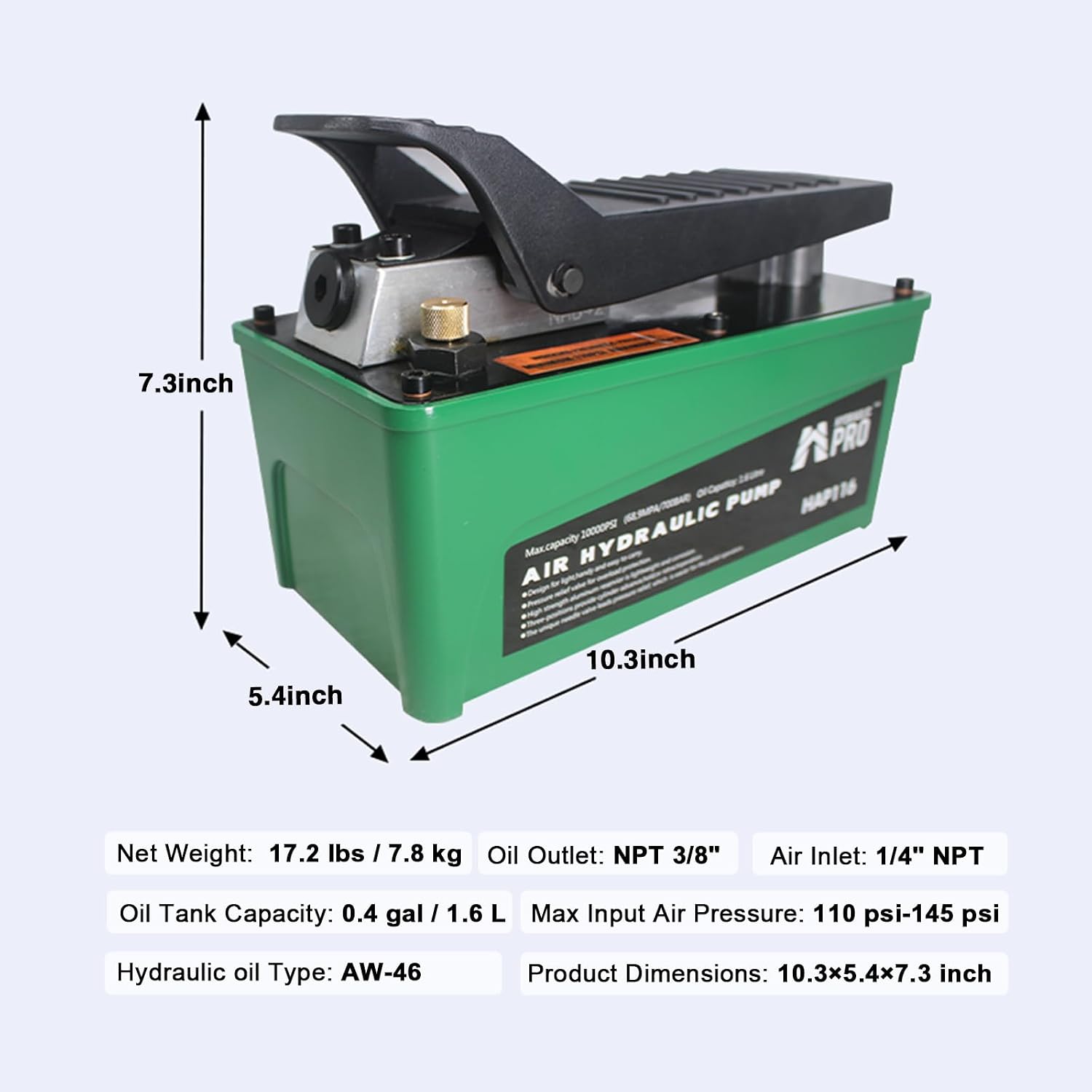
- Maximum output: 10,000 PSI (the label also lists 700 bar)
- Reservoir: 1.6 L aluminum, shipped pre-filled with oil
- Hydraulic outlet: 3/8 in NPT with quick coupler
- Air inlet: 1/4 in NPT, 90-120 PSI supply
- Weight: about 17.3 lb, so it stays put on the floor
- Cylinder type: single-acting only
It is a general shop tool, not tied to one transmission, so it serves GM, Ford, Chrysler and import benches alike. For the rest of the bench, see our transmission tools and the checklist in bench rebuild tools needed.
Setup and use notes
- Put a filter-regulator on the air line and keep supply in the 90-120 PSI range; water in the air line shortens pump life.
- Tighten the hose fittings with thread sealant rated for hydraulic use, then cycle the ram a few times with no load to purge air before the first real press.
- Check reservoir oil with the ram fully retracted, and top up only with hydraulic jack oil, never brake fluid or ATF.
- Use correctly sized drivers. A 52-piece bushing driver and seal installer kit covers most pump and case bushings, and a 5-ton bearing separator set handles bearing removal under the ram.
- Ease up near the end of a bushing install and use the slow release, so the bushing seats without being driven past its depth or cracking the bore.