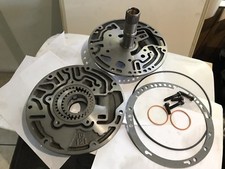
The 1964 model year is where the Turbo Hydra-Matic 400 started, in Cadillac and Buick cars, a year before Chevrolet and Oldsmobile picked it up. If you are restoring one of those first-year cars and the transmission whines with engine speed, picks up Drive slowly once it is warm, or slips in every gear, the front pump is the first part to suspect. This is a remanufactured TH400 pump listed for 1964 units, shown with the pump body, the cover with its stator shaft, the pump-to-case gasket and new sealing rings.
What the pump does in a 1964 TH400
The TH400 uses an internal gear pump bolted to the front of the case. The converter hub rides in the pump bushing, and two tangs on the hub turn the drive gear at engine speed inside the driven gear, with a crescent separating the suction and pressure sides. The cast-iron cover carries the stator shaft, the pressure regulator valve and the boost valve, and its sealing rings feed oil to the forward clutch. Everything downstream depends on it: line pressure to every clutch and band, converter charge, cooler flow and the lube circuit that keeps the gear train alive. When gear and pocket clearances open up or the regulator bore wears, pressure drops or goes uncontrolled, and the whole transmission suffers at once.
Symptoms of a worn TH400 pump
- A whine that rises and falls with engine rpm in Park, Neutral and every gear
- Delayed or soft engagement into Drive or Reverse after the fluid gets hot; Reverse often goes first because it needs the most pressure
- Slipping with all three clutch packs burnt rather than one, a sign the pressure source is weak
- A front seal leak that returns soon after replacement, usually from a worn bushing letting the converter hub move
- Harsh shifts and poor Reverse from a worn pressure regulator bore
How to confirm before you buy
Rule out low fluid, a plugged filter and a rolled filter O-ring first, since each can sound exactly like a bad pump. Then put a gauge on the line pressure tap: GM's figure for Park, Neutral and Drive is roughly 60 to 90 psi at 1000 rpm with the modulator connected. Test cold and again at full temperature; a pump that makes spec cold and falls well short hot is worn. Our TH400 pump failure guide has the full pressure chart and inspection points, and the TH400 common problems guide covers the non-pump causes.
Fitment
This pump is listed for the 1964 TH400 only. First-year units came from the Cadillac and Buick lines, and some early Buick, Olds and Cadillac TH400s used a variable pitch (switch-pitch) stator converter, identified by a two-prong plug on the case and a narrower stator spline at the pump. A switch-pitch converter and a fixed-stator pump are not a matched set, so check your case for the two-prong plug, compare the stator spline and bolt pattern on your old pump, and keep the original converter type. If you are unsure, send us the year, vehicle and VIN or the ID plate code before ordering. For 1965-1967 units see the TH400 pump for 1964-1967, and all early parts are on the TH400 parts page.
Install notes
- Fit a new front seal and pump-to-case O-ring, and check that the bushing is a snug fit on the converter hub.
- Inspect the converter hub for nicks or grooves; a damaged hub cuts the new seal and wears the bushing.
- Use a pump alignment band to center the body and cover before torquing the bolts, then check that the stator shaft turns the input freely.
- Prime the pump with fluid before the first start and refill with licensed DEXRON, finishing the level hot on the dipstick.
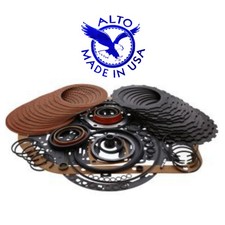
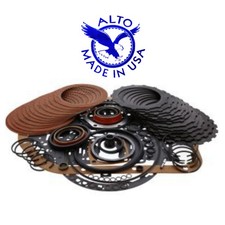
If the clutches are burnt from running on low pressure, rebuild the unit at the same time with the TH400 master rebuild kit for 1964, and center the pump with a front pump alignment band tool. The TH400 rebuild wear points guide covers the endplay checks to make while the pump is out.