A 48RE that stays in first gear, shifts late one day and fine the next, or throws a P0720 is usually telling you about one part: the output speed sensor. Parts counters and forum threads still sell "input and output speed sensor" pairs for this transmission, but a 48RE does not have an input or turbine speed sensor the way a 45RFE or 68RFE does. The ATSG technical manual for the 46RE/47RE/48RE family lists the output speed sensor, the 8-way case connector, the range sensor and (on 2005-up diesels) the throttle valve actuator as the external electronic parts. That is the whole list. If you walk in thinking two sensors, you will spend money on a part the truck does not have.
This guide covers what the 48RE output speed sensor actually does, the symptoms it causes when it fails, how to tell it apart from a governor pressure problem that looks the same from the driver's seat, and how to test and replace it. The operating facts come from the ATSG 46RE/47RE/48RE manual and Dave Skora's two-part governor series in ATRA's GEARS magazine. Sources are listed at the end.

What the 48RE Output Speed Sensor Does
ATSG's 46RE/47RE/48RE technical manual puts the speed sensor in the overdrive gear case, positioned over the park gear, where it monitors transmission output shaft rotating speed. The lugs doing the triggering are the external park lugs on the rear planetary ring gear, so the sensor is reading true output shaft speed, not wheel speed. The manual also notes the signal goes to the transmission control module and is shared with the powertrain control module, which is why one bad sensor can upset both shift scheduling and anything else on the truck that uses output speed.
This sensor did not change when the 48RE replaced the 47RE. ATSG's manual covers the 46RE, 47RE and 48RE as one family for exactly this reason: the same overdrive gear case location, over the park gear, triggered by the park gear lugs, applies across all three. If you are working on a truck with an unknown RE unit, the output speed sensor diagnosis in this article applies either way. See our 47RE identification guide for telling the two apart.
Physically, it is on the driver's side of the overdrive housing, near the rear of the transmission and above the driveshaft yoke, with a two-pin connector. GEARS describes it as an AC-generating sensor: a toothed wheel passes the tip and the sensor makes its own voltage, so there is no 5-volt reference feeding it. ATSG's wiring diagram shows a twisted pair running to the PCM on 1996-2003 trucks and to the engine ECM on 2004-up diesels. The twist is there to reject electrical noise, which becomes important later when we talk about intermittent problems.
The controller uses that signal for two jobs:
- Governor pressure. The 48RE is still a hydraulically shifted transmission for 1st through 3rd. Governor pressure pushes the shift valves over. The computer makes governor pressure electronically with a duty-cycled governor pressure solenoid, and it decides how much to make from vehicle speed, which it gets from the output speed sensor.
- Converter clutch scheduling. ATSG notes that the controller also uses the output speed signal to decide when to apply the torque converter clutch.
The 3-4 shift is different. ATSG is clear that governor pressure controls 1st, 2nd and 3rd only. The 3-4 shift is handled by the overdrive solenoid on the valve body. Keep that in mind, because it helps separate a speed sensor problem from an overdrive circuit problem.
Why a Bad Speed Signal Changes the Shifts
Skora's July 2006 GEARS article lays out the chain in one sentence: if the computer does not receive an output speed sensor signal, it will not open the governor solenoid, and governor pressure stays at zero psi. With zero governor pressure, nothing pushes the 1-2 shift valve over, and the truck stays in first gear.
A healthy system has predictable numbers. GEARS gives the rule for these units: governor pressure should be zero at a stop and rise about one psi per mph up to roughly 40 mph. Above about 40 mph the system sends mainline pressure into the governor circuit so the shift valves stay shifted. ATSG's governor chart shows that rule applies to the gas trucks. The diesel calibration runs noticeably higher governor pressure above 10 mph, so a Cummins truck reading more than 1 psi per mph is not automatically wrong. Compare it to the diesel curve, not the gas one.
The controller has a fallback. According to ATSG, if the output speed sensor fails, the controller uses the vehicle speed signal from the ABS module as a backup and stores P0720 (Output Speed Sensor Circuit). That is why symptoms vary so much from truck to truck. If the backup signal is clean, the driver may only see a check engine light and slightly different shift feel. If the sensor is dropping out rather than failing outright, or the backup cannot fill the gap, you get the shift problems below.
48RE Output Speed Sensor Symptoms
- Stays in first gear or will not upshift. This is the classic symptom. No speed signal means no governor pressure, which means no 1-2 shift. It usually shows up as the truck revving out in first until the driver lifts.
- Late, erratic or inconsistent 1-2 and 2-3 shifts. A weak or noisy signal makes the computer think the truck is going slower than it is, so it builds governor pressure late. Shifts come early one trip and late the next.
- Shift problems that start only at road speed or only when hot. A sensor with an internal winding breaking down, or one with metal fuzz on its magnetic tip, often works in the driveway and quits at 30 mph or after 20 minutes of driving.
- Converter clutch that will not apply or cycles in and out. Since the controller uses output speed to schedule lockup, a bad signal can make the converter clutch hunt at steady cruise.
- P0720 with the check engine light on. Sometimes it is the only symptom, if the ABS backup is carrying the load.
What a bad output speed sensor usually does not cause is a third-gear start. GEARS explains that limp mode de-energizes the governor solenoid, which opens it fully and sends full mainline pressure into the governor circuit. The result is a 3rd-gear start. Limp mode only happens when the computer sets a code or loses power. So a truck that takes off in 3rd points you toward the codes and the controller's power supply, a crossleak in the governor circuit, or a sticking shift valve. A truck that stays in 1st points you toward the speed signal or zero governor pressure. Our 48RE limp mode guide covers the 3rd-gear side of that split.
How to Diagnose It Without Guessing
The mistake we see most often is replacing the output speed sensor, then the governor pressure solenoid, then the transducer, one at a time, until the truck happens to shift right. GEARS gives a better approach: put a gauge in the governor pressure tap, connect a scan tool, drive the truck, and compare three numbers:
- Governor desired pressure – what the computer is commanding the solenoid to make.
- Governor measured (actual) pressure – what the transducer reports back.
- Gauge pressure – what is actually in the circuit.
Then follow the numbers:
- All three match and follow the curve: the electronic side is fine. Look inside the transmission for sticking shift valves or burnt clutches.
- Desired pressure is zero or very low while driving: the computer is not trying to make pressure, which usually means it does not know the truck is moving. Check the output speed signal next. That is the exact path GEARS lays out.
- Desired is correct but actual and gauge are zero: the speed sensor is doing its job. Look at the governor pressure solenoid, a blocked feed, or the governor body.
- Desired and actual match but the gauge disagrees: the transducer is lying. GEARS gives the transducer signal as about 0.60 V at zero psi and about 4.8-4.9 V at its 100 psi maximum.
Sonnax makes the same point in its pressure gauge diagnostics article: a scan tool only shows what the computer believes. A gauge shows what the hydraulics are really doing. On a 48RE, both matter, because the computer's belief depends on that speed signal.
Checking the sensor and circuit
- Compare speeds on the scan tool. Watch the transmission output speed PID next to the ABS vehicle speed. With the truck driving in a straight line, output rpm should track vehicle speed smoothly with no dropouts to zero. A trace that drops to zero and snaps back points to the sensor, connector or wiring. A trace that is simply missing points to an open circuit.
- Use a scope if you have one. ATSG's special note on this sensor is that it "is best checked using a scope under operating conditions." A clean AC sine wave that grows in amplitude and frequency with speed is good. Missing or flattened cycles, or a pattern that falls apart as the truck warms up, is a failing sensor.
- Meter check. GEARS describes the basic test: put a meter across the two sensor leads and turn the output. With the drive wheels safely off the ground, the sensor should produce an AC voltage that rises with speed. No voltage means an open winding or a tip too far from the lugs.
- Pull it and look at the tip. Because it is a magnetic pickup sitting in transmission fluid, the tip collects fine steel. A fuzzy tip weakens the signal. It also tells you something is wearing inside, so pull the pan and read the debris before you call the job done.
- Check the wiring back to the controller. Look for chafe where the harness runs along the transmission and near the exhaust, and for green corrosion in the two-pin connector. Before condemning a PCM or ECM, GEARS says to check all power and ground circuits to the computer and every circuit it controls.
Replacing the 48RE Output Speed Sensor
The sensor comes out from under the truck without dropping the pan. Plan on losing a little fluid.
- Park on level ground, set the brake and chock the wheels. Unplug the two-pin connector.
- Unscrew the sensor from the overdrive housing. Catch the fluid that comes out.
- Inspect the old tip for metal. If it is heavily coated, check the pan and filter before you finish.
- Put a new O-ring on the replacement sensor and lube it with a small amount of assembly gel, as the ATSG assembly procedure specifies.
- Thread it in by hand, then torque to 27 N·m (20 ft-lb), the ATSG torque spec for the output shaft speed sensor. Do not overtighten it into an aluminum housing.
- Reconnect the harness, top off with ATF+4 (the fluid ATSG specifies for this family), and check the level hot per the service manual procedure. A sensor swap only loses a little fluid; for scale, Ram's 2008 fluid capacities sheet lists the 48RE pan service fill at 3.8 L (8 pints), so you are topping off, not refilling.
- Clear codes and road test with the scan tool connected. Governor pressure should read zero at a stop and climb smoothly with speed. Output rpm should track the ABS vehicle speed.
Some older 2WD applications also carry a separate vehicle speed sensor on the speedometer adapter in the extension housing. ATSG lists it with its own torque spec of 2-3 N·m (15-27 in-lb). That is a different part in a different place. Make sure the sensor you ordered matches the one on your truck.
Keeping It From Coming Back
- Treat metal on the tip as a warning. The sensor is often just the first thing to show internal wear. Change the fluid and filter, and if the pan has chunks rather than fine paste, plan for a teardown.
- Keep fluid clean and correct. Use ATF+4 only. Per Ram's 2008 fluid capacities sheet, a 48RE takes 3.8 L (8 pints) at a service fill and 14 to 16 L (29 to 33 pints) after an overhaul, with dry fill varying by cooler and line length. Our 48RE fluid type and capacity guide has the full procedure.
- Protect the harness. Re-clip the harness away from the exhaust and driveshaft after any transmission or exhaust work. Seal the connector if the truck sees road salt.
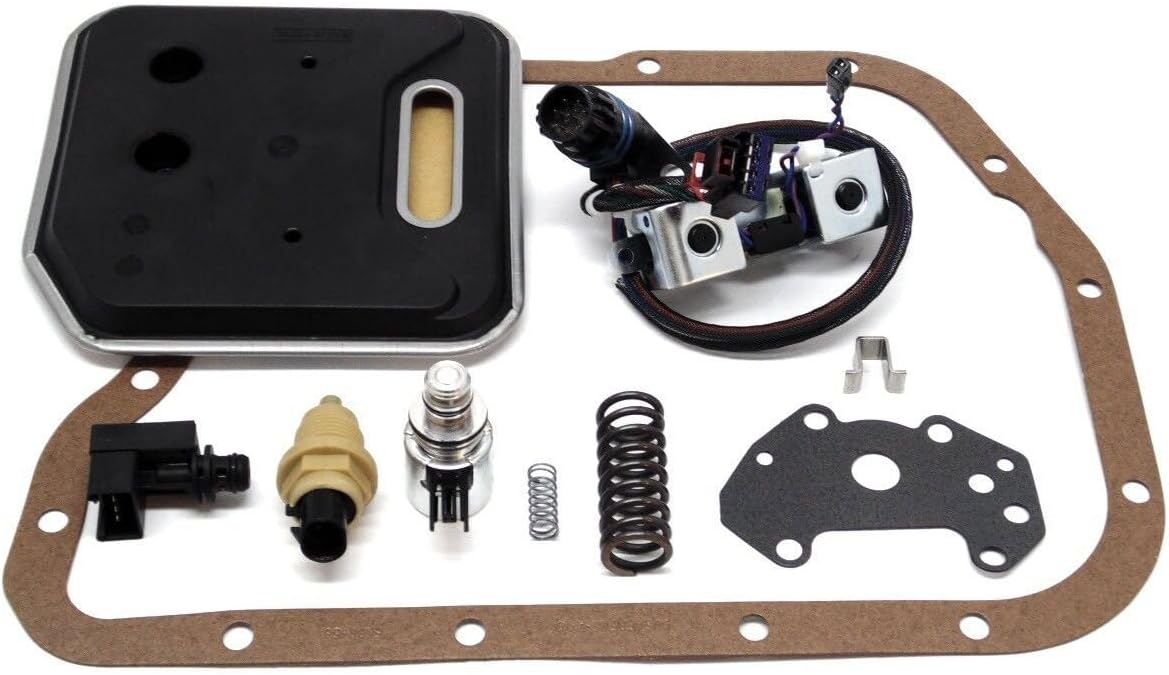
- Fix the whole governor circuit when you are in there. If the scan data shows the governor transducer or solenoid is also off, replacing the solenoid, transducer and filter together as a service kit saves a second pan drop. Our 48RE governor pressure solenoid guide covers those tests.
OEM 48RE Output Speed Sensor (4800879BB)
A direct replacement for the two-pin output speed sensor in the 48RE overdrive housing, for the stays-in-first, erratic-shift and P0720 complaints covered above.
View the 48RE output speed sensor →Shop the 48RE output speed sensor →
Frequently Asked Questions
Does the 48RE have an input speed sensor?
No. The 46RE, 47RE and 48RE family uses a single output speed sensor in the overdrive housing, positioned over the park gear. There is no input or turbine speed sensor like on the 45RFE or 68RFE, so kits sold as input and output pairs for this transmission include a part your truck does not use.
What are the symptoms of a bad 48RE output speed sensor?
The classic symptom is a truck that stays in first gear, because without a speed signal the computer will not build governor pressure. Other signs are late or erratic 1-2 and 2-3 shifts, problems that appear only at road speed or when hot, converter clutch hunting, and a P0720 code with the check engine light on.
Where is the output speed sensor on a 48RE?
It threads into the driver's side of the overdrive housing near the rear of the transmission, above the driveshaft yoke. It reads the lugs on the rear planetary ring gear that also serve as the park gear, and it has a two-pin connector.
Can a 48RE shift with a bad output speed sensor?
Sometimes. The controller can fall back on the ABS vehicle speed signal and store P0720, so a truck with a dead sensor may still shift with only a check engine light. A sensor that drops out intermittently usually causes more obvious shift problems than one that fails completely.
What is the torque spec for the 48RE output speed sensor?
ATSG lists 27 N-m, which is 20 ft-lb, for the output shaft speed sensor. Install a new O-ring lubricated with assembly gel, thread the sensor in by hand, and torque it to spec without overtightening it into the aluminum housing.
Sources
- ATSG (Automatic Transmission Service Group) — 46RE/47RE/48RE Technical Manual. Backs the sensor location in the overdrive gear case over the park gear, the list of external electronic parts (output speed sensor only, no input sensor), triggering from the rear planetary ring gear park lugs, governor and TCC use of the signal, the ABS backup with P0720, "best checked using a scope," the diesel governor curve, the O-ring install, the 27 N·m (20 ft-lb) torque, the 2WD VSS spec and ATF+4. atsgbookstore.com
- ATRA GEARS Magazine, July 2006 — Dave Skora, "Getting to Know the 42-48RE Series Transmissions, Part 1." Backs that no output speed signal means the governor solenoid stays closed at zero psi, the AC-generating two-wire sensor and meter test, and the transducer's 0.60 V at 0 psi and 4.8-4.9 V at 100 psi. atracom.blob.core.windows.net (PDF)
- ATRA GEARS Magazine, October 2006 — Dave Skora, "Troubleshooting the 42-47RE Transmissions." Backs the 1 psi per mph governor rule up to about 40 mph, the desired, actual and gauge comparison, checking the output shaft speed signal when desired pressure is missing, and limp mode's 3rd-gear start. atracom.blob.core.windows.net (PDF)
- Sonnax — "Transmission Diagnostics Using Pressure Gauges." Backs checking scan-tool pressure data against a mechanical gauge and the governor pressure rule of thumb. sonnax.com
- Chrysler / Ram Body Builder Guide — 2008 Ram Fluid Capacities sheet. Backs the 48RE 4-speed automatic service fill of 3.80 L (8.00 pints) and overhaul fill of 14.00 to 16.00 L (29.00 to 33.00 pints), and the footnote that dry fill varies with cooler type, line length and auxiliary coolers. rambodybuilder.com
Shop 48RE governor pressure solenoid kits, filters, valve bodies and rebuild kits — shipped fast from the USA.
Shop 48RE parts →